Is Kanhaiya the moral spine Congress needs?

( First published in the Times of India website as https://rb.gy/uei9cb)

The news of Kanhaiya Kumar joining the Congress has surprised and shocked many of his admirers. Moving from a Communist party to a bourgeois party is seen as regression. Some view it as his attempt to ‘mainstream’ himself. The truth is that both are political parties which believe in parliamentary democracy.

Continue reading Is Kanhaiya the moral spine Congress needs?

Australia-UK-US nuclear deal and India’s role: Statement by Coalition for Nuclear Disarmament and Peace

Coalition for Nuclear Disarmament and Peace (CNDP) issued a statement against AUKUS,  a trilateral security pact between Australia, the United Kingdom and the United States, announced on 15 September 2021 for the Indo-Pacific region. Under the pact, the US and the UK will help Australia to acquire nuclear-powered submarines.

India is part of an older formation, “Quad” (Quadrilateral Security Dialogue)  between US, Australia, India and Japan, revived in 2017, the goal of which is to strengthen security relationships through non-military means. However, the formation of AUKUS throws doubt on Quad’s ability to stay independent of military initiatives, as two of Quad’s partners are now part of AUKUS. It seems that AUKUS could supplant the Quad as the most important strategic initiative in the region. These fears are dismissed by all the governments concerned, but there is no doubt among experts that AUKUS, the military initiative, will now take priority in terms of resources and time.

Expectations of and pressures on India from Quad partners US and Australia as a result of AUKUS, are also matters of great concern.

It is in this context that CNDP has issued the following statement.

CNDP Statement on AUKUS and Quad

The Coalition for Nuclear Disarmament and Peace (CNDP), India expresses its deep concern at the U.S. agreement to sell nuclear submarines and Tomahawk missiles to Australia and also at the ongoing quadrilateral security dialogue of which India is a part.

We call attention to the absurdity of U.S. involvement in a security dialogue in the Asia- Pacific region. The United States has no legitimate security interests in this part of the globe and is simply looking to confront and thereby contain China, which it perceives as a threat to U.S. hegemony.

The United States finds itself unable to maintain its economic hegemony, which has been in steady decline. But U.S. military hegemony remains unchallenged and, for decades, the United States has accounted for 40% of world military expenditure. As a declining empire, the United States seeks confrontation where it is strongest:  by fostering a new arms race in the Asia-Pacific region. Continue reading Australia-UK-US nuclear deal and India’s role: Statement by Coalition for Nuclear Disarmament and Peace

Drona Mindset Plays Havoc with Deserving Students

Modern-day Eklavyas are depriving students of their dues across the country. No government can compensate for robbing students from underprivileged backgrounds of their future.

Drona Mindset Plays Havoc with Deserving Students

In the 19th century, Chatra district in Jharkhand hosted the legendary Raja Rammohan Roy for a while. A memorial to Subedar Nadir Ali Khan and Jay Mangal Panday, martyred during the 1857 war of independence, is also here. Now, this district is in the news again, but for the wrong reasons.

A Comptroller and Auditor General (CAG) report tabled in the state Assembly has detailed the embezzlement of around Rs. 85 crore, meant to fund the scholarship of students belonging to the backward classes. The siphoning went on from 2013-18, says the CAG report for 2018-19.

The modus operandi of the scammers was simple. The money was not transferred to the accounts of beneficiaries, as the state department for Scheduled Caste, Scheduled Tribes, Minority and Backward Class Welfare says. Instead, it went into the bank accounts of other individuals.

The explanation offered by the concerned people was straightforward. They told the CAG that documents related to the transfer of Rs. 70 crore got destroyed in a fire. A significant portion of the Rs. 85 crore is yet to get recovered. The department never bothered to reconcile its accounts even after the fire incident.

( Read the full text here )

CATHOLIC WOMEN URGE BISHOPS TO FOSTER PEACE, NOT STRIFE

Guest Post By Jose Kavi, Matters India

New Delhi: A group of Catholic women says they are deeply concerned over a bishop’s controversial statement that now threatens communal harmony in India.

In a statement endorsed by 89 Catholic women from across India urges the Catholic Bishops’ Conference of India and its Kerala unit to take special steps to foster peace and avoid strife.

The September 16 statement bemoans that a Kerala bishop used unfortunately “Narcotic Jihad,” a term coined without foreseeing its dreadful consequences for various communities in the country.

The text:

A Statement by Concerned Catholic Women of India

We are living in trying times in India when divisive communal forces have become a serious threat to the secular and pluralistic social fabric of our great nation. The insecurities and vulnerabilities resulting from the deepening majority-minority divide between religious communities are increasingly unveiled and this leads to a growing fear of the ‘other’, whichever community the other may belong to.

It is against this highly volatile backdrop that we want to locate the current polemics triggered by the ‘Narcotic Jihad’ controversy in Kerala, which has fueled hate and mistrust between two religious communities that have a track record of peaceful coexistence in the state through the ages.

It is very unfortunate that the term “Narcotic Jihad” was coined and used by someone holding a responsible position in the Catholic Church leadership in Kerala without foreseeing the dreadful consequences of using such an expression.

While it is argued that Bishop Joseph Kallarangatt, the prelate of the diocese of Palai has used this expression as a precautionary measure to safeguard catholic youth from getting trapped by terrorist forces, the terminology deployed is extremely dangerous as it cuts deep into the core religious sensibilities of a community. The use of narcotics is a very serious crime in any part of the world and it is possible that there could be deeper links between the narcotic business and terrorism. If at all this is true, it is up to the government machinery to address it, not the bishops. To brand one particular community with the narcotic label and that too without substantiating evidence is an equally serious offence as it destroys the health and wellbeing of a society. Besides polarizing religious communities that have been coexisting thus far without major conflicts in this state, allegations of this nature have led to divisions even within the Christian community and its families.

Amidst this chaos, it is sad to see the Church becoming a puppet in the political games that are being played by those who want to draw mileage out of this tumultuous situation. As Pope Francis rightly states in Fratelli Tutti, “today, in many countries, hyperbole, extremism and polarization have become political tools.”(No.15).

We strongly object also to the term “Love Jihad” referring to the inter-religious marriages of Catholic women with Muslim partners. This term undermines a woman’s autonomy to choose her partner in life, as well as the freedom of the woman to change her faith if she so wishes. These freedoms are guaranteed by the Universal Declaration of Human Rights as well as by the Constitution of India. We demand that women be respected and treated as adults who can freely exercise their rights. Negating their freedom to choose their life partner or their faith violates their human dignity and deprives them of their personal agency. Using expressions like “Love Jihad” only serve to sow seeds of hate and divisiveness between communities and in the bargain and poison young minds.

These developments run counter to the CBCI Guidelines for Inter-religious Dialogue framed in 1977 and updated in 1989, which states: “We are committed to build up one nation out of many traditions.” In the ‘Document on Human Fraternity for World Peace and Living Together’ jointly signed by Pope Francis and the Grand Imam of Al-AzharAhmad Al-Tayyeb at Abu Dhabi in 2019, it is clearly stated that “Freedom is a right of every person: each individual enjoys the freedom of belief, thought, expression and action. The pluralism and the diversity of religions, color, sex, race and language are willed by God in His [sic] wisdom, through which He [sic]created human beings.”

In spite of this call for unity and tolerance, we have failed to counteract the forces of communalism within the Church. Only dialogue with others can build a culture of LOVE, which is the only commandment that Christ has given us. It becomes imperative then that we as Church sow not the seeds of discord but of unity and peace in our country today.

We, the undersigned Catholic women, are deeply concerned about the Church becoming a counter-witness and so, we urge the ecclesiastical leadership in Kerala and at the national level to take immediate steps that will heal the wounds caused by this controversy. We hope that this crisis becomes for the Church a moment of grace to commit itself once again with renewed passion to the mission of the ‘Kin-dom of God’ founded on justice, truth and inclusive love as shown by Jesus Christ.

1. Ms Virginia Saldanha, Mumbai
2. Dr. Kochurani Abraham, Kerala
3. Dr. Astrid Lobo Gajiwala, Mumbai
4. Adv. Flavia Agnes Mumbai
5. Adv. Philo Thomas, Pune
6. Adv. Sr. Julie George SSpS, Mumbai
7. Dr. Annie Kunnath, Delhi
8. Dr. Maria GorettiGonsalves, Pune
9. Dr.Brinelle D’souza, Mumbai
10. Dr.Lidwin Dias, Mumbai
11. Dr. Maureen Lobo, Navi Mumbai
12. Dr. Sr. AnithaChettiar DHM, New Delhi
13. Dr. Sr. Hazel D’Lima DHM, Mumbai
14. Dr. Sr. Jacinta D’Souza DHM Mangalore
15. Ms Aloma Lobo Bangalore
16. Ms Anita Cheria, Bangalore
17. Ms Anita Manuel, Pune
18. Ms Anita Rodricks, Belgavi, Karnataka
19. Ms Annette D’Almeida CAP, Pune
20. Ms Annie Rose Trichy, Tamilnadu
21. Ms Assisa, Trichy, Tamil Nadu
22. Ms Assumpta Selvaraj, Karaikudi, Tamilnadu
23. Ms Beschi Trichy, Tamilnadu
24. Ms Buddy Ubale, Mumbai
25. Ms Cecilia Soares, Mumbai
26. Ms Christina Samy, Karur, Tamilnadu
27. Ms Coral D’Sylva, Mumbai
28. Ms Evelyn Williams, Pune
29. Ms Glory, Trichy, Tamil Nadu
30. Ms Jacintha W Rosario, Pune
31. Ms Jennifer Rebello, Pune
32. Ms Josephine Sagayam, Bangalore
33. Ms Judy Siqueira, Pune
34. Ms Lee Lobo, Bangalore
35. Ms LeelaD’Sa, Mumbai
36. Ms Lilly Thomas Palocaren, Thrissur, Kerala
37. Ms Manohari Doss , Madurai, Tamilnadu
38. Ms Marcia DCunha, Mumbai
39. Ms Maria Fernandes, Cuddalore, Tamilnadu
40. Ms Marina Colasco, Pune
41. Ms Marina D’Souza GSPG, Mumbai
42. Ms Olga Netto, Goa
43. Ms Philomena Machado DHM, New Delhi
44. Ms Rachael Alphonso, Mumbai
45. Ms Rajakumari Michael, Bangalore
46. Ms Raynah Braganza Passanha, Pune
47. Ms Reena Biju, Ahmedabad, Gujarat
48. Ms Rita Joseph, New Delhi
49. Ms Ritamma David, Madurai, Tamilnadu
50. Ms Sheela.P.L. Thrissur, Kerala
51. Ms Urusula Nathan Trichy, Tamil Nadu
52. Ms Yoesphin,Trichy,Tamilnadu
53. Prof. Dayana, Madurai, Tamilnadu
54. Sr. Alice SJC, Naragund, Karnataka
55. Sr. Anbarasi PBVM Chennai, Tamilnadu
56. Sr. Arpan Carvalho BS, Faridabad, Haryana
57. Sr. BasantiLakra SCN, Mokama, Bihar
58. Sr. Clare ICM, Chennai
59. Sr. Elsa PBVM, Chennai
60. Sr. Florine ICM, Patna, Bihar
61. Sr. Francoise Bosteels SDS, Bangalore
62. Sr. Jessin SJC, Naragund, Karnataka
63. Sr. Joel SCN, Chatra, Jharkhand
64. Sr. Jyoti SMMI, Chappra, Bihar
65. Sr. JyotishaKannamkal SND, Patna, Bihar
66. Sr. Leena SCN, Ranchi, Jharkhand
67. Sr. Lisa Pires PBVM, Goa
68. Sr. Lissy Joseph SCCG, Hyderabad
69. Sr. Lucy Kurien SCC, Maher, Pune
70. Sr. Maggie Allesu DHM, Mumbai
71. Sr. Malini Manjoly, Mokama, Bihar
72. Sr. Manju Kulapuram SCSC, Patna, Bihar
73. Sr. Mary James MCJ, Ahmadabad, Gujarat
74. Sr. Meena Dominic DHM, New Delhi
75. Sr. Meera RGS, Kerala
76. Sr. Mina Lalitha Barwa HM, Odisha
77. Sr. Mudita Sodder, RSCJ, Mumbai
78. Sr. Nancy Vaz, FDCC, Mumbai
79. Sr. Noella de Souza MCJ, Mumbai
80. Sr. Patricia D’Souza, RSCJ, Mumbai
81. Sr. Philomena D’Souza FMA, Bombay
82. Sr. Premila Dias FMM, Putney, London
83. Sr. Rita SCN, Trichy, Tamil Nadu
84. Sr. Rosaria RJM, Gujarat
85. Sr. Sabina RGS, Chennai
86. Sr. Shanti Fernades RSCJ, Pune
87. Sr. Shanti Picardo FC, Siliguri, W. Bengal
88. Sr. Suganthi, Palayamkottai, Tamil Nadu
89. Sr. Vimala Verghese RSCJ, Rishikesh

Continue reading CATHOLIC WOMEN URGE BISHOPS TO FOSTER PEACE, NOT STRIFE

Decolonizing Thought – Beyond Indian/ Hindu Exceptionalism

A Decolonization mural in Oakland, USA, photo HiMYSYeD, Oakland Wiki

This post is prompted by a discussion that followed some remarks I had made on social media regarding the way in which a certain common sense that we may call ‘Hindu Nationalist’, had come to dominate the sensibilities of even those intellectuals in the Hindi world who otherwise might stand opposed to the Hindu Right. ‘Decolonizing’ has lately become a banner of the Hindu Right and for many otherwise secular Hindi intellectuals too, an occasion for an often strident anti-West rhetoric. Such a common sense assumes, simply by default, that the only “authentic” position of critique of the West is one framed by Hindu/ Indian exceptionalism. Needless to say, as I have argued at length in my recent book (Decolonizing Theory), the narrative that structures the imaginative world of many such modern Hindus is already a narrative produced by colonialism.

Continue reading Decolonizing Thought – Beyond Indian/ Hindu Exceptionalism

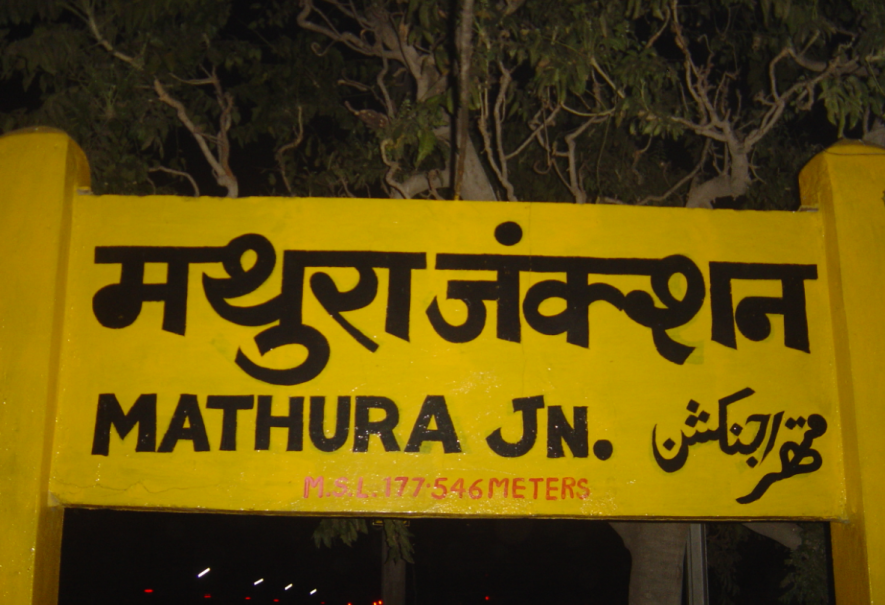
Why BJP Wants Meat Banned in Mathura

The BJP is imposing harmful dietary restrictions and refusing to accept that more Indians want to consume meat, fish and eggs for their nutritional benefits.

Mathura
Representational use only

.

In 1902, the prolific British writer HG Wells delivered a philosophical speech titled “The Discovery of the Future” at the Royal Institution in London. Wells is often remembered for his “predictions”, for example, the approximate date when the second world war would begin. In this speech, he envisioned something else with equally significant ramifications—the collapse of the capitalist system. Wells also anticipated that a world of peace and plenty would follow in its wake.

What if someone, following Wells example, attempts a similar extrapolation for India? If anybody could foresee such things, what would they find lies ahead for the “biggest democracy” in the world?

In the absence of Wells, perhaps present-day events can be a map or guide to the future. For example, during recent Janamashtmi celebrations, Uttar Pradesh, Chief Minister Yogi Adityanath announced that his government would ban meat and liquor in Mathura city. He said the meat-sellers and liquor dealers of the area could switch to selling milk. According to his government, a meat and liquor ban would help combine “modern technology” with the cultural and spiritual heritage of the region.

( Read the full article here)

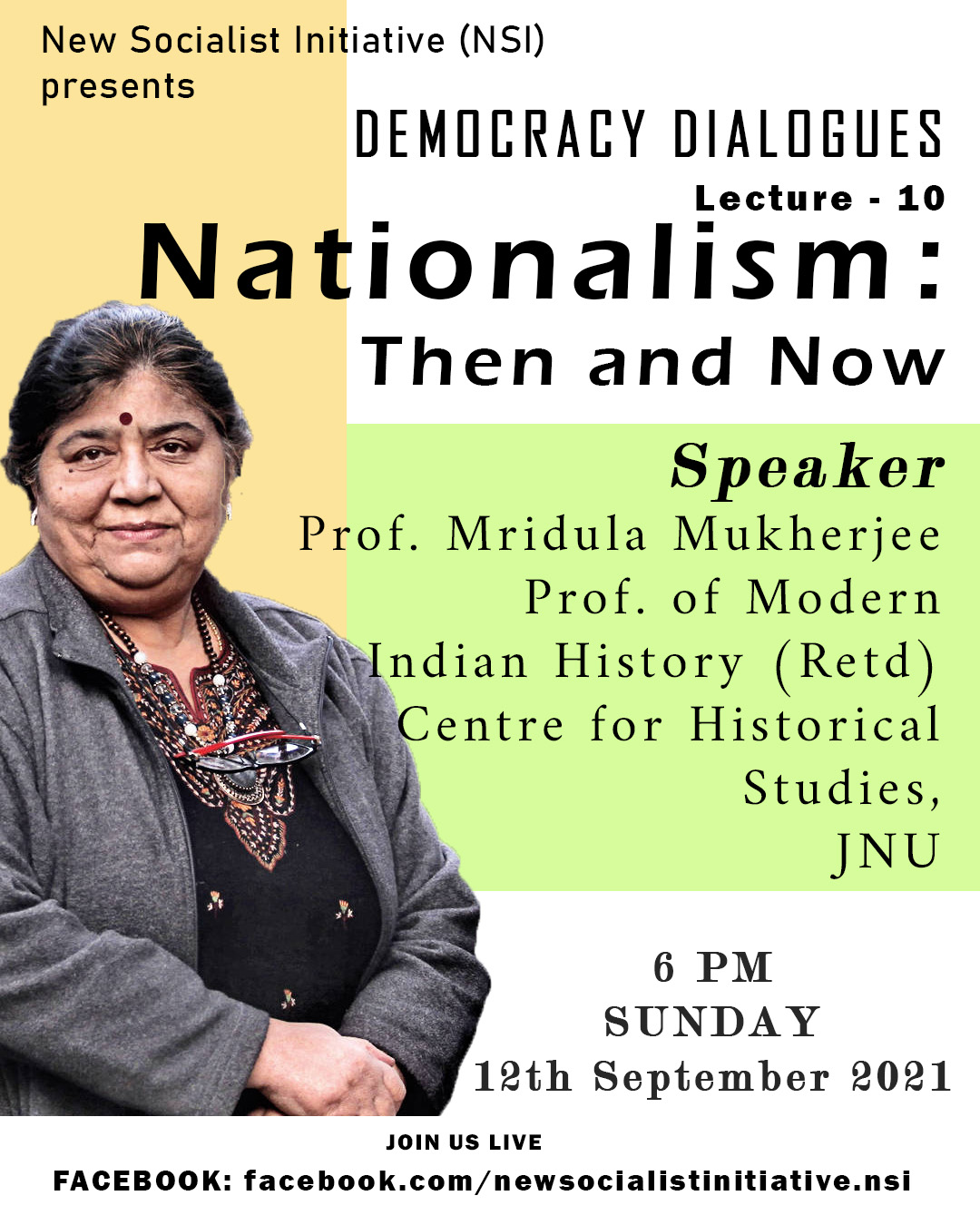
Nationalism : Then and Now – Professor Mridula Mukherjee

The 10 th lecture in the Democracy Dialogues Series organised by New Socialist Initiative was delivered by Prof Mridula Mukherjee ( Retd.) on Sunday, 12 th Sepember at 6 PM ( IST). She spoke on ‘Nationalism : Then and Now’

Prof. Mridula Mukherjee, was associated with Centre for Historical Studies, JNU for a long time and was also Director of Nehru Memorial Museum and Library, ( NMML), New Delhi.

Well known as a historian for her work on the role of peasants in the Indian independence movement, she has authored two important books on the theme, Peasants in India’s Non-Violent Revolution ( Sage 2004) and Colonising Agriculture : Myth of Punjab Exceptionalism ( Sage 2005). She has also coauthored books with Prof Bipan Chandra, Prof Aditya Mukherjee on ‘India’s Struggle for Independence’ ( Penguin 2000) and ‘India After Independence‘ ( Penguin 2008). The monograph ‘RSS, School Texts and Murder of Mahatma Gandhi‘ which she has coauthored with Prof Aditya Mukherjee and Prof Sucheta Mahajan has been widely appreciated.

In this lecture Prof Mridula Mukherjee discussed Nationalism and its origins as a modern ideology, how nations are historical constructs with each nation having its own distinctive historical evolution and the emergence of two kinds of nationalism and how the present notion of aggressive, chauvinistic nationalism is in sharp contrast to the once evolved by the freedom struggle and how the task of preventing the appropriation of nationalism and its creative linking to progressive agenda is the need of the hour.

Please write to us at democracydialogues@gmail.com if you are interested in getting upadates about the series.

The lecture series is available on  facebook.com/newsocialistinitiative.nsi as well.

( Here is a playlist of earlier lectures in the Democracy Dialogues Series :