All posts by Aditya Nigam

Three Years of Nandigram Firing: An Appeal

Sumit Sarkar, Tanika Sarkar, Dilip Simeon, Aseem Srivastava, Amita Baviskar, Amit Sengupta, Nandini Sundar, Satya Sivaraman and others

Nandigram: Punish the guilty, Pay compensation to victims now!

On the third anniversary of the horrific police firing in Nandigram, which occurred on 14 March 2007, we strongly condemn the failure of various state institutions to do justice to the victims and survivors of this violent attack on a peaceful mass movement.

Till date not a single police official, government bureaucrat or CPI (M) politician involved in the wanton massacre of peasants resisting forcible takeover of their land has been prosecuted. At least 14 people were killed in the incident and hundreds injured. Several independent inquiries and tribunals found that more than a dozen women had been sexually assaulted or raped. It is a matter of deep shame for Indian democracy that the men who were responsible for the barbaric violence – including persons in uniform and out of it – continue to roam with impunity.

The Calcutta High Court’s direction to the CBI to inquire into the violence in Nandigram on 14 March and to prosecute those responsible has not been carried out under various pretexts. These include litigation in the Supreme Court against this order, launched by the West Bengal government. That no clear judgment has been pronounced on this important issue till now only serves to lower the credibility of our judicial institutions. In light of the aftermath of the anti-Sikh carnage of 1984, we fear that as time goes on, evidence will be lost and witnesses intimidated. After some years, lip service will be paid to judicial procedure and the criminals will go scot-free. Such a sabotage of justice has happened before in West Bengal.
Continue reading Three Years of Nandigram Firing: An Appeal

Jyoti Basu and the Passing of an Era

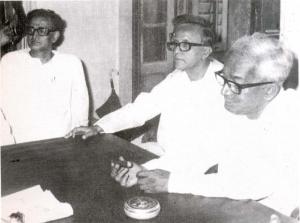
Jyoti Basu, Promode Dasgupta and Saroj Mukherjee

With the passing away of Jyoti Basu, the curtain comes down on an entire chapter of communist history in this country. Basu may have been the last of a generation that learnt its politics in the stormy days of the anticolonial struggle and who lived through the ups and downs of politics – from the underground days of the 1930s and 1940s to the initiation into the ways of parliamentary democracy. The long engagement with parliamentary democracy was to lead to Basu’s – and the communists’ – long stint in power. And Basu was one of those rare communists for whom democracy was not a mere strategic imperative but a value to be internalized.

Basu belonged to a generation of communists who worked their way from the bottom up. Trained in Law in England, Basu returned to India, determined to work in the communist movement. Muzaffar Ahmed, the then secretary of the undivided communist party sent him to work among the railway workers. It was there, working among and organizing the railway workers that Basu entered mass politics.  It was probably in this process that Basu developed his distinctive style of politics – a style that we have yet to understand fully.

Continue reading Jyoti Basu and the Passing of an Era

Remembering Jyoti Basu: Monobina Gupta

This is a Guest Post by MONOBINA GUPTA

Jyoti Basu
Jyoti Basu

While waiting endlessly at the CPI-M headquarters in Delhi, we, the Left-beat reporters, often used to say how incredibly dull the beat would be in the absence of Jyoti Basu, Indrajit Gupta, and Harkishen Singh Surjeet. With their distinctive personalities and distinct style, each one had livened up the tedious job of keeping track of the Left parties and their leaders. Indrajit Gupta would speak in a baritone voice, trotting out gruff answers; the ever-amiable Harkishen Singh Surjeet, never failed to pick up the phone, was always ready to share a laugh with us. But of these three colourful Communist stalwarts, it was Basu who used to keep us most preoccupied, with his ‘read-between-the-line’ one-liners, exasperatingly short, brusque replies, sometimes even with outright sarcasm or rudeness.

Continue reading Remembering Jyoti Basu: Monobina Gupta

The Žižekian Counter-Revolution

[Slovenian Lacanian-Marxist-Hegelian philosopher and cultural theorist, Slavoj Žižek is visiting India currently and will be delivering a few lectures here. This post is prompted by his visit. Interested Delhi-ites can catch him speak on

4 Jan 2010. 5 p.m. on
“Ideology in the Post-ideological World: The Case of Hollywood”
at Sarai-CSDS. 29 Rajpur Road, Civil Lines, Delhi
and
5 Jan 2010. 7 p.m.
“Tragedy and Farce”
Stein Auditorium, India Habitat Centre, New Delhi]


imaaN mujhe roke hai jo khiNche hai mujhe kufr
ka’aba mere peeche hai kaleesa mere aage

[Faith holds me back when infidelity beckons/
Behind me, the Kaaba; before me, the Church]

It is difficult to miss the immense subversiveness of the  dilemma encapsulated in Ghalib’s couplet above.  This dilemma of the believer is produced by the constant threat of corruption – the Kaaba behind the believing Muslim holds him back from indulging in, or falling prey to, the infidelities and temptations that always lie in wait.

Substitute Marxism for Kaaba  and ‘postmodernism’ for Church, and you have the perfect Žižekian incarnation of this classic Ghalibian dilemma: Not quite at home in the Faith (Lacan, jouissance, surplus-enjoyment, the Real…) and yet, not able to leave it either, for the fear of what might befall one deserting the Order. Faith is the anchor that holds one back from committing all kinds of blasphemies. Nevertheless, the seductions of infidelity force our philosopher to turn for sustenance precisely to the philosophers and ideas he mistrusts: unlike most members of the Marxist faith, he repeatedly returns to Nietzsche, Heidegger, to Derrida, Foucault, Laclau and Deleuze. He takes over their language and makes himself at home in it. Is there a hidden jouissance in thus frequenting this forbidden territory?

Continue reading The Žižekian Counter-Revolution

A Journey Into the Dark: Arati Chokshi

This is a Guest Post by ARATI CHOKSHI.

[Chhattisgarh and Dantewada have been in the news for quite some time now, as matters have reached a climax with the state on its anti-Maoist offensive after the near-failure of its stratgey to prop up Salwa Judum as a counter-insurgency outfit. All intermediate spaces stand wiped out now. Recently, Himanshu Kumar of the Vanvasi Chetna Ashram had planned a padayatra in Dantewada and around that time, a team of women’s and human rights organization visited the area apprehending trouble. This a report of that team’s experiences.]

It was night by the time we set out. Four jeeps sped carrying 39 women of diverse age, class, caste, religion, faith, ideologies, from ten states across the nation, and representing 20 women’s and human rights organisations. We sped from Raipur to Dantewada, on wide, smooth highways on a common journey, as part of our campaign to address the alarming reports of sexual violence and repression of women by the State, that were emerging, particularly from Dantewada, in Bastar region of Chhattisgarh. We were headed there both to get a first hand account and to show solidarity with victims of heinous crimes, who defying all threats and intimidation had managed to come forth and lodge complaints against their assailants – in this case, the State. This journey was to be an enquiry – a personal exploration and examination of the truth- of dark, dangerous, secret whispers that managed to trickle out from Dantewada and ooze into wider consciousness – tales of tortures, horror, and barbaric acts that our representatives, our own protectors and security forces meted out on a particular collective us, the weakest, most vulnerable, the voiceless adivasis of Bastar.

Over the next 22 hours, we were to find that our journey had become the goal, revealing to us far more from State’s desperate attempt to hide, than in our wanderings and talkings in Dantewada. In hindering us, we found how the State had repressed civil liberties of its citizens, how democratic spaces had vanished and how the authoritarian subjugation by the State had muted all voices – not just of protest, but of even posing a question.
Continue reading A Journey Into the Dark: Arati Chokshi

बीच का रास्ता नहीं होता, कॉमरेड!: ईश्वर दोस्त

This is a guest post by ISHWAR DOST

ध्रुवीकरण की खासियत यह होती है कि वह बीच की जगह तेजी से खत्म करता जाता है। चाहे वह सांप्रदायिक ध्रुवीकरण हो या अस्मिता पर आधारित या किसी और मुद्दे पर। राज्य की दमनकारी हिंसा बनाम माओवादी हिंसा एक ऐसा ही ध्रुवीकरण है। इस सरलीकरण में छिपी राजनीति पर सवाल उठाना जरूरी हो गया है। युद्ध की भाषा बोलती और बंदूक को महिमामंडित करती इस राजनीति के निशाने पर क्या जनसंघर्षों की लोकतांत्रिक जगह नहीं है? माओवादियों के सबसे बड़े दल पीडब्ल्यूजी के नाम के साथ ही जनयुद्ध शब्द लगा हुआ है। छत्तीसगढ़ सरकार ने एक सरकारी जनयुद्ध को सलवा जुडूम के नाम से प्रायोजित किया हुआ है। केंद्र सरकार ने पहली बार माओवाद के खिलाफ युद्ध की शब्दावली का इस्तेमाल किया है, फिर उस पर सफाई भी दी है। अगर माओवाद लोकतंत्र के प्रति अपनी नफरत नहीं छिपाता तो उत्तर-पूर्व से लेकर गरीब आदिवासी इलाकों तक कई सरकारें भी राजनीतिक-सामाजिक गुत्थियों को महज सुरक्षा के सवाल में तब्दील कर बंदूक की नली पर टंगे विशेष सुरक्षा कानूनों के जरिए सुलझाना चाहती हैं।

अन्याय के खिलाफ जनलामबंदी, संघर्ष और प्रतिरोध की सुदीर्घ परंपरा को युद्ध के अतिरेक में ढांपने की कोशिश की जा रही है। युद्ध सीधा सवाल करता है कि तय करो किस ओर हो तुम? यह सवाल एक-दूसरे से युद्ध करता या उसके लिए पर तौलता कोई भी पक्ष किसी से भी पूछ सकता है।
Continue reading बीच का रास्ता नहीं होता, कॉमरेड!: ईश्वर दोस्त

Notes on Comfort: Akhil Katyal

This is a Guest Post by AKHIL KATYAL

To make our point let us begin with a story of a salon. It might have all the necessary noise of being new and first-of-its-kind but finally it is quite an unremarkable story. Of ‘NYC’ in Hauz Khas market in Delhi. It sells itself as India’s first LGBT salon. Its owner S. Mehta recently filled up all possible online LGBT forums with its ads, mass mailed on to Delhi list serves and dropped tiny text-ads into unwitting facebook groups, robustly selling it as the latest asset of Delhi’s LGBT community. I am not quite interested in how an otherwise 7 month old – some say not-doing-too-great – business venture is viably repackaged as a LGBT paradise in the wake of the Delhi high court judgment. After all, post the repeal of Sec. 377 in July we are only to expect more of this happening around us, more spectacles of the pink rupee. Nor am I presently interested in how a reigning sense of an LGBT community is proffered by such spectacular announcements of things shared – be it historic events or commercial joints, shared among few or many – but instead, I am interested in the all too common rhetoric that this salon uses in its publicity. A rhetoric that is becoming so widespread as to become almost commonsensical and this is the rhetoric of comfort.
Continue reading Notes on Comfort: Akhil Katyal

Mass Politics, Violence and the Radical Intellectual

With the debate on Maoist violence and Operation Green Hunt hotting up, things are taking a disturbing turn. The danger really is that all spaces of radical political movements and indeed the entire space of the Left, part of it gradually vacated by the parliamentary ‘Left’ in recent decades and finally completely abandoned in the last few years, will now be virtually erased. In its place will be installed the phantom of an ‘armed struggle’ that threatens to completely swallow up the spaces once occupied by different shades of the CPI(ML) and the Naxalite movement and other Continue reading Mass Politics, Violence and the Radical Intellectual

Open Letter to Noam Chomsky: Nirmalangshu Mukherjee

[We publish below an open letter to Noam Chomsky, written in the wake of his endorsement of a statement against ‘Operation Green Hunt’, issued recently by a large number of intellectuals in India and in the US. Nirmalangshu’s letter is important because it raises some very serious questions that are being brushed under the carpet by sections of the radical intelligentsia.  Unlike Nirmalangshu, I would not put ‘radical’ within scare quotes, since it is precisely this that highlights the immense tragedy of our times. Radical intellectuals – truly radical intellectuals – once again find themselves caught in this situation where in order to oppose state violence, they will wilfully turn a blind eye to the violence of armed nihilist gangs, simply because these claim to speak on behalf of the oppressed – a claim that Nirmalangshu’s letter exposes in all its falsity. He lays bare how the politics that goes by the name of ‘Maoism’ (i.e. CPI-Maoist) believes in violently erasing all other voices of opposition to and criticism of the state, but that of itself. This brand of politics in fact lives in symbiosis with the state – delegitimizing all forms of mass democratic politics. At this moment one deeply misses the courageous voice of the late Balagopal – recently slightingly dubbed a ‘liberal humanist’ by a spokesperson of the Maoists, at a meeting meant to salute his memory. I cannot help recalling here the feeling of immense sadness many of us were overcome by, watching and hearing speakers at this meeting (in Delhi) for Balagopal – speakers who were ungenerous, if not carping and outright dismissive of the courage of conviction that was Balagopal. AN]

Dear Prof. Chomsky,

I saw your support to the statement issued by Sanhati in the form of a letter to the prime minister— endorsed by some intellectuals from India and abroad. Three points are transparent: (a) the Indian government is planning a massive armed operation in the tribal-hilly areas in the eastern part of the country, (b) the poorest of the poor and the historically marginalised will suffer the most in terms of loss of lives, livelihood and habitat, and (c) for whatever it’s worth, an all-out campaign by democratic forces is needed to resist the armed invasion of people’s habitat by any party. To that extent, the statement does bring out the urgency of the matter.

Continue reading Open Letter to Noam Chomsky: Nirmalangshu Mukherjee

एक पुराने कॉमरेड की अंतिम यात्रा: सांत्वना निगम

The following story/reminiscence is a guest post by SANTWANA NIGAM

नोट: फ़ायरफ़ॉक्स या ऑपेरा इस्तेमाल करने वाले पाठक कृपया पढ़ते वक़्‍त फ़ॉन्ट बढ़ाने के लिए ( Ctrl +) दबाएं।

संस्मरण

एक पुराने कॉमरेड की अंतिम यात्रा

“साला भैंचो गॉरबाचोव, कैपिटलिस्टों का एजेंट … सब तोड़-फोड़ कर चकनाचूर कर दिया। युगों की मेहनत के ऊपर खड़े महल को ताश के घर की तरह ढहा दिया। हरामी ने ग्लासनोस्त हूँ: चूतिया कहीं का” संझले भैया चोट खाए सांप की तरह फुंफकार रहे थे। हालाँकि मेरा मन भी उदासी की गहरी परतों के नीचे दब चुका था, फिर भी मैंने जैसे उन्हें दिलासा देने के लिए कहा “भैया याद है? स्टडी सर्कल में जब हम तुमसे प्रश्न पूछते थे तुम अकसर कहते थे – ‘इतिहास अपने रास्ते पर चलता है लेकिन बेतरतीबी से नहीं – कार्यकारण से जुड़ी होती है सारी घटनाए। सड़ी गली समाज व्यवस्था से ही उपजती है क्रांति वग़ैरह-वग़ैरह।’ शायद उस समाज में भी सड़न आ गई थी, नहीं तो भुरभुराकर ढह कैसे गया?” “अरे रखो तुम्हारी अधकचरी थ्योरीज़, ख़ाक समझती हो, ख़ाक़ जानती हो।” भैया चिड़चिड़ा कर बोले। “मुझे तो लगता है साम्यवाद फिर से वापस आएगा, शायद किसी और शक़्ल में” मैंने कमज़ोर-सी आवाज़ में कहा। “खाक़ आएगा।” यह कैपिटलिस्ट सिस्टम, यह कंज़्यूमरिज़्म का दानव सब कुछ निगल जाएगा। संझले भैया दहाड़े। हरियाणा के एक छोटे-से क़स्बे के मकान के आँगन में यह वार्तालाप चल रहा था। मैं अपने “पुराने कॉमरेड” भाई से मिलने गई थी। महीने में एक बार जाती थी – पिछले तीस सालों से ।

Continue reading एक पुराने कॉमरेड की अंतिम यात्रा: सांत्वना निगम

Editors and Journalists Must Declare Their Assets As Well

On 15 August, our favourite newspaper, the Indian Express, carried a lead article on the edit page by its editor, Shekhar Gupta. The learned editor tells his readers, in case they are feeling depressed with the drought scenario, to drive down to Punjab – to Shimla, Chandigarh or Amritsar. ‘Just drive out’ he says… don’t fly’.

For then you will like Ali Baba be able to enter the magic cave and lo and behold! you will see ‘Totally lush, bounteous fields of paddy stretch endlessly into the horizon on both sides of the highway.’ And he goes on: ‘So where is the drought? Where are the caked, cracked and dried mud-flats with withered saplings that characterise drought? And mind you, Punjab and Haryana are among the worst hit states this year, notching up a rainfall deficit of 50 to 70 percent…’

Lord’s Own Voice, speaking through its prophet, tells us that why this is so:

Continue reading Editors and Journalists Must Declare Their Assets As Well

A People’s Uprising Destroyed by The Maoists: Santosh Rana

[This is a guest post by SANTOSH RANA, one of the legendary leaders of the Naxalite revolt in 1967. Rana lead one of the important CPI(ML) groups that is active in the Jharkhand region. Here he writes of the Lalgarh and the Maoists. The post was written sometime ago. It gives a more nuanced picture of the different strands and phases of the movement, including the PCPA phase.]

Lalgarh lies in Jhargram sub-division of West Medinipur district of West Bengal. It is part of the Paschimanchal (western zone) of the state and is an extension of Chhotanagpur plateau. With its laterite soil of low water-retention capacity and Sal-Mahua forests, the area differs from the Bengal plains both geographically and culturally. It is indeed a part of the Jharkhand cultural region. Nearly 30 percent of the population are Scheduled Tribes (ST), 20 percent Scheduled Castes (SC) and the rest are communities like Kudmi-Mahatos, Telis, Kumbhars, Bagals, Rajus, Tamblis, Khandaits and others. The Kudmi-Mahatos are the biggest among the rest, who had been treated as ST till 1935 when they were de-scheduled. The Mahatos, Bagals and some other communities are actually semi-tribals who have been partly Sanskritised but still retain their tribal characteristics; now they are treated as Other Backward Classes (OBC). There are other OBC communities like Kumbhar, Tanti, Teli and others. But in West Bengal, benefits for OBCs started not only late but also unenthusiastically. Even today, there is very little reservation – only 7 percent, and that too in the government jobs only – given to the OBCs here. The OBCs are not given any reservation in higher education. The SC communities living in the region ( Bagdi, Dom, Jele, Mal and Bauri etc) are so backward that they are unable to get government or semi-government jobs through reservation. The tribals constitute 30 percent of the population Jhargram sub-division, but in local jobs, they are given only 6 percent reservations – the stipulated quota for the STs at the  state level.

Continue reading A People’s Uprising Destroyed by The Maoists: Santosh Rana

The Ghost of Jinnah, Advani and Jaswant Singh

[That the BJP expelled Jaswant Singh for writing a book on Jinnah is hardly surprising, even if it represents really the most rotten part of contemporary India’s political culture from the Right to the Left: intolerance of intellectual differences. What is intriguing is that Jaswant Singh wrote the bookknowing well that this would be the end of his political career; even LK Advani could not survive his praise of Jinnah and even though he came back, he remains a pale shadow of his former self. So Jaswant never really had a chance. I have not yet read the book but have tried to follow those who have. While a more detailed analysis will have to wait, I am posting a piece I had written sometime ago as part of a larger academic paper which deals with Advani’s Jinnah episode and the seductions of secularism. – AN ]

Advani Meets the Ghost of Jinnah
On 5 June 2005, Bharatiya Janata Party leader and former Deputy Prime Minister, Lal Krishna Advani unleashed a storm within his party and its allied organizations of the Hindu Right. On that day, speaking at a function organized by the Karachi Council on Foreign Relations, Economic Affairs and Law (KCFREAL), Advani referred to Mohammed Ali Jinnah’s speech in the Pakistan Constituent Assembly on 11 August 1947 and described it as ‘a classic exposition of a Secular State’ and Jinnah as a genuine secularist (Advani 2005). In this speech, sections of which Advani read out at length, Jinnah, the founder of the ‘Islamic state of Pakistan’ had said: ‘You are free, you are free to go to your temples. You are free to go to your mosques or any other places of worship in this State of Pakistan. You may belong to any religion or caste or creed; that has nothing to do with the business of the State…You will find that in the course of time Hindus will cease to be Hindus and Muslims would cease to be Muslims, not in the religious sense, because that is the personal faith of each individual, but in the political sense as citizens of the State’ (Jinnah 2005).

On the previous day, Advani had already fired his first salvo. He had visited the Qaid-e-Azam mausoleum where he made the following entry in the visitor’s book: ‘There are many people who leave an inerasable stamp on history. There are very few who actually create history. Qaid-e-Azam Mohammed Ali Jinnah was one such rare individual.’ And further, recalling Sarojini Naidu, underlined: ‘Sarojini Naidu, a leading luminary of India’s freedom struggle, described him as an ambassador of Hindu Muslim unity. His address to the Constituent Assembly of Pakistan on August 11, 1947, is really a classic, a forceful espousal of a secular state…’ (Sarwar 2005, Kapoor 2005). If there was any doubt in anybody’s mind that this was not just a polite entry in a visitor’s book, made in a formalistic way, Advani hastened to clear it in the speech that followed the next day.
Continue reading The Ghost of Jinnah, Advani and Jaswant Singh

A Month and a Half after Aila: Jadavpur Academics

This is guest post sent by DEEPTANIL RAY from Jadavpur University

Seven weeks after the cyclone Aila hit West Bengal, the situation in the Sunderbans remains alarming. Some of us, teachers, research scholars and students at JU, without any affiliation tags, have tried over the last month and are still trying to reach out to some of the remote areas with materials and distribute them first hand, though our efforts are feeble and insignificant compared to the magnitude of the crisis. Last weekend, we had gone to one of the remotest villages of the Hingalgunj island in the Sunderbans— with the forests on one side, and the Bangladesh border on the other.

As most of you know, Hingalgunj is a Sundarban island on the south-eastern tip of the North 24 Parganas District of West Bengal, with the Sundarban Tiger Reserve Forest on one side, and a small river separating this country from Bangladesh on the other. It is one of the block areas to suffer most from Aila— with over 28,000 families and more than 1,26,000 people affected, according to modest government reports.
Continue reading A Month and a Half after Aila: Jadavpur Academics

Requiem for a Movement

Current media discussions about Lalgarh seem to miss out one crucial fact: Till less than a month ago, it was not a Maoist fortress, but a place where a fascinating experiment with a new kind of democratic politics was being undertaken. Maoists were certainly present, but they were constrained to go along with the mood inside Lalgarh, as earlier posts on Kafila have pointed out. This mood was certainly not one of forming ‘dalams’ or squads of roving Maoist guerillas. In fact, as People’s Committee Against Police Atrocities (PCPA) leader Chhatradhar Mahato told Times of India a couple of days ago, ‘if the state government had done even 10 percent of what we have done, the situation would have been very different.’ Continue reading Requiem for a Movement

Maoist Violence in Lalgarh, West Bengal, Must be Condemned

The inevitable has happened. As soon as the election results came out and the wall of fear collapsed and mass anger against the ruling CPM became evident, the Maoists waiting in the wings have come out into the open. However, what is happening today in Lalgarh and other parts of West Bengal cannot be justified by pointing at the CPM’s totalitarian terror in the Bengal countryside.

According to reports, the violence, killings of CPM activists and members, especially in Lalgarh, has now acquired unprecedented proportions. CPM members are being driven out of their homes or killed. The offices of the party have been targeted on a large scale, not just in Lalgarh but elsewhere in West Bengal.

Continue reading Maoist Violence in Lalgarh, West Bengal, Must be Condemned

Elementary Aspects of Popular Insurgency in West Bengal

Violence has erupted once again. This time in Khejuri – a place in the vicinity of Nandigram, which was the base from where the CPI(M) launched its operation ‘recapture Nandigram’ on 14 March 2007. This was the red fort where the arms were collected and the goons brought in to liberate Nandigram. As one news report had put it:

‘Along with arms and ammunition, CPM flags and helmets of the kind worn by police were seized from the hideout, triggering suspicion that the men had donned uniforms and joined security forces on the day of the firing. Cellphones found on them showed they were in touch with senior CPM leaders, sources said.’

Khejuri is also the place where, just a little over a month ago, violence had flared up again. This time it was followed by the killing of Prasanta Mondol and the alleged rape of his wife. Prasanta Mondol was one of those who had left the CPI(M) two months ago and become one of the important Trinamool Congress (TMC) leaders in Khejuri. The spiral unleashed by that round of violence has continued through till after the election results were out. Continue reading Elementary Aspects of Popular Insurgency in West Bengal

तिअनानमेन चौक, नन्दीग्राम और एक मक़्‍तूल सपना

[NB: To increase text size while reading, please press Ctrl+ or Ctrl++]

कभी फ़ैज़ अहमद फ़ैज़ ने ‘सीज़र डेड इज़ मोर पावरफ़ुल दैन सीज़र अलाइव’ की तर्ज़ पर पैट्रीस लुमुम्‍बा के बारे में कहा था कि ‘एक मक़्‍तूल लुमुम्‍बा ज़िंदा लुमुम्‍बा से ज़्‍यादा ताक़तवर होता है’।  और एक मक़्‍तूल सपना? या वह सपना देखने वाली ज़बरन सुला दी गई अनगिनत आँखें? उस ख़्‍वाब के बारे में क्‍या कहिएगा फ़ैज़ साहब, जिसका क़त्‍ल करने के लिए उसे देखने वालों को ही टैंकों तले रौंद दिया गया हो? तिअनानमेन चौक पर आज से बीस बरस पहले जिस ख्‍वाब का क़त्‍ल हुआ था, जिन ख्‍वाबीदा आँखों की रौश्‍नी हमेशा के लिए बुझा दी गई, वह सपना कितना ताक़तवर है यह अभी दुनिया का देखना बाक़ी है। अभी तो दुनिया ने उसकी एक बानगी भर देखी थी: तिअनानमेन का ख़ून अभी सूखा भी न था कि समाजवाद के नाम पर फहरा रहा परचम – क्रॉन्‍श्‍टाड्‍ट के नाविकों से लेकर हंगरी 1956, चेकोस्‍लोवाकिया 1968 और न जाने कितने गुज़िश्‍ता तिअनानमेनों के ख़ून से लथपथ परचम – यकायक नोंच कर नीचे उतार दिया गया। जिनके दिमागों पर ताले लगे हैं वे कितना ही चिल्‍ला चिल्‍ला के कहते रहें, यह किसी साम्रज्‍यावादी की साज़िश का नहीं, ग़ुज़रे दिनों के प्रेतों का कारनामा था जो ख़ुद शासकों के ज़मीर में इस तरह जम कर बैठे थे कि वहाँ भी, अचानक किसी गोर्बाचोव का पैदा होना लाज़मी था जो ऐलानिया तौर पर यह कहने का माद्दा रखता कि बिना जम्हूरियत के समाजवाद हो ही नहीं सकता। और जैसे ही जम्हूरियत की तरफ़ क़दम बढ़ाते हुए उसने ज़रा सा ढक्कन हटाया, वैसा ही ज़माने से धधकता लावा फट कर सामने आ गया। एकबारगी ताश के महल की तरह वह पूरा का पूरा निज़ाम ही ढहा के ले गया। Continue reading तिअनानमेन चौक, नन्दीग्राम और एक मक़्‍तूल सपना

To RSS with Love: The Real Story of 2009 Elections

If news reports are to be believed, the RSS has come out with the most classic analysis of the 2009 election verdict: Advani did not enthuse the Hindus. [Read carefully: He could but he did not. A small boy, kal ka chhokra, Varun Gandhi had to lead the way!] Only a shade better than the West Bengal CPM claiming that they lost because Karat and the central leadership withdrew support to the UPA…as if they themselves – or Nandigram had nothing to do with it! Or the Kerala CPM claiming that it was due to chief minister Achuthanandan that they lost – Achuthanandan the agent of the bourgeoisie who ‘roared with laughter’ when the party was losing the elections! Or Sitaram Yechury claiming that UPA won because they claimed the credit for NREGA and Forest Rights Act which ‘we had forced them to enact’ – but ‘we’ lost! Amazing stuff, these elections and even more amazing, the post-election antics. But today’s topic is not the CPM. For, the real story is the RSS and BJP love story that is once again on the rocks.

RSS spokesperson MG Vaidya was forthright: “The BJP must reflect Hindu nationalism or else it is free to remain as any other party not associated with the Sangh… What’s wrong if people have gathered the impression that the BJP uses the Ram temple issue only for political gains?… The mainstream in this country is Hindu and the RSS is engaged in unifying Hindus. The BJP or any other owing allegiance to the Sangh must reflect this philosophy in its deeds.”

Continue reading To RSS with Love: The Real Story of 2009 Elections

Lakshman Seth and the Sheriff of Nandigram: Raghu Karnad

NOTES FROM NANDIGRAM

This is a guest post by RAGHU KARNAD

May 17, 2009
Beauty is all about the details, and these beautiful election results keep parading out sweet new details for our appreciation. What I’m currently delighted about is the voters of Tamluk in West Bengal dispatching their Communist MP, Lakshman Seth.

Seth has been in the Lok Sabha since 1998, stashin’ away the crores and adding fortifications to his eerie headquarters in Haldia. People say he did a good job of developing the Haldia port. Sure enough, if the business of America is business, then the industriousness of Lakshman Seth is directed purely towards industrialization. How come? Seth is also Chairman of the Haldia Development Authority. Because he allegedly gets a cut out of every industrial operation on his turf (what we dissertation-writers call ‘rent-seeking’). There’s a theory that this is why Nandigram was chosen as the site for the Salim plant, and why the resistance was so bitterly punished when the siege fell (but this is just very plausible hearsay).

Continue reading Lakshman Seth and the Sheriff of Nandigram: Raghu Karnad

The Picnic Managers: Prasanta Chakravarty

This is a guest post by PRASANTA CHAKRAVARTY.

Writing in the Encounter, September 1961, Edward Shils characterizes the Indian student in the following terms:

“Your curiosity, idle or ordered, takes you to an Indian university or college. You walk across the dusty sun-stuck grounds or through damp, dark corridors and past malodorous lavatories; and you see clumps of boys, chirruping like birds, an occasional pair walking hand in hand, sometimes a little knot of girls in pigtails. They look extraordinarily childlike, with all the melting tenderness of children, terribly shy, soft-eyed, gentle, fragile, and very quick to smile…Their voices are low and soft, their movements light, elastic, lamb-like. If one of them, darting about in the suddenly ignited outburst of a boyish prank, nearly collides with you, he aplogises with timorous embarrassment. If you ask one of them where to find a certain professor or the head of a particular department, he will go far out of his way to lead you to the right place, and you will be impressed by his shyness and deferentiality. When he has delivered you to your destination, and you thank him, he will say something like ‘Not to mention’ and will turn and dash off as light-footedly as a young deer.”

Continue reading The Picnic Managers: Prasanta Chakravarty