All posts by Nivedita Menon

Caste, Class and the ‘Classical’ – FAQs about the Urur Olcott Festival, Chennai: Nityanand Jayaraman

Guest post by NITYANAND JAYARAMAN

Print

On 15-16 January, 2015, a much talked about festival of dance and music, that intends and promises to be different, is to be held in Chennai. The Urur Olcott Kuppam Margazhi Vizha means different things to different people. But for those who do not know what Urur Olcott Kuppam is or what the Tamil phrase Margazhi Vizha means, the Vizha may have no significance. These answers to FAQs (Frequently Asked Questions) is for such people, and for those who know what it means and have sent many bouquets and a few brickbats my way for being engaged in the organising of this Vizha. The views expressed here are personal and do not reflect a consensus within the group of organisers. However, the process of organising, the event and post-event engagements are itself likely to provide a platform for discussing such views and counterviews.

Carnatic-musician-TM-Krishn_0

T.M. Krishna performs at Besant Nagar beach as a part of the Urur Olcott Kuppam Margazhi festival

What is Urur Olcott Kuppam?

Urur Olcott Kuppam is a centuries-old fishing village in South Chennai. By rights, the Kuppam ought to be the landmark for Besant Nagar as in — “You know Besant Nagar, that newly settled neighbourhood near Urur Olcott Kuppam?” But that’s not how it is. Besant Nagar’s residents are predominantly upper class, upper caste. Urur Kuppam’s are predominantly from the fisher community of Pattinavar. The hip and happening Besant Nagar is well-known; the kuppam is invisible. The injustice doesn’t stop with geography. Dominant history also begins where dominant geography begins – with Besant Nagar. Ask Besant Nagar residents what existed 40 years ago in this area, and people are likely to say “Nothing” or “Nothing but the beach.” It’s as if the fishing villages did not exist before the government decided to carve residential plots for middle and high-income people out of sand dunes carpeted with cashew, palmyra, casuarina and screwpine.  Continue reading Caste, Class and the ‘Classical’ – FAQs about the Urur Olcott Festival, Chennai: Nityanand Jayaraman

‘To those who attacked Charlie Hebdo yesterday shouting Allahu Akbar’: Karima Benoune

KARIMA BENOUNE in Open Democracy

We are all Charlie!

To those who attacked Charlie Hebdo yesterday shouting “Allahu Akbar,” I would like to say that your kind of God – a God of Hate and Murder – is not Great. Nor is that God the God of most Muslims, but rather of your own Islamist cult – which so many people of Muslim heritage oppose. You are incapable of understanding satire; you openly revile the beliefs of others but brook no criticism of the medieval notions you believe. You claim to defend Islam while bringing only shame upon it. You are offended by cartoons but not by killing. You claim to have avenged the Prophet Mohamed but have instead defamed him with your cowardly attack on unarmed journalists in his name.

As a Tunisian woman wrote to me afterwards, “It is so horrible, claiming the name of God while killing these poor people. But, about which God are they speaking?”  With an ironic outrage, worthy of Charlie Hebdo itself, she insisted the deity would be “gratified” that they are “making him a God of intolerance and blood.”  In the name of tolerance and peace, and in memory of the tragically murdered victims in Paris, and of so many others – even more numerous – in places like Peshawar, let us commit after this bleak January day to make 2015 the year we finally put an end to this ghastly jihad.

While first information suggests the authors of the Paris attack may have claimed affiliation with Al Qaeda in Yemen, others suspect an “Islamic State” link. In any case, their indisputable connection is with the pernicious ideology of international Islamism and its myriad armed manifestations.  These are, to quote Algerian sociologist Marieme Helie-Lucas, “political movements of the extreme right that… manipulate religion to achieve their political aims.” We must collectively denounce that ideology and do all we can to defeat these movements.  As Helie-Lucas and Maryam Namazie wrote in an online petition in denunciation of the Charlie Hebdo attack, a statement rapidly signed by activists from Iran to Sudan, “What is needed is straight-forward analysis of the political nature of armed Islamists: they are an extreme-right political force, working under the guise of religion and they aim at political power. They should be combated by political means and mass mobilization….”

Continue reading ‘To those who attacked Charlie Hebdo yesterday shouting Allahu Akbar’: Karima Benoune

Qalam chhin gayi to kya ghum hai/Snatch my pen away, I remain defiant (Faiz Ahmed Faiz)

Post jointly authored by ADITYA NIGAM AND NIVEDITA MENON

o-BANKSY-PARIS-CHARLIE-HEBDO-570

This image celebrating the power of dissent and creativity over forces of tyranny, circulated widely after the murderous attack on the French satirical journal Charlie Hebdo and the shooting of cartoonists Charbonnier, Wolinski, ‘Tignous’ and Cabut, among others. The cartoonists of the ‘equal opportunity offender’ journal were called out by name and coldly slaughtered in the name of Islam.

It seems appropriate now to remember Faiz’s words on censorship and the violent closing of minds:

Mataa-e- lauh-o-qalam chhin gayi to kya ghum hai 

Ke khun-e-dil men dubo li hain ungliyan maine

Zuban pe muhar lagi hai to kya,

ke rakh di hai har ek halqa-e-zanjeer mein, zubaan maine.

Snatch away my ink and pen, I remain defiant,

For I have dipped my fingers in the blood of my heart.

Chain shut my lips, I don’t give a damn,

For in every link of the chain I have placed a tongue ready to speak.

Matargashti on New Year’s Eve, Take Back the Night 2015: Citizen’s Collective Against Sexual Assault

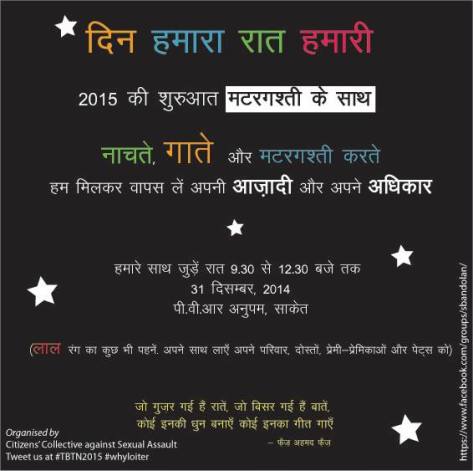
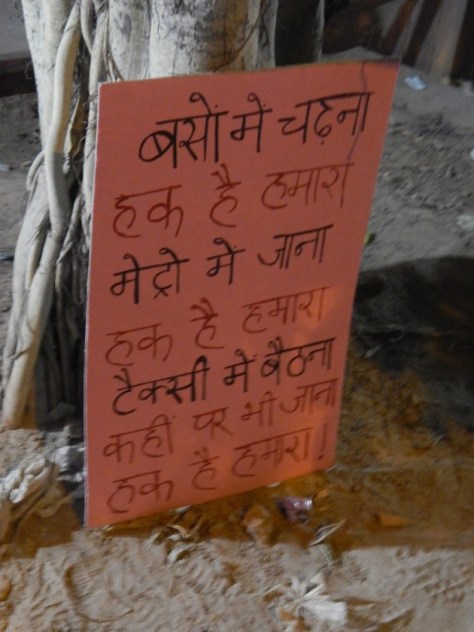
Citizen’s Collective against Sexual Assault (CCSA) is a Delhi/NCR-based group of individuals and organisations that works towards preventing and addressing issues of sexual violence against women, girls and transgender people, including raising awareness among the public, media, administration and the police on issues of women’s rights. CCSA organized for the third year in succession, a Take Back the Night rally on December 31, 2014, ending at 12.30 am on January 1, 2015. The New Year was welcomed with songs of protest, dance, street plays, with everyone meeting at PVR Anupam Saket, walking towards Saket Metro Station. Below is the statement they produced for the occasion, and some photographs.

1507571_10152977747969913_2507326562641751106_n

Matargashti is an expression of freedom, vibrancy, happiness, consent, confidence like reaching out to the clouds and bursting them like bubbles! Matargashti (or “loitering”) should be an essential part of each one’s life. Fearlessly roam on the roads, sprawl in the park, jump on to buses, metro and trains or laze around at a chai stall. I may be anyone — woman, man or transgender. Fearlessly be out at any time, travelling by public transport or in my own car. Proudly flaunting my wheelchair or crutches or tap-tapping my way around with my white cane. Someone who lives on the streets because I have nowhere else to call home. Fearlessly wear whatever clothes I feel like. And regardless of which region of India I belong to – North, South, the Northeast or anywhere else.

DSCN2028-e1420102077264-768x1024

Continue reading Matargashti on New Year’s Eve, Take Back the Night 2015: Citizen’s Collective Against Sexual Assault

An old RC ruminates on his ‘Pseudo-Secularist’ roots: Hartman de Souza

Guest post by HARTMAN DE SOUZA

The background and context to this not-so-enigmatic title is very simple. By today’s standards, I am old – I get a hefty discount travelling by train which I am still hooked on, and I am still counting the years and sniffing my coffee. The ‘RC’ is a lot simpler:

Travelling by train from Mumbai to Delhi many, many moons ago, a man in the compartment, in his thirties, got into conversation with me. After I had answered his opening bullet shot questions – You are from? You are doing what? Your father is doing what? – he told me I spoke English like a ‘foreigner’.

I was still fresh from Kenya those days, where I was born, so I got a lot of grief from having a different accent that no one could place.

This was of course much, much before you could study for an undergraduate degree in India (where you were born) and then, if you had the means and the SATs, go and study in the US for a few years. There, in the land of beef and honey, as we now note with pride, many Indians also discovered the ‘free market’ and their ‘authentic’ Hindu roots – then came back to spew communal venom with a makeshift American accent and the dollars to back it.

As if it was stamped on my bloody forehead, he then asked: “You are Christian?” He pronounced this as “Kir-tchin’.

I pretended I hadn’t heard. So he repeated the question. I nodded, hoping he would disappear and let me get on reading my book.  He did not. Instead had a broad grin on his face, like he knew in which bag he could drop me in.  “You are RC!” he said, almost triumphantly.

For a few seconds, he almost had me stumped. I raised my eyebrows.

Ro-maan Catholic,” he offered.

I shook my head and smiled back. “No,” I replied “Retired Catholic…”

He didn’t get the joke. Guys like that still can’t. Continue reading An old RC ruminates on his ‘Pseudo-Secularist’ roots: Hartman de Souza

Celebrating ‘Good Governance’ : Mary E John and Satish Deshpande

Guest post by MARY E. JOHN AND SATISH DESHPANDE

It seems odd to associate words like ‘mean’ and ‘petty’ with entities like states.  But it is hard to avoid them when confronted by the despicable attempt of the Modi regime to cancel or restrict the holiday for Christmas.  On the other hand, these words are far too mild to capture the poisonous malice behind this small-minded act that, despite its clumsiness, is clearly part of a systematic campaign to cultivate a culture of vicious aggression towards select “minorities”.

How should one respond to such pettiness, knowing that it is only the surface of a deep reservoir of violent hatred?  One could light heartedly point to the irony that 25th December happens to be the birthday of not only Madan Mohan Malviya (1861) and Atal Bihari Vajpayee (1924), but also a certain Mohammad Ali Jinnah (1876).

Alternatively, one could argue, in a spirit of liberal reasonableness, that Christmas has for long been much more than a holy day for Christians.  The secularisation of Christmas is apparent not only in its relentless commercialisation (much like Deepavali), but also in its longstanding status as a broader symbol of festive good cheer marked by giving and sharing.   Continue reading Celebrating ‘Good Governance’ : Mary E John and Satish Deshpande

Peace on Earth and Social Justice – Christmas greetings!

images

Protest at Delhi Police Headquarters after the burning of St Sebastian’s Church in Dilshad Gardens/ Image from The Indian Express

We observe Christmas today under the ominous cloud of Hindutvavaadi violence against minorities, which began on the very day of the BJP electoral victory seven months ago, and their determined attempt to obliterate all religious identities other than their own narrow version of Hinduism, a Hinduism that brutally excludes even large numbers of people who would consider themselves Hindu. From burning churches to physically attacking ‘Muslim-looking’ men, to trying to erase Christmas under the banal bureaucratese of Good Governance Day – Hindutvavaad has never had it so safe, never has it been so arrogant, as under the protective gaze of Modi, a Prime Minister who produces reams of flowery prose in his speeches, but through his public silence on these atrocities, satisfies both Hindutvavaad and his neo-liberal supporters – the one recognizing his benign encouragement, the other fooling itself that his silence shows displeasure. Continue reading Peace on Earth and Social Justice – Christmas greetings!

Converting Religion, Converting law: Rajshree Chandra

Guest Post by RAJSHREE CHANDRA

The right to freedom of religion  (Art. 25 of the Indian Constitution) in a country like India has a burden so extensive and a content so capacious that the same right functions both as an instrument of individual liberty As well as a mode through which the state intervenes to discipline and curtail religious freedom. It has a history so diverse and conflicted that the right often become a mode of settling quid pro quo battles between religious publics, and law often becomes hostage to the principle of ‘historical correction’.

There have been various modes of historical corrections. If the demolition of Babri Masjid was one, ghar wapasi – a return home to one’s religion – is another. The recent ghar wapasi episode in Agra, where RSS affiliate Bajrang Dal converted 57 Muslims to Hinduism; the proposed and then withdrawn conversion of Muslims and Christians in Aligarh on 25th December 2014 by the RSS’s Dharm Jagran Samiti; and the scheduled holy dip of an expected 50,000 “reconverts” (of the last five years) in the Godavari during the Kumbh at Nashik next August are instances and signs of the “re-conversion” rhetoric steadily mainstreaming itself. The question is how does the state and law respond to this?

‘Re-conversions’ are not new in Indian history. Katju & Sikand document instances of mass conversions of Muslims into Hinduism from 1947 onwards, and more forcefully and openly from the 1990s onwards, as part of the Shuddhi (purification) movement. The VHP, an adjunct of the Sangh, extols the practice of ghar wapasi and had claimed that over 200,000 Christians had been converted to Hinduism. The re-conversion argument – of shuddhi and ghar wapasi – is invoked by the various factions of the Sangh Parivar as a modus that aims to correct the history of conversions away from Hinduism.  Continue reading Converting Religion, Converting law: Rajshree Chandra

Statement on Peshawar Massacre: People’s Alliance for Democracy and Secularism, Delhi

People’s Alliance for Democracy and Secularism, Delhi, condemns the ghastly attack on school children in Peshawar (Pakistan) by Tehreek-e-Taliban in which over 140  innocent lives were lost. It is a plain case of murders by the people spewing venom in the name of religion and ideology with no regard for human life. PADS demands that such fundamentalist violence be dealt with firmly by the authorities in Pakistan and expresses its solidarity with the parents of the children whose lives were snatched away by the murderous gang which, only to hoodwink the people, claims to be fighting imperialism. By their act they have shown how dangerous they are for the common citizens of Pakistan.

It is also important to note that people in general in Pakistan have to stand up against all kinds of violence. There is no acceptable violence and unacceptable violence. Violence, under the illegitimate legal cover of Blasphemy Laws is being perpetrated, and celebrated in the name of religion in the country. Condoning any kind of violence against the innocent people in the name of religion, provides raison d’etre to the forces like TTP. The ghastly murders in Peshawar is a signal for the Pakistani society  to look inward and work in unison to keep religion away from State to avail the benefits of the democratic rule.

The Indian school children and Parliament have shown solidarity with people of Pakistan by keeping a two minutes silence, on the suggestion of Prime Minister Modi. Such solidarity, however, should be expressed not only at the moment of grave tragedies, but should become a normal state of affairs between the two countries. The political and military leadership of the two countries should avoid aggressive rhetoric and militarisation and peacefully settle all outstanding issues.

PADS notes with the sense of urgency that the Taliban-like Hindutva forces have grown in size, influence, and impact in India orchestrating killings and triggering mass displacement of the people. PADS would like to forewarn the people of India that communalists of any religion have the same traits and ultimately, it is the members of the same community, whose interests such groups claim to espouse, become their targets. This is the time for the peoples of India and Pakistan to unite against the use of religion for committing murders of the innocent.

18.12.2014

Remembering 1992: School of Media and Cultural Studies, TISS Mumbai

Dislocation

Hardening Divides

Remembering 1992 is a site that seeks to revisit and remember the violence that the city of Bombay/Mumbai experienced in December 1992 and January 1993. This site includes 6 films, video interviews and transcripts, news clippings, reports and other resources. The project started with the films that were made by students (Class of 2013) and faculty and used as a part of the campaign Bombay ki Kahani Mumbai ki Zubaani, held between December 2012 and January 2013.

In a political and social context where the memory of this violence has been rewritten and all but erased, it is crucial to remember, to explore the contours of normalised prejudice and to understand how the survivors have struggled with the denial of justice. It is also necessary to think about how and why the memory of such a watershed event gets erased and who benefits from this erasure.

The website explores different kinds of memory, organised around themes and uses a timeline and map to list the events of the 1992-93 riots,based on the Justice Srikrishna report.

Before the Killing, the End of Honour: Rina Ramdev and Debaditya Bhattacharya

Guest Post by RINA RAMDEV AND DEBADITYA BHATTACHARYA

For daring to elope and marry outside the dictates of caste-community honour codes, a young Delhi University undergraduate came to a brutal death at the hands of her family. The incident since then has become part of public discourse, thanks to our newspaper-educated sensibilities. But the ‘popular’ set of responses that this event has generated from our newsreaderly selves is worth some reviewing. While there has been a large-scale condemnation of this incident from ‘civilized’ quarters of the media-enlightened, the most commonly employed terms of this debate have veered around an imagination of a ‘civilizational modernity’ versus an ‘aggressive-savage primitivism’. Are we still in the Dark Ages, most have asked. Is not ‘love marriage’ a civilizational mandate of the age of the modern, others have comfortably posed and then gone on to conclude that the fact that we – as a ‘society’, metropolitan-converts in this case – have not yet made our peace with a civil code of morality relegates us to a ‘rustic-primitive mindset’. The muse of Indian judicial processes and imaginations of penal justice – ah! the “collective conscience” – has spoken thus and gone back to catching up on Ramzaadas and terror attacks on national ‘honour’. And just while we were conveniently conceding to the relative insignificance of an undergraduate girl’s ‘honour’ compared to the prime-time rhetorical spectres of ‘national honour’ in Jammu & Kashmir, a leading English daily attempted to bring back a few ‘dark’ images from Bhawna Yadav’s past.  Continue reading Before the Killing, the End of Honour: Rina Ramdev and Debaditya Bhattacharya

Stop Manual Scavenging in JNU: Forum Against Manual Scavenging

Authors’ Note:

The Chennai based Forum Against Manual Scavenging, (FAMS) can be contacted at famschennai@gmail.com. We have tried to create some awareness on this issue especially among student community (with the assistance of some of the Professors/Faculty based in Chennai) in which we were guided by Safai Karamchari Andolan, Rashtriya Garima Abhiyan, Tamil Nadu Untouchability Eradication Front, Janodayam Social Education CentreRepublic Trade Union of IndiaRed Flag Union of Tamil Nadu and other similar organizations (in and outside Chennai) struggling on this issue which are led primarily by the Dalit Women from the community itself.  

A documentary, ‘Sahar se Pehle’ (Before the Dawn) on sanitation workers in Jawaharlal Nehru University (JNU) campus in Delhi was made by some students of the university. The JNUSU has been consistently raising the issue of abysmally bad condition of sanitation workers in JNU for quite some years now. Earlier in 2012, JNUSU had also participated in a signature campaign against manual scavenging (signed by the then JNUSU President). The documentary shows the manual scavenging is still prevalent in the premier university even after the ban on manual scavenging by the Delhi government (sanitation is a State subject according to the Constitution of India) and after the enactment of “The Prohibition of Employment as Manual Scavengers and their Rehabilitation Act, 2013.”

This documentary was also selected for the Canadian Labour International Film Festival, 2014, and was available online on YouTube and other sites from February 2014, but was not widely circulated on mainstream media or social media. We also came to know about it only a fortnight ago because the write-up attached to it does not explicitly mention manual scavenging.

The JNU student community has started a campaign called Stop Manual Scavenging in JNU, with the message “Use hashtag #StopMSinJNU to SPEAK OUT against the inhuman practices of manual scavenging and hazardous cleaning in #JNU.”  Continue reading Stop Manual Scavenging in JNU: Forum Against Manual Scavenging

Demolition Drive in Vadodara, 2014: Kathyayini Dash, Rushabh Vishawakarma, Hussain Sabu, Bhagwati Prasad Suryavanshi

Guest post by KATHYAYINI DASH, RUSHABH VISHAWAKARMA, HUSSAIN SABU & BHAGWATI PRASAD SURYAVANSHI

Untitled

In Tarsali, 10 kilometers from Vadodara

Note from authors:

We are a group of friends and students from MS University, Baroda. One of us, Rushabh, lives in Kalyannagar which has partly been demolished and this house too is slated for demolition. We have written this to bring to the surface what demolition and displacement means, from the perspective of those who live in places like Kalyannagar, which cannot even be called a ‘slum’. We could see first hand what happened during the demolition because our friend lived there.  We all have spent happy times at Kalyannagar, Rushabh’s home. We felt we owe it to these memories to at least record these events. You can visit us at BarodaBeat.

Development they say…

They say by 2015, not one jhopdi will be seen…Vadodara’s landscape would be studded with flyovers, high rise buildings, malls, clean pothole-free roads. There will be no stench of garbage, leave alone the sight of it.

The recent floods in Vadodara set off an alarm, urging the quick setting up of “river-front projects” which included the demolition and re-location of slum dwellings near the river which were so awfully affected during the floods.

They say, “this is not fair. They sure need help; first priority in fact. They have to be the first to be taken into consideration before going on to people who have it all: a raised plinth level, a well cemented house, resources to recover the losses incurred in the floods. The jhopdiwaale, well, they have nothing at all, don’t they? Already low on the economic scale, they have no resources to recover the losses incurred during the floods, they don’t even have pakka houses to resist the floods. And on top of it all, they have houses built along the river itself. Poor things, where else would they build their houses. But then, these houses shouldn’t be there in the first place isn’t it? Because this is government land, and they don’t have the right to live there. What good is it anyway?” they say. “It is near the river, there is always a dangerous risk of the river flooding and them and their houses drowning,” they say. Continue reading Demolition Drive in Vadodara, 2014: Kathyayini Dash, Rushabh Vishawakarma, Hussain Sabu, Bhagwati Prasad Suryavanshi

3 lakh bogus voters found in Modi’s Varanasi seat?

It appears that the Election Commission has so far traced 3,11,057 fake voters who cast their votes in Varanasi in the Lok Sabha election earlier this year. The district administration is expecting the number of fake voters to reach around 6,47,085 by the end of the examination process.

Remember – Narendra Modi ‘won’ this seat by 3 lakh 71 thousand 784 votes.

This news was first reported in Navbharat Times on November 25, 2014:

जिस वाराणासी संसदीय सीट से नरेंद्र मोदी ने 371784 वोटों से जीत हासिल की है, वहां 311057 फर्जी वोटर मिले हैं। अभी गिनती जारी है और जिला प्रशासन का अनुमान है कि फर्जी वोटरों की संख्या 647085 जा सकती है। इतनी बड़ी संख्या में फर्जी वोटर पहली बार वाराणसी में सामने आए हैं। लाखों की तादाद में मिले फर्जी वोटरों का खुलासा तब हुआ जब भारत निर्वाचन आयोग के निर्देश पर जिला प्रशासन ने मतदाता सूची का पुनरीक्षण अभियान शुरू किया। जिले के सभी पोलिंग सेंटर पर तैनात बूथ लेवल ऑफिसर से घर-घर जाकर मतदाताओं का सत्यापन करवाने के बाद इन बोगस वोटरों का खुलासा हुआ है।

Aaj Tak reported it on November 26, 2014:

प्रधानमंत्री नरेंद्र मोदी और उनकी पार्टी बीजेपी के लिए मुश्किलें बढ़ाने वाली खबर है. खबरों के मुताबिक, नरेंद्र मोदी के संसदीय क्षेत्र वाराणसी में 3 लाख 11 हजार 57 फर्जी वोटर मिले हैं. याद रहे कि यहां मोदी ने 3,71,784 वोटों से आम आदमी पार्टी के अरविंद केजरीवाल को हराया था.

बताया जा रहा है कि फर्जी वोटरों की गिनती अभी जारी है और जिला प्रशासन का अनुमान है कि फर्जी वोटरों की संख्या 6 लाख 47 हजार से ज्यादा जा सकती है. इतनी बड़ी संख्या में फर्जी वोटर वाराणसी में पहली बार सामने आए हैं. ये वे लोग हैं जिन्होंने दो या उससे ज्यादा विधानसभा क्षेत्र की मतदाता सूची में अपना नाम लिखवा रखा है. इसी के साथ सोशल मीडिया पर AAP समर्थक नरेंद्र मोदी पर फर्जी मतों से जीत हासिल करने का आरोप लगाने लगे हैं. गौरतलब है कि आम आदमी पार्टी पहले भी बीजेपी पर फर्जी वोट डलवाने का आरोप लगाती रही है.

According to Shubhanshu Sharma:
If we go by district administration’s claims, they are expecting to find around 1,12,160 bogus voters in Pindra, 1,01,456 in Ajgara, 87,140 in Shivpur, 84,757 in Rohania, 65,989 in Cantt, and 90,942 in Sewapuri regions. 
Kohram News had claimed soon after results were declared in May 2014 that the calculation of votes in the Varanasi seat was anomalous:
Kohram News had also publicized the news of the EVM found in the home of Ankit Gaurav Srivastava, an engineer in Varanasi, the night before the elections.  This news had circulated widely, including on Kafila.
If this is true, what next? As I understand it, according to Article 329 of the Constituion of India, for an election to be set aside, an election petition must be presented “to such authority and in such manner as may be provided for by or under any law made by the appropriate Legislature.”

The Election Commission later recommended that trial of election petitions should be entrusted to the High Courts instead of election tribunals. Parliament thus enacted Section 80-A of the Representation of the People Act, 1951 providing that the High Court shall be the authority for presentment of election petitions under Article 329 (b) of the Constitution. This was incorporated by an amendment in the year 1966 (Act 47 of 1966).

The last time the election of a sitting Prime Minister was set aside for corrupt electoral practices, on June 12, 1975, Indira Gandhi (for it was she), declared a state of emergency.

We can expect no less from a Prime Minister who watches benignly over the continuous and growing humiliation of minorities and murderous attacks  on them; and who carefully supervises the wholesale handing over of the country to the biggest and most corrupt corporate bidders.

There is a lot at stake for Modi and his corporate bosses. And now they have the full backing of state power.

Nevertheless, if the news of bogus voters in Varanasi is true, Modi’s election should be set aside through due process.

‘Law of the land’ on Kissing in Public: Sanjay Palshikar

SANJAY PALSHIKAR, Professor, Political Science department, University of Hyderabad, clarifies the ‘law of the land’ on kissing in public, to the Committee set up by the Vice-Chancellor to ‘look into the matter of the incident of November 2, 2014.’

Respected Members,

At the centre of the incidents of November 2, 2014, is the alleged act by some students to display demonstratively mutual affection in the form of kissing. Without going into the factual correctness of the charge, let me share with you what I have learnt from legal scholars and activists. I do so in the hope that this will help the Committee “ascertain” “the position of the law of the land” regarding kissing in public.

  1. Indian judiciary at the higher levels has not universally treated kissing in public as illegal. In appropriate context, spelt out variously by the relevant judgments, it has been seen as an expression of love, expression of love and compassion, and its artistic representation as defensible. Absent in all theses cases is the tendency to presume that every kiss is an act of sexual expression and that indulging in this act in public is always obscene. (A & B vs State Thr. N.C.T. of Delhi 2009; Friday vs K.J. Sebastian 2001).
  1. The Supreme Court has observed that the Indian Penal Code “does not define the word obscene and this delicate task has to be performed by courts….” If the Apex Court considers it a delicate task, how much more challenging it would be for university teachers and police officers to say if an act is obscene! (Udeshi vs State of Maharashtra 1965).

Continue reading ‘Law of the land’ on Kissing in Public: Sanjay Palshikar

Statement by Forum for Democratic Rights in EFLU on the present state of affairs

We, concerned citizens and members of women’s organizations, civil rights, students and minority rights forums, have come together to form the “Forum for Democratic Rights in EFL University” to  demand an immediate and thorough enquiry into the incident of gang rape and the suppression of democratic rights in EFL University. We wish to bring the following matter to your notice.

A recent horrific incident of the gang rape of a girl student took place in the EFLU men’s (Basheer) hostel on the night of 31st October 2014. The victim contacted the University authorities and was directed to the police who then arrested two accused on 2nd November 2014.  While this case of sexual assault on the university campus has deeply shocked the campus community, students, faculty and staff, even more shocking and worrying has been the attitude adopted by the university administration in its aftermath. Instead of seeking to undertake measures to make the campus free of violence and assault and promoting gender-sensitivity, the administration has resorted to several measures that are nothing short of severe repression of all democratic rights of the campus community as a whole.

Immediately after the incident, there were some reports with speculations about the victim’s presence in the men’s hostel. Aided by selective leaks by the University and the police, these reports amounted to character assassination and victim blaming, and divulged crucial information regarding the complainant’s identity. This pernicious reasoning amounts to nothing but a justification of the crime. From the well-known case of Rameeza Bee to the recent Nirbhaya Act, it has been repeatedly asserted that the act of sexual assault or gang rape cannot be justified citing the previous history of the victim.  We strongly condemn the propaganda to malign the victim and underplay the gravity of the rape. The complainant must be provided with adequate and competent legal counsel, her psychological and emotional well-being must be taken care of, and her safety must be ensured.   Continue reading Statement by Forum for Democratic Rights in EFLU on the present state of affairs

The end of an era – Mohammedan Sporting, Ambedkar Stadium and Football in Delhi: Jamal Kidwai

Guest Post by JAMAL KIDWAI

Caught up in the launch of the Indian Soccer League (ISL) and its promotion by television and big Bollywood stars, very few noticed that the Kolkata based 123-yr-old Mohameddan Sporting, has effectively decided to close down due to a financial crisis. According to its management, they will stop playing for a year outside Kolkata and have disbanded the senior team.

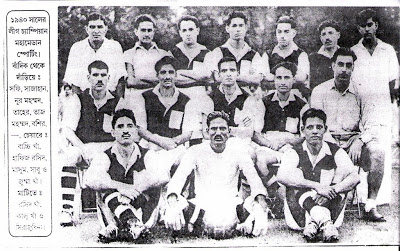
The historic Mohammedan Sporting won the Calcutta league 11 times, the IFA Shield five times,  the Rovers Cup six times, the DCM tournament four times and the Federation Cup and the Durand Cup twice each.

pic 1

Mohammedan Sporting team that won the Calcutta League in 1940

Mohameddan Sporting, along with Mohun Bagan (established 1889) and East Bengal (established 1924) were the most popular clubs of India for over a century. Mohun Bagan drew its fan-following from the elite and the aristocracy of Bengal and its aim was to inspire young people to lead a principled life: for example, those who failed in school and college were not allowed to play and smoking and drinking in the club premises were prohibited. East Bengal, on the other hand, represented the working class and the lower-middle classes who came to stay in Kolkata from east Bengal, which later became Bangladesh.

Given the pan-Indian religious character of Mohd Sporting, it had easily the largest fan following across India. All the big tournaments patronized Mohd Sporting as it drew the largest crowds. The other major clubs like Dempo and Salgaocar came from Goa with a very limited support base outside Goa and Mumbai.  Continue reading The end of an era – Mohammedan Sporting, Ambedkar Stadium and Football in Delhi: Jamal Kidwai

The voices we didn’t hear: K.S. Narendran

Guest Post by K.S. NARENDRAN

As I write this, we are entering the ninth month after the disappearance of Malaysia Airlines flight MH370. I would not want it to be forgotten soon. My wife Chandrika Sharma was on that flight.

Over the past few months, as public attention has shifted to other issues, the long-drawn search for MH370 has seen many developments, ranging from the disturbing to the outrageous. The ineptitude of the Malaysian authorities was on public display, particularly in the early weeks of March 2014, and so merits no further comment. What is intriguing, even worrisome, though is that relevant institutions have been inaccessible or indifferent, be it in terms of pushing for the truth and seeking accountability, or in responding to the affected families’ needs. What follows is my own experience, my take.

The Indian Government: Mute and invisible

In the first week following the disappearance of Malaysia Airlines’ Flight 370, I had asked whether our government had any view on the incident, and any role in responding to it. After all, Indian citizens were involved. This evoked an interesting, if not distressing, set of responses. Indian Minister of State for External Affairs, E Ahmed, deemed the election campaign a higher priority, and opined that the Indian Embassy (at Kuala Lumpur) ought to have stepped in. In informal conversation, many were sympathetic with this view. The Ministry of Civil Aviation and the DGCA seemed similarly indifferent, or saw no role for themselves in responding to the incident or in assisting the affected families. Even the state governments, otherwise quick to take offence at any perceived slight or injury to sons and daughters of their ‘soil’, remained untouched, conspicuous by their silence. The only face of the government that I saw were the CB-CID Special Branch of the Police, the Indian arm of the Interpol and the Intelligence Bureau.  Each asked the same set of questions, suggesting that they work in silos,  that they don’t trust each other. Continue reading The voices we didn’t hear: K.S. Narendran

A kiss for your thoughts, University of Hyderabad: Anu K Antony, Mohan K Pillai, Sinjini Bhattacharya and Vaikhari Aryat

Guest Post by ANU K ANTONY, MOHAN K PILLAI, SINJINI BHATTACHARYA, VAIKHARI ARYAT 

HYD

The protest meeting organised by the students of the University of Hyderabad on the university campus

‘That is knowledge which liberates’, proudly proclaims the crest of University of Hyderabad, a prominent central university in our country. A University space has been traditionally seen as the vanguard of socio-cultural critique and change. Universities pride themselves in upholding the values of freedom of thought, expression and debate. And yet, the reaction of the administration of the University of Hyderabad (UoH) to a recent event, in an otherwise liberal-tolerant and progressive-leaning campus, leaves much space for thought.

On November 2nd, a group of students organised an event on campus in solidarity with the much discussed “Kiss of Love” protest in Kerala. Titled “UoH Against Moral Policing”, the on-campus event, publicised solely on online social media, was supposed to create a space to discuss issues surrounding moral policing and the chain of Kerala incidents, bring out narratives of moral policing, talk about morality and Indian culture, and recite poetry. Also planned was a symbolic act of kissing on a chart paper, with the slogan “Our lips don’t char”. However, some ABVP and BJYM activists, with the aim of saving the students and the Indian culture from Western “immorality”, barged into campus and tried to attack the student protesters. The Telangana Police and campus security, who had failed to stop the intruders, did later succeed in cordoning them off from the protesting crowd, while insisting that the students call off the protest and disperse.

Unaccustomed to Police chauvinism and empowered enough to insist on their rights, the students managed to continue with their planned activities, although once in a while some right-wing activists managed to break ranks and tried to incite violence. The campus community however showed great restraint and continued protesting peacefully.  In response to such moral policing inside campus, the 250-plus students spontaneously started hugging and kissing each other, before dispersing.  Continue reading A kiss for your thoughts, University of Hyderabad: Anu K Antony, Mohan K Pillai, Sinjini Bhattacharya and Vaikhari Aryat

Debating Muslim Law after Shah Bano – the Model Nikahnama Initiative: A Suneetha

Guest Post by A SUNEETHA continuing the discussion on Uniform Civil Code on Kafila.

In popular imagination Muslim women’s unequal position in marriage is symbolized by cases such as Shah Bano or Imrana. It is understood this is the result of the religion-based Muslim personal law and the rigid control of women by the community in general and ulema in particular. Not many are aware that the same religion-based marriage law also offers tools for changing Muslim women’s position in marriage. In the last ten years, an ordinary document that every Muslim couple signs at the time of marriage – nikahnama or marriage contract – has assumed such a role. It has been innovatively used to initiate discussions and push for changes in the community’s thinking about the Muslim women’s position in marriage. In these efforts, a large number of “religious” and “non-religious” Muslim groups got into a conversation and set off a consensus-building process on the issue of a Muslim woman’s “entitlements”.

This discussion assumes importance in the context of the ongoing debate on UCC.  The debate on the UCC entered a new phase when, unhappy with the removal of Muslim women from the ambit of S 125 Crpc that guarantees all divorced women a minimum maintenance and the promulgation of a separate provision for divorced Muslim women called Muslim Women’s Maintenance Act 1986, many women’s groups renewed their demand for a UCC in 1990. Such a Code, it was hoped, would bring marital equality to women of all religions. When the Bharatiya Janata Party hijacked this demand to castigate Muslim men, (as if Hindu men were free of misogynist and patriarchal behaviour), such a hope was irretrievably lost. In the post-Babri Masjid demolition period, when there were pogroms against the Muslim communities, such a law would have found it impossible to garner support from the Muslims, especially if it were made by the BJP dominated Parliament. As anyone familiar with law knows, a consensus is important for law-making so that it is accepted and followed. But the changed situation of unparalleled parliamentary dominance of BJP brings newer challenges to all those working on issues of gender justice in all communities.

Muslim women were caught in this unenviable position since the 1990s – of having to address their own situation – under-age marriages, non-payment of mehr, arbitrary talaq, cruelty in marriage, maintenance after talaq, multiple marriages of men, resistance to women’s employment etc. while taking care that the Muslim men are not vilified further. Continue reading Debating Muslim Law after Shah Bano – the Model Nikahnama Initiative: A Suneetha

Concerns on proposed meetings of Intellectual Property Owners Association with IPAB and the Delhi High Court: Campaign for Affordable Trastuzumab

The Campaign for Affordable Trastuzumab was launched in November 2012 and has been endorsed by over 200 Indian and global patient associations, cancer survivors, health movements, women’s rights activists and eminent jurists.

Kalyani Menon-Sen, Leena Menghaney and KM Gopakumar from this campaign express serious concerns about  the intent and purpose of the “Innovation Dialog” being organised in India from November 16-22, 2014 by the Intellectual Property Owners Association (IPOA).

To: Hon’ble Justice Mr. H.L. Dattu (Hon’ble Chief Justice of India); Hon’ble Justice Smt. G. Rohini, (Chief Justice, Delhi High Court); Hon’ble Justice K.N. Basha (Chair, Intellectual Property Appellate Board)

Dear Hon’ble Justice Dattu, Hon’ble Justice Rohini and Hon’ble Justice K.N. Basha,

We write to you on behalf of the Campaign for Affordable Trastuzumab, a network of treatment activists, patients and public interest lawyers committed to making the breast cancer drug – trastuzumab – affordable in India. We have closely followed the misuse of patent rights and more recently the vexatious litigation of the Swiss pharmaceutical company Hoffmann-La Roche Ltd in India to maintain control over the market for the lifesaving drug (trastuzumab), thus blocking access to treatment for thousands of women with HER2+ breast cancer.

This letter is to express our grave concern about the intent and purpose of the “Innovation Dialog” being organised in India from November 16-22, 2014 by the Intellectual Property Owners Association (IPOA).

The IPOA is a US-based group consisting of large corporations and law firms which has been aggressively lobbying on issues of intellectual property standards and enforcement in India and pushing a pro-corporate agenda. The biased and unbalanced position taken by the IPOA is especially troubling when it concerns medicines, where the use of intellectual property protections have restricted access to affordable treatment and blocked competition.
Continue reading Concerns on proposed meetings of Intellectual Property Owners Association with IPAB and the Delhi High Court: Campaign for Affordable Trastuzumab