All posts by Nivedita Menon

Tribute to Tahira Mazhar Ali: Kavita Panjabi

Guest Post by KAVITA PANJABI

Kavita Panjabi honours the memory of a South Asian feminist from Pakistan who effortlessly produced an ” ‘us’ across generations, contexts and movements”, an ‘us’ across “Kolkata, Dhaka and Delhi, Lahore, Peshawar and Karachi.”

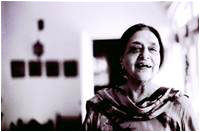
Begum Tahira Mazhar Ali Khan

Just read about Tahira Mazhar Ali passing away, feeling really sad, hence this short piece.

I met her only thrice, and it was like I carried her within me all these years.

The first time was in 2001 at a seminar organized by ASR in Lahore on the 30th anniversary of the genocide in Bangladesh. She came up to chat after my presentation on the Mahila Atma Raksha Samity (MARS) and the Tebhaga women’s movement, excited. It had taken her on a nostalgia trip, and she said she remembered the MARS on a collection drive for the Bengal Famine in Lahore too; many, including she, had taken off the gold bangles they were wearing and contributed on the spot.  Continue reading Tribute to Tahira Mazhar Ali: Kavita Panjabi

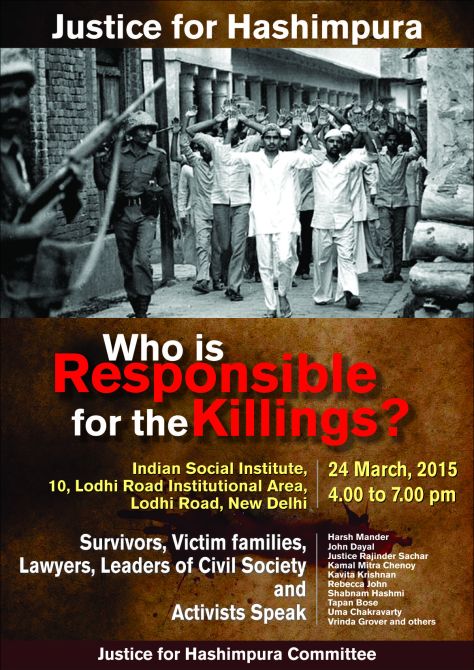
Justice for Hashimpura!

hashmipura killing Poster (1)

Remembering Nishith Bhattacharya, unsung revolutionary hero: Basu Acharya

Guest pots by BASU ACHARYA

The morning of February 15th this year was exceptionally grim. The sun looked pale, its rays mangled, as if somebody had scratched its face with a scalpel blade of tempered steel. Ramakrishna Naskar lane, an obscure by-lane in Beleghata area of Kolkata, was suddenly bustling with unusual activity. A number of people, quite a few in fact, irrespective of the nature of the red flags they carry, had gathered before a modest dwelling; assembled to bid adieu (with clenched fists and the ‘Internationale’ on their lips) to an old man, an octogenarian, wrapped in a crimson cloth with a crossed hammer and sickle in white. Prof. NB, our very own Nishith-da, Comrade Nishith Bhattacharya was no more. Leaving his mortal remains for the pyre to consume and his comrades to weep over, he had left for the final voyage—journey ‘to the undiscovered country from whose bourn no traveller returns’.

My association with Nishith-da dates back to the early years of the past decade when India, like many other ‘developing countries’ of the world, was passing through the initial days of the second information revolution. I, then an activist of a tiny student-youth organisation, met him on the book-fair ground at Maidan and asked scores of questions about Naxalbari and related topics. Most surprisingly, he, without a slightest mark of impatience on his face, answered each question with brutal accuracy and won my heart. From then onwards I was his admirer, also his disciple, who could even dispose of his own thumb—if asked. There are so many fond memories such as this, and as I scribble this piece, old thoughts crowd my mind and the panorama of our decade-long association appear before my eyes. But honestly speaking, it will be absolutely criminal if we limit a man of Nishith-da’s stature to any personal reminiscence. Rather, it is better to tell the story of his life and time in considerable length and as dispassionately as possible, for history should be impartial nay objective.

Continue reading Remembering Nishith Bhattacharya, unsung revolutionary hero: Basu Acharya

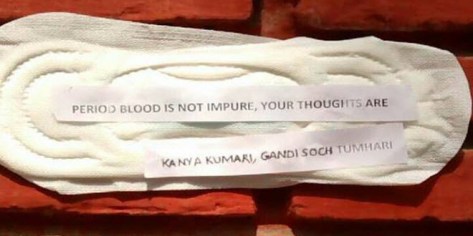
#PadsAgainstSexism campaign at Jamia Milia, Delhi

padsagainstsexism-3

Sanitary pad with message against sexism on Jamia campus

19-year-old Elona Kastrati started the #PadsAgainstSexism campaign in her hometown of Karlsruhe, Germany.

“I thought about how society gets offended by a normal pad. I thought about it so much, the idea came to me to write quotes on them,” she says. So she did.

c5a546f0-cd6d-11e4-93da-f5c367e4b24e_Pads-Against-Sexism-Elona-

Continue reading #PadsAgainstSexism campaign at Jamia Milia, Delhi

Politicians Say the Darndest Things: The Ladies Finger

THE LADIES FINGER gives the finger to politicians and their charming attitudes towards women.

Yesterday in Parliament, Sharad Yadav, head of the Janata Dal (United) and member of the Rajya Sabha, tried to prove he was cool. During a debate on the Insurance Bill, he broke off to talk about south Indian women. What this had to do with the matter at hand is questionable, but here’s what the Indian Express reported from Parliament:

The women of the south are dark but they are… their bodies…”
At this point members sitting around him tried to bring him back to the topic at hand with cries of “Sharadji Bill”. But, Yadav was not finished yet and talked about the “dancing skills” of south India women.

Soon, Trinamool Congress’s Derek O’Brien frantically waved at Yadav to stop.

Want to bet that when he spoke of “dancing skills”, this is what he had in mind?

sridevi-206x300

But it didn’t end there.

Read the rest of this devastating take down at The Ladies Finger.

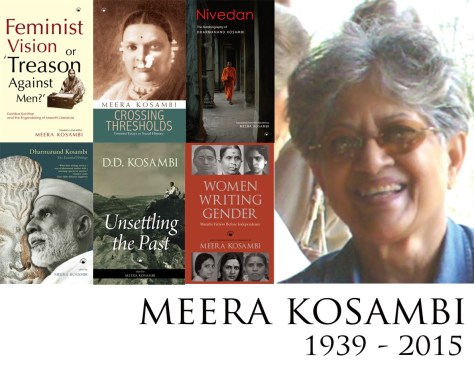
Paying tribute to Meera Kosambi: Uma Chakravarty

kosambiobit

Image courtesy Permanent Black

Meera Kosambi, best known for her scholarship on Pandita Ramabai, passed away at the end of February. Uma Chakravarty, feminist historian, writes on FeministsIndia about the work of Meeratai, as she sternly admonished me to address her, when I casually called her Meera! I met her only once, a few years ago, and was enthralled through the lovely Maharashtrian dinner she had prepared, by her personal warmth and sharp intellect. ‘I dont like these Western ways of addressing older people’, she had said, ‘We have such lovely words of respect and affection, why not use them?’

Meeratai, you will live through your work. Salaam.

And here is Uma Chakravarty: 

Many years ago, before Meera Kosambi began to write on women in 19th Century Western India, a region that I wrote on in my work on Pandita Ramabai, the only Kosambi on my intellectual horizon was D.D. Kosambi, her father, who towered over the history writing scene.

So it was not surprising that when I first met her sometime in the 1990s, a lot of our conversation was about her father and also about her grandfather Dharmanand Kosambi because of my interest in Buddhism. Belonging to such an illustrious family it would have been difficult to carve a distinctive space for herself as Meera Kosambi certainly did.

Read the rest of this tribute here.

Indian feminists, ‘India’s daughter’, and sexual violence: The issues at stake*

International-women-s-day

Today, on International Women’s Day I am proud to acknowledge the deeply contested terrain that we call feminism in India, in which no claim goes unchallenged, no issue is undisputed (and some might say, no good deed goes unpunished!) In which over the decades, every stand and every understanding on practically every issue, has been painfully rethought and reformulated in the face of intense questioning from newer claims and voices.

In the clamour of feminist responses both to Leslee Udwin’s documentary ‘India’s Daughter’, as well  as to the Indian state’s crackdown on it, some themes have emerged that reflect profound fault lines in our (feminist) understanding – not so much of sexual violence itself – but of what to do about it; how to act upon the knowledge of widespread misogyny and pervasive masculinist violence; how to acknowledge that sexual violence cannot be understood except as refracted through prisms of caste, class, Indian state militarism and… a list that will inevitably end in ‘etc’ regardless of how long it is; and in this particular case, above all, what sorts of representations of sex and sexual violence will further our ethical ambitions, and what others will undo decades of work.

In what follows, I will try to uncover some of these themes, on the explicit understanding that I do not claim to have resolved any of the debates, nor even to have highlighted all of them. This is a partial, personal attempt to make sense of the recurring ideas in a tumult of intelligent, concerned and strongly articulated opinions, in the course of which I will of course, make my own views explicit too.

First, perhaps I should state immediately that I saw ‘India’s Daughter’ and liked it very much. This is just to get it out of the way, because my opinion on the film is irrelevant to my belief that freedom of speech and expression ought to be a value that feminists defend at all costs. I did not hold such a strong view on freedom of expression in an earlier decade, but I do now, at the beginning of the 21st century, when it has become increasingly clear that the silencing of uncomfortable voices, even unto murder, has become the preferred mode of snuffing out debate globally.

Continue reading Indian feminists, ‘India’s daughter’, and sexual violence: The issues at stake*

The only New York we see: Juhi Tyagi and Karn Kowshik

Guest Post by JUHI TYAGI AND KARN KOWSHIK

When most tourists visit New York City, what they see is the New York that you see on TV – Times Square, Carnegie Hall, a Broadway Show and maybe a visit to the Legendary Soup Nazi. Our view of the City, though, was vastly different. As one of the authors visited New York for the first time, in the wake of cop killings of young black men in Ferguson, Staten Island and East NY, what we saw was the transformation of neighbourhoods into armed police camps, and a city torn by sharp racial divide.

Maybe our experience of New York was coloured by where we lived and spent most of our time. A tiny apartment on the same street as the 79th Precinct in Brooklyn; not far from where two NYPD officers were shot dead by a mentally unstable man in December 2014. In many of these neighbourhoods, the first piece of advice you got wasn’t about the coolest neighbourhood bar. It was: “On the streets, don’t run, don’t make sudden movements. If a cop stops you, keep your hands out of your pockets and don’t talk back. You don’t want to get shot.”

Continue reading The only New York we see: Juhi Tyagi and Karn Kowshik

The Land Ordinance (now Bill) is Bringing Back the Colonial Legacy: NAPM

Statement from National Alliance of People’s Movements

The Real Battle is between Farmers and Land Grabbing Corporates and BJP, not between Bharat and Pakistan!

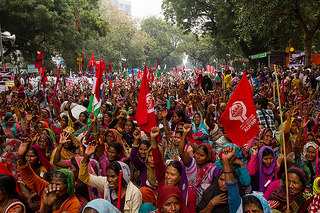
16633316162_2fcb9a5538_n

Protest Against Land Ordinance, February 2015 Delhi

Image courtesy Joe Athialy

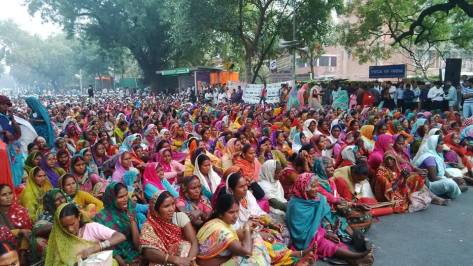
Forcible land acquisition has always been an issue of life and death for millions of people in India, not only farmers but also agricultural laborers and fish workers. With the Land Ordinance it has become a political hot potato. More than 350 people’s organizations gathered at Parliament Street on February 24th, with 25,000 people from Gujarat to Orissa to Assam, and from Himachal Pradesh to Tamil Nadu and Kerala. This show of strength has forced the political parties to take a stand on the issue, leading to heated debates and discussion on the floor of the Parliament. The Ordinance, now Bill, reflects the anti-farmer and anti-poor move of un-democratically amending the 2013 Act on Land Acquisition and Rehabilitation, killing its very spirit and purpose.

The Ordinance brought in by the NDA government just after the Winter session of the Parliament came to an end was an obvious imposition on the country’s common people, of the colonial legacy of a perverted vision of development through an unjust and undemocratic modus operandi. The Ordinance is an attempt to open up the land that is the life support, source of livelihood and shelter for India’s toiling masses, to wealthy investors, including big corporations and builders. Its intention is to forcibly divert India’s agricultural land at the cost of food security, giving a free hand with no ceiling to the private companies as well as private entities i.e. private trusts and expensive profit-making educational and health institutions. The intention is to benefit private interests in the name of public interest.
Continue reading The Land Ordinance (now Bill) is Bringing Back the Colonial Legacy: NAPM

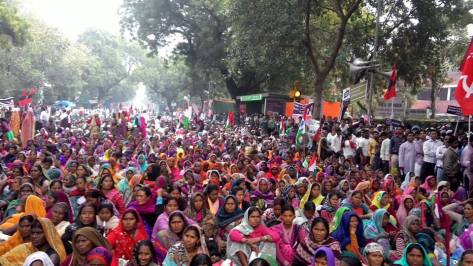
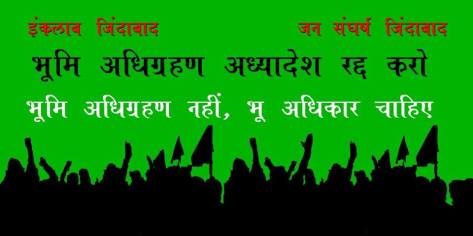
Massive protests against Land Acquisition Ordinance at Jantar Mantar

For updates on the protest, visit Abki Baar Humara Adhikar

11017480_669849169804507_5254527374248079527_n


poster


women

Images courtesy Abki Baar Humara Adhikar

Bus Porters’ Petition for Aadhaar – A Political Analysis: Tarangini Sriraman

Guest post by TARANGINI SRIRAMAN

IMG_20140407_180321

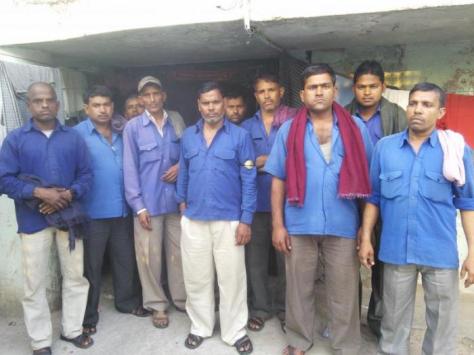
Porters at ISBT  (Image courtesy DNA)

Barely six years into its introduction, the Aadhaar project, otherwise known as the Unique Identification (UID) project has been studied and critiqued extensively – its promises to strengthen welfare delivery, curb corruption, exorcise ghost beneficiaries from government databases, initiate financial inclusion and enhance intra-governmental coordination have been enthusiastically received in certain corporate and technocratic circles and skeptically, if not scathingly viewed in other academic and journalistic quarters. The liberties this far-advanced project has taken with individuals’ privacy and its failure to acquire a statutory basis (even as enrollment drives continue unabated) have justly attracted severe censure. And until recently, the surreptitiously mandatory nature of the project – where welfare entitlements were linked to the possession of numbers – was cause for alarm. The Supreme Court judgment in 2013 challenging this mandatory linkage between Aadhaar and subsidies/entitlements may have slowed down processes of the number’s proliferation as an exclusive proof.

However, since the new government at the Centre took over, newer uses and linkages are being imagined. How indispensable the Aadhaar will be to such schemes and entitlements only time can tell: cases in point the Jan Dhan Yojana (JDY) and the linkage of the Aadhaar with the passport. As new linkages appear in place of the old, the new government is urging all of us to walk boldly into the embrace of biometric identification that will, to a certain extent, at least, pervade public transactions (for some) and their very socio-economic chances of welfare support (for most others).  It was against this conceptual and empirical backdrop (so competently elucidated by the various scholars, lawyers and journalists following this project) that I decided, as part of my work on a larger book project, to speak with a migrant community in Delhi about their Aadhaar-related experiences – did they wish to get these numbers, if so why?

For these purposes, I picked a community of bus coolies or porters in North Delhi most of whom were migrants from different parts of the country and who stayed in a makeshift residence on the premises of the bus terminal. Continue reading Bus Porters’ Petition for Aadhaar – A Political Analysis: Tarangini Sriraman

The Genealogy of the Secular Discourse of Bangladesh – A Second Reading to Bangladesh History: Mubashar Hasan

Guest Post by MUBASHAR HASAN

Even though, according to a series of Gallup and Pew Research polls, Bangladeshi society is now perhaps most illiberal in its history of existence, most informed readers know that a strong secular discourse led by a group of academics, creative writers and artists still continues to flourish and resisting the illiberalism to be the main discourse of the country.

After the independence, the 1972 constitution of the country have endorsed secularism, socialism and democracy as key founding principles among others. However, it is unclear to me as a Bangladeshi who is in his thirties whether these principles were propounded within the constitution with mass support or influential elite intellectuals who were close to the power-base asserted these values because they had the luxury to construct Bangladesh in paper the way they wanted to. May be the latter is true. If secularism was a value held close to the hearts of Bangladeshi masses, it does not make sense now why there is a huge mass support-base for the center-right party Bangladesh Nationalist Party (BNP) or the growing shift to Islam by the ruling Awami League (AL).

In this article, I want to revisit the role of a group of intellectuals who were instrumental in shaping a secular discourse for Bangladesh when Bangladesh was known as the East Pakistan. I call my approach as a second reading to Bangladesh history simply because I haven’t come across any narratives that looks into the thought process of the key constructors of secular discourse in Bangladesh. In this lieu, I shall try to point out to the motivational forces of key actors behind the secular discourse of Bangladesh.  Continue reading The Genealogy of the Secular Discourse of Bangladesh – A Second Reading to Bangladesh History: Mubashar Hasan

War and the Lightness of Being Adivasi – Security camps and villages in Bijapur, Chhattisgarh: PUDR

Report produced by PEOPLE’S UNION FOR DEMOCRATIC RIGHTS

Between December 26th and 31st 2014, a PUDR fact-finding team visited 9 villages of Bijapur district, Chhattisgarh to ascertain reports of arrests, intimidation and harassment, including sexual abuse by security forces who are stationed there to fight the Maoists. Predominantly Adivasi villages, the residents of Basaguda, Kottaguda, Pusbaka, Lingagiri, Rajpeta, Timmapur, Kottagudem, Korsaguda and Sarkeguda, narrated the daily acts of violence and violations committed by armed personnel residing in security camps. Apart from documenting the continuance of ‘area domination’ by the security forces, the report draws particular attention to:

  1. The large number of ‘permanent warrants’ issued against the populace, of which a significant number is declared as ‘absconders’. A rough estimate indicates that as many as 15-35,000 people live under the threat and fear of these warrants in Bijapur alone.
  2. The lawless conduct of the armed personnel and Special Police Officers (SPOs) who routinely raid, beat, loot, detain and compel the Adivasi villagers to perform ‘begar’ (free labour) at the security camps. Instances of sexual torture were also noted.
  3. The impossibility of lodging FIRs against the security forces as against the rising number of arrests of villagers who languish in jails. Continue reading War and the Lightness of Being Adivasi – Security camps and villages in Bijapur, Chhattisgarh: PUDR

Rohtak Gang Rape Reveals the Attitudinal Differences Disabled Face in India: Rupande Mehta

Guest Post by RUPANDE MEHTA

By now it is all beginning to sound very familiar: A woman gang raped, her vital organs missing, stones and blades found in her stomach, other objects found in her anus and vagina and the doctor conducting the post mortem stating it was the most horrific case of his life. This case, however, has one additional parameter – the woman raped and killed was mentally challenged and being treated for her condition at the Post Graduate Institute of Medical Sciences (PGIMS) in Rohtak, Haryana.

There is conflicting information on the mental condition of the woman raped and killed. While some reports state she was suffering mental retardation, others state her as condition as being psychiatric. Never mind that mental retardation is untreatable but the contradiction in reporting highlights a fact we all know – how widely misunderstood mental illness really is.

Mental illness is the most undertreated of all diseases around the world. There is an unspoken stigma around it and most sufferers usually do not want to talk about their “condition.” We have a difficult time grasping its severity and hence victims usually quietly suffer on their own until the situation often gets very serious. Many famous people have suffered mental illness and it has taken many of them years to come out and acknowledge their suffering. Few of them have fallen to their disease, the most notable recent case being that of Robin Williams who suffered from extreme depression. Other personalities who suffered mental illness include: Winston Churchill, the Prime Minister of UK, Buzz Aldrin, the second man on the moon, Beethoven, musical genius, Diana, Princess of Wales who suffered from bulimia, an eating disorder, and depression. Mental illness is the most unrecognized and, perhaps, one of the most damning diseases.

Continue reading Rohtak Gang Rape Reveals the Attitudinal Differences Disabled Face in India: Rupande Mehta

Shuddhikaran of Hindu Mahasabha by Lovers of Love in Delhi

Well, they tried, and more power to them.

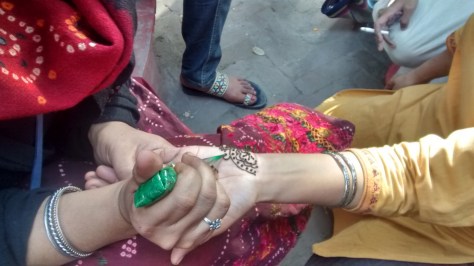
shuddhikaran of that hate-filled, divisive, toxic organization (and others of the Hindutva brigade) would have considerably reduced pollution in the only vasudha we have, which is our kutumb, but the attempt was foiled by a compliant Delhi Police. However, Parliament Street Police Station was very shuddh indeed by the end of the day, its noxious atmosphere cleansed by the cosmic vibrations of music, dance and “marriages” among all sorts of human beings.

IMG_20150214_152622113_HDR

Mehndi ceremony inside parliament Street Police Station

Image courtesy feminisminindia.com

This hilarious subversion of the idea of marriage, with which Hindu Mahasabha threatened lovers, is in fact a deeply political gesture against the institution of patriarchal, heterosexual marriage with all its violent hierarchies of age and gender, in which disobedient women and younger people are in the custody, much like prisoners in jail, of the patriarchs of the family, which include compliant women. There are no honour killings – these are custodial deaths, when families violently separate couples who chose to marry outside their caste or religious community, often killing one or both of them.

Continue reading Shuddhikaran of Hindu Mahasabha by Lovers of Love in Delhi

BJP and Sangh spokespersons reveal real reason for witch hunt against Teesta Setalvad and Javed Anand

[LINK TO SOLIDARITY STATEMENT BELOW]

If you saw the programme on IBN7 last night, vilifying Teesta Setalvad and Javed Anand, with BJP spokesperson Sambit Patra and Sangh spokesperson Rakesh Sinha at their asabhya virulent best, shouting down and intimidating mild Sandeep Pandey and shouting continuously throughout whatever feisty Priyanka Chaturvedi (Congress spokesperson) had to say (which was hard-hitting and unanswerable), you would know what the case against the two activists is really about.

B9qSg1BCcAQUC_b

Of course, the charges against them are of corruption and embezzling of funds collected for Gujarat riot victims, but when Priyanka Chaturvedi pointed out that the case against them is dubious because Gujarat police and judiciary are not exactly exemplars of probity, given the assiduous stalking carried out by the Gujarat police on behalf of Modi’s man, of a young woman (whose family was paid off/ intimidated in classic Hindutva style, ending in the woman claiming gratitude for being stalked) they had no answer. (She could have added the blatant miscarriages of justice in cases of fake encounters and the Ishrat Jahan killing.) Continue reading BJP and Sangh spokespersons reveal real reason for witch hunt against Teesta Setalvad and Javed Anand

Vandalism – The Perfect Solution To Communalism! Nandini Rao

Guest Post by  NANDINI RAO

Thank you, unknown-vandals-out-there.

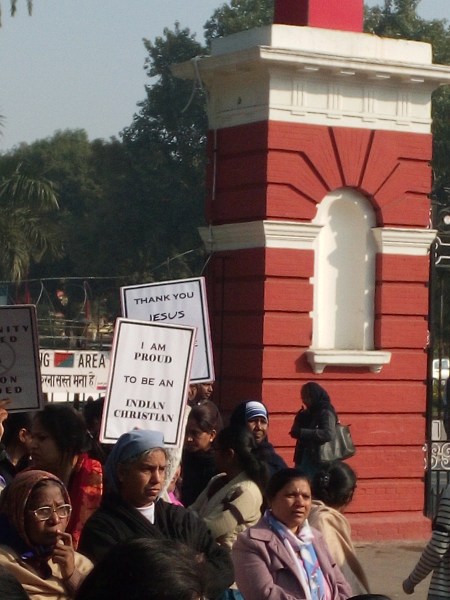
For burning church altars to ashes; for desecrating sacred objects inside houses of worship, for tossing carcasses inside religious places; for converting, de-converting, un-converting or re-converting (as the case may be); for stealing objects from churches that are more valuable to their parishioners for their emotional significance rather than monetary value. For making people ask in hushed tones when and where the next attack is going to take place and what form it will take. For making the pastor conduct midnight mass on Christmas eve outside the church in Delhi, with the faithful offering their prayers in the freezing winter night, simply because they did not have a church to go to.

But most of all, thank you for frightening communities who follow different religions and worship different gods. As for those who do not believe in god or religion, thank you for making them worried about how the social fabric of this country is being pulled apart, thread by thread, through political machinations.

IMG_20150205_094537

Because by doing all of the above, the unknown vandals (they are, needless to say, not criminals, just harmless “vandals”) have made people stop in their tracks and think. They have made communities question law enforcement agencies that brush aside fears and doubts and try to minimise the crimes taking place in their houses of worship. They are compelling them to discuss and debate about forced versus consensual conversions to religions of one’s choice. They are making people of all communities and religions realise how they are being pitted against each other and used as pawns in devious political games. They understand that, in the bargain, it is the poor and the marginalised living on daily wages who are being exploited in the worst possible way. People are realising the importance of their vote and of the very real impact they can make and the change they can bring about, with the single act of pressing a button.

Vandalism has made people come together to hold meetings and consultations to chart out a course to resolve the crises. It has made them stand outside their churches on pavements and on roads, demanding justice and accountability from a state and administration that does not seem to be heeding their voices.

And most important of all, vandalism is teaching us (more than political speeches and advertisements) how one needs to keep on asserting till our voices are heard that we are all citizens in a secular, socialist and democratic republic. That as believers and non-believers, we may worship (or not worship) in varied ways and learn from the teachings of one holy book (or a multitude of books and philosophies), but as citizens, our Holy Book is only the Constitution of India and what it has defined for us, as Indians.

Continue reading Vandalism – The Perfect Solution To Communalism! Nandini Rao

Open Letter to Hindu Mahasabha – we’ll be there on February 14th!

GET READY TO MARRY! 

To the National President, Akhil Bharat Hindu Mahasabha

Dear Chandra Prakash Ji,

It has come to our notice that  you and your self-appointed brigade of protectors of ‘Bharatiya Sanskriti’ have openly vowed to undertake a massive programme on the 14th of February where you promise to marry off anyone who openly expresses their love, whether on the streets or on Facebook. Since you have taken on this gigantic task of marrying so many people on a single day, we would like you to answer some questions that have ‘unnaturally’ crept into our heads as a result of ‘westernization’.

5d67984a9261b26c3a10a7214ddf55d3

Will you marry a boy to a boy he likes, or a girl to a girl?  Will you acknowledge their love for each other, repeal section 377? Or will you send them to jail or Baba Ramdev? Continue reading Open Letter to Hindu Mahasabha – we’ll be there on February 14th!

Adivasis in Assam – Extermination without a Camp: Suraj Gogoi and Prasenjit Biswas

Guest Post by SURAJ GOGOI AND PRASENJIT BISWAS

Repeated genocides in Assam and justification and rationalization of the same can be seen as the severest form of crime against humanity that one can imagine. It is the most reprehensible form of hatred that is committed and perpetually pushed under the carpet. Located in the foothills of Bhutan, the villages where 81 or so Adivasi persons were exterminated in the recent killings by the National Democratic Front of Bodoland (Songbijit faction) is no less than a genocide. Apparently the motive for such killing is attributed to Adivasi villagers helping the army and police in busting camps of Bodo militants. Seemingly they turn out to be the easy targets for insurgent firepower.

The adivasis, therefore, remain in a state of being exterminated. If camps mark the predicament of a modern fragmented society, one might say that the Adivasis are permanently thrown into shelters and camps as internally displaced. An estimated 2.75 lakh people of Adivasi origin are settled in about 250 camps across Udalguri and Chirang. They are decamped before the act of being camped and by the very act of remaining in the state of being camped they are rightless and defenseless. Herein we find a sense of perennial othering which subverts any democratic attempt to empower them with right and dignity. They are othered in a state of displacement and pushed form their settlements to an uncertain destiny. This continual displacement completes the fate of marginality. The process marks an inner othering of the marginalized that actualizes fragmentation of mainstream social identities of Assam. Continue reading Adivasis in Assam – Extermination without a Camp: Suraj Gogoi and Prasenjit Biswas

Modiji suniye, jo Dilli ka mood hai, vohi desh ka mood hai!

10983414_921021707917116_5374565183841541049_n

Image courtesy Kumar Sundaram

BJP’s bravado on exit polls – do they know something about EVMs that we don’t?

BJP says exit polls will fall flat on counting day – I wonder where this confidence comes from. Are they counting on the fact that in many booths, whatever party voters selected, their votes were registering in the BJP’s account? After the murkiness of Lok Sabha results especially in Banaras, with EVMs found in officials’ homes before election day and 3 lakh duplicate voters on the lists, the Election Commission’s ‘clarifications’ raising more questions than they answered, such possibilities no longer seem paranoid.

(The Election Commission said that in Banaras it found 6.47 lakh duplicated names, all of which are repeated at least once across the state. The official said, however, that these are not all necessarily fake entries in the rolls. They could be people who share a name. “For instance, a ‘Rajesh, son of Ramesh’, might be found several times in UP,” he said. “We are in the process of checking whether these people are same or different.”

The question is, when the process was to compare both the voter’s as well as his/her father’s name with other voters, how were 6.5 lakh duplicate names found in a constituency with 17 lakh voters?)

But my point in this post is not about electoral rolls, and a growing suspicion among many that the EC is not entirely un-compromised.

My point is that Electronic Voting Machines are extremely problematic from the point of view of exercising the democratic right to vote (not to mention costs) and have been given up by many ‘advanced’ countries after trying them out for some years. Whatever happens in this particular election, it is time for Indian citizens to think seriously about whether EVMs should be retained. Continue reading BJP’s bravado on exit polls – do they know something about EVMs that we don’t?