While Rita Kothari’s post on Hindi and the politics of language is being debated, take a look at this performance by JAMILA LYISCOTT that makes you fundamentally rethink what ‘being articulate’ means.

While Rita Kothari’s post on Hindi and the politics of language is being debated, take a look at this performance by JAMILA LYISCOTT that makes you fundamentally rethink what ‘being articulate’ means.
BISHAKHA DATTA is on the Wikimedia Foundation Board of Trustees. In the wake of the shocking distortions found in the Wikipedia entry on Bhanwari Devi by an alert reader, Bishakha gives us a tutorial on how Wikipedia works.
1. Wikipedia is the world’s 5th biggest website, visited by almost 500 million readers each month – but created entirely by volunteers. We (meaning the Wikimedia Foundation in San Francisco/wikimedia chapters in 40 countries) do not pay writers or anyone to contribute to wikipedia; anyone contributing to wikipedia is called an ‘editor’. Currently, there are about 80,000 editors around the world creating wikipedias in 285 languages, of which 20 are Indian languages. To see English wikipedia being created in real time, click this link: https://en.wikipedia.org/wiki/Special:RecentChanges
Each line represents a change being made to an article. If you refresh the page, you’ll see how quickly new content keeps getting added.
2. This model of open knowledge has its own pros and cons. Biggest pro: it is a bottom-up grassroots model of gathering knowledge, based on the assumption that each of us has some knowledge (or ‘expertise’) that we can share with the world. The site is designed such that anyone who knows how to use a wiki can add content. So if you know how you can add facts, make it more accurate, correct spellings, add new information etc. This is how Wikipedia lives and grows and becomes better each day, through volunteer efforts. Continue reading How Wikipedia Works: Bishakha Datta
DRISHANA KALITA’s subversive imagining of Soorpanakha’s version of the events that befell her, was one of the top 5 entries for June’s ‘Muse of the Month’ on Women’s Web.
I am Soorpanakha. My name is synonymous with Sin for many, encased for eternity in the pages of the epic Ramayana. I am not the role model parents would point their daughters towards. Why is that? You may ask. Because I admitted to lust. My name was pitted against Sita, the embodiment of purity and womanly virtues. She was everything I was not and I was everything she was not.
She was beautiful and so was I. Do not believe those terrible sketches of me with sharp fangs and blood shot eyes. I was a peerless beauty with large fish shaped eyes, for which my mother had named me ‘Minakshi’ at birth. A single woman, independent enough to roam the forests alone. I was free.
My freedom was my sin, as was my open sexuality. I dared to invite a man, the exiled king of Ayodhya, to make love to me.
Read this wonderful retelling here.
And as a bonus, watch Harinarayana Ehat Edneer performing Shoorpanakha in Yakshagana – ‘Main swachhand bhraman karti hoon!” she declares – I wander at my will!
Guest Post by URVASHI SARKAR
Until June 20th 2014, if you visited the Wikipedia entry on Bhanwari Devi — a women’s rights Dalit activist who was raped for taking on child marriage in an upper caste community in her Rajasthan village— you would have been in for a nasty surprise.
The following lines from the biography section of the article would have stood out starkly:
“Bhanwari, the young, illiterate potter woman…strutting about the village giving gratuitous, unctuous advice to her social superiors made attempts to persuade the family against carrying out their wedding plans. Standing unveiled in the street outside the house of the brides-to-be she loudly berated the elderly patriarch… flaunted her government appointment…and threatening them that she would stop at nothing to ensure their public disgrace by stopping the planned marriage.”
The citation for this paragraph was provided as ‘Bhateri Rape Case: Backlash and Protest’ by Kanchan Mathur published in the Economic and Political Weekly (EPW).
Not a single sentence from that paragraph features in the EPW article; but a preceding paragraph in the Wikipedia entry, which describes Bhanwari Devi’s work as a sathin or grassroots worker with the Women’s Development Project of the Rajasthan Government, is correctly attributed to the EPW piece. Continue reading Wikipedia, Bhanwari Devi and the need for an alert feminist public: Urvashi Sarkar
Guest post by SAROJ GIRI, continuing the discussion on roll-back of FYUP in Delhi University.
Earlier posts on this issue are listed and linked to here.
Here is one way to make sense of the core issue at stake in Delhi University today – this piece by Nandini Sundar arguing that the UGC directive amounts to hampering institutional autonomy of DU.
But this is a flawed position in the present context. It conflates the autonomy of DU with the autonomy of the VC. It construes DU’s autonomy in narrow institutional terms, overlooking the larger movement of teachers and students which is also ‘DU’ and which has consistently opposed the FYUP.
Sundar suggests withdrawal of the UGC directive, the setting up of a DU committee to overhaul the programme, and deliberation in the Academic Council, this time taking proper heed of anti-FYUP views. But do we need a fresh round of discussion on the pros and cons of FYUP?
Absolutely not. For there have been tons of deliberations over the FYUP. Just go back to the minutes and records of the many different meetings and Committees, or recall the many demos and dharnas. There is ample evidence of deliberation where the members of the University have given sound reasons why the FYUP is bad.
Indeed, the picture presented that it is the Ministry or the UGC imposing its diktat from above is simply not true. It is not some committee in the UGC or Ministry which on their own have decided to stall the FYUP. For it is force of the movement against FYUP and the many, many voices active since the last few years who have prevailed now – it is this which is reflected in the UGC directive. Continue reading Collective struggle strengthens autonomy: Saroj Giri
Guest post by RITA KOTHARI
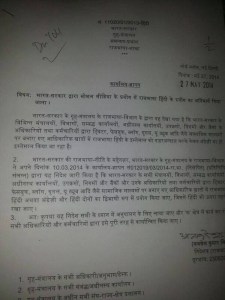
We live with multiple Hindis – one for instance, in railway and flight announcements, the other in cinema, a mixture of Hindi and Urdu, or Hindustani, the kind Gandhi wanted India to adopt as its national language. The former kind – sarkari Hindi – survives only in its ceremonial avatar. This was acknowledged in a rare moment of honesty when the Rajbhasha unit of Ministry of Home Affairs issued an order in December 2011 to provide relief to beleaguered translators who came up with words like ‘Misil’ (for file) and sanganak (for computer). It suggested using English words or words from Indian languages instead of coining new ones but to be written in the Devangari script. It is interesting that this remained unnoticed, for it was business as usual when it happened. How is language both incidental and central at the same time? I wondered.
Government Order dated May 27, 2014 on use of Hindi
Continue reading The Hindi Imbroglio – Videshi Nationalism? Rita Kothari
Second Part of Growing Up With the Cup by HARTMAN DE SOUZA.
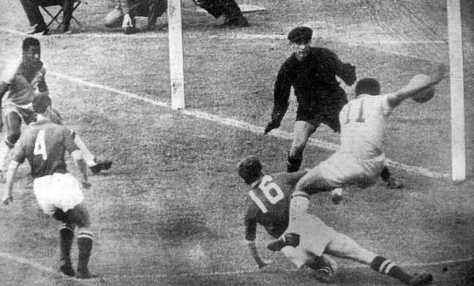
Brazil playing the Soviet Union in the 1958 World Cup, ‘stamping their imprint on the game’, as Hartman puts it below. (Image from here).
It is an interesting coincidence that my mother ended her part of the scrap book for me, with the World Cup in Sweden 1958: while I ended that scrap book in 1963 with the World Cup in Chile in 1962.
In both tournaments, for contrasting reasons, Brazil played an important role. So, at the outset, it ought to be said that the style of playing they gave the world – by virtue of stamping their imprint on the game in 1958 – continues to be the universal model aspired to. You can always find reasons to deny this, rationalize matters, but when push comes to shove the whole world knows who plays authentic football!
This is largely because the Brazilians continue to bring their gifts and place them on a football field where everyone partakes, rival players as well as spectators. The élan with which they play is an inspiration that is duly acknowledged, respected, bowed to and imitated, in every single part of the world where they learn to love playing with a ball and get to see re-runs of Brazil’s old matches. While rival players may hate them with a vengeance, no spectators whose teams have lost to them ever bear them a grudge. Continue reading Growing up with the Cup (Part Two): Hartman d Souza
Guest post by HARTMAN DE SOUZA
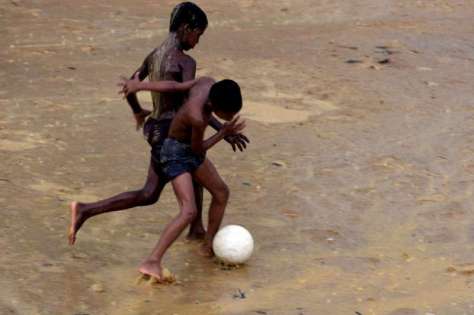
Boys playing football in Bangladesh. The only thing this has to do with Hartman’s post is that it has boys playing football. Also, it’s a lovely picture. (From the UNCHR Bangladesh website)
I only knew there was something called the World Cup courtesy an eccentric mother who kick-started a thick scrap book dedicated to football, to get me to start reading the newspaper. I was ten years old, and lived in Mombasa, on the coast of Kenya.
In it, my mother had gummed various newspaper and magazine articles and features on football. In 1960 when she handed it to me to continue, the last entry was her exhaustive coverage of the World Cup in Sweden in 1958, with reports of every one of the qualifying rounds and all the internationals friendly matches leading up to it. The very last clippings were news-items and commentaries talking about the next World Cup in Chile, in just two years time.
My tasks were cut out. Armed with a dictionary, I may have been one of the first ten year olds in Kenya if not the so-called Commonwealth, to discover Brian Glanville, a very bright and daring football columnist; a man who still writes about the game as if it was the only pleasure worth pursuing with passion.
I spent days and nights reading and re-reading my scrap book. I replayed countless matches in my head so that I could tinker with them and change the results. I always changed the results in my head, so logically the teams I supported always won. Continue reading Growing up with the Cup: Hartman De Souza (Part I)
The Intelligence Bureau has, as we know prepared a document, updating it from the time of the UPA regime (which had reportedly started the dossier) indicating large scale foreign funding for subversive anti-development activities. Such as claiming that you have a greater right to your own lands and to your livelihood than monstrous profit-making private companies. Or raising ecological arguments that might stand in the way of the profits to be made by private corporations and the corrupt state elite, from mining, big dams, multi-lane highways and so on.
The IB report, signed by IB joint director Safi A Rizvi — alleges that the “areas of action” of the foreign-funded NGOs include anti-nuclear, anti-coal and anti-Genetically Modified Organisms protests. Apart from stalling mega industrial projects including those floated by POSCO and Vedanta, these NGOs have also been working to the detriment of mining, dam and oil drilling projects in north-eastern India, it adds.
Imagine – working against the interests of POSCO and Vedanta! Is there no end to the depraved anti-nationalism of these NGOs!
These folks must have made millions of dollars
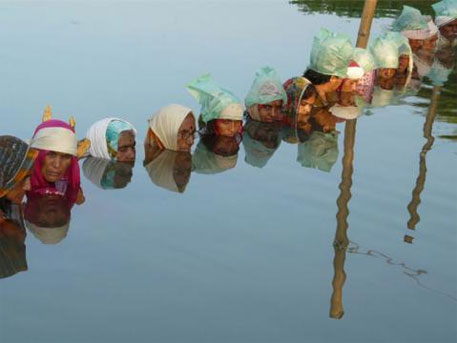
In 2012, people affected by the Omkareshwar and Indira Sagar dams protested the raising of dam storage levels by staying in neck-deep water for over a fortnight (Photo: Narmada Bachao Andolan).
The average observer of Indian politics – being like me, not as sharp as the IB – might be a little befuddled by this apparently anachronistic allergy of two successive governments and its intelligence gathering organization, towards foreign funding, in an era in which the slightest slowing down of the pace of handing over the nation’s resources to multi-national corporations, is termed as “policy paralysis”, and attacked as detrimental to the health of the mythical “Sensex”. Older readers might remember that the inspiring slogan of the legendary Jaspal Bhatti’s Feel Good party was Sensex ooncha rahe hamara.
This post is just to help you figure out then, when it is Okay to applaud foreign funding and when it is not – because otherwise you might post something on your FaceBook page that attacks foreign funding when it is actually Okay – and then how stupid and anti-national you’ll look. Continue reading When Are Foreign Funds Okay? A Guide for the Perplexed
We apologize to readers for having to take down this guest post by WAZHMAH OSMAN, which was a chapter from her Ph.D thesis from New York University, Thinking Outside the Box: Television and the Afghan Culture Wars.
The author has since written to us that she does not have permission to reproduce the entire chapter. Apologies to everybody all round!

A young Afghan poster seller displaying Smriti Irani as Tulsi
Image: Reuters/Ahmad Masood
To:
The Chairman, University Grants Commission.
Dear Sir,
The University Grants Commission has mandated that an exam i.e. the National Eligibility Test, be passed as a requirement for the teaching of History at the undergraduate and post-graduate levels, except in the case where the candidate has a PhD. Those who score highly are given the Junior Research Fellowship which greatly strengthens their candidacy for the Ph.D. program.
We the undersigned, as teachers and researchers of History, believe that the NET exam as it exists does not measure competence in History as a discipline in any imaginable sense. The NET’s own understanding of History is fundamentally different from the practice of the discipline across the world. This understanding, as reflected in the question papers, holds History to lie solely in the memorization of facts. Therefore, in the NET’s version of History, the mechanical retention and retrieval of information appears to be the only competence required for the teaching of the subject. Continue reading History Scholars Write to UGC on Need to Radically Restructure NET
ANAND TELTUMBDE in The Hindu today
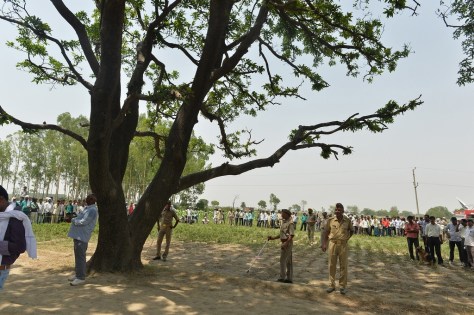
The tree in Katra Shahadatganj village (Badaun district) from which two young Dalit women, sisters, were found hanging after being gang-raped on May 27, 2014. Their bodies were found on May 28th.
The images of two innocent Dalit girls hanging from a tree in Katra village in Badaun district of Uttar Pradesh and a crowd of spectators looking bewildered at them best describes our national character. We can endure any amount of ignominy, can stand any level of injustice, and tolerate any kind of nonsense around us with equanimity. It is no use saying if those girls were our own daughters or our own sisters, we would still stare at them, bewildered and resigned like anyone in that crowd did. In just the past two months, while we as a country were busy playing fiddle to Narendra Modi and his promise of acche din, there have been a series of gory rapes and murders of Dalit teens across the country.
Guest Post by SANKARAN KRISHNA
As journalists, academics and other pundits scramble to make sense of the just concluded elections to the Indian parliament, one can discern a few broad strands of opinion. One group – lets call them the Optimists – point to India’s almost seven-decades long experiment with electoral democracy and aver that we have the institutional strength and resilience in civil society to keep Prime Minister Narendra Modi and his Bharatiya Janata Party confined to a moderate middle that will be, ultimately, not very different from other regimes (single-party or coalition) that have ruled from Delhi. Prominent voices among the Optimists are Ashutosh Varshney, Ram Guha and Pratap Bhanu Mehta.
A second group – lets call them the Alarmists- see the BJP’s clear parliamentary majority (albeit arising from a mere 31% of the popular vote) as inaugurating an era of unapologetic Hindu majoritarianism that could severely strain and irreparably damage the plural fabric of Indian society. They are especially concerned about the fate of the Muslim minority and regard the 2002 pogrom in Gujarat as a foretaste of things to come. The Alarmists range across activists like the late Asghar Ali Engineer, politicos like Mani Shankar Aiyar and intellectuals such as Akeel Bilgrami. Continue reading A Chronicle of an Event Foretold? Sankaran Krishna

Two planets meet.
Oh hello, says one, long time no see. How are you?
Not doing so well, says the other. I think I have Homo Sapiens.
That’s terrible, responds the first planet, I had that too. But dont worry, it doesn’t last long.
(Popular climate change joke, courtesy Goran Fejic. Bottom line? The earth doesn’t need us, we need it.)
Guest post by PUNINDER SINGH
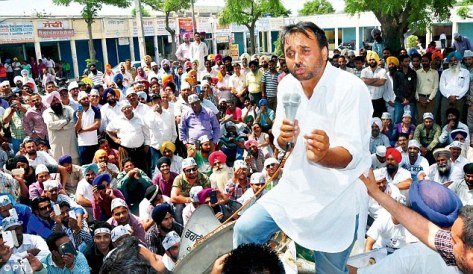
Bhagwant Singh Mann, now AAP MP from Sangrur, on the campaign trail
The Indian general election of 2014 will firstly be remembered for the signal self-destruction and implosion of independent India’s three-quarters-of-a-century-old ruling dynasty and its political arm, the Congress Party. Whether the unexpected series of victories by the fledgling Aam Aadmi Party (AAP) in Panjab will be remembered as an interesting anomaly, or as a galvanizing moment of genuine political change, remains to be seen. But just how a party that only a few months ago was essentially unknown on the national political scene, short on funding, and with virtually no organizational infrastructure, managed to secure 25% of the popular vote and four of thirteen Lok Sabha seats in Panjab (with a narrow miss on a fifth seat) is a tale that needs to be told. Although the newly demarcated role of the AAP as the gadfly and moral conscience of the political scene has been important to its success from a national perspective, it was the intersection of a new political ideology with a particular historical juncture that enabled the AAP to emerge as a giant-killer in Panjab where it met with frustrating disappointment in every other Parliamentary election that it contested elsewhere in India.
The AAP’s success in Panjab comes almost exactly thirty years after the devastating events of 1984, including Operation Bluestar (the Indian army’s full out assault on one of the holiest of Sikh shrines, Harmandir Sahib, and the adjacent Akaal Takht, one of the seats of Sikh temporal power), the subsequent assassination of then Prime Minister Indira Gandhi, and in its aftermath, the Congress Party-orchestrated retaliatory massacres of thousands of Sikhs in New Delhi. The timing of the AAP’s success in Panjab precisely three decades after 1984 is by no means coincidental, but rather is closely tied to the unfolding history of Panjab in the post-1984 period. The momentous events of 1984 were followed by the tumultuous period of 1984-1992 in Panjab. Continue reading History and Idealism in the Aam Aadmi Party’s 2014 Victories in Panjab: Puninder Singh

April 4, 1928 – May 28, 2014
We, this people, on a small and lonely planet
Traveling through casual space
Past aloof stars, across the way of indifferent suns
To a destination where all signs tell us
It is possible and imperative that we learn
A brave and startling truth
And when we come to it
To the day of peacemaking
When we release our fingers
From fists of hostility
And allow the pure air to cool our palms
When we come to it
When the curtain falls on the minstrel show of hate
And faces sooted with scorn are scrubbed clean
When battlefields and coliseum
No longer rake our unique and particular sons and daughters
Up with the bruised and bloody grass
To lie in identical plots in foreign soil
When the rapacious storming of the churches
The screaming racket in the temples have ceased
When the pennants are waving gaily
When the banners of the world tremble
Stoutly in the good, clean breeze
When we come to it
When we let the rifles fall from our shoulders
And children dress their dolls in flags of truce
When land mines of death have been removed
And the aged can walk into evenings of peace
When religious ritual is not perfumed
By the incense of burning flesh
And childhood dreams are not kicked awake
By nightmares of abuse
When we come to it
Then we will confess that not the Pyramids
With their stones set in mysterious perfection
Nor the Gardens of Babylon
Hanging as eternal beauty
In our collective memory
Not the Grand Canyon
Kindled into delicious color
By Western sunsets
Nor the Danube, flowing its blue soul into Europe
Not the sacred peak of Mount Fuji
Stretching to the Rising Sun
Neither Father Amazon nor Mother Mississippi who, without favor,
Nurture all creatures in the depths and on the shores
These are not the only wonders of the world
When we come to it
We, this people, on this minuscule and kithless globe
Who reach daily for the bomb, the blade and the dagger
Yet who petition in the dark for tokens of peace
We, this people on this mote of matter
In whose mouths abide cankerous words
Which challenge our very existence
Yet out of those same mouths
Come songs of such exquisite sweetness
That the heart falters in its labor
And the body is quieted into awe
We, this people, on this small and drifting planet
Whose hands can strike with such abandon
That in a twinkling, life is sapped from the living
Yet those same hands can touch with such healing, irresistible tenderness
That the haughty neck is happy to bow
And the proud back is glad to bend
Out of such chaos, of such contradiction
We learn that we are neither devils nor divines
When we come to it
We, this people, on this wayward, floating body
Created on this earth, of this earth
Have the power to fashion for this earth
A climate where every man and every woman
Can live freely without sanctimonious piety
Without crippling fear
When we come to it
We must confess that we are the possible
We are the miraculous, the true wonder of this world
That is when, and only when
We come to it.
Guest Post by IRFAN AHMAD
This article offers a preliminary analysis of what the Modi phenomenon means in terms of BJP’s sweeping win on 16 May. It makes four propositions.
First, we stop seeing it as an individual phenomenon centered on the personality of Modi even as his votaries as well as some critics tend to view it that way.
Second, the Modi phenomenon is triumph of a massive ideological movement at the center of which stands the Rashtriya Swayamsewak Sangh, RSS. Sharply distinguishing between the BJP and the RSS is a naivety; the RSS’ influence goes far beyond as numerous politicians under its influence have gone to the non-RSS parties in the same way as politicians from the non-RSS parties have joined the RSS-BJP collective.
Third, the BJP victory is neither due to development nor due to anti-corruption but due to Hindutva dressed as development so that both were rendered synonymous. The BJP victory, I contend, is an outcome of a violent mobilization against “the other”, Muslims.
Fourth, BJP’s victory is not the triumph of democracy but its subversion. Charting a different genealogy of demokratiain Greek, I argue how it is pseudo democracy.
As I explain these propositions, I request readers to be somewhat patient –they are a bit long, like the night of 16 May. Continue reading Welcome to Pseudo-Democracy – Unpacking the BJP Victory: Irfan Ahmad
Reports of manipulations of Electronic Voting Machines across constituencies have been coming in, and discrepancies in voting figures have been noted in some constituencies. Earlier, before the elections, there had been reports of two machines in Assam that were so programmed as to vote BJP, whichever button you pressed. A Congress counterpart of this was also discovered in Maharashtra. These reports were then dismissed as aberrations. The question now, it seems, is far more serious. Here is a report from Dainik Jagaran (Varanasi edition), that reports that a Sector Magistrate who had taken the machines home is now in trouble after the EC had to investigate an allegation to this effect and found it to be true. Acdcording to the report, the son of the magistrate concerned took some photographs and posted them on Facebook. One of them went viral.
The self-righteous Delhi based mainstream media has of course chosen to ignore this news completely; Jagaran has at least reported it, even it actually minimizes the significance of this lapse. Here is the Jagaran report:

Of course, this is not the first time that this has happened. Earlier, soon after the 2009 elections too, serious allegations had been raised and this is what one report in Huffington Post had observed:
From May 6 onwards, the candidate’s name was ‘coded’, based on their position on the EVM, and the number of ‘votes polled’ were added, even though voting had yet to take place in many constituencies and, even where voting had taken place, votes were yet to be counted. Even more confounding, the ‘votes polled’ numbers were adjusted in subsequent spreadsheets before the results were announced.
The matter is very serious and needs to be pursued. Investigations continue.
Guest Post by MADHUMITA DUTTA AND JAGDISH PATEL
Amidst a plethora of articles published, trying to explain Mr Narendra Modi’s nation-wide popularity leading to BJP’s eventual electoral win in the 2014 parliamentary elections, a column by Mr Swaminathan S Anklesaria Aiyar in Times of India caught our attention. In his usual style, exuding confidence, Mr Aiyar attributed Mr Modi’s victory in states like Uttar Pradesh and Bihar to “the message carried home by migrant workers in Gujarat”
Apparently Mr Aiyar found his “biggest, credible explanation” (for Modi’s win) while on a pre-election tour in these states where he quizzed the villagers about Modi. Villagers who were otherwise skeptical of the “vultures who came around promising the moon at election time” were swayed by the ‘tales of good governance’ that migrant workers brought home from Gujarat.
While Mr Aiyar doesn’t explain what these ‘tales’ are since he confesses that these are ‘not very detailed or specific’, one wonders who are these migrant workers that Mr Aiyar refers to? And might it be possible that there are other ‘tales’ that are never fully told by the workers when they come visiting families after long periods of time? Continue reading Dead Men (of Gujarat) Tell No Tales: Madhumita Dutta and Jagdish Patel
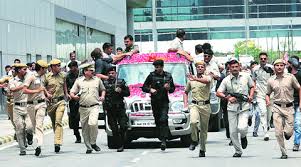
Prime Minister Elect of the world’s largest democracy arrives at the airport in New Delhi
Image Ravi Kanojia, Indian Express May 18, 2014
Circulating on Facebook for two days, and still unreported in mainstream media, is the story of overjoyed BJP workers attacking two mosques in Dakshina Kannada Lok Sabha constituency. Inebriated saffron activists, raising Hara-Hara Modi slogans, attacked two Masjids in separate places of the district on May 16th, after the poll results were announced.
The BJP activists also tried to harm the Imam of Muhiyuddin Juma Masjid, but he managed to escape from the hands of the miscreants.
Meanwhile, another group of miscreants, believed to be BJP activists, reportedly pelted stones at a Masjid in Suralpady near Kaikamba under the limits of Bajpe police station.
Today’s Hindu reports that a Muslim chicken stall owner was beaten up by a gang at Hoode village.
Mr. Ais told The Hindu that he was cooking food, for nearly 400 students at a nearby school, when seven persons came on four motorcycles asked for him with his daughter Ayesha at around 4.30 p.m. They later pushed her and came to him and asked if he was present when a victory procession [of the Bharatiya Janata Party] was taken out on May 16, to which he replied in the negative. They then beat him up.
But none of this muck sticks to the Teflon visage of Modi, ever. Continue reading Excitotoxins and MSG. (Or, the Modi Style of Governance)
‘Varanasi’ is only the official name. Sometimes, to make a poetic point, someone may say Kashi. But ‘Banaras’ is how Banarasis refer to their city.
Banaras ki parampara, they say. Or hum Banaras ke musalman.
Kaal Bhairav Banaras ke kotwal hain, says the mahant of the Shitala Mata temple. Kaal Bhairav (Shiva) is the keeper of the gates of Banaras.
And of course, Banaras ki chaat khaayi hai aapne? Banaras ka paan nahin khayenge?
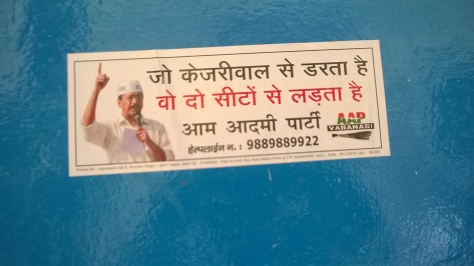
Sticker on wall of home in Rajmandir, a Hindu locality (All pictures by JAMAL KIDWAI)
My old friend and comrade Jamal Kidwai and I were in Banaras to observe the AAP campaign, being supporters of AAP (me) and of Arvind Kejriwal in Banaras (Jamal), and to hang out with the (largely young) volunteers who have landed up – from IT and advertising, from colleges and small government jobs, from Bangalore and Mumbai, from Madhya Pradesh and Arunachal Pradesh – to map Banaras with their feet. So this does not purport to be an objective account – unlike journalists’ accounts of the ‘Modi wave’, which do claim to be purely factual. As Professor Randhir Singh is fond of reminding us – in Paris in 1968, the first question the students would hurl at all speakers was always – “Where do you speak from?” Continue reading Two days with AAP in Banaras
 KAFILA - COLLECTIVE EXPLORATIONS SINCE 2006