All posts by Nivedita Menon

A Chronicle of an Event Foretold? Sankaran Krishna

Guest Post by SANKARAN KRISHNA 

As journalists, academics and other pundits scramble to make sense of the just concluded elections to the Indian parliament, one can discern a few broad strands of opinion. One group – lets call them the Optimists – point to India’s almost seven-decades long experiment with electoral democracy and aver that we have the institutional strength and resilience in civil society to keep Prime Minister Narendra Modi and his Bharatiya Janata Party confined to a moderate middle that will be, ultimately, not very different from other regimes (single-party or coalition) that have ruled from Delhi. Prominent voices among the Optimists are Ashutosh Varshney, Ram Guha and Pratap Bhanu Mehta.

A second group – lets call them the Alarmists- see the BJP’s clear parliamentary majority (albeit arising from a mere 31% of the popular vote) as inaugurating an era of unapologetic Hindu majoritarianism that could severely strain and irreparably damage the plural fabric of Indian society. They are especially concerned about the fate of the Muslim minority and regard the 2002 pogrom in Gujarat as a foretaste of things to come.  The Alarmists range across activists like the late Asghar Ali Engineer, politicos like Mani Shankar Aiyar and intellectuals such as Akeel Bilgrami.  Continue reading A Chronicle of an Event Foretold? Sankaran Krishna

Some Good News for Planet Earth

17qkyzsqz2of9jpg


Two planets meet.

Oh hello, says one, long time no see. How are you?

Not doing so well, says the other. I think I have Homo Sapiens.

That’s terrible, responds the first planet, I had that too. But dont worry, it doesn’t last long.

(Popular climate change joke, courtesy Goran Fejic. Bottom line? The earth doesn’t need us, we need it.)

History and Idealism in the Aam Aadmi Party’s 2014 Victories in Panjab: Puninder Singh

Guest post by PUNINDER SINGH

article-2625216-1DBB956700000578-258_634x367

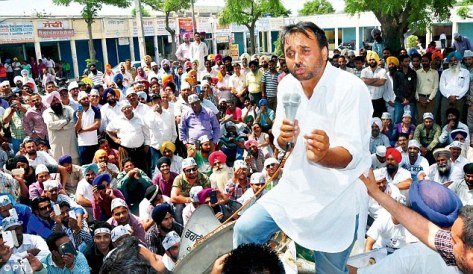
Bhagwant Singh Mann, now AAP MP from Sangrur, on the campaign trail

The Indian general election of 2014 will firstly be remembered for the signal self-destruction and implosion of independent India’s three-quarters-of-a-century-old ruling dynasty and its political arm, the Congress Party. Whether the unexpected series of victories by the fledgling Aam Aadmi Party (AAP) in Panjab will be remembered as an interesting anomaly, or as a galvanizing moment of genuine political change, remains to be seen. But just how a party that only a few months ago was essentially unknown on the national political scene, short on funding, and with virtually no organizational infrastructure, managed to secure 25% of the popular vote and four of thirteen Lok Sabha seats in Panjab (with a narrow miss on a fifth seat) is a tale that needs to be told. Although the newly demarcated role of the AAP as the gadfly and moral conscience of the political scene has been important to its success from a national perspective, it was the intersection of a new political ideology with a particular historical juncture that enabled the AAP to emerge as a giant-killer in Panjab where it met with frustrating disappointment in every other Parliamentary election that it contested elsewhere in India. 

The AAP’s success in Panjab comes almost exactly thirty years after the devastating events of 1984, including Operation Bluestar (the Indian army’s full out assault on one of the holiest of Sikh shrines, Harmandir Sahib, and the adjacent Akaal Takht, one of the seats of Sikh temporal power), the subsequent assassination of then Prime Minister Indira Gandhi, and in its aftermath, the Congress Party-orchestrated retaliatory massacres of thousands of Sikhs in New Delhi. The timing of the AAP’s success in Panjab precisely three decades after 1984 is by no means coincidental, but rather is closely tied to the unfolding history of Panjab in the post-1984 period. The momentous events of 1984 were followed by the tumultuous period of 1984-1992 in Panjab. Continue reading History and Idealism in the Aam Aadmi Party’s 2014 Victories in Panjab: Puninder Singh

A Brave and Startling Truth: Maya Angelou

mayaangelou

April 4, 1928 – May 28, 2014

We, this people, on a small and lonely planet
Traveling through casual space
Past aloof stars, across the way of indifferent suns
To a destination where all signs tell us
It is possible and imperative that we learn
A brave and startling truth

And when we come to it
To the day of peacemaking
When we release our fingers
From fists of hostility
And allow the pure air to cool our palms

When we come to it
When the curtain falls on the minstrel show of hate
And faces sooted with scorn are scrubbed clean
When battlefields and coliseum
No longer rake our unique and particular sons and daughters
Up with the bruised and bloody grass
To lie in identical plots in foreign soil

When the rapacious storming of the churches
The screaming racket in the temples have ceased
When the pennants are waving gaily
When the banners of the world tremble
Stoutly in the good, clean breeze

When we come to it
When we let the rifles fall from our shoulders
And children dress their dolls in flags of truce
When land mines of death have been removed
And the aged can walk into evenings of peace
When religious ritual is not perfumed
By the incense of burning flesh
And childhood dreams are not kicked awake
By nightmares of abuse

When we come to it
Then we will confess that not the Pyramids
With their stones set in mysterious perfection
Nor the Gardens of Babylon
Hanging as eternal beauty
In our collective memory
Not the Grand Canyon
Kindled into delicious color
By Western sunsets

Nor the Danube, flowing its blue soul into Europe
Not the sacred peak of Mount Fuji
Stretching to the Rising Sun
Neither Father Amazon nor Mother Mississippi who, without favor,
Nurture all creatures in the depths and on the shores
These are not the only wonders of the world

When we come to it
We, this people, on this minuscule and kithless globe
Who reach daily for the bomb, the blade and the dagger
Yet who petition in the dark for tokens of peace
We, this people on this mote of matter
In whose mouths abide cankerous words
Which challenge our very existence
Yet out of those same mouths
Come songs of such exquisite sweetness
That the heart falters in its labor
And the body is quieted into awe

We, this people, on this small and drifting planet
Whose hands can strike with such abandon
That in a twinkling, life is sapped from the living
Yet those same hands can touch with such healing, irresistible tenderness
That the haughty neck is happy to bow
And the proud back is glad to bend
Out of such chaos, of such contradiction
We learn that we are neither devils nor divines

When we come to it
We, this people, on this wayward, floating body
Created on this earth, of this earth
Have the power to fashion for this earth
A climate where every man and every woman
Can live freely without sanctimonious piety
Without crippling fear

When we come to it
We must confess that we are the possible
We are the miraculous, the true wonder of this world
That is when, and only when
We come to it.

Maya Angelou

Continue reading A Brave and Startling Truth: Maya Angelou

Welcome to Pseudo-Democracy – Unpacking the BJP Victory: Irfan Ahmad

Guest Post by IRFAN AHMAD

This article offers a preliminary analysis of what the Modi phenomenon means in terms of BJP’s sweeping win on 16 May. It makes four propositions.

First, we stop seeing it as an individual phenomenon centered on the personality of Modi even as his votaries as well as some critics tend to view it that way.

Second, the Modi phenomenon is triumph of a massive ideological movement at the center of which stands the Rashtriya Swayamsewak Sangh, RSS. Sharply distinguishing between the BJP and the RSS is a naivety; the RSS’ influence goes far beyond as numerous politicians under its influence have gone to the non-RSS parties in the same way as politicians from the non-RSS parties have joined the RSS-BJP collective.

Third, the BJP victory is neither due to development nor due to anti-corruption but due to Hindutva dressed as development so that both were rendered synonymous. The BJP victory, I contend, is an outcome of a violent mobilization against “the other”, Muslims.

Fourth, BJP’s victory is not the triumph of democracy but its subversion. Charting a different genealogy of demokratiain Greek, I argue how it is pseudo democracy.

As I explain these propositions, I request readers to be somewhat patient –they are a bit long, like the night of 16 May.    Continue reading Welcome to Pseudo-Democracy – Unpacking the BJP Victory: Irfan Ahmad

Tampering of EVMs, Benaras Magistrate in Trouble

Reports of manipulations of Electronic Voting Machines across constituencies have been coming in, and discrepancies in voting figures have been noted in some constituencies. Earlier, before the elections, there had been reports of two machines in Assam that were so programmed as to vote BJP, whichever button you pressed. A Congress counterpart of this was also discovered in Maharashtra. These reports were then dismissed as aberrations. The question now, it seems, is far more serious. Here is a report from Dainik Jagaran (Varanasi edition), that reports that a Sector Magistrate who had taken the machines home is now in trouble after the EC had to investigate an allegation to this effect and found it to be true. Acdcording to the report, the son of the magistrate concerned took some photographs and posted them on Facebook. One of them went viral.

The self-righteous Delhi based mainstream media has of course chosen to ignore this news completely; Jagaran has at least reported it, even it actually minimizes the significance of this lapse. Here is the Jagaran report:

Jagaran photo on EVM manipulation
Jagaran report EVM manipulation and the photograph that went viral, courtesy Naveen Gaur


Of course, this is not the first time that this has happened. Earlier, soon after the 2009 elections too, serious allegations had been raised and this is what one report in Huffington Post had observed:

From May 6 onwards, the candidate’s name was ‘coded’, based on their position on the EVM, and the number of ‘votes polled’ were added, even though voting had yet to take place in many constituencies and, even where voting had taken place, votes were yet to be counted. Even more confounding, the ‘votes polled’ numbers were adjusted in subsequent spreadsheets before the results were announced.


The matter is very serious and needs to be pursued. Investigations continue.


Dead Men (of Gujarat) Tell No Tales: Madhumita Dutta and Jagdish Patel

Guest Post by  MADHUMITA DUTTA AND JAGDISH PATEL 

Amidst a plethora of articles published, trying to explain Mr Narendra Modi’s nation-wide popularity leading to BJP’s eventual electoral win in the 2014 parliamentary elections, a column by Mr Swaminathan S Anklesaria Aiyar in Times of India caught our attention. In his usual style, exuding confidence, Mr Aiyar attributed Mr Modi’s victory in states like Uttar Pradesh and Bihar to “the message carried home by migrant workers in Gujarat”

Apparently Mr Aiyar found his “biggest, credible explanation” (for Modi’s win) while on a pre-election tour in these states where he quizzed the villagers about Modi. Villagers who were otherwise skeptical of the “vultures who came around promising the moon at election time” were swayed by the ‘tales of good governance’ that migrant workers brought home from Gujarat.

While Mr Aiyar doesn’t explain what these ‘tales’ are since he confesses that these are ‘not very detailed or specific’, one wonders who are these migrant workers that Mr Aiyar refers to?  And might it be possible that there are other ‘tales’ that are never fully told by the workers when they come visiting families after long periods of time? Continue reading Dead Men (of Gujarat) Tell No Tales: Madhumita Dutta and Jagdish Patel

Excitotoxins and MSG. (Or, the Modi Style of Governance)

download

Prime Minister Elect of the world’s largest democracy arrives at the airport in New Delhi

Image Ravi Kanojia, Indian Express May 18, 2014

Circulating on Facebook for two days, and still unreported in mainstream media, is the story of overjoyed BJP workers attacking two mosques in Dakshina Kannada Lok Sabha constituency. Inebriated saffron activists, raising Hara-Hara Modi slogans, attacked two Masjids in separate places of the district on May 16th, after the poll results were announced.

The BJP activists also tried to harm the Imam of Muhiyuddin Juma Masjid, but he managed to escape from the hands of the miscreants.

Meanwhile, another group of miscreants, believed to be BJP activists, reportedly pelted stones at a Masjid in Suralpady near Kaikamba under the limits of Bajpe police station.

Today’s Hindu reports that a Muslim chicken stall owner was beaten up by a gang at Hoode village.

Mr. Ais told The Hindu that he was cooking food, for nearly 400 students at a nearby school, when seven persons came on four motorcycles asked for him with his daughter Ayesha at around 4.30 p.m. They later pushed her and came to him and asked if he was present when a victory procession [of the Bharatiya Janata Party] was taken out on May 16, to which he replied in the negative. They then beat him up.

But none of this muck sticks to the Teflon visage of Modi, ever. Continue reading Excitotoxins and MSG. (Or, the Modi Style of Governance)

Two days with AAP in Banaras

‘Varanasi’ is only the official name. Sometimes, to make a poetic point, someone may say Kashi.   But ‘Banaras’ is how Banarasis refer to their city.

Banaras ki parampara, they say. Or hum Banaras ke musalman.

Kaal Bhairav Banaras ke kotwal hain, says the mahant of the Shitala Mata temple. Kaal Bhairav (Shiva) is the keeper of the gates of Banaras.

And of course, Banaras ki chaat khaayi hai aapne? Banaras ka paan nahin khayenge?

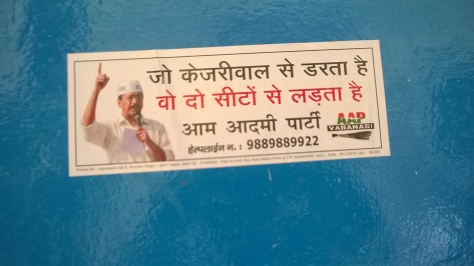
do seet

Sticker on wall of home in Rajmandir, a Hindu locality (All pictures by JAMAL KIDWAI)

My old friend and comrade Jamal Kidwai and I were in Banaras to observe the AAP campaign, being supporters of AAP (me) and of Arvind Kejriwal in Banaras (Jamal), and to hang out with the (largely young) volunteers who have landed up – from IT and advertising, from colleges and small government jobs, from Bangalore and Mumbai, from Madhya Pradesh and Arunachal Pradesh – to map Banaras with their feet. So this does not purport to be an objective account – unlike journalists’ accounts of the ‘Modi wave’, which do claim to be purely factual. As Professor Randhir Singh is fond of reminding us – in Paris in 1968, the first question the students would hurl at all speakers was always – “Where do you speak from?” Continue reading Two days with AAP in Banaras

Petromax Light in Modi’s Gujarat? Sanjeev Kumar

Guest Post by SANJEEV KUMAR 

Electricity Guj Kafila

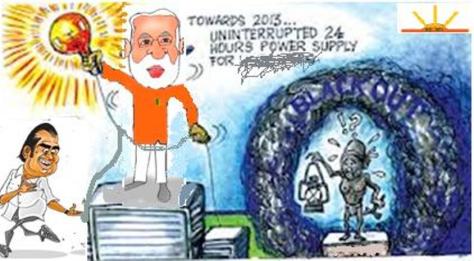
The most visible hype that Modi and his supporters have been generating is over their claim of supplying round-the-clock electricity all over Gujarat. There is no doubt that Gujarat has almost doubled its electricity production between 2001 and 2011. But in the same period Haryana has tripled its generation [1]. Moreover, during Modi’s period (2000’s) the total installed capacity in Gujarat increased by only 44% when during the 1990s it had increased by 73%.

Consider now the consumption pattern. In a state which has been increasing its electricity production rapidly in the recent past, it is expected that the consumption of the electricity must be relatively higher than other states. But here’s what the figures show.

Gujarat claims that they are giving 24 hour electricity to villagers but if we examine the comparative figures with other states, the per capita consumption of electricity in Gujarat (15.547 Kwh per month) is much less than the per capita consumption of electricity in nine states or union territories while  there are five states that are only marginally behind Gujarat. Moreover, the growth in consumption of electricity in Gujarat was less during the Modi regime than in the decades before it – 143.97% during 1990s while during the decade-long rule of Modi, the growth was only 59.97% [2].

What is the reason for low consumption of electricity in Gujarat? The duty on use of electricity which is the highest in India. The tariff rate on electricity in rural areas is 20% if the consumption is less than 40 units per month,and 25% to 30% if the consumption is more 40 units [3]. Continue reading Petromax Light in Modi’s Gujarat? Sanjeev Kumar

David Cohen’s superficial understanding of Indian politics: Pran Kurup

Guest post by PRAN KURUP

This article is in response to a piece published in The Hindu by David Cohen: “Is India about to elect its Reagan” An American backing Modi seems to have got BJP fans all excited, given that the western media has, for the most part, taken an anti-Modi stance driven largely by his rather suspect human rights record.

Cohen finds that Indian elites “look down their noses at Mr. Modi, cringing at the thought of being led by a common chai wallah who can barely speak English.” Cohen is completely wrong here and appears to have a superficial understanding of India and the controversies surrounding Modi.

India has elected any number of leaders over the years who rose from humble beginnings and don’t speak English. Atal Bihari Vajpayee, former PM and BJP leader, is widely revered across the country though he never spoke English in public. Even to this day, you have so many elites who back leaders like Achutandanan from Kerala, Mayawati in UP, or Mamta Banerjee in Bengal. In fact, there are a whole host of Indian leaders who fit this “humble beginning, don’t speak English” profile. So Modi is no exception in this regard.  Continue reading David Cohen’s superficial understanding of Indian politics: Pran Kurup

A letter to Father Frazer Mascarenhas SJ

Endorsed by academics, activists and educationists across India.

Dear Father,
In these troubling times, when the mightiest are being bought over, lured, seduced, or silenced, we salute you for your courage and moral clarity in asking your students to choose wisely. By drawing the attention of your students (who would have voted for the first time) to the seamy underbelly of a ‘model’ that is being promoted unabashedly by the corporate media as the panacea of all that which ails India, we believe you acted responsibly and ethically. The purpose of education is to inculcate critical thinking, to provide
tools of analysis, and to make students sensitive to social realities – no matter how unpleasant they may be. Far from abusing your position, as the BJP is alleging, we think that your advice is the appropriate way for a teacher, and head of an academic institution, to act. Continue reading A letter to Father Frazer Mascarenhas SJ

Speak to us, not for us: students respond to media coverage of the St Xavier’s letter

On April 21st, 2014, Dr. Frazer Mascarenhas, S.J., Principal of St Xavier’s College, Mumbai, posted a letter on the college’s official website. In it, Fr. Mascarenhas, who also teaches a course in Anthropology of Development, dissected the “Gujarat model of development”. He warned against the dangers posed by an “alliance of corporate capital and communal forces coming to power”, and stressing the importance of a strong welfare state, ended by informing students to “choose well.”

The Bharatiya Janta Party (BJP) has lodged a complaint with the Election Commission, claiming this was “an attempt to influence the minds of students”, and that it “violated the Model Code of Conduct.” A simultaneous campaign on electronic and social media alleged Fr. Mascarenhas had overstepped his authority. Unfortunately, all this is being said on behalf of students of St Xavier’s, without considering their views on the same.

While we as alumni and students might not agree unanimously with Fr. Mascarenhas’ statement, or the method he chose to disseminate it, we strongly oppose the biased media reports and falsehoods propagated on social media, which are twisting this case beyond merit. Thus, we, students and alumni of St. Xavier’s College, Mumbai, wish to strongly bring home a few points: Continue reading Speak to us, not for us: students respond to media coverage of the St Xavier’s letter

In the Background of Elections – The Development Debate: Frazer Mascarenhas

This is the post by FRAZER MASCARENHAS, SJ that came under attack from the Moditva Brigade, aided ably by the ‘propaganda machine’ that the media has become, and which has since been taken down from the St Xavier’s College website. We have Fr Mascarenhas’ permission to reproduce it here. As any committed teacher would certify, it is our privilege and responsibility to place before our students a range of views, including our own, provided we make clear what our own views are, and do not cloak these as truth or the only valid view. I believe in this piece Fr Mascarenhas has adhered to this ethical principle.

It is also not a coincidence that the Moditva  Brigade frontally attacks particularly people from minority communities when they express their views fearlessly, whether it be Shazia Ilmi labelled as communal for asking Muslims to vote for their “own” – Arvind Kejriwal, mind you, not a Muslim, thus redefining the very idea of community as has been pointed out here – or Fr Mascarenhas placing his views before his students.

Of course, the fear of the Modi Masks is that “minorities” are communities that are “led” by their own.

The truth that they dare not confront is that Fr Mascarenhas and Shazia Ilmi belong to another community altogether – our community of Indians who believe in a strongly democratic society, a society that secures to its citizens justice, equality and dignity. As the two statements endorsing Fr Mascarenhas (that will shortly go up here on Kafila) show – one from the St Xavier’s academic community and the other from a wider set of people –  “We the People” will never ever fit neatly into the hateful divisions the Hindutvavaadis try so hard – and keep failing – to propagate.

The approaching elections have brought an interesting discussion to the public forum on what constitutes human development and how it is to be achieved. The Gujarat model has been highlighted for our consideration. That is very apt because it puts in stark contrast two current views. Is the growth of big business, the making of huge profits, the achievement of high production – what we seek? Or is it the quality of life for the majority in terms of affordable basic goods and services and the freedom to take forward the cultural aspirations of our plural social groups that make up India? Continue reading In the Background of Elections – The Development Debate: Frazer Mascarenhas

Unbroken History of Broken Promises – Adivasis and Election Manifestos: Kamal Nayan Choubey

Guest Post by KAMAL NAYAN CHOUBEY

Election manifestos of political parties have a distinct and vital role in the parliamentary elections. Parties present their policies on crucial issues of the country and their programmes to address the problems of the country. These elections, however, have seen minimal discussions on the contents of the manifestos of different parties because perhaps these elections are less policy centric and more individual centric. That is why the principal opposition party in the Parliament, BJP had not released its manifesto till the first day of polling. Election manifestos of all parties explain their policy and programme for the each and every section of society. It would be useful to consider that what kind of policies and programmes are promised for adivasis in the manifestos of prominent political parties. This is also necessary because these people have paid the price of the ‘development’ based on the extraction of natural resources and the use of corporate capital for this purpose. (Here I want to clarify that I will not focus on the issue of adivasis of North East India, because their problems are very different from the adivasis of the rest of India and one cannot do full justice by analyzing them as one unit).

In last twenty years this expropriation of resources has increased in the forest areas of the country. In each tribal dominated state, State Governments have signed hundreds of Memoranda of Understanding (MoUs) with many national, international and multinational companies. These are the areas where Maoists have strong influence as the ‘biggest internal security threat’ of the country. So, it is important to ask what the policies of various political parties for adivasis are and is there any continuation in their policies and their actual performance as the ruling party in the Centre or in the States? Can adivasis expect, on the basis of these policies and programmes, that next government would follow more sensitive approach towards their problems? Continue reading Unbroken History of Broken Promises – Adivasis and Election Manifestos: Kamal Nayan Choubey

Ab ki baar Modi ki haar!

Yesterday from about 3 pm, nobody could get into Kafila. All we could see was a notice that said WordPress had suspended the blog for ‘violating terms of service’. We wrote immediately to WordPress, who replied that they would get back to us.  No reply from them so far, but Kafila suddenly reappeared at about 9 pm last night.

On a possibly unrelated note, we have all been noticing the mysterious disappearance from cyber space of much anti-Modi content, sometimes even his own previous speeches that do not fit his currently projected persona. Hmm.

Anyway, we’re celebrating Kafila’s return with this rousing anthem, in solidarity with all of us out there – from Mumbai to Banaras to Kudankulam. We’re here, and here we’ll stay. To Pakistan – a friendly reassurance – don’t bother about preparing for the sudden influx of a billion illegal immigrants!

We’ll see the bubble burst. Hum dekhenge.


Courtesy Bombay ki Kahani, Mumbai ki Zubani

Is Arvind Kejriwal dangerous for India? Pran Kurup

Guest Post by PRAN KURUP

Who is more dangerous for India – Arvind Kejriwal or Narendra Modi? This is a question that India needs to answer. But a recent article titled ‘Arvind Kejriwal: The most dangerous man in India’ has ventured to supply a one-sided answer to this question. The title is as catchy as it is misleading if not subversive. The ensuing ‘analysis’ is sadly not borne out by facts but relies on obfuscation and rhetoric. The tragic outcome is that many pertinent facts have been buried beneath the rubble of unsubstantiated allegations and sinister accusations. On the whole the article is an anti-Kejriwal diatribe disguised as an intellectual treatise.

While conferring on Modi the respectable halo of a “firebrand Hindu nationalist”, the writer goes on to indulge in pure speculation and sweeping generalizations about Kejriwal and other AAP leaders.

Here are some samples:

“Kejriwal spent his time in office preening for the cameras.” Continue reading Is Arvind Kejriwal dangerous for India? Pran Kurup

Democracy dies in Mewat – Should Gurgaon Elections be countermanded? Vivek Sharma

VIVEK SHARMA on FaceBook

If elections have been called the ‘dance of Indian democracy’, the number staged in Mewat recently could well be one of the most vulgar yet.  Evidently, the Executive has done the tango with the choreographers. The question now is: will the dance break records at the box-office or will it crash?

Last week Mewat demonstrated at the hustings how a people could be swindled in front of the half-shut eyes of the world’s largest democratic state. Beyond the squeaky clean Nirvachan Sadan on Ashoka Road, the supra-institution of the electoral process flounders in muddy waters. Its grassroots representative, the presiding officer on the last polling outpost, is conceivably either a stooge of the system or just too afraid of it. Mewat stands testimony.

Even in this day and age, women did not cast their vote in Mewat. Why not? The argument forwarded by one of the ostensibly independent election observers of the Gurgaon Parliamentary constituency – after the AAP team made their complaint – was, they are politically blind. After all, through the mustard-wheat harvest season in Mewat which coincided with the elections on April 10, the women worked in the fields while the men smoked hookahs and sipped on chai discussing politics. Women harvested, tended the cattle, ran the hearths, and raised the long train of children born to them practically every other year. With a life so busy where is the time to exercise their most basic right of casting their vote?

But in fact, not only did women not vote – nor did the youth, the poor and all those placed lower in the social pecking order. And the reason is simple. They did not vote because were physically prevented from reaching the polling stations. Continue reading Democracy dies in Mewat – Should Gurgaon Elections be countermanded? Vivek Sharma

Billboards and Booze – Celebrating Indian democracy: Sajan Venniyoor

Guest Post by SAJAN VENNIYOOR

What is the purpose of a political ad?

The page-killer print ad, the giant hoarding, the radio jingle and the TV spot do not serve to inform or educate the public, but only to impress them. These are peacock tails, gambling on the handicap principle that reliable signals must be costly to the signaler, and cannot be afforded by those with less worth. They are public displays of political virility, the media equivalent of a baboon’s red butt which signals the animal’s potency not just to the female but to the entire tribe.

BABOON
Appealing to a target audience

Last month, DNA newspaper reported that the Congress is ‘buying endless radio air time in Mumbai promoting the Rajiv Awaas Yojana, the UPA’s flagship housing scheme.’ Continue reading Billboards and Booze – Celebrating Indian democracy: Sajan Venniyoor

Some Myths About Muslims

Received via Shankar Gopalakrishnan

As the 2014 elections begin, the time has come again to state the obvious. In the context of massive propaganda campaigns, the subtle use of stereotypes, and the fact that both the Western and the Indian media share certain basic biases, many people end up believing in a range of myths about the adherents of the world’s second largest religion. This is a quick attempt at exposing those myths.

Myth: ‘Muslim’ countries are never secular. Muslims do not tolerate minorities in ‘their’ countries but demand minority rights in other countries.

The world’s largest Muslim majority country is Indonesia (total population approximately 25 crores, larger than Pakistan). Indonesia is a secular democracy. Indeed, its population is almost a mirror image of India’s – 88% Muslim, 9% Christian, 3% Hindu, 2% Buddhist, etc. (as compared to India, which has a population that is 80% Hindu, 13.4% Muslim, 2.3% Christian, etc.) Indonesia’s national slogan is “Unity in Diversity.” Yes, Indonesia has occasional riots and bomb blasts, but so does India.

In reality the majority of Muslim majority countries in the world are secular. Several large examples include Turkey, Mali, Syria, Niger, and Kazakhstan. Despite having Islam as ‘state religion’, Bangladesh’s government is also secular in law. The same is true of many other countries. Only six countries in the world claim to use Islam as the basis of their law making – and their total population is roughly the same as the population of Indonesia, Turkey and Kazakhstan combined. In other words, the vast majority of Muslim majority countries are secular, and the vast majority of Muslims live under secular governments.

Myth: Not all Muslims may be terrorists, but most terrorists are Muslims.

Continue reading Some Myths About Muslims

If you can’t join ‘em, beat ‘em: Ayesha Kidwai

AYESHA KIDWAI on FeministsIndia

Ayesha Kidwai on the need for Left-Secular people to take sexual harassment seriously when it comes home to “us”.

The burning question is why Mustafa and Joseph have done this? Are they misogynistic ‘supporters’ of Tejpal or fearless worshippers of fact and intrepid journalism? While the latter question may be good for an author’s self-image, and the former one can be dismissed as presupposing too tidy a critique, the real issue is a general failure amongst the professionals to come up with an adequate response to what the changed mood in the middle class demands. Mustafa and Joseph’s failures are just repeats of ones that we have witnessed over and over again, and each profession has plunged into a crisis when a colleague has been accused: How does a ‘senior’ professional approach the fact that some young woman has gone and complained about something that wasn’t even a grievance just a few years ago? After all, it is ”her’ word against ‘his’ and we know him; and while he may have his faults, he has done so many good things, and he is above all, secular. In any case, why are these outsiders, this “bunch of feminists” getting so involved in these matters (which are always so stippled with grey when seen from our side)?

For an outsider feminist like me, the answer is obvious: no one but this bunch knows what to do when a complaint is made from within one’s own kind. When the complaints have been made from within academia or within the judiciary, it is this bunch that has fought for them to be addressed, protested and thwarted the misuse of hierarchical power and its machinery of slander and intimidation, and reminded their professions that the ideal of equality must first be expressed in the creation of conditions conducive to its access. In doing so, they have imbued the phrase “let the law  take its own course” with substantive meaning.

READ THE FULL ARTICLE HERE