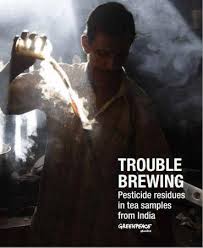
Trouble Brewing – Pesticide Residues in Tea Samples is the result of an investigation carried out by Greenpeace India to understand the situation concerning the use of pesticide usage in tea, which is a quintessential part of Indian culture and critical to the economy. The study has found residues of hazardous chemical pesticides in a majority of samples of the main brands of packaged tea produced and consumed in India. Over half of the samples contained pesticides that are ‘unapproved’ for use in tea cultivation or which were present in excess of recommended limits. The report underscores possible implications for health and the environment, which is both unnecessary and avoidable. While it highlights the fact that the tea industry is stuck on a pesticides treadmill, it suggests that tea companies, which are critical stakeholders in the tea industry, take the necessary steps in moving away from pesticides while adopting a holistic approach is best way forward. Continue reading Indian tea is laden with pesticides: Greenpeace India
All posts by Nivedita Menon
Fast Track to Troubling Times: The Ghadar Alliance

A promise fulfilled? File photo from scroll.in of what was left in the wake of Modi’s helicopter on the election campaign trail (Image by Ravi Mishra)
The first 100 days of the Modi government points to emergent disaster, says this report by The Ghadar Alliance, a US-based educational/watchdog coalition created by concerned citizens in the wake of the BJP victory. The report points to the Economy, Religious Extremism and Human Rights as areas of biggest concern, and is released on the eve of Modi’s visit to the USA as Prime Minister of India.
The entire report can be downloaded at Fast Track to Troubling Times.
In a press release, The Ghadar Alliance said:
The report is the first independent ‘people’s’ report to be published since Modi came into office, and identifies the economy, religious extremism and human rights as grave areas of concern. Continue reading Fast Track to Troubling Times: The Ghadar Alliance
Syrian Jihad spawned the Islamic State: Nauman Sadiq
Guest Post by NAUMAN SADIQ
Let me admit at the outset that Assad is an illegitimate tyrant who must abdicate his hereditary throne to the will of the people when the opportune moment arrives. But at the moment our primary concern shouldn’t be bringing democracy to Syria; at the moment our first and foremost priority should be reducing the level of violence in Syria. There are two parties to this conflict: the regime and the rebels (the majority of whom are takfiri jihadis). It is not possible for the regime to deescalate the conflict because it is holding a tiger by the tail. The regime is fighting a war of defense; and what is at stake in this war is its survival; not only its survival but the survival of its clan: the Alawite minority of 2.6 million people who comprise 12% population of Syria’s 22 million people.
The second party to the conflict is the rebels who are generously supported by the Gulf monarchies, Turkey (Sunni Muslims), Western powers and Israel. Don’t get alarmed and be dismissive of the possibility of an alliance [1] between the Sunni Muslims of Saudi Arabia, Qatar, Jordan, Turkey and the Zionists of Israel. It is realpolitik: the enemy of my enemy is my friend. In fact the Western interest in this war is partly about Israel’s regional security[2] because the Shia axis comprising Iran-Syria-Hezbollah is an existential threat to Israel; and with each passing year the nature of this threat will enhance proportionally with the increased sophistication of Iranian missile program. During the 2006 Israel-Hezbollah conflict in Lebanon, most of the rockets fired by Hezbollah into the Israeli territory missed their target; but according to some reports Iran and Hezbollah have already developed smarter missiles and with every passing year the threat of Hezbollah’s guided missiles so close to Israeli borders will keep on haunting the Israeli strategists’ dreams. Continue reading Syrian Jihad spawned the Islamic State: Nauman Sadiq
Some Feminist Blogs from India
Please feel free to add to the list!
1. Ultra Violet. Indian Feminists Unplugged

Image – Sheba Chhachhi
From
Ultra Violet. Indian Feminists Unplugged
2. The Ladies Finger
A post from The Ladies Finger: The Varied Social Life Of Hindustani Classical Music Before Respectability Took Over

3. Savari – adivasi bahujan and dalit women conversing

A post from Savari: Sanskritization or Appropriation : Caste and Gender in “Indian” Music and Dance
4. Feminists India
A post from Feminists India: Bhagana rape in the context of Dalit rights to common land

The Islam we do not like: Nandagopal R Menon
Guest post by NANDAGOPAL R MENON
Some recent posts on Kafila have identified a “movement of sorts” in South Asian Islam – A Short Memoir On the Arabisation of Islam in India and The Sheepification of Bakistan
Named ‘Arabisation’, this is a “remarkably dispersed” and “subtle” movement most readily evident in certain changes in quotidian linguistic choices, for example, Khuda Hafiz and Ramazan has or is being replaced by Allah Hafiz and Ramadan. This linguistic shift from Farsi/Urdu to Arabic is taken to index a “great cultural battle” under way in South Asian Islam – one that attempts “to ‘correct’ Islam as Muslims in the subcontinent have understood, practiced and lived it, and instead replace it with an Islam which is uniform, seemingly universal and which need not have any affiliation with our cultural and local identities and beliefs”. That ‘Arabisation’ is not something innocuous or laudable is clear, for it “conveniently ignores” – or undermines? – Islam’s “age-old assimilation in the Indian sub-continent”. The following are some thoughts provoked on reading these posts. This is not meant as a coherent response to any of the posts, but just an unsystematic attempt to think through some of the assumptions that condition the creation of concepts like ‘Arabisation’ in public discourse. Continue reading The Islam we do not like: Nandagopal R Menon
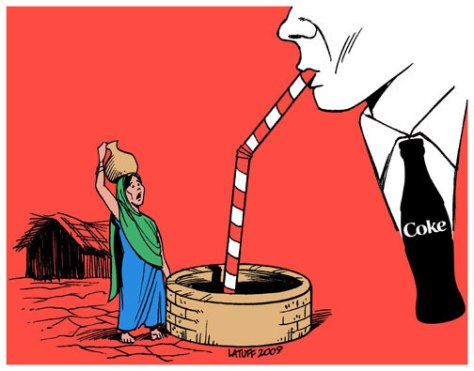
Narmada waters for Coca Cola – really, how much more development can we take?
Farmers who have for three decades non-violently protested the brutal ousting from their lands for the dam project on the Narmada river have been castigated for being anti-development. The dam would bring water to the thirsty, to the parched agricultural lands around it, we were told. Continue reading Narmada waters for Coca Cola – really, how much more development can we take?
Look who’s leading the campaign against ‘Love Jihad’!

Hindu Mahasabha members protest against ‘love jihad’ in Lucknow (File photo by Vishal Srivastav in The Indian Express)
Right up in front, a police bike. Imagine the level of intimidation. And the brazen implication of state agencies in what Paul Brass described as “institutionalized riot systems.“
Jadavpur University students struggle against gender violence
In Jadavpur University (a State aided university of West Bengal), the Arts Students Faculty Union organizes a students’ cultural festival, Sanskriti. On the second night of the festival, an incident of violence occurred in the campus that resulted in a chain of events.
On the night of 28th August, during the ongoing festival, a second year student from the Department of History, Jadavpur University, was allegedly molested inside campus premises by a group of people from the hostel, and her male friend (not a JU student), was beaten up. According to the victim, she had gone near the hostel to relieve herself given the unavailability of bathrooms at the time, accompanied by her friend. On their way back, a group of hostel boys allegedly passed snide remarks which led to a scuffle, and then escalated to something bigger. While her friend was allegedly pulled away and beaten up, she was dragged into the hostel, where she claims she was molested. Continue reading Jadavpur University students struggle against gender violence
‘Son, you outgrew my lap but never my heart’ – Fauzia Ansari in search of her son: Debangana Chatterjee
On August 14, 2013, Shivam Vij wrote in Kafila about Hamid Ansari, a young Management Studies graduate from Mumbai who crossed the border illegally to Pakistan in November 2012, to meet a young woman, and has been missing since. At the time Shivam wrote the post, there were indications that Hamid had been picked up by Pakistani security agencies.
Beena Sarwar, Pakistani human rights activist, wrote in July this year about the possibility of ‘cautious optimism’, following the directive of Peshawar High Court to Pakistan’s defence and interior ministries to provide full information about the forced disappearance of Hamid Ansari and of 25 others, who are Pakistani nationals. Her account is worth reading in full, outlining as it does, the ways in which cross border solidarities of democratic forces consistently work to soar above and also to undermine the barbed wire fences of nation-states.
DEBANGANA CHATTERJEE, a Delhi-based MA student, met Hamid’s mother a few days ago, and wrote this piece after talking to her, outlining some new developments in the case. We have retained Fauzia Ansari’s voice as far as possible in this narrative.
The story of Hamid Ansari, a 28 year old IT engineer and management studies graduate, started unfolding when I came across his mother, Fauzia Ansari at a conference on ‘Challenges to Indian Democracy’ organized in Delhi by the Coalition for Nuclear Disarmament and Peace a few days ago, on August 30-31. Fauzia Ansari is a lecturer of Hindi at a college in Mumbai. Like other mothers, Fauzia says she too had vibrant dreams of her son’s bright future. But a nightmare has unfolded instead. Continue reading ‘Son, you outgrew my lap but never my heart’ – Fauzia Ansari in search of her son: Debangana Chatterjee
The European Union And The Twin Civil Wars In Syria/Iraq: Peter Custers
Is this one of those rare occasions where policymakers self-critically correct a gigantic blunder? Or is it a cold turn-about guided by pure self-interest? On August the 15th, the Foreign Ministers of EU-countries gathered in Brussels and decided that each would henceforth be free to supply arms to Kurdish rebels fighting Sunni extremists of ISIS in the North of Iraq. Even Germany which in the past had been unwilling to furnish military supplies to warring parties in ‘conflict zones’, is now ready to provide armoured vehicles and other hardware to the Kurds opposing ISIS’ advance. The decision of Europe’s Foreign Ministers may surprise some, for barely a year and four months ago, in April of 2013, the European Union had lifted a previously instituted ban on all imports of Syrian oil (1). Moreover, the lifting of this boycott was quite explicitly intended to facilitate the flow of oil from areas in the North-East of Syria, where Sunni extremist rebel organisations had established a strong foothold, if not overall predominance over the region’s oil fields (2). ISIS was not the only Sunni extremist organisation disputing control over Syrian oil fields. Yet there is little doubt but that the fateful decision the EU took last year has helped ISIS consolidate its hold over Syrian oil resources and prepare for a sweeping advance into areas with oil wells in the North of Iraq (3). Continue reading The European Union And The Twin Civil Wars In Syria/Iraq: Peter Custers
The Wrongs In The Right To Education: Noyonika Bose
Guest Post by NOYONIKA BOSE
In the winter of 2013 I had carried out a survey as part of an NGO CRY, Child Rights and You in 10 schools in the heavily populated slums of Rajabazar, an area in north Kolkata. The objective of the survey was to see whether the Right To Education (RTE) Act was being properly implemented in these schools. The findings of the survey though not absolutely abysmal, were not positive either. However what I learnt is that it is not entirely the fault of these government and government aided schools that they were unable to provide their students with quality education. It has also to do with the basic structure of the RTE act which is peppered with several flaws. This article is a critique of the RTE and some possible solutions. Continue reading The Wrongs In The Right To Education: Noyonika Bose
Strange yet familiar – race politics in the USA

Here is a link to Jon Stewart on race politics in the USA, in the context of the recent shooting by a white cop of a black unarmed teenager in Ferguson.
See any resemblances to our own fair country and the politics of caste, class, gender and community here? So familiar are the doubts expressed, questions raised, biases proudly stated, you could be pardoned for thinking it’s not the US of A, but Mera Bharat Mahan. Continue reading Strange yet familiar – race politics in the USA
Reflections on Solidarity for Palestine in India: Urvashi Sarkar
Guest post by URVASHI SARKAR
Some sections of Indian civil society have reacted to Israel’s most recent brutalities in Gaza with outrage, and rightly so. In its pounding of Gaza which lasted over a month, Israel destroyed essential services and infrastructure, razed houses to debris and wiped out entire families. Over 2000 Palestinians were killed, many of them civilians, and of which over 400 were children. On the Israeli side, sixty-four soldiers and four civilians died. A shaky ceasefire between Israel and Hamas, announced in early August, did not last, with hostilities resuming almost immediately.
It is not uncommon to hear Indian voices supporting Palestine even at a time when right wing forces hold sway in the country; yet there is more to this support than meets the eye. There are internal differences on the matter of Kashmir for instance, regarding the extent to which parallels can be drawn between the Palestine and Kashmir conflicts. The actualization of both conflicts dates back to the 1940s. Both regions are heavily militarized; its people suffer routine human rights violations and both are undergoing prolonged self-determination struggles. Each year, Kashmir joins different parts of the world to observe Al-Quds day, held on the last Friday of Ramzan, to observe solidarity with the Palestinian struggle. Popular anti-India protest sites in Kashmir, such as Ramban Chowk and Maisuma, are referred to as ‘Gaza’ in local parlance. A Kashmiri teenager lost his life during firing by security forces, in an anti-Israel protest in South Kashmir in July this year. Continue reading Reflections on Solidarity for Palestine in India: Urvashi Sarkar
Why should we stand for the national anthem?

With increasing reports of people being arrested for not standing for the national anthem, it’s a good idea to remember why they stopped the practice of playing the thing in cinema halls in the first place – nationalism cannot be coercively produced in people’s breasts through such inane, superficial and empty gestures.
And the converse – just because you dont stand up for the national anthem, it doesn’t make you anti-Indian. You may just have another idea of India, or you may show your concern for “India” by some more concrete gesture, or through your politics.
As Anmol Karnik asks:
If we play the national anthem before a television show begins at home, would people stand up? I doubt it. Most people who do it, do it because it’s not socially acceptable to sit down when everyone else is standing. It’s being part of the herd, so there’s probably some part of unity embedded in it, but unity in a forceful and degrading manner.
Just as a matter of interest, this is what the Prevention of Insults to National Honour Act, 1971 says:
Whoever intentionally prevents the singing of the Jana Gana Mana or causes disturbances to any assembly engaged in such singing shall be punished with imprisonment for a term, which may extend to three years, or with fine, or with both.
There is thus, no legal obligation whatsoever to actually stand while Jana Gana Mana plays. Continue reading Why should we stand for the national anthem?
Arrested for sitting during the national anthem: Solidarity Statement with Salman
A youth from Peroorkada (Kerala) was arrested on Wednesday by the police on charges of showing disrespect to the national flag and the national anthem.
The police said Salman, 25, and his six friends, including two women, had showed disrespect to the national anthem while it was being played inside a movie theatre in the city on August 18. A few others who saw the group remaining seated and allegedly “making catcalls” when the anthem was being played lodged a complaint with the police.
This incident comes just days after a student was arrested in Karwar, Karnataka for similar charges. The Kumta police had arrested Jabeer Khan, a student for allegedly forwarding a message, that according to the complainant, mocked the National Anthem and India.
Statement by concerned citizens on the arrest of Salman and demanding his immediate release
On August 20th night 12 pm Salman a student and social activist from Trivandrum was picked up by the police from his home in Peroorkada. The immediate accusation against him was that he had insulted the national anthem while it was being played in a theatre, where he had gone to watch a movie. Later his comments on Facebook where he questions nationalism as a philosophical and political concept were also pointed out as a reason for his arrest. It is also being reported that there was a deliberate attempt to frame him by some right-wing hindutva groups and that they are the ones who are behind his arrest.
There is a lack of clarity regarding his arrest and the way it was conducted, late in the midnight hours of August 20th. It is clear, though, that none of the customary norms were followed during his arrest. Even after it was said that Salman was taken to the Thampanoor station, the police themselves later denied this. For a whole night and the next day even Salman’s parents had no access to him. In fact, Salman was taken from prison to prison like it is usually done with so called ‘notorious terrorists’ and the police refused to give out any information about him both to his parents and to the lawyers who had contacted them. It was onlyon August 21st evening that it was made known that there was an FIR recorded against him and that a case was registered under IPC act 124 A and 66 A charging him of sedition and of sending offensive messages through communicative service. Though there were many other students with him it is surprising that it was only Salman who was picked out and arrested. Continue reading Arrested for sitting during the national anthem: Solidarity Statement with Salman
September 5 as Teachers’ Day – The Dalit Critique: Abhay Kumar
Guest post by ABHAY KUMAR
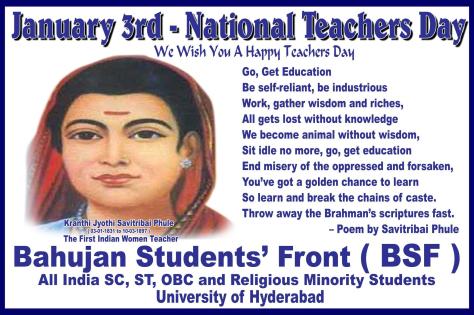
While the schools and educational institutions of the country have been observing September 5 as Teachers’ Day since 1962, on the birth anniversary of the first Vice-President and second President of independent India Dr. Sarvepalli Radhakrishnan (1888-1975), a section of Dalits, mostly students, activists and intellectuals at public universities, are increasingly denouncing its observance. They contend that the birthday of Radhakrishnan, a Brahmin, should no longer be held as Teachers’ Day because he had made no contribution to the educational uplift of lower castes and classes. Instead they exhort people to observe National Teachers’ Day on January 3, the birth anniversary of the nineteenth century social reformer, and teacher from backward caste, Savitribai Phule (1831-1897).

According to the biographer of Savitribai Phule, M. G. Mali (Krantijyoti Savitribai Phule, 2005), she was taught by her husband in a school run under the shade of a mango tree. Access to education enabled her to become aware about egalitarian movements at global level as she managed to read the biography of Thomas Clarkson (1760-1846), who fought for liberation of the Black. Later when she became a teacher, it was vehemently opposed by reactionary Brahmins who pelted stone and threw dung on her in order to “save” orthodox Hindu religion. When frustrated Brahmins were unable to deter the zeal of Phules about imparting education, they succeeded in reasoning with her father-in-law, Govinda Rao, to force them to leave home. She preferred eviction with her husband from home to giving up her mission on education. Despite the opposition, they continued to persuade parents to send their daughters to schools. As a result of their hard work, 18 schools were opened from 1848 to 1852. Her dedication to spread education, particularly among subalterns is self-evident from a few lines of her poem. ‘All gets lost without knowledge… We become animal without wisdom…So learn and break the chains of caste….Throw away the Brahman’s scriptures fast.’ Continue reading September 5 as Teachers’ Day – The Dalit Critique: Abhay Kumar
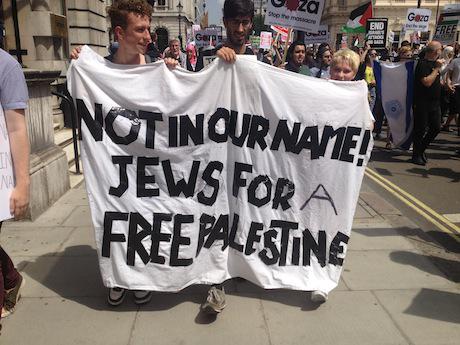
Why I am an anti-Zionist Jew: Ray Filar
RAY FILAR on openDemocracy

The Israeli government deliberately invokes terrorist attacks, rockets, and scary brown men in headscarfs to stoke the population’s fear, but I am scared of the racism Zionists use to justify the occupation.
The discussions in the comments that follow are equally instructive and interesting – do scroll down and follow those as well.
African Solidarity with Palestine: African scholars and scholars of Africa
We, the undersigned African scholars and scholars of Africa, hold that silence about the latest humanitarian catastrophe caused by Israel’s new military assault on the Gaza Strip—the third and most devastating in six years—constitutes complicity. Member state of NATO which mounted an air war on Libya ostensibly to protect civilians in Benghazi have been by and large quiet about the fate of civilians in Gaza. World governments and mainstream media do not hold Israel accountable for its violations of international law. We, however, as a community of scholars have a moral responsibility to do so.
Neither the violation of international law nor the destruction of Palestinian life in Gaza, however, began or will end with the current war[1]. The suffering of Palestinians is not limited to Gaza: the occupation and dispossession in East Jerusalem, the Naqab (Negev), and the West Bank; the construction of walls and fences around the Palestinian population, the curtailment of Palestinian freedom of movement and education, and the house demolitions, all have long histories that will have to be addressed.
Continue reading African Solidarity with Palestine: African scholars and scholars of Africa
Gaza Calls! Day of Rage August 9th, Jantar Mantar, Delhi

The Apartheid Wall with which Israel has annexed almost half of the already Occupied West Bank
The Indian Campaign for the Academic and Cultural Boycott of Israel (InCACBI) calls on all Indians to join the Day of Rage on August 9, called by the International BDS Movement.
Join us at Jantar Mantar between 4 – 8 PM.
InCACBI and the Palestine Solidarity Committee in India join the world in condemning Israel’s war on Gaza.
We also condemn the Indian government’s continuing military, trade, educational and cultural ties with Israel.
The war Israel is currently waging against the Palestinian civilians in Gaza is a continuation of its occupation and blockade of Gaza over many years; its violation of international laws; its apartheid policies and day-to-day violence against people in Gaza. It has become a truism that Gaza has for long been “an open air prison” for its men, women and children, making it impossible for them to live normal lives, leave alone move forward on the road to self determination.
The international community has responded to the mounting civilian death toll in Gaza with millions of people on the streets to demand that Israel stop its one-sided war. In Berlin and other places, including Israel, Jewish people have joined protests. Palestinian protesters across France have defied a ban on demonstrations. The African National Congress has called on the Israeli ambassador to leave immediately. Latin American countries Brazil, Chile, Ecuador Peru and El Salvador have recalled ambassadors from Tel Aviv. Bolivian president Evo Morales has called Israel a “terrorist state” and revoked their visa exemption agreement. 21,000 noted individuals in London have demanded an immediate arms embargo on Israel. A major shift in international public opinion against Israel is taking place.
In India, citizens have protested against Israel’s actions, as well as the Indian government’s timid response to the ongoing carnage in Gaza. While citizens in Mumbai and other cities have called for a boycott of Israeli products, the Indian government is strengthening its relations with Israel, ignoring our call to stop military ties with Israel—one way in which India subsidises the occupation and violence in Gaza.
We ask you, as Indians of conscience, to
1. Demand that the Indian government respond to our call for a military embargo on Israel;
2. Boycott all direct and indirect collaborations with the Israeli state, and demand that the Indian government, Indian industry, media, educational and cultural institutions do the same;
3. Build afresh our old association with Palestine, beginning with more education and cultural exchanges; and
4. Share information with fellow Indians on the siege and destruction of Gaza.
End the Blockade/Siege on Gaza!
Tear down the Apartheid Walls in West Bank & Gaza!
End the Israeli collective punishment on the Palestinian people!
End the illegal Israeli Occupation of all of Palestine!
Right to Return to their homes and homeland for all Palestinians!
End all U.S. aid to Israel!
End India’s military ties with Israel!
Free Palestine!
The Indian Campaign for the Academic and Cultural Boycott of Israel (InCACBI)
The Palestine Solidarity Committee in India
Urgent Call: Bir Zeit University Institute of Women’s Studies, Palestine
Statement from Bir Zeit University Institute of Women’s Studies, Palestine

Gaza Under Attack
As we write this statement, 25 days after the brutal incursion on Gaza, over a thousand and four hundred of innocent civilian women, men and children have been butchered by Israel’s war machine and much more are threatened to be killed. The call for raping Palestinian women by the so-called “Bar-Illan University Arabic Literature Professor” teaches us, once again, that Israeli “scholars” and “academic institutions” are an organic and integral part of the Zionist colonial project. Also, the parliament member, who happens to be a woman, advocates the killing of all Palestinian women, a Rabbi calls for mass murder of Palestinians while taking their foreskins as trophies, in addition to the display of many rape references on banners and images (head covered woman from the top while indecent from the waist down with a very provocative statement below) in their neighborhoods that promotes a rape culture and misogyny at the least. Continue reading Urgent Call: Bir Zeit University Institute of Women’s Studies, Palestine