All posts by Nivedita Menon

Harvard to the rescue!

Some good news for embattled and weary Indian feminists. All those endless submissions to the Verma Committee prepared and submitted, all those critiques of the Ordinance written and disseminated, all those street protests, all those meetings with students and the public, all those delegations to government officials, ministers…not to mention decades of efforts to amend the rape laws.

It’s been a long hard haul, so it’s a great relief that the Harvard Law School has stepped in to take this burden off our shoulders. Continue reading Harvard to the rescue!

Health professionals and sexual assault – some resources from CEHAT

These are some resources available from Centre for Enquiry into Health & Allied Themes (CEHAT)

Role of Health Systems in Responding to Sexual Assault – Frequently Asked Questions

What is the role of Health Professionals in responding to survivors of sexual assault?

Health professionals have a dual role to play in responding to survivors of sexual assault. Firstly, they are required to provide medical treatment and psychological care to survivors as sexual assault has short and long-term physical and psychological effects. Secondly, the health professional  is required to perform a ‘medico-legal examination’. This entails accurate documentation, examination, collection of  forensic evidence and provision of a medical opinion related to the assault, which can serve as evidence in the
court of law.

Read the rest of this manual here.

Links to more resources for health professionals dealing with sexual assault


Two Encounters with the Right Wing: Anonymous

Guest post by an ANONYMOUS student of DU who is afraid, not of the Right Wing, but of the university administration. We can be very proud of our democracy.
I
I have never been so scared of being a minority before. Today I saw two Kashmiris (a girl and a boy) being chased by a mob in what was to be a silent protest. I don’t know when and what circumstances will bring me to running from a mob to save myself. No one deserves to live in fear. Not me, not the two Kashmiris, not even a fiend.
Said a friend who witnessed the saffron mob at Jantar Mantar.
Today, no one can tell me that India is democratic, that India is secular. Today no one can tell me that India is free. Today I saw a glimpse, just a glimpse of what Hindutva truly is, and it was terrifying.
I went to Jantar Mantar for a silent protest against the hanging of Afzal Guru and for the abolition of capital punishment. We reached a little late, and by the time I reached, the number of people had reduced considerably. Why? Because the police had rounded up and detained a bus-full of protesters, mostly Kashmiri, and taken them to the police station.
When we got out of the metro station, all I could hear was cries of Bharat Mata ki Jai interspersed with Pakistan Haye Haye.
Bharat Mata ki Jai, because a man has been hanged. Not for his crimes, if they even exist, but for his identity.
Bharat Mata ki Jai, as we murder Indian Muslims, because that is our idea of nationalism. Continue reading Two Encounters with the Right Wing: Anonymous

We remember Gujarat 2002. And we know you’re lying about development.

Gujarat Riots-Sanjiv Bhatt Arrest-Tehelka

Don’t tell us stories about development, Narendra Modi. Your Vibrant Gujarat and claims of development are shameless hollow lies, and even if they were true, it would still be an unethical and blood-stained development.

But they are lies, Modi, lies.

Here’s a report by Pranjal Sharma in Business World that sees through the working of your  aggressive PR machinery:

The Centre for Monitoring Indian Economy (CMIE) recently examined the investment statistics flaunted by the Gujarat.  The Vibrant Gujarat investment summit held by the chief minister has been projected to have earned billions of dollars of fresh investment into India. But a closer look at the figures reveals a different story. Only a small percentage of projects announced in Vibrant  Gujarat (VG) summits in 2009 and 2011 have actually moved on the ground. The details of many grand projects are missing… Continue reading We remember Gujarat 2002. And we know you’re lying about development.

A crumbling fourth pillar, and the forgotten politics of boycott: Manav Bhushan

Guest post by MANAV BHUSHAN

Assaulted as we are by the deafening cacophony of India’s 24-hour news channels (183 of them, as Manav Bhushan tells us below), there are some of us who for a long time now, have simply refused to appear on TV “debates”, to give them sound bytes to be seamlessly incorporated into their endlessly looping mindlessness. Essentially, we have exercised a politics of refusal – we will not add to the din. At a recent meeting on media ethics at the Indian Women’s Press Corps, I had expressed a fervent desire that every single 24-hour news channel should shut shop for one week while they went into deep introspection – one week of blessedly blank screens, one week of healing quiet in which people could once again learn to listen, to remember that there can be more than 2 or 3 sound-bytes through which to capture the complexities of the world in which we live. MANAV BHUSHAN makes a more radical suggestion below –   that we exercise the only power we have under capitalism, our power as consumers, and exercise a week-long boycott of a news channel for specific reasons, to force drastic changes to its policy and style of functioning. “In an age where each channel depends more on our TRPs than we do on any one of them, we hold enormous, albeit unrealized power,” he says. Over to Manav:

In a speech delivered at the Reuters memorial lecture in November 2012 at Oxford University discussing the Indian news industry, Prannoy Roy candidly said that ”Indian news is currently in a race to the bottom”. He further added that upon comparing the average TV viewership in India (1 hour) to that in the US (5 hours), one is led to the utterly dismal conclusion that this race is far from over. Of course, this is nothing new, and anyone who has followed the ‘debates’ (if you can call them that) on the extremely unfortunate incidents at the LOC can testify that the shows conducted by Arnab Goswami and Barkha Dutt were less news and more war-mongering. In fact, the brutal truth about the flourishing news industry- which has gone from one state-run news channel to 183 independent news channels in just 25 years- is that many of its members are in the business of blackmail, of selling sex, violence and are prepared to go to any lengths for the sake of advertising revenues. And there is a difference, though subtle, between advertising revenues and television rating points (TRPs).  Continue reading A crumbling fourth pillar, and the forgotten politics of boycott: Manav Bhushan

The Criminal Law Ordinance 2013 on Sexual Assault – Cut, Paste and Shock! Pratiksha Baxi

Guest post by PRATIKSHA BAXI 

Once the Criminal Law Ordinance 2013 was uploaded, circulated and read many times, an overwhelming desire to mark the ordinance to all one’s students as an example on how not to frame laws has grown. Yet, explain one must, why the current law on sexual assault is so bizarre, even if we do not bring in the so-called controversial elements and keep to the text of the ordinance.

The Criminal Law Ordinance 2013 begins with the definition of sexual assault as a gender-neutral offence. It does not make an exception to state that women do not rape men in everyday contexts under s. 375. Since such an exception is not added, and the ordinance specifies that ‘sexual intercourse or sexual acts by a man with his own wife, the wife not being under sixteen years of age, is not sexual assault’, we are faced with a confounding and deeply misogynist legal consequence. Wives, we are told cannot prosecute husbands for sexually assaulting them. But since sexual assault is gender neutral without any exceptions and the marital rape exemption is not extended to husbands, now husbands can accuse wives of sexual assault but wives can never prosecute husbands for sexual assault!  Continue reading The Criminal Law Ordinance 2013 on Sexual Assault – Cut, Paste and Shock! Pratiksha Baxi

Why the law on sexual offences must be changed: Madhu Mehra

Guest post by MADHU MEHRA

The public outrage in the wake of the Delhi gang rape has been as much a reaction to the brutality of the case, as it has been against the pervasiveness of sexual violence in our society. Instead of condemnation and action, rape cases frequently evoke public statements blaming the victims, and calls to reign in women’s freedom. That our social structures and mindsets remain patriarchal is well known. The question however is, to what extent does the law counter societal misogyny in the way it frames and responds to sexual violence? Do the criminal laws establish norms that uphold women’s bodily integrity and dignity in all situations, against all offenders without selectivity or discrimination? Continue reading Why the law on sexual offences must be changed: Madhu Mehra

“The impunity of every citadel is intact” – the taming of the Verma Committee Report, and some troubling doubts

Legal activist Vrinda Grover said in the FeministsIndia e-list about the Ordinance: “The impunity of every citadel is intact – family, marriage, public servants, army, police.” In effect, she said, the Ordinance is simply the pending Criminal Law Amendment Bill 2012, widely criticized by women’s organizations, which has been sneaked in as law without debate or consultation, in Parliament or outside. Feminists activists are rightly suspicious of the sudden sense of “emergency” that has gripped the government, when it has ignored our demands for criminal law reform on sexual violence for over twenty years.

Here I will document two press releases issued by women’s groups, and draw attention to some troubling and unresolved debates within the women’s movement in India today. The post will conclude with a useful table comparing the Ordinance and the JVC Report, issued by the Ministry of Home Affairs. Continue reading “The impunity of every citadel is intact” – the taming of the Verma Committee Report, and some troubling doubts

Sexual Violence, Consumer Culture and Feminist Politics – Rethinking the Critique of Commodification : Sreenanti Banerjee

Guest Post by SREENANTI BANERJEE

I will begin with the by now well-known interview of author and social activist Arundhati Roy, conducted by Channel 4 (a British Media House), about the widespread protests after the horrific December 16th incident of the brutal gangrape of the 23 year old medical student in Delhi. Permit me to quote Roy at length as I do not wish to take bits and pieces from her talk, and pluck them out of their context.

We are having an unexceptional reaction to an event which isn’t exceptional […] But the problem is that why is this crime creating such a lot of outrage is because it plays into the idea of the criminal poor, the vegetable vendor, the gym instructor, the bus driver actually assaulting a middle-class girl. But when rape is used as a means of domination by upper castes, by the army or the police it’s not even punished. Continue reading Sexual Violence, Consumer Culture and Feminist Politics – Rethinking the Critique of Commodification : Sreenanti Banerjee

Learning gender, learning caste: two reflections

We received two brief submissions separately sent by two women, reflecting on incidents in their childhood or youth that returned to haunt them more recently. Rethinking, reworking their own sense of self, they present before us questions both timely and urgent.

AYSHWARIA SEKHER looks back on her ignorance of caste, PRANETA JHA revisits a childhood game that taught her about sexual violence.

AYSHWARIA SEKHER

I was seventeen, and an undergraduate when I met this friend at hostel.  She was from a southern district of Tamilnadu almost near Kanyakumari. I was always amused by her southern dialect and teased her immensely, for it was very different from what I was used to speaking, being a northerner. She lived next door at hostel, so we got into conversations every time we bumped into each other. One evening she was sweeping her room and cleaning it.  I stopped by to see the way she swept so I could bully her.  As I observed I did realise that she was so much better than me at it and did it with ease. As we got talking, she revealed that she always did it at her home, and it was not a task for her.

Ignorantly I enquired why they did not have a help at home, which according to me was something that every household possessed. She looked at me, and brushed aside the question plainly, saying simply that they just didn’t have any help. I pestered with the question giving her no space. She stopped sweeping and rested her hand against the wall and said that people would not come to her house to work. I was amazed at why people would not go to a home for work.  So my cross questions persisted and she had no choice but to answer.

Continue reading Learning gender, learning caste: two reflections

Israeli repression at The Gate of the Sun

Bab-AlShams

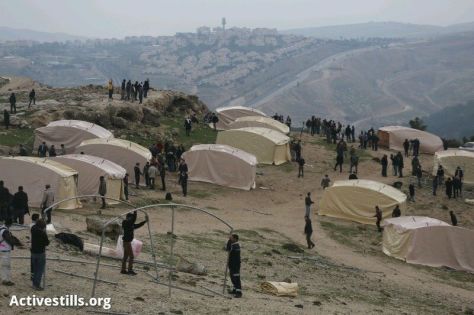
On January 11, 2013, 250 men and women from across Palestine established a new Palestinian village named “Bab Al shams” (Gate of the Sun).

They declared:

We, the sons and daughters of Palestine from all throughout the land, announce the establishment of Bab Alshams Village (Gate of the Sun). We the people, without permits from the occupation, without permission from anyone, sit here today because this is our land and it is our right to inhabit it.

A few months ago the Israeli government announced its intention to build about 4000 settlement housing units in the area Israel refers to as E1. E1 block is an area of about 13 square km that falls on confiscated Palestinian land East of Jerusalem between Ma’ale Adumim settlement, which lies on occupied West Bank Palestinian land, and Jerusalem. We will not remain silent as settlement expansion and confiscation of our land continues. Therefore we hereby establish the village of Bab Alshams to proclaim our faith in direct action and popular resistance. We declare that the village will stand steadfast until the owners of this land will get their right to build on their land.

Continue reading Israeli repression at The Gate of the Sun

Against Castration: Himika Bhattacharya and Deepti Misri

Guest post by HIMIKA BHATTACHARYA and DEEPTI MISRI

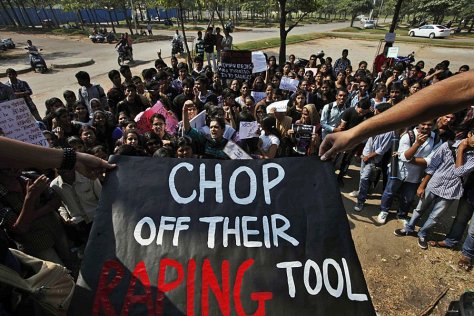
some-protestors-have-been-calling-for-rapists-to-be-castrated

The public preoccupation with both the death penalty and castration as punishment for rape continued last week, with the Pakistani activist Asma Jahangir reportedly suggesting that the rapists of the Delhi rape case be either punished with castration or else face the death penalty.[1] The consistent demand for punitive castration in India may be somewhat boosted by the Indian media reporting the following developments – last week, the South Korean court ordered Asia’s first chemical castration[2]; the Malaysian bar is pushing for castration[3] as a punishment for repeat sex offenders; and that such punishment has reportedly been long used in other countries[4]such as Germany, Denmark, and some states in the U.S. Continue reading Against Castration: Himika Bhattacharya and Deepti Misri

Engendering the Sovereignty of the Islamic Republic of Pakistan: Afiya Shehrbano Zia

Guest post by AFIYA SHEHRBANO ZIA

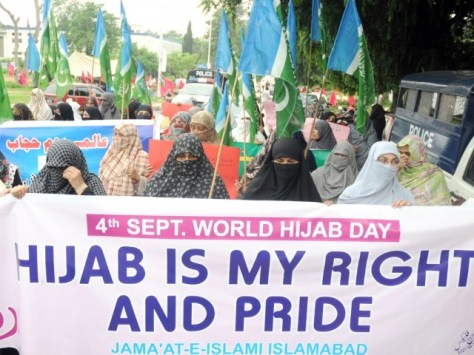
431247-zafaraslamisl-1346769071-809-640x480

The Islamia College in Karachi is the hub of the Islami Jamiat-e-Tulba (IJT) [1]. Last year, the nationalist banners displayed near the college to mark Pakistan Defense Day (6th Sept), were strategically flanked by two complementary gendered messages. One such banner publicized the event (in Urdu) as ‘Hejab Numaaish’ (Parade of the Hejab – 4th Sept) and below it, in English ran the claim ‘Hejab is My Right and Pride’. The other banner declared simply, ‘Afia[2] is our Pride’. Both messages are signifiers and comments on the re-visitation of the themes of religious and nationalist agendas, played out across the body politic of women, in a post 9/11-Pakistan.

This essay discusses the resurgence of a new form of religious nationalism and its impact on the narrative of gendered politics in Pakistan. It also examines the worth of a recent body of Pakistani scholarship[3]that opposes the misguidedness of liberal-secular resistance to religious politics. Instead, such academic work invests hope in something termed, ‘Islamist secularization’. Continue reading Engendering the Sovereignty of the Islamic Republic of Pakistan: Afiya Shehrbano Zia

Posco – Building A Better Tomorrow with Steel: Madhumita Dutta

Guest post by MADHUMITA DUTTA

11TH_POSCO_SITE_655201g

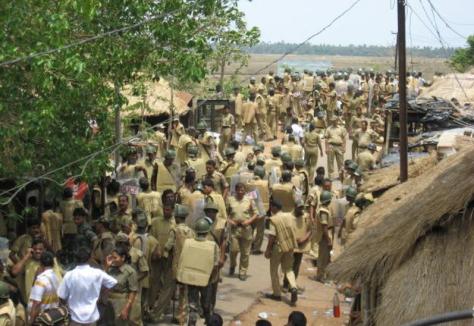
Policemen deployed at the proposed Posco site in Jagatsinghpur, June 2011

As I read the ‘sustainability-commitment’ page[1] on the website of Posco India Ltd, I was reminded of the images of a morning in a village square in the Ersama block of Jagatsingpur district in the Orissa. On April 1, 2008, Balithutha, a small village square, became the battle ground as hundreds of women, men, young and old tore down with their bare hands a 20 feet high bamboo barricade erected by the district police.  An act of defiance by people who came in hundreds, mustering whatever they had—courage, fear, rage—to battle a giant – Posco Steel company of South Korea and the state of Odisha. They came to say ‘we disagree, we oppose’ the plans to take over the lands that we have farmed for generations. That day the sound of their voices and ululations reverberated from the small village square of Balithutha to the offices of the powerful. Continue reading Posco – Building A Better Tomorrow with Steel: Madhumita Dutta

Male students, female teachers and patriarchy in the classroom: Snehlata Gupta

Guest post by SNEHLATA GUPTA

Smug patriarchal pronouncements about ‘dented and painted’ women and ‘rape in India and Bharat’ brought back to me an experience I faced in the classroom some years ago.

I teach English in grades 11 and 12 in a co-ed school in Delhi. That year I had this rather ‘difficult’ boy in class. I can’t remember now how the discussion really began. The discussion got to the point where students were talking about the amount of freedom available to girls and boys and why girls have far less ‘freedom’ than boys. It was somewhere at this point that this boy stood up (unlike the regular practice of standing to speak in the classroom, I insist students should sit and talk in my class) and stated with complete confidence that  ‘if girls dress so provocatively boys can’t help themselves.’

I remember being completely aghast at this blatant show of patriarchal arrogance. I went all hot and cold in the same moment. Continue reading Male students, female teachers and patriarchy in the classroom: Snehlata Gupta

Unlearning submission: Neha Dixit

Guest post by NEHA DIXIT

In the last fortnight, we unlearned submission. On December 16, a 23 year old girl, just on the brink of leading a socio-economically independent life was raped in a moving bus at 9.30 at night.

We saw protests, we saw outraged masses. It is the first time in the history of this nation, when people were out on the streets on the issue of gender. For more than two weeks in a row. And it continues. Figures have been thrown at us: every 20 minutes a woman is raped in India, every third victim is a child, according to the National Crime Records Bureau.

At one of these protest sites, the car parking contractor informed me that they have slashed the parking charges from 30 bucks to 10 bucks in solidarity with the girl and her family. This may be dismissed as a ‘simplistic’ contribution by those who have been accusing these protests of being ‘middle class’. But we need to hit the core, to understand the wider repercussions of the Parking contractor’s this simple act. Continue reading Unlearning submission: Neha Dixit

Dear Abhijit babu – The Society of Painted and Dented Ladies responds

Rajyasree Sen in Firstpost:

Dear Shri Abhijit Mukherjee,

I am writing to you in my capacity of  General Secretary of the Society of Painted and Dented Ladies of India. First of all, I would like to state that I was most touched that you have noticed our presence in your midst. For long, we the Painted and Dented Ladies have suffered on the fringes of society, waiting to be recognised – especially by the likes of political luminaries such as you. This honour from a sitting MP, has given me inestimable joy. Not to forget that you are our venerable president, Pranab Mukherjee’s very own son. I stand up in respect, sir.

Read the rest of this article here.

This Truth Will Never Be Televised: Saiyed Danish

Guest post by SAIYED DANISH

The death of the police constable Subhash Tomar in the middle of the anti-rape protests at India Gate is eerily reminiscent of the controversial death of Inspector Mohan Chandra during the infamous Batla House encounter in 2008.

 The post-mortem report of Constable Subhash Tomar says that he died of a heart attack which was triggered by internal injuries. The police say those injuries were the result of fatal blows given to him by the angry protestors. However, a protestor named Yogendra had earlier said on national TV that he “saw him running towards the protestors and then collapsing suddenly on his own.” Yet another controversy over the death of a police man,  with a familiar  clash of State vs People’s versions has now begun.

Continue reading This Truth Will Never Be Televised: Saiyed Danish

Men against Sexual Violence, Men for Gender Justice

Statement by Men for Gender Justice, Bangalore

Public Protest on December 30th


Men against Sexual Violence, Men for Gender Justice

As men, we are ashamed over the continuing domination of men over women!!

Women and men are Equal. Men should understand and accept this!!

Men should become responsible, humane and non-violent!!

As protesters are pouring into the streets all across the country and demanding justice for the recent brutal gang-rape of a 23 year old woman in Delhi, we as men who stand for justice and equality are ashamed, as a large section of men in our country are committing abuses against women – rape, sexual harassment, domestic violence, economic and legal discrimination.

Continue reading Men against Sexual Violence, Men for Gender Justice

Cash Transfers and UID: Essential Demands

Statement by citizens (signatures below)

We support cash transfers such as old age pensions, widow pensions, maternity entitlements and scholarships. However, we oppose the government’s plan for accelerated mass conversion of welfare schemes to UID-driven cash transfers. This plan could cause havoc and massive social exclusion. We demand the following:

1. No replacement of food with cash under the Public Distribution System. 

The PDS is a vital source of economic security and nutrition support for millions of people. It should be expanded and consolidated, not dismantled.

2. Immediate enactment of a comprehensive National Food Security Act, including universal PDS.

Instead of diverting the public’s attention with promises of mass cash transfers before the 2014 elections, the government should redeem its promise to enact a National Food Security Act (NFSA).  Continue reading Cash Transfers and UID: Essential Demands

Statement by women’s and progressive groups and individuals condemning sexual violence and opposing death penalty

On 16 December, 2012, a 23-year old woman and her friend hailed a bus at a crossing in South Delhi. In the bus, they were both brutally attacked by a group of men who claimed to be out on a ‘joy-ride’. The woman was gang raped and the man beaten up; after several hours, they were both stripped and dumped on the road. While the young woman is still in hospital, bravely battling for her life, her friend has been discharged and is helping identify the men responsible for the heinous crime.

We, the undersigned, women’s, students’ and progressive groups and concerned citizens from around the country, are outraged at this incident and, in very strong terms, condemn her gang rape and the physical and sexual assault.

As our protests spill over to the streets all across the country, our demands for justice are strengthened by knowing that there are countless others who share this anger. We assert that rape and other forms of sexual violence are not just a women’s issue, but a political one that should concern every citizen. We strongly demand that justice is done in this and all other cases and the perpetrators are punished.  Continue reading Statement by women’s and progressive groups and individuals condemning sexual violence and opposing death penalty