All posts by Nivedita Menon

Israeli repression at The Gate of the Sun

Bab-AlShams

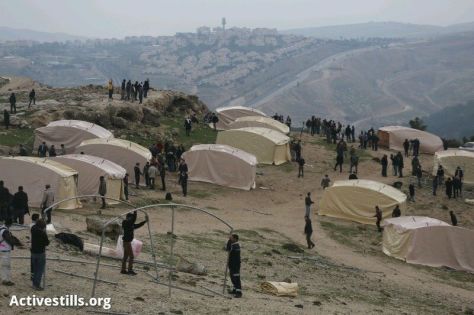
On January 11, 2013, 250 men and women from across Palestine established a new Palestinian village named “Bab Al shams” (Gate of the Sun).

They declared:

We, the sons and daughters of Palestine from all throughout the land, announce the establishment of Bab Alshams Village (Gate of the Sun). We the people, without permits from the occupation, without permission from anyone, sit here today because this is our land and it is our right to inhabit it.

A few months ago the Israeli government announced its intention to build about 4000 settlement housing units in the area Israel refers to as E1. E1 block is an area of about 13 square km that falls on confiscated Palestinian land East of Jerusalem between Ma’ale Adumim settlement, which lies on occupied West Bank Palestinian land, and Jerusalem. We will not remain silent as settlement expansion and confiscation of our land continues. Therefore we hereby establish the village of Bab Alshams to proclaim our faith in direct action and popular resistance. We declare that the village will stand steadfast until the owners of this land will get their right to build on their land.

Continue reading Israeli repression at The Gate of the Sun

Against Castration: Himika Bhattacharya and Deepti Misri

Guest post by HIMIKA BHATTACHARYA and DEEPTI MISRI

some-protestors-have-been-calling-for-rapists-to-be-castrated

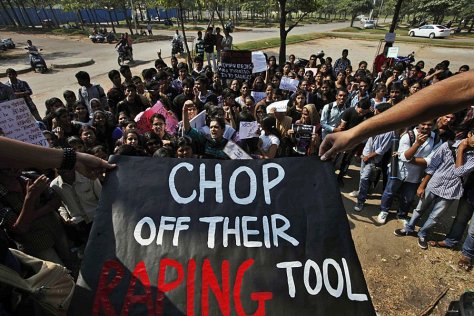
The public preoccupation with both the death penalty and castration as punishment for rape continued last week, with the Pakistani activist Asma Jahangir reportedly suggesting that the rapists of the Delhi rape case be either punished with castration or else face the death penalty.[1] The consistent demand for punitive castration in India may be somewhat boosted by the Indian media reporting the following developments – last week, the South Korean court ordered Asia’s first chemical castration[2]; the Malaysian bar is pushing for castration[3] as a punishment for repeat sex offenders; and that such punishment has reportedly been long used in other countries[4]such as Germany, Denmark, and some states in the U.S. Continue reading Against Castration: Himika Bhattacharya and Deepti Misri

Engendering the Sovereignty of the Islamic Republic of Pakistan: Afiya Shehrbano Zia

Guest post by AFIYA SHEHRBANO ZIA

431247-zafaraslamisl-1346769071-809-640x480

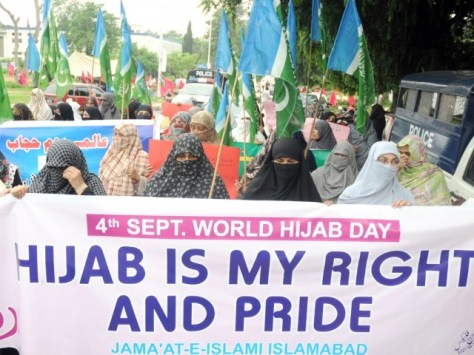
The Islamia College in Karachi is the hub of the Islami Jamiat-e-Tulba (IJT) [1]. Last year, the nationalist banners displayed near the college to mark Pakistan Defense Day (6th Sept), were strategically flanked by two complementary gendered messages. One such banner publicized the event (in Urdu) as ‘Hejab Numaaish’ (Parade of the Hejab – 4th Sept) and below it, in English ran the claim ‘Hejab is My Right and Pride’. The other banner declared simply, ‘Afia[2] is our Pride’. Both messages are signifiers and comments on the re-visitation of the themes of religious and nationalist agendas, played out across the body politic of women, in a post 9/11-Pakistan.

This essay discusses the resurgence of a new form of religious nationalism and its impact on the narrative of gendered politics in Pakistan. It also examines the worth of a recent body of Pakistani scholarship[3]that opposes the misguidedness of liberal-secular resistance to religious politics. Instead, such academic work invests hope in something termed, ‘Islamist secularization’. Continue reading Engendering the Sovereignty of the Islamic Republic of Pakistan: Afiya Shehrbano Zia

Posco – Building A Better Tomorrow with Steel: Madhumita Dutta

Guest post by MADHUMITA DUTTA

11TH_POSCO_SITE_655201g

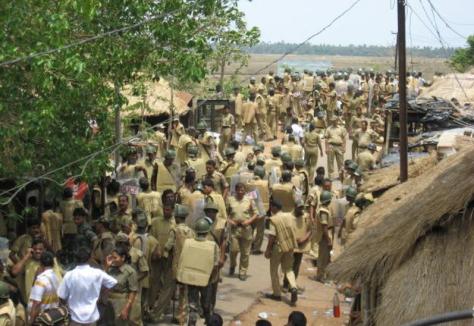
Policemen deployed at the proposed Posco site in Jagatsinghpur, June 2011

As I read the ‘sustainability-commitment’ page[1] on the website of Posco India Ltd, I was reminded of the images of a morning in a village square in the Ersama block of Jagatsingpur district in the Orissa. On April 1, 2008, Balithutha, a small village square, became the battle ground as hundreds of women, men, young and old tore down with their bare hands a 20 feet high bamboo barricade erected by the district police.  An act of defiance by people who came in hundreds, mustering whatever they had—courage, fear, rage—to battle a giant – Posco Steel company of South Korea and the state of Odisha. They came to say ‘we disagree, we oppose’ the plans to take over the lands that we have farmed for generations. That day the sound of their voices and ululations reverberated from the small village square of Balithutha to the offices of the powerful. Continue reading Posco – Building A Better Tomorrow with Steel: Madhumita Dutta

Male students, female teachers and patriarchy in the classroom: Snehlata Gupta

Guest post by SNEHLATA GUPTA

Smug patriarchal pronouncements about ‘dented and painted’ women and ‘rape in India and Bharat’ brought back to me an experience I faced in the classroom some years ago.

I teach English in grades 11 and 12 in a co-ed school in Delhi. That year I had this rather ‘difficult’ boy in class. I can’t remember now how the discussion really began. The discussion got to the point where students were talking about the amount of freedom available to girls and boys and why girls have far less ‘freedom’ than boys. It was somewhere at this point that this boy stood up (unlike the regular practice of standing to speak in the classroom, I insist students should sit and talk in my class) and stated with complete confidence that  ‘if girls dress so provocatively boys can’t help themselves.’

I remember being completely aghast at this blatant show of patriarchal arrogance. I went all hot and cold in the same moment. Continue reading Male students, female teachers and patriarchy in the classroom: Snehlata Gupta

Unlearning submission: Neha Dixit

Guest post by NEHA DIXIT

In the last fortnight, we unlearned submission. On December 16, a 23 year old girl, just on the brink of leading a socio-economically independent life was raped in a moving bus at 9.30 at night.

We saw protests, we saw outraged masses. It is the first time in the history of this nation, when people were out on the streets on the issue of gender. For more than two weeks in a row. And it continues. Figures have been thrown at us: every 20 minutes a woman is raped in India, every third victim is a child, according to the National Crime Records Bureau.

At one of these protest sites, the car parking contractor informed me that they have slashed the parking charges from 30 bucks to 10 bucks in solidarity with the girl and her family. This may be dismissed as a ‘simplistic’ contribution by those who have been accusing these protests of being ‘middle class’. But we need to hit the core, to understand the wider repercussions of the Parking contractor’s this simple act. Continue reading Unlearning submission: Neha Dixit

Dear Abhijit babu – The Society of Painted and Dented Ladies responds

Rajyasree Sen in Firstpost:

Dear Shri Abhijit Mukherjee,

I am writing to you in my capacity of  General Secretary of the Society of Painted and Dented Ladies of India. First of all, I would like to state that I was most touched that you have noticed our presence in your midst. For long, we the Painted and Dented Ladies have suffered on the fringes of society, waiting to be recognised – especially by the likes of political luminaries such as you. This honour from a sitting MP, has given me inestimable joy. Not to forget that you are our venerable president, Pranab Mukherjee’s very own son. I stand up in respect, sir.

Read the rest of this article here.

This Truth Will Never Be Televised: Saiyed Danish

Guest post by SAIYED DANISH

The death of the police constable Subhash Tomar in the middle of the anti-rape protests at India Gate is eerily reminiscent of the controversial death of Inspector Mohan Chandra during the infamous Batla House encounter in 2008.

 The post-mortem report of Constable Subhash Tomar says that he died of a heart attack which was triggered by internal injuries. The police say those injuries were the result of fatal blows given to him by the angry protestors. However, a protestor named Yogendra had earlier said on national TV that he “saw him running towards the protestors and then collapsing suddenly on his own.” Yet another controversy over the death of a police man,  with a familiar  clash of State vs People’s versions has now begun.

Continue reading This Truth Will Never Be Televised: Saiyed Danish

Men against Sexual Violence, Men for Gender Justice

Statement by Men for Gender Justice, Bangalore

Public Protest on December 30th


Men against Sexual Violence, Men for Gender Justice

As men, we are ashamed over the continuing domination of men over women!!

Women and men are Equal. Men should understand and accept this!!

Men should become responsible, humane and non-violent!!

As protesters are pouring into the streets all across the country and demanding justice for the recent brutal gang-rape of a 23 year old woman in Delhi, we as men who stand for justice and equality are ashamed, as a large section of men in our country are committing abuses against women – rape, sexual harassment, domestic violence, economic and legal discrimination.

Continue reading Men against Sexual Violence, Men for Gender Justice

Cash Transfers and UID: Essential Demands

Statement by citizens (signatures below)

We support cash transfers such as old age pensions, widow pensions, maternity entitlements and scholarships. However, we oppose the government’s plan for accelerated mass conversion of welfare schemes to UID-driven cash transfers. This plan could cause havoc and massive social exclusion. We demand the following:

1. No replacement of food with cash under the Public Distribution System. 

The PDS is a vital source of economic security and nutrition support for millions of people. It should be expanded and consolidated, not dismantled.

2. Immediate enactment of a comprehensive National Food Security Act, including universal PDS.

Instead of diverting the public’s attention with promises of mass cash transfers before the 2014 elections, the government should redeem its promise to enact a National Food Security Act (NFSA).  Continue reading Cash Transfers and UID: Essential Demands

Statement by women’s and progressive groups and individuals condemning sexual violence and opposing death penalty

On 16 December, 2012, a 23-year old woman and her friend hailed a bus at a crossing in South Delhi. In the bus, they were both brutally attacked by a group of men who claimed to be out on a ‘joy-ride’. The woman was gang raped and the man beaten up; after several hours, they were both stripped and dumped on the road. While the young woman is still in hospital, bravely battling for her life, her friend has been discharged and is helping identify the men responsible for the heinous crime.

We, the undersigned, women’s, students’ and progressive groups and concerned citizens from around the country, are outraged at this incident and, in very strong terms, condemn her gang rape and the physical and sexual assault.

As our protests spill over to the streets all across the country, our demands for justice are strengthened by knowing that there are countless others who share this anger. We assert that rape and other forms of sexual violence are not just a women’s issue, but a political one that should concern every citizen. We strongly demand that justice is done in this and all other cases and the perpetrators are punished.  Continue reading Statement by women’s and progressive groups and individuals condemning sexual violence and opposing death penalty

Rape Cultures in India: Pratiksha Baxi

Guest post by PRATIKSHA BAXI

Delhi has tolerated intolerable forms of sexual violence on women from all backgrounds in public spaces for decades. It is a public secret that women are targetted in streets, neighbourhoods, transport and workplaces routinely. There have been countless campaigns and appeals to all agencies concerned to think of safety of women as an issue of governance, planning and prevention. However, prevention of sexual violence is not something, which features in the planning and administration of the city. It is not seen as an issue for governance that extinguishes the social, economic, and political rights of all women.

 It is a public secret that rape of women in moving vehicles is popularly seen as a sport. The sexualisation of women’s bodies accompanies the projection of cars as objects of danger and adventure. Private buses now participate in this sexualisation of moving vehicles as a site of enacting pornographic violence. In this sense, safety is not seen as a commodity that can be bought, purchased or exchanged. Men consume images of a city tolerant of intolerable violence. City planners enable rapists to execute a rape schedule. Streetlights do not work. Pavements and hoarding obstruct flight. Techniques of surveillance and policing target women’s behaviour, movement, and clothing, rather than policing what men do. The city belongs to heterosexist men after all. Continue reading Rape Cultures in India: Pratiksha Baxi

“Being South African, it felt like walking into another apartheid ambush”

The 3 Wise Men blocked by Israels Apartheid Wall

The Three Wise Men blocked by Israel’s Apartheid Wall

A delegation of South African Christian Church leaders has just returned from a one-week solidarity visit to the holy cities of Bethlehem and Jerusalem in Palestine-Israel. On their return, they released this joint statement [extracts]:

“Being South African, it felt like walking into another apartheid ambush. We witnessed violations of international law on so many levels – the multiple Israeli house demolitions, the discriminatory Israeli legal system, the daily intimidation of Palestinians by the Israeli Defence Forces, the Israeli Apartheid Wall and its associated regime of restrictions on movement and access for Palestinians, the imprisonment of a large percentage of Palestinians (including children), the ongoing confiscation of Palestinian water and land, the closure of previously bustling Palestinian streets and businesses, separate pavements for Israelis and Palestinians…”

Continue reading “Being South African, it felt like walking into another apartheid ambush”

Finding Women among “Common Men”: Aradhana Sharma

Guest post by ARADHANA SHARMA

Arvind Kejriwal_new2--621x414

I have often wondered about the place of women in all the current talk about the aam aadmi. Is she included in this expansive and apparently un-gendered discourse that claims to represent every ordinary citizen? Who speaks for her and how? And what does this tell us about the gendered, dare I say patriarchal, nature of the contemporary discourse on democratic transformation?

Congress’ claims on the political symbol aside, the aam aadmi’s recent resurgence has much to do with Anna Hazare and Arvind Kejriwal. Be it the mobilizations around the RTI Act or Lokpal Bill, the Gandhian cap or Kejriwal’s new party, the aam aadmi’s durdasha and a fight for his rights are front and center in political debate today. The largely male leadership of ongoing agitations for governance reform and their critics rarely talk about women or gender concerns specifically. They assume, it seems, that women are automatically included under the common man category and therefore are spoken for each time the figure of the ordinary citizen is invoked.

So imagine my surprise, when, during an NDTV show titled “The Kejriwal School of Politics,” gender issues within governance were raised directly, if fleetingly. Continue reading Finding Women among “Common Men”: Aradhana Sharma

On Mourning and Memory: Sameer Khan

Guest Post by Sameer Khan

It was an amazing sight to see Bal Thackeray draped in the National Flag like a decorated war hero on way to his funeral among the sea of followers and curious onlookers. More surprising were the news anchors, media persons and other flag bearers of our proud democracy, singing paens and eulogies on Prime Time TV for two days. I wondered at the reason for this laudatory outpouring from the news anchors, some of whom had been, not too long ago, at the receiving end of the fury of the deceased man

As a person belonging to a minority community who grew up in Central Mumbai in the 80’s, it was extremely painful for me to listen to the news anchors as they heaped praises on the dead cartoonist. It was a shocking sight for someone who had witnessed the searing effects of the policies and the politics of the man that had targeted not only my community but many others, and had also eroded the secular and multicultural society in the city of my birth. Continue reading On Mourning and Memory: Sameer Khan

Sex, Lies and God’s Promise: Response to a Diatribe

An article titled “In Defence Of Israel” is being circulated to media-persons in India by the Spokesman of the Embassy Of Israel in Delhi. This article, published in Open magazine, was written by Jonas Moses Lustiger (a student based in Paris, who has earlier lived in India).  The article names me specifically, and refers to mine and Aditya  Nigam’s posts on Palestine in Kafila, but I was not interested in engaging with Lustiger’s largely ill-informed, propagandist and misrepresenting rant. But now that it appears we are responding directly to the Israeli state, I feel perhaps I should put some things on record.

(Our three posts on Kafila are Nakba and Sumoud, Living the Occupation and Imagining Post-Zionist Futures)

 Let me begin by stating my complete agreement with Lustiger on three of his key statements in the Open article.

First:

It is true that Israel’s current government is one of the worst it has known and most of its citizens have lost hope for peace. It is also true that Israeli society is turning more racist, intolerant and ignorant of the suffering and existence of their immediate neighbours—Palestinians. Of course, the Palestinian people have been denied many rights and have been living under precarious conditions since Israel’s 1967 occupation of the West Bank and Gaza. True, they have been repeat victims of unjustifiable violence and a large proportion of Israeli politicians deny their claim to an independent land, even as Israel threatens the viability of a Palestinian state by wielding tools of colonisation. 

Pretty much sums up our three posts on Kafila – what’s not to agree?

Second:  Continue reading Sex, Lies and God’s Promise: Response to a Diatribe

Amitabh Bachchan in Gaza

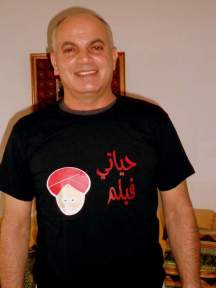
T shirt from shop in Ramallah. The Arabic text reads, “My life is an Indian film”. Photo by Sunaina Maira.

Radhika Sainath writes:

Palestinians in Gaza love Indians. They love Indian dancing, they love Indian music, they love Indian clothes. Whenever I walk out of the house, someone inevitably asks “hiyya hindeyee?” Is she Indian? ”I knew it!” they say when the response is in the affirmative. “Bheb al Hind,” I love India….

So Amitabh, Abhishek, Aishwarya, Amir, Hrithik, Kareena, Salman, Shahrukh, if you’re reading this, how about a shout out to 1.5 million of your biggest fans in the Gaza Strip? Israel has forbidden pasta, tea, cement and freedom flotillas from entering Gaza, but it hasn’t stopped Bollywood. We watch you under the Israeli drones and the F-16s, after being shot at by the Israeli navy and army while fishing, picking olives or going to school. You bring a sliver of joy to people living under the world’s longest occupation in the world’s largest prison, and for that we thank you.

Read the rest of this post by Radhika Sainath at Notes from Behind the Blockade Life: politics and nonviolent resistance inside the Gaza Strip.

We are fine in Gaza. How about you?

Palestinians carry the bodies of members of the al-Dalo family during their funeral in Gaza City. Reuters

Listen to the Palestinian singer and writer—Khaled El-Hibr sing these words on Jadaliyya:

We are fine in Gaza

How about you?

We are fine under attack

How about you?

Our martyrs are under the rubbles

Our children now living in the tents

And they ask about you

We are fine in Gaza

How about you?

Kerala Police arrest one more for hurting some feelings: Sajan Venniyoor

This just in from our Thiruvananthapuram correspondent SAJAN VENNIYOOR

Trivandrum, 21 Nov: An unnamed youth from Thiruvananthapuram was arrested by the Kerala Police cyber-crime squad for allegedly ‘liking’ a Facebook post written by a complete stranger. The Facebook account in the name of ‘Indian Patroit Who Fuking Hates Everybody’ – believed to be an alias – carried a comment that was allegedly critical of something reportedly concerning a recently deceased non-Malayali. The Facebook comment was also withdrawn soon after the arrest of the Thiruvananthapuram native under sections 505 of IPC (“promoting ill-will among groups with different imaginary friends”) and 66A of the IT Act (“causing annoyance while belonging to a minority group”).

It is not known what the offensive post said, but police sources confirm that while the comment “did not actually hurt religious sentiments in the proper sense of the word”, it jolly well hurt the feelings of people who knew someone who had some kind of  sentiments that may well have been hurt had he been alive.

In his defence, the unnamed youth submitted before the Judicial Magistrate First Class, Vanchiyoor, that he had clicked on the Facebook button only because he violently disagreed with the post, thinking it said “Yikes”.

His lawyer confirmed later that the youth, who was let off on bail, was either dyslexic or from Ulloor.

(Clarification: Some Of Us Are Actually Dyslexic and/or From Ulloor. Any offence caused is therefore to us.)

Gaza Solidarity actions in Delhi and Lucknow

Lucknow Monday, November 19, 2012

Delhi, November 19, 2012

Photographs of Delhi demonstration by Benny Kuruvilla. For more pictures, click here.

Statement of Indian feminists to Irish Parliament on abortion rights for women

About 10,000 people marched through Dublin today, many of them mothers and daughters walking side by side, holding pictures of Savita Halappanavar who died of blood poisoning in an Irish hospital after being denied an abortion. In a symbolic move, they gathered at the Garden of Remembrance dedicated to the memory of Irish freedom fighters, and walked to the parliament building with banners saying, “Never Again”, “No More Tragedies” and “Abortion Rights Now”.

As the campaign for safe and legal abortion rights for women picks up steam worldwide, Indian feminists join Irish feminists in solidarity.

Dear Elected representatives of the Irish Parliament, 

We, the undersigned, are deeply shocked at the callous treatment meted out to Savita Halappanavar who was refused a medical abortion in a hospital in Galway even though it was clear that her baby was miscarrying and had no chance of survival. We hope that the impact and serious consequences of your vote against the Medical Termination (Termination of Pregnancy in Case of Risk to Life of Pregnant Woman) Bill 2012 have fully registered with you now. 

We call upon you to show leadership and bring in legislation urgently that is in tune with the Irish Supreme Court ruling that stipulates that when a pregnant woman’s life is in danger, including from the risk of suicide, she has the right to an abortion in Ireland. We ask that you not be governed by any sentiments and opinions beyond the human right to life of Irish women. You are no doubt fully aware that women’s rights have been internationally recognized as human rights. We believe it is wrong and unjustifiable for religion to interfere with women’s ability to live full, free lives and have control of their bodies, in any part of the world.

November 21st, 2012 Endorsements to this letter are now closed.

Previous posts on abortion on kafila:

Abortion as a feminist issue – who decides, and what?

Dil Se Nahin Dimaag Se Dekho – Thoughts on Satyamev Jayate Episode 1