All posts by Nivedita Menon

Modest? Sexy? Or just an athlete?

By goddess, it’s that spot again – at once familiar and deeply uncomfortable. Us feminists in the same rage as the patriarchs and religious right, over the same damn thing. For very different reasons, we bellow (cutely), but is anybody listening?

The  Badminton World Federation has announced its new dress code that requires women players to wear skirts  “to ensure attractive presentation of badminton.” Almost every Indian woman player has objected, saying that dress should be one’s personal preference.

Of course most workplaces have dress codes.  So this is about more than simply an infringement of individual tastes. This is about the utter blatant sexism of this particular requirement. Basically, what’s the BWF saying quite shamelessly? That they expect more people to come to the sport if they can see suggestively flying skirts (on women). Even if there are shorts beneath, which they have grudgingly permitted. It’s not enough to show legs, skirts have to fly. Continue reading Modest? Sexy? Or just an athlete?

The gospel according to a divine identifier – An essay on the biblical origins of UID: Taha Mehmood

Guest post by TAHA MEHMOOD

1.

Simon Bar Jona was a fisherman based in small town called Bethaida. They say one day Simon’s brother, Andrew, led him to a man who called himself Jesus. They say Simon and Andrew became disciples of Jesus.

One day Jesus asked his disciples, “Who do you think I am?”

His disciples looked at each other. They did not know anything about him. They did not know who he was. Some disciples said Jesus was actually John the Baptist: some said he was Elijah; and others though he was Jeremias. Jesus could have been any of these or none of these. But Jesus was not satisfied with the answer, so he asked again, “Who do you think I am?”

At that point Simon Bar Jona, the fisherman answered, “Are you not Christ, the Son of the living God?’“

Jesus was pleased, he replied, “Bless you, Simon Bar Jona: for flesh and blood has not revealed it to you, but my Father who is in heaven.” Continue reading The gospel according to a divine identifier – An essay on the biblical origins of UID: Taha Mehmood

The UGC’s dictates: Pratiksha Baxi

Guest post by Pratiksha Baxi

The UGC’s new regime of qualifications, evaluation and supervision of teachers employed in universities makes fascinating reading for those who are entertained by the sublime ludicrousness of those with the power to shape our everyday lives in the academia.

The new regime betrays a lack of understanding of the basic enterprise of what academics do. The new regime is too voluminous to be read with lucidity at once. However it is not too difficult to understand immediately that the new regime, ushered in with the new pay hike, has imposed adverse conditions of employment. This is specially true for assistant professors who now are eligible for associate professorship only after 12 years of serving the University (instead of 5 years as earlier). The doctrine of reasonable and legitimate expectations  stands fully violated by the UGC, as assistant professors at the time of employment would not have expected the imposition of these adverse conditions.

The UGC has ignored the fact that the revision of pay scales cannot enforce a contract – signed or otherwise – on any faculty to adhere to the new rules since such a contract can only be constituted as un-free and therefore, not valid. In other words, better pay which was ostensibly ushered in to meet the rising cost of living cannot be conditional to the UGC’s homogenising and uncreative vision of how to enhance evaluation of teachers’ performance and determine promotions.

Continue reading The UGC’s dictates: Pratiksha Baxi

Anti-Nuclear Parliament March on 25th March, 2011

Organized by  Anti-Nuclear Struggles Solidarity Forum

Mandi House to Parliament. Assemble in front  of the Sahitya Academy Lawns at 12.00 noon.

This protest march is to state our stand that we oppose all  forms of nuclearisation of India, including nuclear (fission) power and weaponisation plans and programmes.

We further demand an immediate moratorium on all new projects, and a stringent review of existing plants by independent experts.

We demand investment in exploring sustainable alternative forms of energy.

Continue reading Anti-Nuclear Parliament March on 25th March, 2011

The evidence from Fukushima: nuclear power means nuclear catastrophe – Daniel Tanuro

Excerpts from an article by Daniel Tanuro, an eco-socialist environmentalist

What has happened is entirely predictable: yet another major nuclear “accident”. At the time of writing, it is not yet certain that it will take on the dimensions of a disaster similar to Chernobyl, but that is the direction in which things, alas, look set to evolve. But whether it develops into a major disaster or not, we are once again faced with evidence that the technology can never be 100% secure. The risks are so frightening that the conclusion is obvious: it is imperative to abandon nuclear energy, and to do so as quickly as possible. This is the first lesson of Fukushima, one which raises absolutely fundamental social and political questions, requiring a real debate throughout society about an alternative to the capitalist model of infinite growth…

Continue reading The evidence from Fukushima: nuclear power means nuclear catastrophe – Daniel Tanuro

Praful Bidwai on Lessons for India from Fukushima

Excerpts from a recent article by Praful Bidwai, journalist, social science researcher and activist on issues of human rights, the environment, global justice and peace.

The crisis holds a number of lessons for India as it embarks on a massive nuclear power expansion programme, which will double and then further triple India’s nuclear power capacity.

First, nuclear power generation is inherently hazardous. It is the only form of energy production that can lead to a catastrophic accident with long-time health damage and environmental contamination. Human error or a natural calamity can trigger a catastrophe—but only because reactors are themselves vulnerable.

Reactors are high-pressure high-temperature systems in which a high-energy fission chain-reaction is only just controlled. Nuclear reactors are both systemically complex, and internally, tightly coupled. A fault or malfunction in one sub-system gets quickly transmitted to others and gets magnified till the whole system goes into crisis mode.

Continue reading Praful Bidwai on Lessons for India from Fukushima

Compromise in Rape Cases: Whither Constitutional Morality?: Kalpana Kannabiran

Guest post by KALPANA KANNABIRAN

The Supreme Court judgement reported in some newspapers on 24 February 2011, legitimizing compromise in rape cases, is cause for serious concern.  For thirty years now human rights groups and women’s groups have fought difficult battles to have rape recognised as a serious offence both in communities and by courts.  Rights advocates have been concerned by the fact that all too often the view of the judiciary converges with the view of the community in seeing women’s sexuality as communally owned property, thus removing any articulation of violence from the crime of rape.

Some years ago, at a workshop of judicial officers, we had one senior officer arguing that if a man found guilty of raping a woman offered to marry her, this offer should be considered as a “mitigating circumstance,” and his sentence reduced to the bare minimum.  That done, since his continuing in jail will be detrimental to his new family life, he should be set at liberty under the provisions of the Probation of Offenders Act.  Fortunately in that gathering, the majority of officers, most of them junior to the officer concerned, felt strongly that this is a gross misapplication of the law.  But the existence of the possibility that a judge might actually rationalize the gross misinterpretation of a law as critical to women as this, has far reaching consequences.

Continue reading Compromise in Rape Cases: Whither Constitutional Morality?: Kalpana Kannabiran

Nukes, Wikileaks and Corruption: National Alliance of People’s Movements

Press Release by NAPM

PM Must Reveal Truth to Nation
Cancel all the Proposed Nuclear Power Plants and Related Facilities
Moratorium on Dams in High Seismic Zones

New Delhi Delhi, March 18 : Prime Minister Manmohan Singh’s statement after the nuclear disaster in Japan that there is no need to be panicky as India will take all safety measures is not only amateurish but also lacks wisdom.
His statement gives the impression that the Japanese have not taken adequate safety measures. What type of natural calamities or man made lapses are in store for us, no one can visualise or predict leave alone taking safety measures against them.

The Prime Minister who has no control over his own cabinet ministers and has unashamedly wailed in public that he was ineffective due to coalition government, and caused the nation unimaginable and unprecedented loss by allowing mind blowing scams, issuing such absurd statements like taking all safety measures- lacks any tangible weight. Continue reading Nukes, Wikileaks and Corruption: National Alliance of People’s Movements

The ‘new’ Indian filmi woman: Arpita Das

Guest post by ARPITA DAS

In these times of celebrating ‘small’ films, ‘new’ unheard-of young directors, little India, and non-filmi characterizations, it seems to have become mandatory for critics to praise every film claiming to build its  narrative around a so-called non-mainstream idea.  If this were not so, two ‘small’, ‘different’ films which created a lot of hype recently, would not have gathered as much post-release steam.  I am talking about No One Killed Jessica and Manu weds Tanu.  Both have been promoted and described in reviews as bold films, with star heroines showing a no-holds-barred temperament and verbal acumen, and this being the central focal point of their ‘different-ness’, both have made that oft-repeated Bollywood claim, ‘pikchar hatke hai’. If the films are to be believed, this new Indian woman can be instantly recognized by one or more of the following traits: smoking nicotine or other substances, mouthing expletives both in Hindi and English with ease, being sexually promiscuous or even vaguely ambivalent, manipulating people close to them without giving a thought to causing hurt, and a sound lack of any sense of ethics in the professional sphere or personal turf.

Continue reading The ‘new’ Indian filmi woman: Arpita Das

You fill up my Census…

…quipped my brother Dilip in response to the following mail from my sister Pramada:

So the bell rings this afternoon. desperate clanging. i open the door and there is a man with forms in his hand and a general irritated demeanor. figured that this was the census man. he comes in and settles down. starts by wanting to know who the head of the household is. i say there is no one. he insists. i continue to say no one.

Census of India 2011 mascot

He proceeds to explain that if the parents live in the house, then they are the head of the household, if married then the husband is. I proceed to ask for definition and say that all three of us who live in the house are head of the household since we all earn and take decisions. he promises to erase what he has written since he was sure my mother was head of household.

He seemed to find my gender a bit dubious so questioned my mother if i was a boy or a girl and then repeatedly said “ladki” to me. having established that i indeed was a woman, he wanted to know date of birth, which was not difficult, but place of birth he found extremely challenging. he could not get his spellings right, or did not know districts or states in the country so tattamangalam in palghat district in kerala was as baffling as mysore in karnataka. calcutta was easy to deal with and he said calcutta was in calcutta!!! mother tongue caused him more angst because he had to write malayalam and again the spelling eluded him.

Continue reading You fill up my Census…

The disappearing body and feminist thought

Presented at conference organized by  Department of English (Delhi University)  February 14, 2011. The title of the  conference was “Postfeminist Postmortems?  Gender, Sexualities and Multiple  Modernities”.
Cross-posted on Critical Encounters

To paraphrase Anthony Appiah’s famous and oft-quoted question – Is the post of postfeminist the post of postmortem? That is, as in postmortem, does “post” mean definitively over, after, having transcended, gone beyond? To those who would answer “yes”, those privileged young women who float through their empowered lives in the wake of over a century of feminist struggles but disown their own heritage, to them I can only say – I’ll be a post-feminist in post-patriarchy. Or – not for a long time yet, baby.

But my answer to that question is “no”. I understand the post of postfeminism in the sense that Laclau and Mouffe understand their postmarxism. That is, post-feminist as indicating “having passed through” that body of thought; having lived through, experienced, feminist theory and politics in such a way that the terrain one now inhabits has been decisively transformed; but also post-feminist in the sense that in the course of this passage new objects have been configured that the old feminism could not have seen, or recognized.

It is in this kind of postfeminist moment that I locate my presentation today.

Continue reading The disappearing body and feminist thought

Anbulla kaadu (My beloved forest): Madhumita Dutta

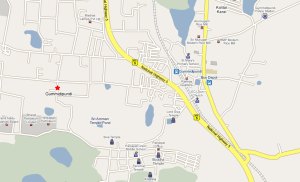
Thervoy Kandigai Industrial Complex. The Government issued orders alienating 1127 acres of poramboke land in favour of SIPCOT for formation of a new Industrial Complex in Thervoy Kandigai village of Gummidipoondi Taluk, Thiruvallur District. The land development work is in progress now.
From the website of Industries Department, Government of Tamil Nadu

What this “land development work” involves, and the price that will be paid in human and ecological costs is something that MADHUMITA DUTTA encountered recently.

“A forest that was once ours is now private, a land that was once green now stands barren, a forest where we played, where we wandered freely is now fenced, men in uniform now guard the forest which we protected for generations.”

Thervoy Kandigai. A small nondescript village in Gummidipoondi Taluk of Thiruvallur district, 50 kms north of Chennai.  Surrounded by dense shrubby forests, natural lakes, rice fields and undulating terrain with misty mountain range of Sathyavedu in Andhra as the back drop. This small dalit village of about 1000 families is in the eye of a storm.  A storm that can blow away the dreams of Tamil Nadu government to hand over hundreds of acres of land to French tyre company Michelin, a big ticketed investment worth Rs 4000 crore for the state.   Continue reading Anbulla kaadu (My beloved forest): Madhumita Dutta

JNU and the ‘sex scandal’: Aprajita Sarcar

This is a guest post by APRAJITA SARCAR

As a former JNU student, it is a pity that I have to write this post in order to draw attention to a crisis that needs urgent attention: the inability to talk about intimacy.  I say intimacy, as against sex, as against scandal, as against molestation, as against the “professionally shot” footage that made it to the front pages of newspapers.

Jawaharlal Nehru University (JNU) has a crisis to face that has been imminent for a while, and it comes from the inability to talk intimately, about intimacies. Because intimacies are distinct from rhetoric. Continue reading JNU and the ‘sex scandal’: Aprajita Sarcar

A Photo Album of Women of the Egyptian Revolution: Leil-Zahra Mortada

A photo collection by various photographers, compiled by Leil-Zahra Mortada

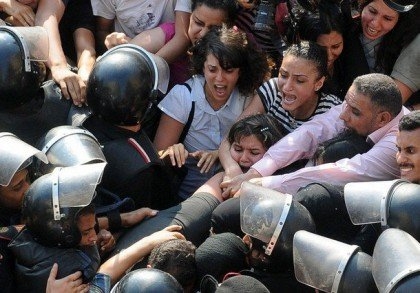
This is a homage to all those women out there fighting on the streets of Egypt, to those whose voices and faces were hidden from the public eye during the first days of the revolution! The album by now has traveled the world back and forth via online social networks, blogs and websites.
First and foremost the credit for this album goes to the courageous people of Egypt who are teaching us that freedom is taken and not given.
Second, to the women who by their courage, determination and strength are inspiring millions of us around the world.
Third to the photographers who took these photos and especially to those who have caused absolutely no problems when it came to copyright issues.


See the album and read more here

More photos from the Free Binayak Sen rally, Delhi, 30 January 2011

This slideshow requires JavaScript.

Photographs by Koyel Lahiri, Antara Rai Chowdhury, Anil Tharayath, Joe Athialy and Amrita.

Some photographs post here, earlier.

Release Binayak Sen! Repeal Section 124 A!

Pictures of the rally in Delhi yesterday, January 30th, by PRASHANT TALWAR

This slideshow requires JavaScript.

ATS Chief concedes “burst of over-enthusiasm” on part of Nagpur ATS: IAWS press release

A small victory, but heartening in these times to see what solidarity and concerted political action can achieve…
But still worrying given that ATS Chief Rakesh Maria seems to be back-tracking, if he is correctly quoted in the Mumbai Mirror yesterday (see below), which is why the IAWS has issued this press release.

(Clarification – This is a random image and not from the IAWS National Conference! But if anybody can send us some pix from the Wardha Conference, that would be great.)

Press Release dated 28 January 2011 by IAWS Continue reading ATS Chief concedes “burst of over-enthusiasm” on part of Nagpur ATS: IAWS press release

Women Struggling Against Rape in India Find the Assange Case Hard to Digest: Kavita Krishnan


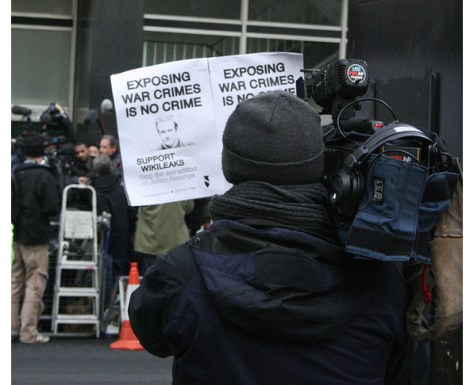
Kavita Krishnan expresses the irritation and anger of many feminists at the attempt to distract attention from the damage Wikileaks has managed to inflict on the powerful, by doubtful charges of sexual harassment against Assange, its architect:

…Certainly, from the perspective of all those women in India who find the most brutal of rapists going free, protected by the police and the state, and their most serious charges of rape trivialized or even suppressed by force, the idea of a man being hunted down by Interpol on charges which are as complex and ambiguous as those in the Assange case is disturbing…. [Full article here]

Open Letter to the Home Minister: Indian Association for Women’s Studies

Dear Mr.  Chidambaram,

We, the members of the Executive Committee of the Indian Association for Women’s Studies (IAWS), write to you in shock in the face of our recent experiences of intimidation and harassment at the hands of the Anti Terrorism Squad during the XIII National Conference of the IAWS in Wardha at the Mahatma Gandhi Antarrashtriya Hindi Vishwavidyalaya (MGAHV), from January 20-24th 2011. The IAWS (established in 1982) is an academic and professional association of nearly two thousand Women’s Studies scholars, teachers, students and activists. A National Conference is held once in three years, which deliberates on various scholarly and social concerns focussing on women’s lives in the country.  The programme included 5 plenary sessions and 10 subtheme sessions, totalling over 300 submitted papers and 19 plenary speakers.  The highest standards of excellence were demonstrated over the course of the conference. There were 750 participants from different parts of the country, including a few South Asian and other participants who had come to understand gender issues in an atmosphere of intellectual exchange and learning.  A South Asia plenary is an old practice of the IAWS—this time eminent writers and poets from Sri Lanka, Bangladesh and Pakistan spoke, for whom full clearance had been obtained from the respective Ministries.  The university authorities supported the conference throughout, including dedicated volunteers and enthusiastic students and staff. Continue reading Open Letter to the Home Minister: Indian Association for Women’s Studies

Branding Binayak: Balmurli Natrajan

Guest post by BALMURLI NATARAJAN

Writing on the history of insanity in the age of reason in seventeenth century Europe, French philosopher Michel Foucault notes: “People know what they do; frequently they know why they do what they do; but what they don’t know is what what they do does.” Foucault’s insight into the workings of power is an incitement for us to think boldly in public, sadly an endangered species in today’s India.

The recent judgment on the Guha-Sen-Sanyal case prompts one to wonder: Could state functionaries know what what they do does? Could ruling elites who watch silently or goad and guide the guardians of law and order to perform at their bidding know what what they do does? Could the state’s branding of Binayak and thousands of others as Naxalites, Maoists, terrorists or seditionists (terms that it conflates but without scholarly or legal basis) allow civil-liberties activists to create a brand Binayak? Continue reading Branding Binayak: Balmurli Natrajan

Ilina Sen harassed again. Long live the Republic!

FINAL UPDATE: Over a hundred names (113) that were received by 9 am on 27th morning have now been added. Apart from the press, the statement will be sent also to the Union Home Minister, Chief Minister of Maharashtra and Chairpersons NHRC and NCW. Final list of names now posted here.

UPDATE: Close to a hundred endorsements from all over the country have been received from academics, social activists, lawyers, film-makers, theatre persons, students, journalists and office bearers of PUCL and IAWS . This will now be sent to the press, and may be circulated widely. All names received by  3 pm are now listed at the end of the statement.


Below is a statement being circulated by some of us for endorsement. Please endorse by 3 pm tomorrow (26th January)

Continue reading Ilina Sen harassed again. Long live the Republic!