From Kafila archives:
If blasphemy is an attempt to speak truth to power, bigotry is the reverse: an attempt by power to instrumentalize truth. [Mahmood Mamdani]
See also: Citizens for Democracy

From Kafila archives:
If blasphemy is an attempt to speak truth to power, bigotry is the reverse: an attempt by power to instrumentalize truth. [Mahmood Mamdani]
See also: Citizens for Democracy

Guest post by KARTIK NAIR
Why does No One Killed Jessica open with the execution of Jessica Lal but rush so quickly to the windswept altitudes of Kargil? And why, when she first blasts on to the screen as embedded journalist Meera reporting on the war, does Rani Mukerji look more like she’s embedded inside an SNL skit on Barkha Dutt? I let out a little laugh then, but the laughs only got bigger from there. Here is a film that knows nothing about how the media works; worse, it fails to pass off its version of the media as believable. Here are a few lessons I learned watching the film:
1. Aspiring reporters will be glad to note that though journalists generally fight tooth-and-nail at press conferences to get their questions heard, a helpful “Yaar, please, mujhe poochne do!” will elicit total co-operation and rapt attention.
Continue reading Ab Bhi Dilli Dur Hain: On ‘No One Killed Jessica’: Kartik Nair

Guest post by JYOTI RAHMAN
Bangladesh will mark its 40th year of independence in 2011. The celebrations have already begun, and will continue until next December. The TV channels are already playing patriotic tunes. One such tune is Shona shona shona. The song says the land, mati, of Bangladesh is better than gold, and under this land sleeps many heroes: Rafiq, Shafiq, Barkat, Titu Mir and Isa Khan.
Who are these heroes? Rafiq, Shafiq and Barkat were killed by the Pakistani authorities during the language uprising of 1952 — a milestone moment in Bangladesh’s nationalism. Titu Mir defied the East India Company and organised a peasant revolt in the 19th century. Isa Khan was a Bengali chieftain who resisted the Mughals in the 16th century.
Notice how all of these heroes are Bengali Muslim men?
Continue reading ‘Islamic secularism’ in Bangladesh: Jyoti Rahman
 2011 marks the birth anniversary of one of Southasia’s greatest poets, Faiz Ahmed Faiz. Centenary celebrations are planned in Pakistan, India and Bangladesh throughout this year. The Southasian magazine Himal has brought out in its January 2011 issue a set of six articles on Faiz. A note accompanying the issue reads:
Over the course of human history, intellectuals and artists have helped broaden the scope of citizenship and the nebulous contours of citizen rights. Southasia is no exception. Despite its colonial past and internal fault-lines, it can boast of extraordinary individuals who have stood up against tyranny and reaffirmed the innate strength of the human spirit. Continue reading Celebrating Faiz
Guest post by MAHTAB ALAM
Ilina Sen, wife of the human rights’ activist and people’s doctor, Binayak Sen, reacting over the judgment, which gave life imprisonment to Dr. Sen said, “My faith in the judiciary has been shattered”. “I am in a state of complete shock…in our stupidity we believed the judicial process would be fair,” she told media persons at a press conference in Delhi. Continue reading Look who has faith in the judiciary!: Mahtab Alam
On January 6th, it is almost certain that a referendum in South Sudan will lead to a vote to secede from the rest of the country, thus paving the way to the formal inauguration of Africa’s 54th sovereign state. The vote comes after many years of discord between Sudan’s Arab-and-Muslim north and its black, animist and Christian south, and civil war in which almost 2m have died. Thus, divorce seems the only option in Sudan’s case. However, many in Africa, including the African Union, which has long inveighed in principle against secessionist tendencies in Africa, worry that it could set a trend that encourages other self-determination movements on the continent, potentially causing instability and worse. Others argue that the right of all peoples to self-determination must be allowed to hold good. In these terms, would the secession of South Sudan be good for Africa?
Well, you can cast your vote here.
See also: Celebrations across south as millions flock to polling stations.
Great job, Balaji Narasimhan and Jyoti Punwani.
This note comes from the JAMIA TEACHERS’ SOLIDARITY ASSOCIATION
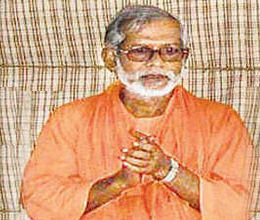
Swami Aseemanand’s confession before the metropolitan magistrate of Tees Hazari Court has finally put the seal of legal validity over what had been circulating for months now, since the surfacing of the audio tapes seized from Dayanand Pande’s laptop. That Hindutva groups had been plotting and executing a series of bomb blasts across the country—including Malegaon (2006 and 08), Samjhauta Express (2007), Ajmer Sharif (2007) and Mecca Masjid (2007).
For the past several years however, dozens of Muslim youth have been picked up, detained, tortured, chargesheeted for these blasts—with clearly no evidence, except for custodial confessions (which unlike Swami’s confessions have no legal value). Report after report has proved that the Maharashtra and Andhra police willfully refused to pursue the Hindutva angle preferring to engage in communal witch-hunt—or as in the case of Nanded blast—where the evidence was so glaring as to be unimpeachable—weakening the prosecution of these elements.
Continue reading Swami Aseemanand’s Confessions: It’s time for an apology?: JTSA
With so much talk of Hindutva terrorism (see Kafila archive), I as a Hindu want to clarify that:
And that’s only one of 115, only from one year of many years.
 …which in these dark times is so life-affirming:
I can spot a Khushwant Singh, a Khalil Gibran and a Chetan Bhagat in the pile of books. “Most of these books have been gifted to me by my lover,” she says. This is the first I’ve heard of a man in her life. I hesitate, but Sharmila is clearly keen to talk about him. A Britisher based in Kerala, he got to know about Sharmila after he read Burning Bright, a 2009 book on the Manipuri struggle written by Deepti Priya Mehrotra and published by Penguin. “He wrote me a letter after he read the book. We have been exchanging letters since then,” she says shyly. Continue reading Irom Sharmila is in love
Guest post by AMITAVA KUMAR
Till a few days ago, I hadn’t heard of Aqeel Shatir. A friend sent me a link to a report in the Indian Express on December 20 about a poet who had been asked to pay for an anti-Narendra Modi remark in his anthology, Abhi Zindaa Hoon Main (I Am Still Alive). I got in touch with the reporter, in Ahmedabad, who had filed the story and soon after that spoke on the phone with Shatir.
Aqeel Shatir is his takhallus or literary alias. The name his parents gave him was Aqeel Ahmed. His ustad offered him a choice of two pen-names. One was Aazar, which means a sculptor, someone who carves beautiful forms from marble. The other was Shatir, whose literal meaning is chess-player but denotes someone who possesses cunning. Continue reading “I Am Still Alive”: Amitava Kumar
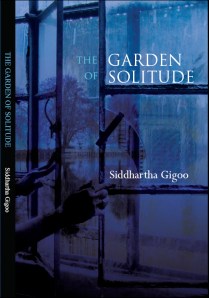 SIDDHARTHA GIGOO‘s The Garden of Solitude [Flipkart / Amazon] is the first novel in English by a Kashmiri, on Kashmir. As it starts arriving in bookstores, I am grateful to him for sharing an extract.
‘Life teaches us that there is beauty in ugliness,’ Sridar said.
Then Pamposh said something that Sridar was not prepared for.
‘Every day I lead the life of a centipede. I crawl. I lick. I hide. I sting. I wake up to the fumes of kerosene in the morning and the sting of speeding ants, feeding ravenously on the sugar spilled on the floor of the tent. It feels as if I have never had a morsel of rice for ages. I wake up hungry and go to bed hungry. I lead the life of a centipede, I crawl. All around the camp, there is stench of human excrement and waste. People wake up in the morning, hungry and muddled.
Guest post by VASANTH KANNABIRAN
Kannabiran died on 30 December 2010. As per his wishes and ours, and based on previous discussions we declared that the last rites would be simple, speedy and secular. The secular part we ensured. There were no flowers, no lamps, no mantras, no ceremonies. But the clamour for progressive “traditions” was what I found troubling in the extreme. In doing away with religious orthodoxy, all we have done is replaced it with other orthodoxies. Continue reading The Dead Need No Reification: Vasanth Kannabiran
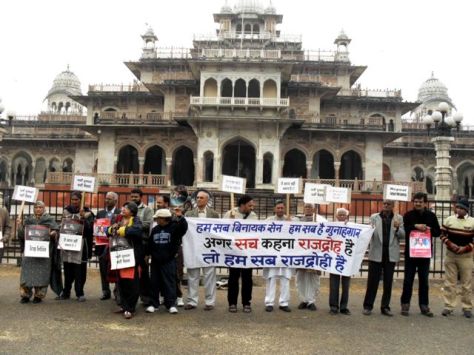
(Given below is the full text of the judgement sentencing Dr Binayak Sen for life. It is a translation from the Hindi. The translation has been done by the Free Binayak Sen Now campaign. You can download here (.pdf) the Hindi original. For updates on the Free Binayak Sen Now campaign, see BinayakSen.net. If you are on Facebook, you can join the Binayak Sen Solidarity Forum.)
Continue reading Full text: The Binayak Sen Judgement (English Translation)
Guest post by ANANT MARINGANTI

I was on my way to the Basheerbagh Press Club at 5.45 pm Thursday, December 30 when my mobile rang.
“Have you heard the news ?” I knew what that ominous question meant. But who was it?
The friend who called was one of the listed speakers at the Free Binayak Sen meeting at the Press Club where I was going. It had to be someone both of us knew intimately. “Kannabiran. I am on my way. I can pick you up,” he said quickly. Continue reading KG Kannabiran (1929-2010)
[An edited version of this article by me has appeared in the November-December 2010 issue of Conveyor, a magazine published from Srinagar.]
On 22 October 2010, there was a public seminar in Delhi, titled “Azadi: The Only Way”. I did not plan to attend it as I had important work that day. However, a day before the event, it was announced that the keynote speaker would be none other than Syed Ali Shah Geelani. How could one not go to hear what the man of the moment had to say?
I reached late, when two speakers had already spoken, Kashmiri Pandits had already created a scene, even getting into a physical fight with some Kashmiri Muslims. As I entered the precincts of the Little Theatre Group auditorium, I met Delhi University student Suvaid Yaseen who showed me a small cut in his hand, caused by the fisticuffs with the Pandits. Some of the Pandits had been taken away by the Delhi Police and detained for a few hours, many others still inside the auditorium. The auditorium was full of cries of “Hum kya chahtay? Azadi!” To hear that in central Delhi rather than Srinagar’s Lal Chowk is a little incredible. But it had happened before, on 7 August, at Jantar Mantar, the only place in the capital of the world’s largest democracy where protest is allowed. At Jantar Mantar too, Pandits were being restrained by the Delhi Police. Continue reading The Logical Urges of Sedition
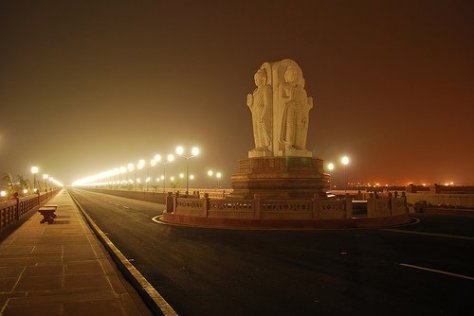
A prominent Dalit academic once told me that when a Dalit entered the seminar room, the rest of them should feel uncomfortable. Given the monumental oppression Dalits face, this should be the least consequence of Dalits getting a voice.
I am reminded of this when I think of Mayawati’s gigantic Dalit memorials that have changed Lucknow’s landscape.
This open letter by SHIV VISWANATHAN has been circulated by Communalism Combat
Dear Professor Manmohan Singh,
I hope you don’t mind the temerity of this letter. It is written as one scholar to another, one citizen to another. I know you are a PM and people like me may not be influential. However some things must be said and said clearly.
I was aghast to find that Doctor Binayak Sen has been given a life term for sedition. Let me put it simply. I think it is an appalling act of injustice and a betrayal of an ethical vision. Continue reading A Case of Conscience: Shiv Viswanathan writes to Manmohan Singh on the conviction of Binayak Sen
This note critiquing the judgement that setences Binayak Sen for life has been written by ILINIA SEN, SUDHA BHARADWAJ and KAVITA SRIVASTAVA
As you are aware the Second Additional District and Sessions Judge of Raipur Sh. B. P. Verma convicted Binayak Sen, Pijush Guha and Narayan Sanyal for rigorous life imprisonment on the 24 December, 2010. A ninety two page judgement was delivered by Judge BP Verma on the 24 December, 2010. What follows is a quick analysis of the facts of the case and the judgement that has finally been delivered. Continue reading A Critique of Binayak Sen’s Judgment
Guest post by DILIP D’SOUZA
Responding to Rahul Gandhi’s recent Wikileaked comment, Sadanand Dhume asks “What Terrorizes India?” (Wall Street Journal, December 20). It’s a good question that deserves an answer. Did Dhume answer it?
As is well known now, Gandhi said this to US Ambassador Tim Roemer last year: “The bigger threat [to India] may be the growth of radicalized Hindu groups, which create religious tensions and political confrontations with the Muslim community.” Dhume’s essay is a severe criticism of Gandhi’s comment, and in the end of the man himself. The criticism, I’m not particularly interested in: people have their varying opinions about Gandhi and that’s fine with me. But I wonder if Dhume has thought through the implication of his own title. Indeed, what does terrorize India, and Indians? Continue reading The Definition Shortchanges India
 KAFILA - COLLECTIVE EXPLORATIONS SINCE 2006