All posts by Shivam Vij

Shivam Vij is a writer and journalist based in New Delhi.

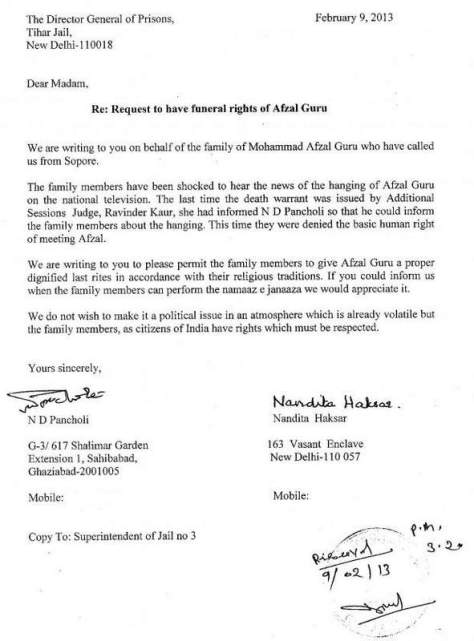
Afzal Guru’s family demands his body

Four statements on the execution of Afzal Guru

Statement from the PEOPLE’S UNION FOR CIVIL LIBERTIES

The PUCL condemns the hanging of Afzal Guru in Tihar Jail early in the morning (9.2.2013) today.

The tearing hurry with which Afzal Guru was hanged, accompanied by the flouting of all established norms by not giving his family their legal right to meet him before taking him to the gallows, clearly indicates that there were political considerations behind taking this step. More shameful is the explanation of the Home department that the wife and family of Afzal Guru were intimated of the hanging by a mail sent by Speed Post and Registered Post. Decency and humanity demanded that the Union Government give prior intimation to the family and an opportunity to meet him. Such a surreptitious action of the government also deprives the family of Afzal Guru to right to seek legal remedy.

PUCL also condemns the repressive stand of the Delhi police in not allowing a group of people who were protesting against the hanging and detaining them in police stations. We are equally concerned by reports that right-wing goons were permitted by the police to use violence against the protestors. PUCL asserts the right of citizens to dissent and express their opposition to capital punishment in a peaceful manner. Continue reading Four statements on the execution of Afzal Guru

Child sexual abuse in India: the police blames the victims

This is a press release put out by HUMAN RIGHTS WATCH on 7 February; link to full report towards the end


India: Child Sex Abuse Shielded by Silence and Neglect Police, Doctors, Courts Need to Change Policies and Mindset to Support Victims

New Delhi, February 7, 2013:  The Indian government should improve protections for children from sexual abuse as part of broader reform efforts following the gang rape and murder of a student in New Delhi in December 2012, Human Rights Watch said in a new report released today. Continue reading Child sexual abuse in India: the police blames the victims

Newslaundry ki dhulai: Kashif-ul-Huda

Guest post by KASHIF-ul-HUDA

In just a year, Newslaundry has achieved quite a following for its in-depth and hard-hitting interviews.  “Welcome to newslaundry – Sabki dhulai. You watch. We’re watching,” says the “About Us” page of this website. But the question is who will do dhulai of Newslanudry?

Newslaundry’s interview of eminent Islamic Scholar Asghar Ali Engineer makes you wonder what kind of preparation did Madhu Trehan did before doing this interview? How is this interview, asking stupid questions on the topic of women’s education, Salman Rushdie, purdah, etc., any different than idiots that play journalists on news channels? Continue reading Newslaundry ki dhulai: Kashif-ul-Huda

Theories of Oppression and another Dialogue of Cultures: Ashis Nandy

This is the text of the Ambedkar Memorial lecture delivered by ASHIS NANDY at the India International Centre on 14 April 2012, under the auspices of Ambedkar University, Delhi.

It was published in Economic and Political Weekly, July 28, 2010

Every generation likes to believe that it is living in momentous times, witnessing the death of one world and the birth of another, negotiating what pre-war Bengali writers used to grandly call yugasandhikshana, the moment when two epochs meet. This generation of Indians too believes that it is seeing such changes and even participating in them. Perhaps they are. However, I shall argue here that, along with transitions in society and politics to which they like to stand witness, there are transitions in cultures of knowledge and states of awareness of which they may be gloriously innocent. And they perhaps try to protect that innocence. The categories we deploy to construe our world images are parts of our innermost self and to disown them is to disown parts of ourselves and jeopardise our self-esteem. Even when we struggle to shed these categories, they survive like phantom limbs do in some amputees. Or perhaps they survive the way one of Freud’s three universal fantasies, the one about immortality, does. When you imagine yourself dead, you are still there, fully alive, looking at yourself as dead. Continue reading Theories of Oppression and another Dialogue of Cultures: Ashis Nandy

Life without YouTube: Haseeb Asif

Guest post by HASEEB ASIF

Graphic via Dawn
Graphic via Dawn

A young man wearing faded jeans and a t-shirt too unpleasantly tight around his middle, sits on his end in front of a laptop, weeping. The tears aren’t exactly the gushing springs of fresh grief, more the trickling of nostalgic streams. He misses his favourite website. Everything bookmarked in his browser that isn’t pornography is from that site. He contemplates an incalculable loss. Today, as many times before, he’s come home from a hard day of not doing anything at work, just wanting to lose himself in the magical world of user uploaded videos. Continue reading Life without YouTube: Haseeb Asif

On the arrest of Nilim Dutta

The Times of India reports that Nilim Dutta has been arrested by the police in Assam on charges of financial fraud and impersonation. The Indian Express reports:

“While there are now six cases registered against him in Guwahati, what we have gathered is that the Delhi Police had also registered a case against him last year,” Assam DGP J N Choudhury told The Indian Express. [Link]

Dutta announced his own arrest on Twitter some days ago, claiming the police had assaulted his family and him, and so on.

I first discovered Nilim Dutta on Twitter in July or August last year. Bodo groups in Kokrajhar and other BTAD area of Assam had killed Muslims and driven them out, many of whom still live in refugee camps there, too afraid to go home. Intellectual cover to this pogrom was being given not only by the mainstream media but also in social media by Hindutva fanatics, with the excuse that all Mulims in Assam are illegal Bangladeshi immigrants. Dutta had been tweeting against this claim, and published a rebuttal to one such claim by a Bodo IAS officer in the Indian Express.

I thus invited Dutta to write a long piece for Kafila, which was published here on 16 August. “The Myth of the Bangladeshi” became a very popular piece, initiating many discusssions and disagreements in Assam, Delhi and elsewhere. Hindutva fanatics who were unsettled by Dutta’s excellent piece in Kafila and similar pieces elsewhere, and his appearance in TV channels and so on. Now that Dutta is arrested on charges of financial fraud, these people are saying on Twitter and elsewhere that this nullifies Dutta’s claims about Muslims/’Bangladeshis’ in Assam. Continue reading On the arrest of Nilim Dutta

A rare victory for freedom of speech and expression in India

Times of India photo

In a country where freedom of speech and expression is under assault every day, where scholars and cartoonists increasingly have to regularly face the law to defend their statements and works of art,  where the government gives in to anyone and everyone demanding censorship, where the government conduct stealth censorship of online speech, finally comes a rare piece of good news.

For once the police is not asking to shut down an exhibition citing ‘law and order’ issues to appease protestors, but instead giving protection to the exhibition.

The Times of India reports: Continue reading A rare victory for freedom of speech and expression in India

A petition demanding the ‘Grand Mufti’ of Kashmir to step down

This petition has been put out by OMAR BASHIR

This is in context with your recent fatwa against the girl band Pragaash. This is less a fatwa and more a direct threat to silence young girls who have chosen for themselves a career path untrodden by women of Kashmir because of your misogynist approach. Your nefarious and illogical fatwas have caused more harm than they have done any good.

Mr Grand Mufti you have forgotten that Kashmir has a long tradition of Kashmiriyat and Kashmiriyat is an expression of solidarity and resilience regardless of religious differences. It embodies an ethos of harmony and a determination of survival of the people and their heritage. Women in music industry is nothing new in Kashmir, we have stalwarts like Raj Begum, Shameema Azad, Kailash Mehra and Mehmeet Syed singing for the past so many years. You must be aware that Raj Begum has been awarded the Padma Shri award in 2002. Continue reading A petition demanding the ‘Grand Mufti’ of Kashmir to step down

Ajmal Kasab, Tajinder Pal Singh Bagga, biryani and me

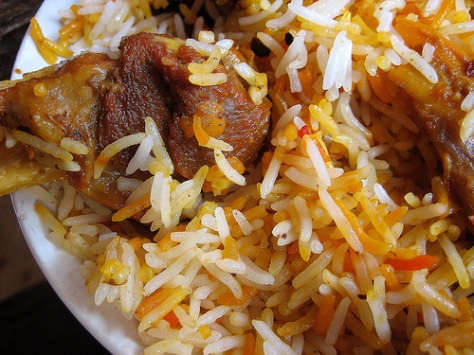
biryani-kafila

A large number of people have been asking me on Twitter over the last few days why I had signed a petition asking for Ajmal Kasab to be granted mercy and spared capital punishment. Kasab was hanged 21 November, why have all these people woken up to that petition now? That’s thanks to a belated but concerted online campaign initiated by the Tajinder Pal Singh Bagga-led Bhagat Singh Kranti Sena (BKSS), a rag-tag vigilante organisation which goes around threatening and committing violence against people it has political disagreements with. Continue reading Ajmal Kasab, Tajinder Pal Singh Bagga, biryani and me

Dear Pakistani friends, Put yourself in my shoes

I did not want to write this post.

There are enough Indian voices, from Times Now to Hindutva Online, who point fingers at Pakistan. Like M Ziauddin of the Express Tribune newspaper, I think that the two countries need more unpatriots – not people who ‘hate’ their own countries but who question their own nationalist narratives. People who ask: could we be wrong? Asking questions of yourself is difficult, and blaming the other is instant gratification of ego. Questioning yourself has long-term rewards in helping you make peace with yourself.

I am forced to write this piece because I continue to see well-meaning Pakistanis online continue to complain about the Bad Hospitality given by India to the Pakistani women’s cricket team in Cuttack in Orissa. The complainants online have included some of my Pakistani friends whom I know to be liberal, peace-loving and well-meaning, and who have clearly been influenced by some clever propaganda that is deliberately not showing them the full picture. Continue reading Dear Pakistani friends, Put yourself in my shoes

Ashis Nandy, Media and the Work of Acceleration: Anirban Gupta Nigam

Guest post by ANIRBAN GUPTA NIGAM

The hornet’s nest stirred by Ashis Nandy’s comments at the Jaipur Literature Festival might – hopefully – be dying down, but certain questions raised by the occurrences on the 26th probably require a little reflection on everyone’s part.

In the corporate and social media blitz, a lot of the details have been forgotten, excised and overlooked. Till yesterday it was not clear what his entire speech consisted of. The most quoted line from his talk at the festival is: “it is a fact that most of the corrupt come from the OBC, the Scheduled Castes and now increasingly the STs and as long as it is the case, the Indian republic will survive.” None of those attacking Nandy for being casteist or spewing hate-speech have in fact even attempted to explain the latter part of the quote: “as long as it is the case, the Indian republic will survive.” How is that a casteist statement? More importantly, media reproductions of his statement have excised a crucial disclaimer he himself gives at the beginning: “It will be an undignified, even vulgar statement, but it is a fact that most of the corrupt come from the OBC, the Scheduled Castes and now increasingly the STs and as long as it is the case, the Indian republic will survive.” Continue reading Ashis Nandy, Media and the Work of Acceleration: Anirban Gupta Nigam

Our memories come in the way of our histories: Gowhar Fazili

Guest post by GOWHAR FAZILI

Our Moon Has Blood Clots by Rahul Pandita; Pages: 258; Vintage Books, Random House, India; Price: Rs 499

Rahul Pandita’s book Our Moon Has Blood Clots must be looked at both as a personal account of suffering as well as a political project that implicitly and explicitly makes use of that suffering towards a particular end. The undertaking is a legitimate one on both counts.  What the book manages to achieve on each, warrants a fair and dispassionate assessment.

His narration of events experienced by the Pandits is a welcome exposition of subjectivity around a range of traumatic events, humiliations, killings and betrayals undergone prior to and after the outbreak of mass political rebellion in Kashmir in 1989. The events thus narrated, especially the account of the personal experiences of trauma do make one strongly identify with the suffering of the families involved and agree with the wide swathes of subjective anger and hurt shared by the community.  The chilling accounts of individual and mass killings and the circumstances that made them possible, call for collective self-reflection, remorse and atonement. This account also calls for serious reflection on the fragility of human associations and trust in exceptional circumstances that we normally take for granted.

The book as well as the promotional interviews around the book push the claim that not only certain militants but also many ordinary people, including those personally known to the victims, were responsible for the exodus through their acts of omission and commission.  This claim is substantiated through a range of indictments based on personal encounters with individuals, shared nuggets of information, as well as the interpretation of the larger political symbolism and slogans which were seen as a deliberate attempt to intimidate Pandits, and Pandits alone.  While it is difficult to deny that a number of individuals took advantage of those anarchic times to gratify personal hate and lust for loot, it makes for an overstatement to underplay the equally frequent narrative of mutual support between individuals that one gets to hear during conversations between the members of the two communities privately. Such underplay does violence to those aspects of shared memory.  Continue reading Our memories come in the way of our histories: Gowhar Fazili

Free Naveen Soorinje

This is a public statement; names of signatories given at the end.

As editors and senior journalists representing a cross-section of the print, television and online media, we wish to bring to your notice a matter of serious professional concern for the journalist fraternity.

Naveen Soorinje, a district reporter with the Kannada channel Kasturi Newz 24, was arrested by the Karnataka police on 7 November 2012 for the role he played in covering the 28 July 2012 attack by Hindutva vigilantes on innocent boys and girls who were celebrating a birthday at a homestay in Mangalore. In the two months that Naveen Soorinje has been in judicial custody in Mangalore, his mental and physical health has deteriorated drastically. He was recently discharged from the jail ward of the district hospital after suffering a bout of chickenpox. Continue reading Free Naveen Soorinje

India and Pakistan – Peace Now, a global vigil today

Events are planned today in Lahore, Delhi, Mumbai, Karachi, Cambridge MA, Washington DC, New York and Toronto to observe a vigil for India-Pakistan peace. More details given at this Facebook page. Event created by SAMIR GUPTA and disseminated by Aman ki Asha. Given below is a statement.

India – Pakistan Peace Now – Global Vigil

January 27, 2013

Lahore – Lahore Press Club, Shimla Pihari at 6 pm
Mumbai – Gateway of India 7 pm
Delhi – Gandhi Peace Foundation 5:30 pm
Karachi – Karachi Press Club, 5:30pm
Cambridge, MA – Harvard Square Pit, 4-5 pm
Washington, DC – Chutney Restaurant, Springfield, Virginia, 6 p.m
New York – Near Gandhi statue at Union Square, 5 pm
Toronto – 365 Bloor St. East, outside Indian Consulate, 5 pm

The hate mongers have had their moment of fame. It’s time to tell the political leadership of India and Pakistan what we stand for. We, peace-mongers around the world, are gathering on January 27, 2013, in different cities as part of a series of peace events. All we have is some candles, some placards and many hearts full of love. We want the governments of India and Pakistan know that people in dozens of cities across six continents want them to continue the dialogue and take forward the peace process. Continue reading India and Pakistan – Peace Now, a global vigil today

Why the Parliament should reject the standing committee’s recommendations on the Food Security Bill: RTFC

This statement was put out by the RIGHT TO FOOD CAMPAIGN on 24 January

The much awaited recommendations of the Standing Committee on Food, Consumer Affairs and Public Distribution on the National Food Security Bill are a letdown to those who wrote to the Committee urging it to ensure justice to the people of India.  The Committee despite taking a year since December 2011 when the Bill was tabled in the Lok Sabha, has undermined the goal of food security for all the people of India through its recommendations given to the Parliament on 17 January, 2013. Instead of moving forward, the Committee’s recommendations are a leap backward by removing even existing entitlements. If the Committee’s recommendations are to be legislated, then it is the Campaign’s reasoned position that it rather not have a food security law rather than accept one which: Continue reading Why the Parliament should reject the standing committee’s recommendations on the Food Security Bill: RTFC

On Hindutva terrorism

This joint public statement, signed by 34 citizens whose names are given at the end, was put out on 25 January

Swami Aseemanand (second from right): Terrorist?

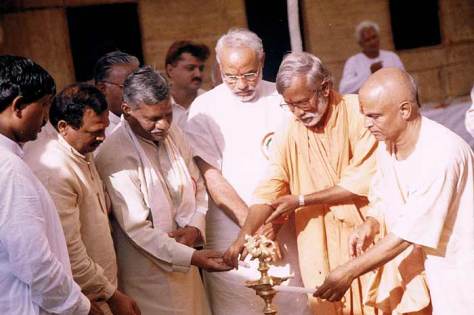
While one may or may not agree with the terminology employed by the Home Minister in his recent speech at Jaipur, we feel that for long prejudice has ruled investigations, obscuring the role of organizations and their multiple affiliates in planning and executing of attacks and bombings in the country. The veneer of ‘nationalism’ — narrow, exclusionary and based on hatred for minorities as it is– cannot hide the violence that Sangh and its affiliates beget and peddle.  Continue reading On Hindutva terrorism

PUCL Rajasthan condemns FIR against Ashis Nandy

This release was put out by the Rajasthan unit of the PEOPLE’S UNION FOR CIVIL LIBERTIES on 26 January

PUCL condemns the FIR lodged under sec. 506 IPC, criminal intimidation and 3-1(10) of prevention of atrocities against SC,ST 1989 against Prof. Ashis Nandy for his statements in a discussion at the Jaipur Literature Festival 2013 and the protest demanding his arrest.

From the reports we have received, he was not exhorting hate and not being casteist and was only making an academic point which means that nobody is free from corruption.

Proceeding criminally against him and arresting him is restricting academic freedom and academic debate. Now that he has apologised and regretted  what he has said the matter should be closed.

Prem Krishan Sharma, President
Kavita Srivastav, General Secretary

See also: Most of the corrupt come from SC/ST, OBCs: Ashis Nandy
Below: Video report from CNN-IBN and ABP TV video of Nandy’s press conference Continue reading PUCL Rajasthan condemns FIR against Ashis Nandy

The Justice JS Verma committee report

For a summary with commentary, see this guest post by Arvind Narrain.

A visit to the abode of Guru Nanak: Shiraz Hassan

Guest post by SHIRAZ HASSAN

This slideshow requires JavaScript.


Photographs by Shiraz Hassan

You can divide a piece of land but you cannot divide a belief. This was my first impression when I reached Kartarpur, a historic and sacred place, located just three kilometres away from the Indian border in the north-eastern city of Narowal, in Pakistani Punjab.

My journey started from Lahore and it was one of the most exciting journeys of my life. As I travelled, I saw  lush green rice fields on either side,and wondered why I had undertaken this journey. It was only when I reached Kartarpur that I got the answer. Continue reading A visit to the abode of Guru Nanak: Shiraz Hassan

On the Karnataka Police’s charges against KK Shahina: IFJ

This release was put out by the INTERNATIONAL FEDERATION OF JOURNALISTS on 15 January 2012

The International Federation of Journalists (IFJ) is extremely concerned to learn of the criminal charges filed against investigative reporter K.K. Shahina by police in the southern Indian state of Karnataka.

Shahina, who currently works with the weekly magazine Open, faces charges under various sections of the Indian Penal Code, including criminal conspiracy and intimidation of witnesses with intent to commit a crime. The chargesheet filed in the sessions court in the district of Kodagu in Karnataka state, also indicts her under sections of the Unlawful Activities (Prevention) Act, which is most commonly invoked to deal with terrorist offences.

These charges stem from a story published under Shahina’s byline in the weekly magazine Tehelka in December 2010, which appeared to cast doubt on the prosecution of a prominent Islamic cleric and political figure on terrorism charges. Continue reading On the Karnataka Police’s charges against KK Shahina: IFJ