
Lahore-based journalist-singer ALI AFTAB SAEED explains how we can classify news into three kinds, and how doing so helps us make better sense of the world. He says at the end this is true not just of Pakistan – indeed, this is a very useful classification to understand the Indian medial landscape as well!
All posts by Shivam Vij
Let’s Meet – On Ajay Bharadwaj’s ‘Milange Babey Ratan De Mele Te’: Virinder S Kalra
Guest post by VIRINDER S KALRA
Milange Babey Ratan De Mele Te (Let’s Meet At Baba Ratan’s Fair); Length: 95 minutes, Year 2012; Directed and Produced by Ajay Bhardwaj
Ajay Bhardwaj’s third documentary film based in East Punjab, India, takes us into a deeper exploration of some of the themes touched upon in his previous works: Kitte Mil Ve Mahi and Rabba Hun Ke Kariye. Indeed, at one level Milange Babe Ratan De Mele Te is about a journey of an impossible return to a pre-Partition Punjab in which religious identity was fluid and the sacred and profane intermingled and fused. Continue reading Let’s Meet – On Ajay Bharadwaj’s ‘Milange Babey Ratan De Mele Te’: Virinder S Kalra
This Troll Has a Very Long Nose
 Ironically, the random arrest of people for tweets or Facebook postings made some of us happy—happy that, at last, citizens have started showing concern about internet censorship. But lock-up gates had to clang at night on the faces of a few people before we realised that, in our pompous democracy, the might of the state is Ctrl-Alt-Deleting opinion with such serious zeal. The arrests have been made under Section 66A of the Information Technology (Amendment) Act, 2008, notified in October 2009. This section makes punishable with up to three years’ imprisonment anything that is perceived as “grossly offensive” but does not set out the parameters of how to decide on that—even if we were to believe that could at all be done. Questions about these arrests are deflected: the government blames the police, the police says a vague law is the problem, and those who file the complaints that lead to such arrests say that they are free to seek enforcement of an existing law.
Anyone can see that the section is not designed to nudge a case towards a conviction verdict. It is designed only to harass. Arrests, courtwork, bail. You are ground down, but the government spokesman is able to say, “The law is taking its own course.” The implication: “Aren’t you grateful you have obtained bail?” But the recent arrests have caused outrage. Taking up a PIL against the section, the Supreme Court had said in December that had it not been filed, it would have taken up the matter anyway. Despite this, the government defended the section in the Rajya Sabha, refusing to repeal it and merely adding guidelines that such arrests should be made by an officer of a higher rank—as if that would make it better.
Read more, here.
In Multiples of Ten Ravanas
Some (more) thoughts on Indian and Pakistani soldiers beheading each other at the ceasefire line in Jammu & Kashmir
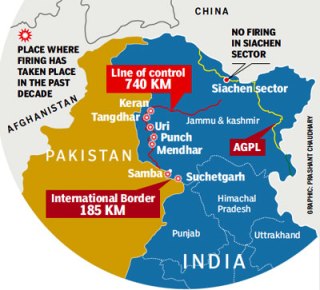
In the early hours of 10 January 2013, I published a post here that asked, “Was an Indian soldier decapitated at the Line of Control or not?” Soon thereafter, the family of Lance Naik Hemraj Singh of 13 Rajputana Rifles cremated his body and went on a hunger strike, demanding the government get the head. Several readers commented that now that it was clear a beheading did take place, I owe them an apology. I do not see why I owe them such an apology considering I never said that an Indian soldier wasnot beheaded. I only pointed to the conflicting reports, the absence of official mention about whether or not a soldier was beheaded, a quoted a Reuters report that categorically said that according to the official spokesperson of the Northern Command, no soldier was beheaded, though the two soldiers’ bodies were mutilated. Despite such an official denial quoted in a trusted news source, I had written, “It is possible the anonymous sources are right, because this is not the first time both sides are blaming each other of showing disrespect to bodies of dead soldiers in violation of the Geneva convention.” Continue reading In Multiples of Ten Ravanas
An open letter to Madhu Purnima Kishwar: Zahir Janmohamed
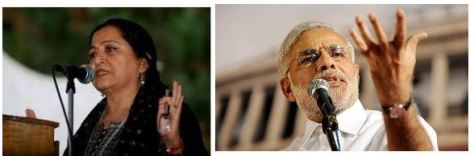
Dear Madhu ji,
I was very excited when I learned you were coming to Ahmedabad and I was honoured that you expressed interest in possibly meeting with me.
I was sitting with a journalist friend when I read your Tweet about visiting Ahmedabad and he told me you are a “pioneering feminist who did ground breaking work.” He also told me that in 2005 you signed a very strong petition calling for Gujarat Chief Minister Narendra Modi’s dismissal because of Modi’s role in the 2002 Gujarat riots. He also added that you have been very vocal on behalf of Kashmiri Pandits. After I witnessed the Gujarat riots in 2002, I returned to the United States—where I was born and raised—and I gave lectures for six months about the violence I saw. In each lecture, an audience member would inevitably shout at me that I have ignored the plight of the Kashmiri Pandits. It is true. I know very little about Kashmir, and for that matter Kashmiri Pandits, and I would have enjoyed and benefited from listening to your views on the conflict there.
I understand from your Twitter feed that you have left Ahmedabad. I know your days in Ahmedabad were limited and I fully understand that you were not able to meet. Therefore in this letter I will try to convey some of the things I had hoped to tell you in person, in particular about your Tweets. Continue reading An open letter to Madhu Purnima Kishwar: Zahir Janmohamed
A petition to end tensions at the Line of Control from citizens on both sides of the LoC
Signatures given at the end. Should you want to add your signature to this petition, write to Anuradha Bhasin at anusaba[at]gmail[dot[com]. The petition with the final list of signatories will be sent to the heads of state in both India and Pakistan.
To,
Indian Prime Minister Manmohan Singh and Pakistan President Asif Ali Zardari,
Dear Sirs,
We, the people of Jammu and Kashmir on both sides of the Line of Control, have been observing with great concern the escalation of tensions at the LoC that have been building up gradually since June 2012 and have suddenly taken an ugly turn since the first week of January, 2013.
We express grave concern at the loss of lives of the soldiers and any casualties to civilians on both the sides. At the same time, we are also concerned about the safety and security of the people of Jammu and Kashmir, particularly the people living at the borders, who are directly hit by sporadic incidents of shelling and firing. Continue reading A petition to end tensions at the Line of Control from citizens on both sides of the LoC
Suran: A poem by Uzair
This guest post is a poem by UZAIR, who grew up near the Indian side of the ‘Line of Control’ in Poonch
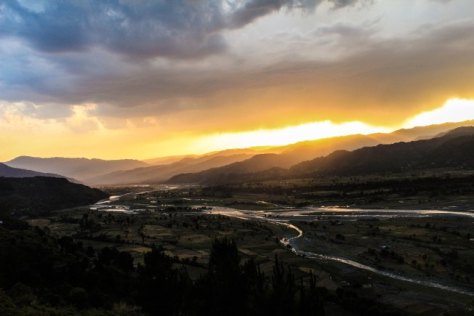
The river carries with it
Snow of distant peaks,
Floating memories
Twigs, leaves.
Only a few miles west
it would be stripped
at the border, asked
to produce a permit,
shot dead or may be not.
Waters were negotiated upon;
so the river travels seamlessly
only a few miles west
to another country.
On its bank, I heard
a cuckoo speak
“The sun shines during day
and stars illuminate the night sky
even across the border”
“And a few collect the twigs
like memories of childhood;”
“smell of dead wood, so familiar
grief and longing, so natural
decades of hope; still alive,
even across the border”
One day the river would flow
eastwards, said the old man
whose corpse floated across,
only a few miles west
and met his children
across the border.
(Uzair blogs at Untitled Untitled.)
See also:
Was an Indian soldier decapitated at the Line of Control or not?
*
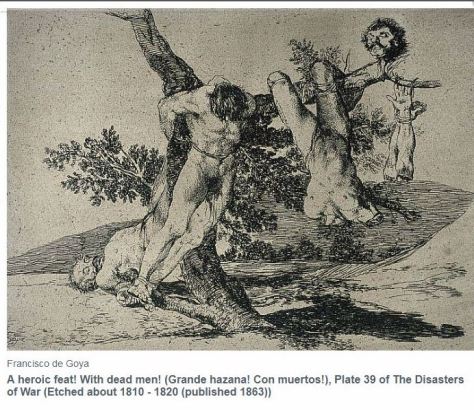
In a skirmish on the Line of Control on Tuesday, 8 January 2013, did Pakistani soldiers behead an Indian soldier or did they not? Or did they behead two soldiers and take away the head of one of them? Or did they behead one and slit the throat of another? Reports in the Indian media have left me utterly confused. I’ll let you decide. Continue reading Was an Indian soldier decapitated at the Line of Control or not?
Indians and Pakistanis Condemn Exchange of Fire and Killings on LoC
List of signatories from both countries given at the end.
We, the undersigned Indians & Pakistanis, are deeply disturbed with the recent exchange of firings and killing of two Indian and one Pakistani soldier across the Line of Control (LoC). The incidence as reported is highly deplorable and no sane person or society can accept such unwarranted and gruesome incidences. The said incidences have a potential to derail the ongoing peace process that has shown remarkable progress in recent times in easing the visa regime, improving trade relations and securing many other confidence building measures that hold great promise for both the countries.
We are happy that the Director Generals of Military Operations (DGMOs) of both countries have spoken to each other after the incidents. We urge that suitable mechanisms must be evolved and implemented immediately to ensure that the concerned authorities on both sides are in constant touch to avert recurrence of any such incidence rather than meet after some damage is done. Continue reading Indians and Pakistanis Condemn Exchange of Fire and Killings on LoC
Now that Owaisi is in jail, how about Praveen Togadia?: Mahtab Alam
Guest post by MAHTAB ALAM
Akbaruddin Owaisi, an MLA of Andhra Pradesh Legislative Assembly, who belongs to a Hyderabad-based political party All India Majlis-e-Ittihad al-Muslimin, better known as MIM, and its floor leader in the Assembly made an inflammatory speech against Hindus on 24 December 2012 at a public meeting in Adilabad District. The speech attracted widespread condemnation by Muslim activists, rightly so, apart from left, liberal individuals and organizations. Dr. Zafarul Islam Khan, President, All India Muslim Majlis e Mushawarat (AIMMM), an umbrella body of prominent Indian Muslim organizations termed it ‘a hate and rash speech’ arguing, ‘words that should never have been uttered by a responsible person, let alone a political leader, were used’.
Shabnam Hashmi, a prominent social activist and who has been relentlessly working on the issue of minority rights registered an FIR in Delhi against Owaisi stating, ‘the whole speech is highly objectionable, inflammatory and against the values of our constitution, democracy and secular values’. Similarly, FIRs were also registered in the State invoking section 295 A (for deliberate and malicious acts intended to outrage religious feelings) and 153 A (promoting enmity between different groups) of Indian Penal Code (IPC). Owaisi was arrested finally arrested on Tuesday (8th January) and sent to 14-day judicial custody. Continue reading Now that Owaisi is in jail, how about Praveen Togadia?: Mahtab Alam
The muezzin’s last call at Babri Masjid: Krishna Jha and Dhirendra K Jha
This guest post by KRISHNA JHA and DHIRENDRA K JHA is an excerpt from their book, Ayodhya: The Dark Night, about the original Ayodhya conspiracy of 22 December 1949
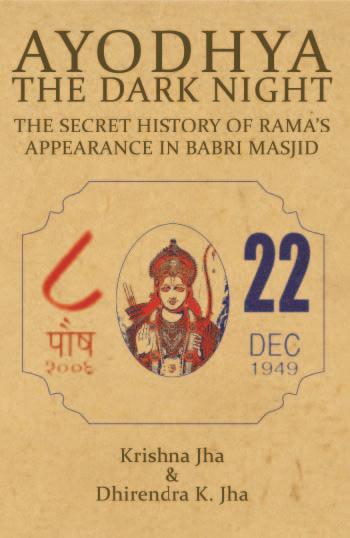
The sound of a thud reverberated through the medieval precincts of the Babri Masjid like that of a powerful drum and jolted Muhammad Ismael, the muezzin, out of his deep slumber. He sat up, confused and scared, since the course of events outside the mosque for the last couple of weeks had not been very reassuring. For a few moments, the muezzin waited, standing still in a dark corner of the mosque, studying the shadows the way a child stares at the box-front illustration of a jigsaw puzzle before trying to join the pieces together. Continue reading The muezzin’s last call at Babri Masjid: Krishna Jha and Dhirendra K Jha
You were amongst those six; un chhay main tum bhi shamil thay: Swaang Songs
This song in memory of the unknown citizen is produced by Swaang, a Bombay based cultural group, whose members include actors, writers, music directors, musicians and producers “all in the grips of the market-driven Bombay film industry, but whose hearts continue to pull towards progressive politics!”
Composer – Rohit Sharma
Lyrics – Ravinder Randhawa
Singers – Rohit Sharma, Pankaj Badra, Pinky
Narration – Pravishi Das, Ravinder Randhawa
English translation of ‘Maa Nee Meri’
Mixed in every morsel,
What was that chant you kept repeating?
In the garb of concern and worry,
Why was fear the only virtue I learnt of your teaching?
Mother, I will not fear
Mother, I will not become you. Continue reading You were amongst those six; un chhay main tum bhi shamil thay: Swaang Songs
A review of human rights in Jammu & Kashmir in 2012: JKCCS
This brief has been put out by the JAMMU AND KASHMIR COALITION OF CIVIL SOCIETY
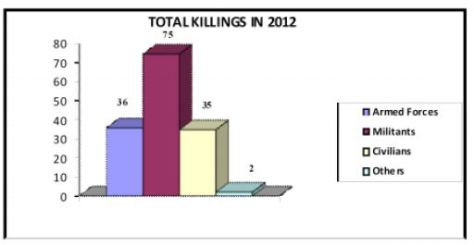
TOTAL KILLINGS
The year 2012 has just passed, and yet again like previous years, the government of Jammu and Kashmir has disgracefully claimed the year to be peaceful. This hyped peace is void of justice & peace and is packed with violence & injustice. In the year 2012 the people of Jammu and Kashmir in routine have witnessed unabated violence, human rights abuses, denial of civil and political rights, absence of mechanisms of justice, heightened militarization and surveillance. The figures of violent incidents suggest that 2012 as usual has been the year of loss, victimization, lies, mourning and pain for the people. Continue reading A review of human rights in Jammu & Kashmir in 2012: JKCCS
Notes from a bachelorette party in New India: Swathi Sukumar
Guest post by SWATHI SUKUMAR
Last week, I went to a bachelorette party. The party props were unbelievable to the point of being ridiculous—shot-glasses shaped like body parts, kinky trinkets, balloons in unmentionable shapes and sizes—and other items that would have made many women of another generation collapse in horror.
At the end of the party, everyone was slightly drunk and a good deal of time had been spent asking the bride-to-be embarrassing questions and cracking dirty jokes. I realized that our revelry had a close parallel in the cult classic “The Hangover”, a story of four men who go to Las Vegas to celebrate a very eventful bachelor’s party. Our party shared common themes from the script of the movie, including inebriation and the obsession with bodies, both perfect and imperfect. We missed the tiger and the stripper from the movie, but I am told that strippers are a very common feature in bachelorette parties in India.
Tigers are not common, I hope. Continue reading Notes from a bachelorette party in New India: Swathi Sukumar
The epiphanic moment of the lathi charge
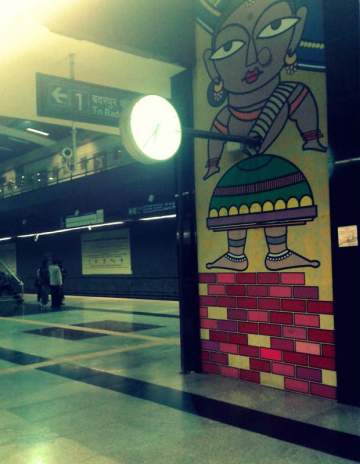
The girl wasn’t aware that the Udyog Bhavan Metro station in central Delhi had been shut down. In the Metro going to Gurgaon, she needed to get down at Udyog Bhavan. Her friend was waiting in a car outside the station. She waited at the door. The train stopped too, but the gates didn’t open. The PA system — the annoying PA system of the Delhi Metro that never stops saying something or the other — fell silent. The station was deserted. Not a soul in sight.
The girl asked fellow passengers — all of us men around her — which would be the nearest station that would be open. All the options were far off. Ramakrishna Ashram station on one end, for instance, was four kms. away. “Now what?” the girl asked her friend on the phone in a tone that blamed him, in a way only lovers can. “Now what?” she kept repeating. Continue reading The epiphanic moment of the lathi charge
Your rapists and ours
Two interesting articles:
Emer O’Toole in the Guardian CiF:
There’s something uncomfortably neocolonial about the way the Delhi gang-rape and subsequent death of the woman now known as Damini is being handled in the UK and US media. While India’s civil and political spheres are alight with protest and demands for changes to the country’s culture of sexual violence, commentators here are using the event to simultaneously demonise Indian society, lionise our own, and minimise the enormity of western rape culture. [Full article]
And Ananth Krishnan in The Hindu:
The rape case was one of the most discussed topics in Chinese microblogs over the past week, prompting thousands of posts and comments. By Sunday, however, the authorities appeared to move to limit the debate: on Monday, a search for the topic triggered a message on Sina Weibo – a popular Twitter-equivalent used by more than 300 million people – saying the results could not be displayed according to regulations. The message is usually seen as an indicator of a topic being censored by the authorities. [Full article]
The things you learn at a protest: Aakshi Magazine
Guest post by AAKSHI MAGAZINE
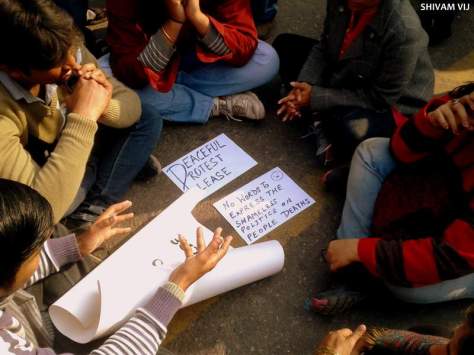
She was sitting among a group of young men and women at Jantar Mantar, shouting “Hang those bastards.” When the slogan lost its effectiveness, it turned to “We want Justice,” “Inquilab Zindabad,” and then “Bharat Mata ki Jai”. Borrowed and heard slogans, but they came from a very real place. “I work in Saket but live in Dwarka.” That is a long distance to travel especially at night. She nodded. “I don’t like it when my parents tell me to come home early just because other people are at fault,” she said anger rising in her voice. She didn’t know any of the people in the group she was sitting with. “We just met here. I had come with a friend who I can’t locate at the moment.” Continue reading The things you learn at a protest: Aakshi Magazine
For Anonymous: Nilanjana Roy
Guest post by NILANJANA ROY
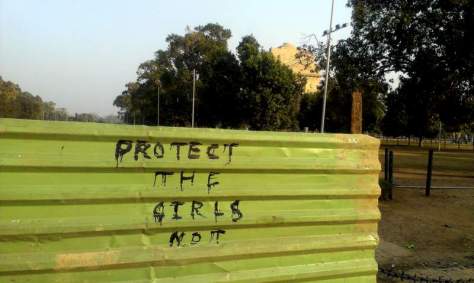
That girl, the one without the name. The one just like us. The one whose battered body stood for all the anonymous women in this country whose rapes and deaths are a footnote in the left-hand column of the newspaper.
Sometimes, when we talk about the history of women in India, we speak in shorthand. The Mathura rape case. The Vishaka guidelines. The Bhanwari Devi case, the Suryanelli affair, the Soni Sori allegations, the business at Kunan Pushpora. Each of these, the names of women and places, mapping a geography of pain; unspeakable damage inflicted on women’s bodies, on the map of India, where you can, if you want, create a constantly updating map of violence against women. Continue reading For Anonymous: Nilanjana Roy
Hope
Some images from Jantar Mantar today.
A Day in the Life of a Sikh Prejudice: Pukhraj Singh
Guest post by PUKHRAJ SINGH
Part I
“The very ink with which history is written,” allegorised Mark Twain, “is merely fluid prejudice.” By that rationale, religion can often be the quill which defaces the truth with its broad strokes, perverting history than promulgating it. And like the bastard child of these perversions, a few counter-narratives manage to wade through the tides of public opinion, carrying the dim outline of the ossified ideas that led to its tragic pursuit. But one has to have the right kind of eyes, says Hunter S. Thompson, to “see the high-water mark—that place where the wave finally broke and rolled back.”
A similar, horrid apparition of truth opened the floodgates of memories and angst very recently as a headline screamed through the Twitterverse—40 Sikhs Convert to Christianity in a Tarn Taran District Village: Gurdwara Management’s Treatment of “Low Caste” Sikhs Calls for Strict Action—in the particularly sultry month of August. Continue reading A Day in the Life of a Sikh Prejudice: Pukhraj Singh
Seeing Pakistan from Juhapura: Zahir Janmohamed
Guest post by ZAHIR JANMOHAMED
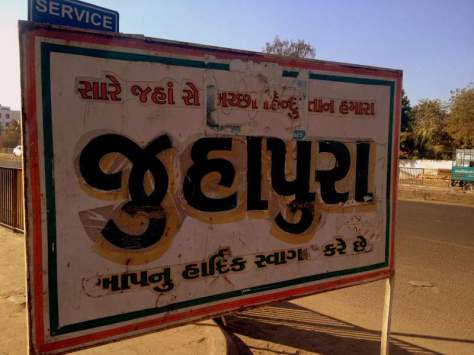
Since I started conducting research in March 2011 about the aftermath of the 2002 Gujarat riots, I have learned that the worst way to begin a conversation with a Muslim here in Ahmedabad is to ask about the 2002 riots. I was an eye-witness to the riots in 2002 and I thought my experiences might make some Muslims in Gujarat feel more comfortable speaking with me. I was wrong.
Sometimes I had to interview a person four or five times before they felt comfortable speaking about the 2002 riots. The reasons are varied. Some feel there is no use speaking about the riots as they know justice will never come under Narendra Modi’s watch. Others feel exploited by NGOs and Islamic groups who have used their stories to raise funds for their organizations abroad. And others, as one rape survivor told me, do not want to “relive the trauma.”
But if you ask Muslims in Ahmedabad about Pakistan, chances are you will walk home with a notebook full of comments. Earlier this week I went around my neighborhood of Juhapura—an area pejoratively known as “mini Pakistan”—and asked residents for their comments on Pakistan. The answers are telling. Continue reading Seeing Pakistan from Juhapura: Zahir Janmohamed
 KAFILA - COLLECTIVE EXPLORATIONS SINCE 2006