
This is the second post in the series that I began in October. I want to thank Rasagy Sharma for prompting me to put down the second post in this series.
This evening, Rasagy raised a question on twitter about whether the effort of a developer to make the database of the Indian railways downloadable is ‘official’ or not? As Rasagy later explained, the downloadable database is a list of trains, stations and the railway timetable. This list has has been made available in various downloadable formats (such as .csv, .pdf, etc) to encourage developers/interested persons to make web/mobile based applications. Rasagy’s question was more in the nature of checking the legality of the act of putting this information/database on another website when it is explicitly copyright of the Indian Railways (as declared on their website). He argued that cities such as New York and some countries across the world have made this information ‘open’, meaning available to the ‘public’. Hence, it is unreasonable for this government entity i.e., the Indian railways, to be ‘closed’ about reuse of this information by private entities and individuals.
Continue reading When Openness is Unfreedom (alternatively, when data is unfreedom) – Part II
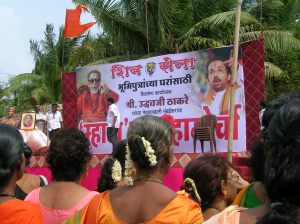 I was moving around Mumbai city on that weekend, mainly in the western suburbs. Several posters and banners were put up all over, announcing a call to a mass rally by Shiv Sena chief Uddhav Thackeray. Thackeray’s clarion call for that meeting was: “Housing for the bhoomiputra“. Bhoomiputra literally means son of the land. On an overt reading of the poster and slogan, one could conclude that the Sena is back to its advocacy of the sons of the soil theory which originally raised it to prominence in the 1960s. But when I attended the rally and noticed the people who attended it, I asked myself, so who exactly is this son of the soil that the Sena is talking about? Is it the Marathi manoos, the local underdog who the Sena argues has no social and economic space in his/her own city? If it is truly the Marathi manoos, then how do I interpret the presence of North Indian women, Bohra muslim women, perhaps even Dalit women, and many other women who I tried to mark but could not classify as either Hindu or Christian or any other particular else. Hmmm ….
  KAFILA - COLLECTIVE EXPLORATIONS SINCE 2006