Category Archives: Bad ideas

Before We Tape Our Mouths Forever…

It’s always better to begin with a caveat. Sets the tone, and prepares readers for what not to expect. I am one of those self-obsessed people who seldom see beyond their existence. I google my name twice a week, and inevitably find other people getting enriched when conversing with me. It’s an achievement if I could rescue their names from these conversations for my memory. So, you can imagine now my level of awareness.

But once in a while something gets my goat and then I start reading about it. One of those things has been the Nira Radia tapes recently. I first saw a mail from a friend in my inbox with the transcripts and links to the audio versions. I read the scripts and followed the audio links. It led me to more links. And soon I found it was all over the virtual world. First it was Nira Radia and Barkha Dutt, then Nira Radia and Vir Sanghvi, then Nira Radia and Ratan Tata, then Nira Radia and A. Raja, then… I don’t know what else is there. I was like what the f*#@? They just kept stumbling out. I thought Amar Singh was the most tapped guy but then I stopped following politics long back. I am told now that these days he doesn’t even make it to the 7th page. Continue reading Before We Tape Our Mouths Forever…

Revisiting Obama’s Visit: Suvrat Raju

Guest post by SUVRAT RAJU

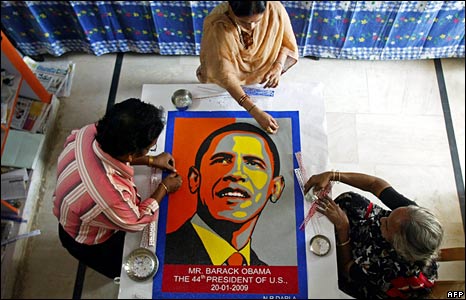
January 2009: Indian artist Darla Nageswara Rao (left) has used more than 33,000 coloured stickers on his portrait of Barack Obama. The work has taken 160 hours to complete.

Although the Indian media collectively swooned on President Obama, and breathlessly informed its audience about how many rooms he had booked at various five-star hotels, there was surprisingly little discussion on two key questions. What is Obama’s foreign policy record? Moreover, what impact will his visit have on most Indians?

Continue reading Revisiting Obama’s Visit: Suvrat Raju

Protesting FTII students write to Ambika Soni

Studnets at the Film and Television Institute of India, Pune, have been protesting against the commercialisation of India’s best known film school. In letters to the Union Information and Broadcasting Minister Ambika Soni, they write:

In the proposal, made by Hewitt at the behest of your ministry for the ‘up-gradation of FTII to international standards’, refers to FTII as a ‘brand’. What this company fails to understand that this ‘brand value’ it refers to has come into being because of the diploma films that the students of the ‘3 year subsidized course’ have made it in the last 50 years. The other ‘self sustained courses’ that exist today (with its self sustainence) exists and has any value, if at all, because of these 3 year diploma courses. Continue reading Protesting FTII students write to Ambika Soni

Ayodhya Verdict: Does it provide closure?

Guest post by WARISHA FARASAT

I was a child when the Babri Masjid was desecrated. After the news of the demolition spread across Uttar Pradesh, we were huddled in buses and packed off home from our boarding school. We were happy that the school had announced the winter break earlier than usual. That apart, we didn’t think much of the episode. In fact, I think that we were oblivious, almost entirely, to the gravity of the incident.

Much later, when I read the Sri Krishna Committee Report on the Bombay riots of 1992-93, and about thousands who had lost their life in the aftermath of the demolition, memories of 1992 returned. I remembered whispers. I remembered the fear in the eyes of our teachers accompanying us home. I remembered the instructions to the bus driver not to stop the bus if we were mobbed. I remembered leaving school at three in the morning. And, I remembered being asked not to tell my real name if we were stopped. Continue reading Ayodhya Verdict: Does it provide closure?

India Bans US Professor from Kashmir, threatens Indian writer with sedition charges: JKCCS

A note from JAMMU KASHMIR COALITION OF CIVIL SOCIETY

November 2, 2010

On November 1, 2010, shortly after 5.10 am, Professor Richard Shapiro was denied entry by the Immigration Authorities in New Delhi. Richard Shapiro is the Chair and Associate Professor of the Department of Anthropology at the California Institute of Integral Studies (CIIS) in San Francisco. He is also the life partner/husband of Angana Chatterji, who is the Co-convener of the International People’s Tribunal on Human Rights and Justice in Indian-administered Kashmir (IPTK) and also Professor of Anthropology at CIIS. Continue reading India Bans US Professor from Kashmir, threatens Indian writer with sedition charges: JKCCS

The Shock Doctrine

GQ Boy’s platinum pain

Guest post by HILAL MIR


There are various divisions of pain the different classes of people feel in Jammu and Kashmir. Like those bank credit cards which classify customers according to precious metals—Platinum, Gold, Silver—pain is a class thing. For example, when PDP veteran Muzaffar Hussain Baig, after making a long convoluted speech in the Jammu and Kashmir Assembly, said Omar Abdullah’s name figured in the list of the people who used their authority to sexually exploit girls, the junior Abdullah was transformed into a character from a Greek tragedy.

Continue reading GQ Boy’s platinum pain

Daayen Ya Baayen

Tradition-modernity. Rural-urban. Hope-despair. Consumption-frugality. Experience-theory.

Doesn’t it sometimes seem like we may end up spending our entire lives pendulum-ing between these poles? Dipping into her Uttaranchal childhood, first-time director Bela Negi negotiates these heavy-duty extremes in the most delightfully humble way, only to emerge with an incandescent little gem of a film. Daayen ya Baayen is the story of an utterly inconsequential human being – a small blip on the grand radar of things, a man named Ramesh Majhila who returns from Mumbai to his village in the Uttaranchal hills. Continue reading Daayen Ya Baayen

Sedition: ‘The highest duty of a citizen’

Sedition: the attempt “to excite disaffection towards the Government established by law in India”, a crime under Section 124 A of the Indian Penal Code, a provision introduced by the British colonial government in 1860.

The only revisions to this colonial legal provision since its passing have been over the years, to remove anachronistic terms like “Her Majesty”, “the Crown Representative”, “British India”, “British Burma” and “Transportation for life or any shorter term”.

But it seems “Disaffection towards the government”, the archaic usage notwithstanding, is a timeless crime. Section 124A, therefore, these few cosmetic changes apart, has remained unchanged for the last 150 years.

Continue reading Sedition: ‘The highest duty of a citizen’

Sedition provision gags free speech: Barun Das Gupta

This is a guest post by BARUN DAS GUPTA

The detractors of Arundhati Roy have found a fresh casus belli against her for her recent speech (Oct. 21) in New Delhi, on Kashmir. The participants in the polemics include such intellectuals as Swapan Dasgupta, a journalist and a BJP leader. The burden of their criticism is that Arundhati should be arrested for sedition because by her speeches she has caused hatred and disaffection towards the Government and actually championed the secession of a part of India, that is, Jammu and Kashmir.

Let us examine this matter of “creating hatred and disaffection” towards the Government, not from the legal point of view but from the political point of view. Section 124A of the Indian Penal Code says: “Whoever brings or attempts to bring in hatred, contempt or excites disaffection towards the Government shall be punished ……” Before proceeding further, let us note that the concerned section speaks of “disaffection towards the Government”, without specifying whether by “Government” the Central Government is meant or the State Governments. Since there is no explanation, it may be inferred that “Government” means both Central and State Governments. Continue reading Sedition provision gags free speech: Barun Das Gupta

Kashmir: A “No-Peace” Political Initiative

Guest post by ANGANA CHATTERJI

The 8-point Plan, New Delhi’s political initiative to address the crises in Kashmir, attests to the parallel and incommensurate realities of the sovereign and the subjugated, the Indian state and the Kashmiris.

The 8-point Plan renders obvious New Delhi’s limited comfort zone. The Plan is not an overture to healing the reality of suffering and outrage inside Kashmir. Rethinking militarization and military governance is not the priority. The ambition is to manage Kashmiris and to keep the disarray concealed from the international gaze.

New Delhi announced its 8-point Plan on September 25, 2010, following the visit to India-ruled Kashmir of a 39-member All Party Delegation from New Delhi led by Union Home Minister Palaniappan Chidambaram, and parallel to the 65th Session of the United Nations General Assembly meetings in New York City. That Defence Minister Arackaparambil Kurian Antony did not accompany the All Party Delegation was indicative of New Delhi’s mood.

Continue reading Kashmir: A “No-Peace” Political Initiative

WikiLeaks, Azadi and Arnab Goswami: Monobina Gupta

Guest post by MONOBINA GUPTA

This Friday Dean Baquet, Washington Bureau Chief of the New York Times defended his paper’s publishing of explosive information gathered by WikiLeaks, putting the US intelligence and the military establishment squarely in the dock for the Iraq war. The largest ever classified military leak in history, the WikiLeaks revelations have exposed the complicity of the US military and civil administration in whittling down the number of civilian deaths/casualties as well as ignoring hard information about the torture of US soldiers in the hands of Iraqi forces.

Baquet said that his paper worked on stories culled from nearly 4,00,0000 documents furnished by WikiLeaks as “it would any other journalistic project.” He also pointed out that it is not often that reporters get to scrutinize documents testifying to the largest US intelligence leak ever.

Continue reading WikiLeaks, Azadi and Arnab Goswami: Monobina Gupta

Let Delhi have its thali

Guest post by HILAL MIR

During the convention, Azadi the only Way, at LTG auditorium on Thursday, a potbellied man was standing on the aisle, listening intently to the speech of professor of history at Jadavpur University Sugata Bhadra. The man, I reckon, might be easily burdening earth with nearly 130 kilograms of his fair, north Indian bulk.  The professor was stripping the Indian state to its bare minimum and the audiences clapped. The man could stand it no more. I soon found out his voice was equally weighty, and gravelly—a cross between Shatrugan Sinha and Kulbushan Kharbanda. Quite audibly he said jis thali ma khatey hai usi main chaid kartey hain. In Bollywood films this saying condemning treachery is reserved for domestic helps who fall in love with the pretty daughters of their employers. Here, the context was different. A Maoist sympathizer was sharing the dais with a Kashmiri pro-freedom leader who was sharing the dais with a Sikh secessionist who was sharing the dais with a Naga human rights defender…A veritable thali of secessionism and dissent indeed. No wonder Arnab Goswami was hysterical. Continue reading Let Delhi have its thali

The Japanese are telling you something, MMS

Manmohan Singh is in Tokyo, trying to conclude yet another nuclear deal with yet another country. As the deal is under a cloud, many Japanese citizens have written an open letter to him:

It is true, as India has repeatedly pointed out, that the Nuclear Non-Proliferation Treaty (NPT) is an unequal treaty. However, looking at India now, one cannot help thinking that India believes power and prestige derive from the possession of nuclear weapons. India might have adopted a nuclear no-first-use strategy, but seen from the perspective of the experience of the Hibakusha, the possession of nuclear weapons is by no means a source of power and prestige. Rather, it is the epitome of immorality.

India reaffirmed its moratorium on nuclear testing when the Nuclear Suppliers Group (NSG) amended its guidelines to allow a special exemption permitting nuclear cooperation with India, which is not a member of the NPT. However, India has not promised never again to conduct a nuclear test. Nor has it agreed to IAEA safeguards that would prevent it from using domestically produced material to produce nuclear weapons. Under these circumstances, given that India has not promised not to produce nuclear weapons in future, if Japan were to proceed with cooperation on nuclear technology with India, this would be interpreted by other countries, including Pakistan and other Islamic countries, as meaning that Japan, the victim of nuclear weapons, is cooperating in India’s development of nuclear weapons. [Read the full letter]

No to social apartheid! JNU students protest today against CWG ‘view cutters’


AP photo by Manish Swarup


Latest Indian addition to the English language: View cutter.
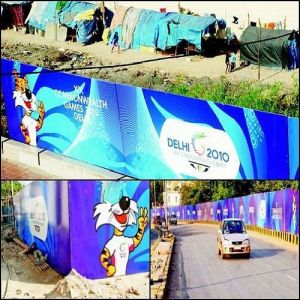
The government and civic agencies in association with the Commonwealth Games Organising Committee (OC) had identified several sites central to hosting the Games where view cutters were put up to conceal the eyesores as well as for security reasons.
A government official said one of the purposes to put up the view cutters was to screen the beggars who crowd major religious and historical landmarks.
The plan is to relocate the destitute to parks and surround the place with slick banners and paraphernalia sporting Games mascot Shera and other logos, the official said.
Protest March today, 13th of October, 4 p.m. from Ganga Dhabha to the slum dwellings at the Priya crossway. 


Leaflet issued by the joint protest committee, JNU

Friends, CWG 2010 is now almost coming to an end. The whole country has been in a celebratory frenzy for the last two weeks. The government has made the successful completion of these games an issue of “National pride”. They have left no stones unturned to impress the whole world. The same government which claims to have no money when it comes to the issues of drought, health and education has wasted thousands of crores on just the opening ceremony. It is distressing to see that while we are counting medals won by India, we have completely forgotten that there is a vast section of people who instead of benefitting are adversely affected during our blind celebration of this “colonial hangover”.

Continue reading No to social apartheid! JNU students protest today against CWG ‘view cutters’

Notes from a Beautiful City


Research and Edit:
Rintu Thomas

Photography and Sound:
Sushmit Ghosh

Produced by:
Open Space & Black Ticket Films

Eight reasons why you should oppose Unique Identification: Stop UID Campaign

Drafted by KALYANI MENON-SEN for the Stop UID Campaign

AN APPEAL TO CITIZENS

The National Identification Authority of India Bill approved by the Union Cabinet on Friday has sidestepped critical privacy aspects relating to profiling and function creep — a term used to describe the way in which information is collected for one limited purpose but gradually gets used for other purposes.

Here are some reasons why you should oppose this Bill:

1. False claims

The Government of India and Nandan Nilekani, Chairperson UIDAI, have been claiming that the UID scheme will enable inclusive growth by providing each citizen with a verifiable identity, that it will facilitate delivery of basic services, that it will plug leakages in public expenditure and that it will speed up achievement of targets in social sector schemes.

Continue reading Eight reasons why you should oppose Unique Identification: Stop UID Campaign

On the Day of the Games

On the morning of the Games, what should many of us — who have dissented against them in different ways and forms — make of our dissent?

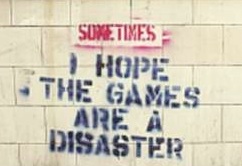
Let me begin with a confession. I am one of the authors of this graffiti that dots some of South Delhi and, ironically, remains on the wall opposite the main entrance of the JLN stadium, though now its probably hidden under a hoarding of Shera who appears to be not nearly as endangered as his real life inspiration:

It was a few months ago when the Games fervour was just beginning. The magnitude of all that they would become hadn’t quite sunk in. The graffiti felt, at that time, like a momentary defiance that opened up some space to breathe in a city where the deafening and deadening drum rolls that precede any spectacle were inching closer. You could hear them. You could tell that soon little else would be audible.

Continue reading On the Day of the Games

Apni Dilli Unke Khel

Written, performed and directed by  ASUR (Narendra,  Rakesh, Archna  and Ravi)

To Delhi

I had used Baudelaire for the post pasted below because on the day  I sat to write about the CWG, nothing I wrote made any sense or captured my frustration other than the poem. Yet, as an email I got this morning reminded me, I have partially substituted one injustice with another. Since good critiques are so wonderfully rare and this one voiced so well, I cite the email below (with permission) as an amendment to my own post since my agreement with its charges are complete:

“Dear Gautam,
I was disappointed to read your post on Kafila , the one where you posted an extract from Baudelaire [http://kafila.org/2010/09/25/to-delhi/]. It is very tiring to read of woman / the feminine as characterized by caprice and associated with luxury + cruelty.
Even if it is Delhi , the city, that one is supposed to read as the woman, unfeeling, capricious, this still ties up with the discourse around women as the consumers of luxury goods, thus responsible for the exploitation resulting from the production / trade of these goods. [Off the top of my head – look at Pope’s Rape of the Lock , Gray’s goldfish-enamoured cat, and the sequel to Love Story – Oliver’s Story with the woman who works for the sweatshop-patronising firm]. I don’t see how the sexism in this piece can be excused or explained away. And to quote it without atleast pointing out the problems in it?

Also, isn’t caprice a problem in itself? Aren’t you disappointed in the reporting that characterizes the Commonweath expenditure as resulting from the caprice of a few in power? Without exploring the systems, structures of thinking/ideology that make such expenditure possible in the first place? Without connecting this, the commonwealth-exploitation, to the histories of similar exploitation?

Yes, it is possible to see that you were highlighting injustice and class – but –
the piece ends up valourizing a man who feels what – pity? guilt? A little shame. Shame is so comfortable – he can occupy moral high ground, diss the woman, use the services of the cafe, and do nothing after that.

I hope your work goes okay.
Best wishes,
Akshi.”

The original post:

“Oh!  You want to know why I hate you today.

Continue reading To Delhi

Commonwealth Postcards

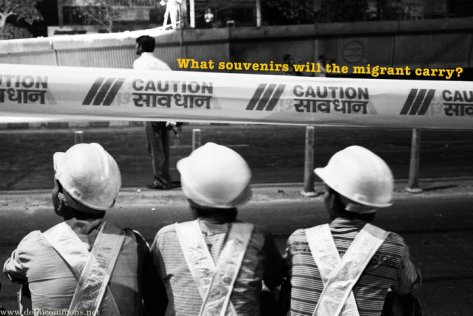
This and other postcards, expressing what many Delhi residents feel about the Commonwealth Games, have been put out by Delhi Commons (Facebook). They are available at Sarai CSDS (North Delhi), People Tree (Central Delhi) and Yodakin Bookstore, Hauz Khaz Village (South Delhi).