Category Archives: Debates

And aren’t OBC women “women”? Loud thinking on the Women’s Reservation Bill

The career of the Women’s Reservation Bill in Parliament since it first appeared in 1996 as the 81st Amendment Bill, has been striking for the high drama and rhetoric of women’s rights that has accompanied it, the passionate opposition to the proposed 33% reservation for women in Parliament, generally being characterised by its supporters as anti-women and patriarchal. However, if we try to organize the welter of arguments that have been flying around for 13  years, we would find that while the proponents of the measure certainly base their claims on the idea of gender justice, the opposition to the Bill does not come from an anti-women position.  Rather, the latter arguments stem from either

1) a generally anti-reservation position (which I am not interested in here) or

2) a claim that reservations for women should take into account other disempowered identities within this group – that is, the “quotas within quotas” position, which says that there should be reservation within the 33% for OBC and Muslim women. (The 22.7% reservation for SC/ST women would come into operation automatically.)

In other words, the sharp opposition to the Bill cannot simply be dismissed as anti-women. Continue reading And aren’t OBC women “women”? Loud thinking on the Women’s Reservation Bill

तिअनानमेन चौक, नन्दीग्राम और एक मक़्‍तूल सपना

[NB: To increase text size while reading, please press Ctrl+ or Ctrl++]

कभी फ़ैज़ अहमद फ़ैज़ ने ‘सीज़र डेड इज़ मोर पावरफ़ुल दैन सीज़र अलाइव’ की तर्ज़ पर पैट्रीस लुमुम्‍बा के बारे में कहा था कि ‘एक मक़्‍तूल लुमुम्‍बा ज़िंदा लुमुम्‍बा से ज़्‍यादा ताक़तवर होता है’।  और एक मक़्‍तूल सपना? या वह सपना देखने वाली ज़बरन सुला दी गई अनगिनत आँखें? उस ख़्‍वाब के बारे में क्‍या कहिएगा फ़ैज़ साहब, जिसका क़त्‍ल करने के लिए उसे देखने वालों को ही टैंकों तले रौंद दिया गया हो? तिअनानमेन चौक पर आज से बीस बरस पहले जिस ख्‍वाब का क़त्‍ल हुआ था, जिन ख्‍वाबीदा आँखों की रौश्‍नी हमेशा के लिए बुझा दी गई, वह सपना कितना ताक़तवर है यह अभी दुनिया का देखना बाक़ी है। अभी तो दुनिया ने उसकी एक बानगी भर देखी थी: तिअनानमेन का ख़ून अभी सूखा भी न था कि समाजवाद के नाम पर फहरा रहा परचम – क्रॉन्‍श्‍टाड्‍ट के नाविकों से लेकर हंगरी 1956, चेकोस्‍लोवाकिया 1968 और न जाने कितने गुज़िश्‍ता तिअनानमेनों के ख़ून से लथपथ परचम – यकायक नोंच कर नीचे उतार दिया गया। जिनके दिमागों पर ताले लगे हैं वे कितना ही चिल्‍ला चिल्‍ला के कहते रहें, यह किसी साम्रज्‍यावादी की साज़िश का नहीं, ग़ुज़रे दिनों के प्रेतों का कारनामा था जो ख़ुद शासकों के ज़मीर में इस तरह जम कर बैठे थे कि वहाँ भी, अचानक किसी गोर्बाचोव का पैदा होना लाज़मी था जो ऐलानिया तौर पर यह कहने का माद्दा रखता कि बिना जम्हूरियत के समाजवाद हो ही नहीं सकता। और जैसे ही जम्हूरियत की तरफ़ क़दम बढ़ाते हुए उसने ज़रा सा ढक्कन हटाया, वैसा ही ज़माने से धधकता लावा फट कर सामने आ गया। एकबारगी ताश के महल की तरह वह पूरा का पूरा निज़ाम ही ढहा के ले गया। Continue reading तिअनानमेन चौक, नन्दीग्राम और एक मक़्‍तूल सपना

To RSS with Love: The Real Story of 2009 Elections

If news reports are to be believed, the RSS has come out with the most classic analysis of the 2009 election verdict: Advani did not enthuse the Hindus. [Read carefully: He could but he did not. A small boy, kal ka chhokra, Varun Gandhi had to lead the way!] Only a shade better than the West Bengal CPM claiming that they lost because Karat and the central leadership withdrew support to the UPA…as if they themselves – or Nandigram had nothing to do with it! Or the Kerala CPM claiming that it was due to chief minister Achuthanandan that they lost – Achuthanandan the agent of the bourgeoisie who ‘roared with laughter’ when the party was losing the elections! Or Sitaram Yechury claiming that UPA won because they claimed the credit for NREGA and Forest Rights Act which ‘we had forced them to enact’ – but ‘we’ lost! Amazing stuff, these elections and even more amazing, the post-election antics. But today’s topic is not the CPM. For, the real story is the RSS and BJP love story that is once again on the rocks.

RSS spokesperson MG Vaidya was forthright: “The BJP must reflect Hindu nationalism or else it is free to remain as any other party not associated with the Sangh… What’s wrong if people have gathered the impression that the BJP uses the Ram temple issue only for political gains?… The mainstream in this country is Hindu and the RSS is engaged in unifying Hindus. The BJP or any other owing allegiance to the Sangh must reflect this philosophy in its deeds.”

Continue reading To RSS with Love: The Real Story of 2009 Elections

साधारण की उदात्तता यानि जनादेश 2009

2009 के लोकसभा चुनाव के नतीजों ने कुछ लोगों को हतप्रभ किया है और अनेक को चमत्कृत. इस जनादेश की व्याख्या इस रूप में की जा रही है कि भारत की जनता ने विकास को तरजीह दी है और इस बडी मंदी के दौर में अपेक्षाकृत सुरक्षित चुनाव किया है. हमारे एक मित्र का कहना है कि इस असुरक्षा के समय में जनता जो हाथ में है , उसे ही संजोए रखना चाहती थी. भारतीय जनता पार्टी और तथाकथित तीसरे मोर्चे के ऊपर कांग्रेस के नेतृत्व वाले गठबंधन को चुनने के पीछे बिजली-पानी –सडक और जान-माल की हिफाजत की रोज़मर्रा की चिंताएं ज़रूर रही होंगी, लेकिन क्या यह इतना ही था? साधारण जनता क्या सिर्फ मामूली सवालों में ही उलझी रहती है और कभी अपने रोज़मर्रेपन से ऊपर नहीं उठती? बार-बार उसे इसी हद में बांधकर देखने की कोशिश की जाती हैहालांकि उसने कई बार यह बतलाया है कि उसके मुद्दे सिर्फ वही नहीं हैं जो व्याख्याकार बताते रहे हैं. साधारण जनता की उदात्तता की आकांक्षा आखिर किस रूप में व्यक्त होती है?

भारत में मोहनदास करमचंद गांधी ने शायद सबसे पहले साधारण के भीतर छिपी इस उदात्तता को ठीक-ठीक पहचाना था और उसका आदर किया था. क्रांतिकारियों या फिर कम्युनिस्ट विचार रखने वालों को साधारणता पर सन्देह ही था.
क्रांतिकारियों ने इसीलिए चुने हुए लोगों के दस्ते बनाए और कम्युनिस्ट खुद को जनता के एक अगुआ दस्ते के रूप में पेश करते रहे. शास्त्रकारों या सिद्धांतकारों को भी साधारणता को समझने में काफी दिक्कत होती रही है. इसलिए उनकी दिलचस्पी उन कोटियों के निर्माण में रहती है जो आसानी से सामूहिक आचरण की व्याख्या करने में सहायक हों. पिछले बीस वर्षों में भारतीय जनता के सारे निर्णयों को पहचान की कोटि के आधार पर समझने की कोशिश की गई है. यहां यह नहीं कहा जा रहा कि यह कोटि या इस तरह की सैद्धांतिक कोटियां बिलकुल अप्रासंगिक हैं, सिर्फ यही कहने की कोशिश की जा रही है कि इस प्रकार की किसी एक कोटि में किसी समूह को शेष कर देने से हम उसके भीतर छिपी सारी सम्भावनाओं को नज़रअंदाज़ देते हैं.
Continue reading साधारण की उदात्तता यानि जनादेश 2009

वाम के खिलाफ अवाम: ईश्वर दोस्त

This is a guest post by ISHWAR DOST. Ishwar is a Left activist and journalist. He works with Jansatta.

एक वक़्त था जब नंदीग्राम माकपा के बर्ताव से अचंभे और सदमे में था। आज पूरे बंगाल में बुरी तरह खारिज कर दिए जाने पर माकपा की यही स्थिति है। कभी नंदीग्राम पीड़ित के रूप में उभरा था, आज माकपा और उसके साथ और पीछे खड़ी पार्टियों की पीड़ा समझी जा सकती है। नंदीग्राम और सिंगूर के एक स्थानीय घटना बन कर रह जाने की माकपाई उम्मीद अचानक खत्म हो गई। नतीजे बताते हैं कि नंदीग्राम की पीड़ा के साथ बंगाल के देहात ने ही नहीं, शहर कोलकाता ने भी साझा किया है। किसानों के साथ हुए हिंसक सलूक से कोलकाता के बुद्धिजीवी ही नहीं, आम लोग भी हिल गए थे।

नंदीग्राम अब माकपा की पीड़ा और छटपटाहट को समझ सके, इसमें शायद काफी देर हो गई है। ऐसा कभी हो सके, इसके लिए माकपा और उसके पीछे चलने वाली पार्टियों को सारे अहंकार छोड़ कर एक पुरानी पीढ़ी के किसी कम्युनिस्ट की तरह नंदीग्राम तक सिर झुकाए आना होगा। सत्ता और सफलता का अहंकार पीड़ा को समझने और उससे जुड़ने की क्षमता नष्ट कर देता है। इस अहंकार ने कम्युनिस्टों की एक वक्त की नैतिक, ईमानदार और जज्बाती होने की पहचान को कमजोर कर दिया है। Continue reading वाम के खिलाफ अवाम: ईश्वर दोस्त

Making Sense of the Ravi Dasis: Surinder S. Jodhka

The recent attack on the head of Dera Sachkhand Ballan in one of their gurudwaras in Vienna and the ensuing shoot-out between Dalit and non-Dalit Sikhs, spilling over in India into angry street demonstrations in Jalandhar by followers of Dera Sachkhand and other Dalit bodies, forces us to confront the question of caste in contemporary Punjab. We asked SURINDER S. JODHKA, sociologist and Director, Institute of Dalit Studies, who works in this area, to give us a background note.

The Dera Sachkhand Ballan is one of the most important Guru Ravi Das Deras in Punjab today. Ravi Das was a 15th century saint of the Chamar caste whose message is constructed by his contemporary followers in a modern language that foregrounds questions of caste oppression and the  fight against the prevailing structures of authority and the Brahmanical moral order.  In his piece here, Surinder gives us a historical background to the emergence of this movement, and brings us to the point of the 1990s, when the “diasporic energy” of Ravi Dasis who had emigrated to the UK and Europe, gave a boost to the movement both at home as well as in the diaspora, where Ravi Dasis had found things to be no different. In the alien context, with no systemic justification for caste ideology, the Punjabi Dalits did not expect to be reminded of their “low” status in the caste hierarchy, says Surinder, but facing systematic discrimination from wealthy Jat Sikhs, were forced to set up their own autonomous organizations and their own gurudwaras. Continue reading Making Sense of the Ravi Dasis: Surinder S. Jodhka

When Buddha Did Not Smile: Monobina Gupta

This is a guest post by MONOBINA GUPTA

Buddhadeb with Tata building as backdrop, courtesy Calcuttans.com
Buddhadeb with a laterally inverted Tata as backdrop, courtesy Calcuttans.com

As the true magnitude of the West Bengal election results sank in, a sulking Buddhadeb responded, stonewalling the media as if to say that had it not been for them the Party would have romped home victorious! Here is a conversation reported in The Telegraph (May 18,2009). The reporters in Writer’s Building asked the Chief Minister:

Is it true that you have offered to resign?

No reply.

Will you step down as chief minister owning moral responsibility for the party’s debacle?

No reply.

Why didn’t you go to Delhi to attend the CPM politburo meeting?

No reply.

Silence has rarely been so eloquent in the corridors of Writers’ Buildings as when a grim-faced Buddhadeb Bhattacharjee walked out at 1.30 pm for lunch at home.
Faced with a volley of questions whether he had offered to resign, the Bengal chief minister left without replying. The Telegraph had reported that the chief minister had offered to resign but CPM boss Prakash Karat had been trying to make him change his mind.

This is not the first time Bhattacharjee has faced tricky questions but he usually deflects them by saying “I don’t reply to questions flung at me from the corridors’’.
But this afternoon, he opted for silence.

Continue reading When Buddha Did Not Smile: Monobina Gupta

Sri Lanka: A Tragedy Foretold – Rohini Hensman

guest post by ROHINI HENSMAN

Once a forest fire is raging, putting it out is difficult, and an enormous amount of destruction is inevitable. The same is true of the war in Sri Lanka. Even over the past fifteen years, there were several chances to prevent this tragedy, but only a tiny minority of those who are now grieving over the dead and injured were arguing then that a failure to take these chances would lead to a bloodbath. Continue reading Sri Lanka: A Tragedy Foretold – Rohini Hensman

Anatomy of a prejudice

The BSP’s politics may trouble the popular conception of Indianness, among English speaking middle classes, who understand India as one whole, where the ‘Indian’ identity dominates and the rest, which reflect real India (inequality and conflicts) are hushed up. On the other hand, the BSP’s politics reiterates that India is a country of various minorities (castes, religions, regions) who may be victimised by fellow Indians in different contexts. Emphasising the BSP or Mayawati’s Dalitness ignores the complexity of caste society and associated politics. Kanshiram in the past and Mayawati now raise issues of caste not to sustain inequality but to challenge them. What Mayawati and BSP’s growth represents is the deepening of democracy in India. [Suryakant Waghmore]

हिंसा की राजनीति के पैरोकार

२००९ के लोकसभा  चुनाव की अगर इसके पहले दो चरणों के आधार पर कोई खासियत बतानी हो तो कहना पडेगा कि समाज के पारम्परिक शक्ति संतुलन में विचलन के भय से तथाकथित ऊंची जातियों के द्वारा पहले  जो हिंसा होती थी, वह नहीं दिखी. बिहार और अन्य स्थानों पर चुनाव के वक्त बूथ पर होनेवाला खूनखराबा इस बार नहीं हुआ. फिर भी इस बार हत्याएं हुईं. और ये हत्याएं हिंसक वर्ग-युद्ध में विश्वास रखनेवाले माओवादी समूहों ने कीं. बिहार, झारखंड, ओडीसा, छत्तीसगढ और महाराष्ट्र में इन समूहों के द्वारा हत्याएं की गईं, सार्वजनिक स्थलों को जलाया गया और दहशत फैलाई गई. पूरी ट्रेन का अपहरण कर लिया गया और अपना शक्ति प्रदर्शन करके फिर उसे छोड़ दिया गया. इस बीच उसके यात्रियों को जो भयंकर मानसिक यंत्रणा हुई होगी उसके लिए माओवादियों के पास कोई सहानुभूति का शब्द नहीं है. बंगाल में   सी.पी.एम. ने अपने हिंसक अहंकार में सिंगुर और नांदीग्राम और  उनके बाद लालगढ में जो कुछ किया उसने माओवादी समूहों को बंगाल में अपनी पकड मजबूत करने का मौका दिया. अब ये खबरें आम हैं कि बंगाल के गांवों और कस्बों में लोगों को सी.पी.एम. की सदस्यता छोड्ने को मजबूर किया जा रहा है और बात न मानने पर उनकी हत्या तक की जा रही है. ऐसी ही हत्याएं पिछले  साल बिहार  और झारखण्ड में की गयी थी. क्योकि माओवादी मारे गए लोगों  को ‘गलत पार्टियों’ में रहने नहीं देना चाहते थे. बंगाल में सी.पी.एम. की हिंसा का विरोध करनेवालों को शायद सी.पी. एम. के कार्यकर्ताओं की हत्या में  एक प्रकार का प्राकृतिक न्याय होता दीख रहा हो, वरना क्या वजह है कि अब तक इन हत्याओं की और दल छोडने को बाध्य करने की इस तरह की घटनाओं की कहीं से कोई भर्त्सना नहीं सुनाई पडी है !

“हिंसा को किसी भी तरह जायज नहीं ठहराया जा सकता ,चाहे  उसका औचित्य कुछ भी क्यों न दिया जाए.” पिछ्ले दो साल से माओवादियों को मदद पहुंचाने के आरोप में जेल में बंद बिनायक सेन ने हाल में एक पत्रकार को यह कहा जब उसने माओवादी हिंसा के बारे में उनसे सवाल किया. बिनायक जब यह बातचीत कर रहे थे, उनके चेहरे पर वह दाढी नहीं थी  जिसने उन्हें एक रूमानी शक्ल दे रखी थी. दाढीविहीन  होकर भी बिनायक उतने ही आकर्षक लग रहे  थे, हालांकि उसके होने से जो एक रहस्य की आभा उनके इर्द-गिर्द थी, वह नहीं रह गयी थी.
Continue reading हिंसा की राजनीति के पैरोकार

Afghan Women Protest New Law on Home Life

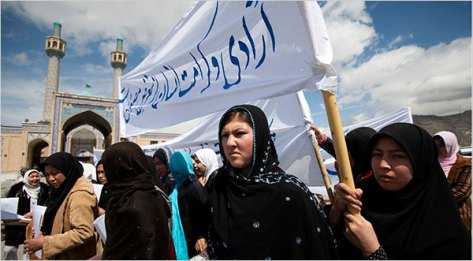
About 300 Afghan women, facing an angry throng three times that number, walked the streets of Kabul on Wednesday to demand that Parliament repeal a new law that introduces a range of Taliban-like restrictions on women, and permits, among other things, marital rape.

Afghan women demonstrate against new law, courtesy NYT

‘The young women stepped off the bus and moved toward the protest march just beginning on the other side of the street when they were spotted by a mob of men.’

‘”Get out of here, you whores!” the men shouted. “Get out!”….It was an extraordinary scene. Women are mostly illiterate in this impoverished country, and they do not, generally speaking, enjoy anything near the freedom accorded to men. But there they were, most of them young, many in jeans, defying a threatening crowd and calling out slogans heavy with meaning.’ Read the full story by Dexter Filkins here.

[Courtesy: SACW]

Obama and the End of Other Dreams?

poar01_obama0803

This guest post comes to us from NISSIM MANNATHUKKAREN

And I have seen the promised land. I may not get there with you. But I want you to know tonight, that we, as a people, will get to the promised land.

Martin Luther King, Jr.

Continue reading Obama and the End of Other Dreams?

The Tragedy of Politics in Sri Lanka

I am posting below an article that I wrote with Cenan Pirani.  The shorter version of this article is in Combat Law. The longer version below delves into the history of left politics in Sri Lanka and attempts at a political solution.  Another article by me reflecting some of these concerns and raising questions of solidarity titled ‘The Challenges of Solidarity’ was published in Red Pepper.

The Tragedy of Politics in Sri Lanka

By AHILAN KADIRGAMAR and CENAN PIRANI

In the last few months, the Sri Lankan security forces have managed to ruthlessly push the LTTE into a 40 square km strip of land in the North of the island, and along with the LTTE leadership and its cadres, a sizable civilian population, anywhere from seventy thousand to one hundred and fifty thousand, have also been cordoned off in this area.  As the security forces continue their offensives purporting to rid Sri Lanka of the LTTE, they also claim the lives of these civilians daily. Continue reading The Tragedy of Politics in Sri Lanka

Closed minds

The Constituent Assembly’s ‘Committee to protect and preserve National Interests’ has suggested that a passport regime be introduced at the Nepal-India border. Committee Chair Amik Sherchan has said this is necessary to ‘protect waning Nepali nationalism’ and ‘to treat both China and India equally’. Sherchan claimed that ‘majority of the Nepali people share this view’, an assertion hard to believe.

The clamour to end the open border relationship comes from three different quarters of the Kathmandu (and yes this is confined to the capital) political spectrum. The first is the nationalists who borrow the Westphalian notion of absolutely sovereign nation states. In this version, the Nepali state has never been totally independent because it has not controlled the movement of people across its boundaries. The act of walking across unchallenged is seen as an attack on state authority. Continue reading Closed minds

BJP without RSS?

Right since the controversy over L K Advani’s remarks on Jinnah, there is a section of the ‘liberal’ Indian media which has argued that all the BJP needs to do is divorce/separate/delink itself from the RSS. It would then turn into a ‘normal’ right wing party. I remember this was a line taken up strongly by the Indian Express. The subtext of their editorial position was that there is a strong left tilt in Indian polity; Nehruvian socialist rhetoric remains ingrained; and a ‘non-communal’ BJP can provide the right balance. (Where they see the left tilt when few of us can or how much further right they still want to push India is an altogether different debate). In a chat with CNN IBN website readers, Ramchandra Guha takes up a similar position arguing what India needs is BJP without RSS. (and ‘a Congress without the dynasty and a modern and unified left’).

I do not understand Indian politics too well, nor have covered the BJP. There are others who have written about the relationship between the two in great depth. But from the little I have seen of them while reporting in a few Indian states, here is a simple thought – the BJP will not be BJP if it is detached from the RSS. To assume that BJP can remain a party without the RSS structure to back it or BJP can separate itself from the larger ‘parivaar’ seems to be based on a limited understanding of both the BJP and RSS. Continue reading BJP without RSS?

Who Is Responsible For The Slaughter Of Civilians In The Vanni?: Rohini Hensman

guest post by ROHINI HENSMAN

With the military defeat of the LTTE imminent, the terrible plight of civilians in the Vanni has attracted worldwide concern and sympathy, and rightly so. While the circumstances are completely different, the civilian death toll in the Vanni over the past few months (over 2700) is already triple the number of civilians killed in the Gaza massacre of December-January, and is still mounting. The thousands who suffer serious injuries are further victimised by the delay or lack of medical attention, which means, for example, that injuries to limbs which could have been saved with prompt treatment, instead result in gangrene and amputations. Even those who have not lost lives, limbs or loved ones, have lost their homes and livelihoods, and live in appalling conditions which could well claim more lives through disease or even starvation.

Meanwhile, the LTTE and Government of Sri Lanka (GOSL) trade charges, each accusing the other of being responsible for the slaughter. What truth is there in their respective allegations? Continue reading Who Is Responsible For The Slaughter Of Civilians In The Vanni?: Rohini Hensman

Where have they disappeared?

Aman Kachroo is not the first teen to die of ragging. But there is one curious first: this time the death has not led to any ‘public debate’.

This time the defenders of ragging are silent. Who knows, maybe some of them have changed their views and are now lighting candles at Jantar Mantar. There are no TV debates calling ragging fun. This time no one is arguing that a murder case should not be used to defame the socially productive ‘tradition’ of ragging. This time nobody is asking how boys will become men unless they are ragged, and nobody is calling the victims sissies.

What has changed? Continue reading Where have they disappeared?

The Rise of the Underground – A New Discovery?

Believe it or not, experts at the World Bank and the IMF are disovering the virtues of something we at Kafila have been, off and on, debating: the so-called ‘underground economy’, the ‘informal sector’ or what has also been called the sphere of ‘noncorporate capital’.

“Economists have long thought the underground economy — the vast, unregulated market encompassing everything from street vendors to unlicensed cab drivers — was bad news for the world economy. Now it’s taking on a new role as one of the last safe havens in a darkening financial climate, forcing analysts to rethink their views”, states a recent Wall Street Journal report from Ahmedabad. Continue reading The Rise of the Underground – A New Discovery?

Evangelist Zizek and the End of Philosophy – II

Idea of communism? Courtesy Oscar's global blog
Idea of communism? Courtesy Oscar’s global blog

Today was the third and final day of the ‘Idea of Communism’ conference and it was the truly most bizarre experience – bizarre philosophical experience, I should say – of my life. Let me start backwards today.

The preacher from Ljubliana was in full form and he closed his own hour-long (or was it 55 minutes) presentation ‘To Begin from the Beginning, Over and Over Again’ with the following: “If the rumour that Gilles Deleuze was writing a book on Marx before he died, is true then this should be seen as a sign that after having spent a life time away from the Church he wanted to come back to its fold…We welcome all those anti-communist Leftists who have spent their lifetimes attacking us to come and join us.” Continue reading Evangelist Zizek and the End of Philosophy – II

Re-booting Communism Or Slavoj Zizek and the End of Philosophy – I

Zizek - the postmodern Lenin?

Today, 13 March, a whole galaxy of philosophers and theorists got together for a three-day conference “On The Idea of Communism” under the auspices of the Birkbeck Institute for the Humanities, London University. The Conference opened to a jam-packed hall where all tickets had sold out (no jokes, this was a ticketed show where the likes of Alain Badiou, Slavoj Zizek, Jean Luc-Nancy, Toni Negri, Jacques Ranciere, Terry Eagleton and many many others are to perform on the ‘idea of communism’). The huge Logan hall with a capacity of about 800-900 was so packed that the organizers had made arrangements for video streaming in another neighbouring hall – and that too was half full! Very encouraging in these bleak days.

The conference began in the afternoon with brief opening remarks by Alain Badiou and Slavoj Zizek. Badiou made his general point (see below) about the continuing relevance of the ‘communist hypothesis’. Staid and philosopherly. Continue reading Re-booting Communism Or Slavoj Zizek and the End of Philosophy – I

Save the left from left scholars

I have just returned from an atrocious talk delivered by a famous Nepal expert, David Seddon, who claims to belong to the ‘old British Marxist tradition of Eric Hobsbawm and E P Thompson’.

So this Mr Seddon is well known in Nepal for a book he wrote three decades back – Nepal in Crisis. More recently, he got along with a local activist to edit a book on the People’s War.

Now, Seddon sahib comes here. He tells a Nepali audience how he is worried about the rising violence and the ‘law and order’ problem. He links the violence with identity – “people feel they have a legitimate basis to pick arms and throw stones because they belong to a caste and ethnic group.” He tells the audience, many of whom have struggled for long to bring some change in the exclusionary Nepali state structure, that ‘identity politics is profoundly undemocratic and federalism is not necessary.” And here is the clincher, “When your constituent assembly members adopted a federal democratic republic, I am sure they were thinking only about the republic part. No one really thought about the federal part.” Continue reading Save the left from left scholars