[निम्नलिखित बयान साठ से ज़्यादा ऐसे संगठनों और कार्यकर्ताओं की तरफ़ से 15 फरवरी को जारी किया गया है जिनका मनरेगा के कार्यान्वयन से संबंध रहा है। ]
हम, नीचे दस्तखत करने वाले एक्टिविस्ट्स, जो भारत के कोने-कोने में मनरेगा मजदूरों के साथ काम करते हैं, महात्मा गांधी राष्ट्रीय ग्रामीण रोजगार गारंटी अधिनियम (मनरेगा) को खत्म करने की कड़ी निंदा करते हैं, जो माँग पर मिलने वाला ‘काम के अधिकार‘ का प्रोग्राम था। हमारा मानना है कि:
– मनरेगा महाराष्ट्र की रोजगार गारंटी योजना से सीख लेकर भारी समर्थन और बातचीत के बाद शुरू किया गया था।
Today, exactly 266 days after it began, the ASHA workers’ protest led by the Kerala ASHA Health Workers’ Association vowed to continue the protest in a new form. Since the evening before, news channels and in the morning, newspapers, were claiming that the protest had ‘ended’ or was going to be ‘wound up.’ The meeting the KAHWA organised in front of the State Secretariat in Thiruvananthapuram was both a celebration of the victory the workers had secured over the hubris of the CPM and its lord and master, the Chief Minister of Kerala. But more importantly, it was a declaration of the workers’ determination to continue the struggle. The local body elections are imminent, and the protesting workers intend to turn their grievance into a campaign issue.
[Below is theEnglish Version of a Public Statement in Malayalam released by a group of concerned economists and social activists that appeared in the Malayalam and Kerala-based English Newspapers today (31 October 2025)]
Background: The Government of Kerala have been preparing to declare the State of Kerala as India’s First Extreme Poverty-Free State on 1 November, 2025 being the State formation day. Th government claims that this achievement was attained through sustained efforts to eradicate extreme poverty in the state since July 2021, with just 64,006 extremely-poor families identified through a survey conducted by the Kudumbashree Mission and the Panchayats and Municipalities. The criteria used, as the government claims, were (i) households with no income, (ii) not even food for two times a day, (ii) those unable to cook food even with food articles available from ration shops, and (iv) those with very bad health conditions. This makes Kerala the first state in India to attain the two Sustainable Development Goals of No Poverty and No Hunger. However, this raises a number of crucial questions. It is in this background the following public statement was issued.
Rejoinder written collectively by Anamika A, Archana Ravi, Ayana Krishna D, J Devika, Divya G S, Gayatri Devi, Shraddha Jain, Shradha S and Srimanjori Guha
[This piece was written in response to a flagrant misrepresentation of the ASHA workers’ ongoing struggle in Kerala, by Binitha Thampi and Varsha Prasad, which appeared in the Economic and Political Weekly early this month, titled “Labouring on the Margins: ASHA Workers’ Protests in Kerala and Working-class Solidarities” (Oct.4, 2025, LX, 40, 13-17). A group of us — scholars, activists, artists and others who have been closely following the struggle since its beginning — wrote a rejoinder to it. The EPW editor verbally agreed to consider it, but the edit desk insisted that it be subjected to the same peer-review process (as their special articles, it seemed).Commentary pieces, as those who have published in the EPW earlier know, were dealt with at the editorial desk, and the editor was back then obviously competent to judge whether a rejoinder to a commentary piece was a fair one or not. Now that seemingly requires a review process! That does not suit us simply because this atrocious piece of slander is aimed at an ongoing struggle, at the lives of struggling women workers, by other women steeped in academic, social, and political privilege. There is, then, the need to respond quickly, to defend the struggle from the verbal equivalent of a shower of stones thrown at it. At the same time, the very fact that B Thampi’s and V Prasad’s piece, which parrots the CPM troll position in each line and trips over themselves several times empirically and theoretically, has clearly not been subjected to peer-review by the same EPW editorial, for it would definitely would not have got published like it is now — biased in the extreme.
On 21 September 2025, The New Indian Express published an interview with Professor Irudaya Rajan about migration patterns from Kerala where the Professor characterised the rising trend of student migration from Kerala as a ‘mad rush’ and said that young people fail and don’t benefit much from migration. He also said that overseas employment as care providers, a growing form of employment in the developed countries, was a form of ‘slavery’.
Statement by NATIONAL ALLIANCE OF PEOPLE’S MOVEMENTS demands principled investigation to establish command responsibility. It also demands that Govt review the unsustainable and unjust ‘development’ model fuelled by land mafias and casino interests in Goa .
National Alliance of People’s Movements (NAPM) unequivocally condemns the heinous assault on adivasi youth leader, Rama Kankonkar on 18th September, the subsequent intimidation against another activist Swapnesh Sherlekar, and the alarming descent into lawlessness that these incidents in Goa exemplify. We extend unwavering solidarity to Rama Kankonkar, Swapnesh Sherlekar and the people of Goa who continue to fight for justice, environmental protection, and the preservation of their collective identity. We also demand adequate protection to these activists, principled investigation to establish command responsibility and a review of the current unsustainable, unjust and unsafe ‘development’ model; fuelled by land mafias and casino interests. Continue reading Protest Assault on Adivasi Youth Leader Rama Kankonkar, Lawless Casino-based Development in Goa: NAPM→
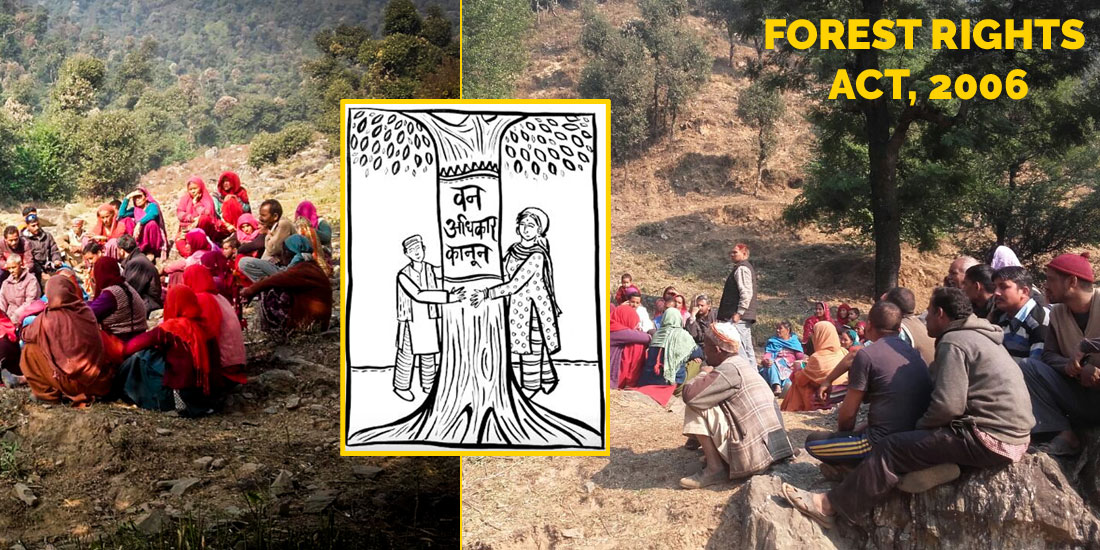
The road to hell is paved with good intentions. That’s the first, visceral reaction that many passionate wildlife conservationists have, when you utter the 3 letters: FRA. The Forest Rights Act (2006) aims to give native tribal and forest dwelling populations ownership of, and decision-making rights over what happens in the wildlife areas that they are residents of. But many conservationists see it as a gateway for rampant encroachment into protected areas.
I was initially a bit more circumspect, having been a longtime advocate for community-based conservation. Having always believed that ivory tower conservation can never work, without putting the people involved at the center of it. But I have also had to temper my position over time, as I witnessed the complexities of how it was playing out on the ground. (ref- https://india.mongabay.com/2020/07/commentary-making-communities-central-to-conservation/ )
I will share what I have learned about the process of transforming complex systems, the changes necessary in ideologies, and in the way in which public policies are being made, for India to progress towards its vision of poorna swaraj. The following points indicate an outline of the argument I plan to make in the talk:
• Global governance has broken down. The world is in disorder.
• India is strategically vulnerable. It is a long way off from its ‘tryst with destiny’ of poorna swaraj.
• India must become much more self-reliant, and less dependent on the US and China to protect its strategic autonomy. It must find its own democratic path to strengthen its society and economy. The US (and the West) cannot provide a blueprint.
• Development and progress are processes of learning.
• Nations are complex ‘self-adaptive’ systems.
• Power and wealth in a system accumulate by a process of cumulative causation.
• The process of change must be democratic for new ideas to emerge.
I have explained such ideas in my book, Reimagining India’s Economy: The Road to a More Equitable Society,published this year, and in some previous books.
About the Speaker:
Arun Maira is an eminent author, a strategic thinker and a former member of the Planning Commission of India. He had joined the Commission at the invitation of then Prime Minister Dr Manmohan Singh himself. Mr. Maira has had a distinguished career as an enlightened business leader and management consultant. He worked as Executive Director on the Board of Tata Motors and later as the Chairman of Boston Consulting Group. He has authored many books including Transforming Systems: Why the World Needs an Ethical Toolkit; Transforming Capitalism: Improving the World for Everyone; Redesigning the Aeroplane While Flying: Reforming Institutions; Shaping the Future: A Guide for Systems leaders; and most recently, Reimagining India’s Economy: The Road to a More Equitable Society, published in June 2025.
In the thick, humming night of a city that never truly sleeps — only flickers. Flickers between traffic signals and app pings, between delivery promises and the quiet violence of exhaustion.
He collapsed just beyond Gate Number Three in a residential colony in Delhi, somewhere between the parked dumpers and the weary under-construction site of the Metro.
He fell softly, without spectacle. The kind of death a city absorbs without noticing, like rain into dust.
In a few days, the Resident Welfare Association had drafted a statement — not out of grief, but out of inconvenience: “What if it had been one of us?”
Following is a statement on the violent displacement and dispossession in Dhubri, Assam by some leading civil society members of the state who were also the conveners of the Assam United Citizens Convention.
We strongly condemn the inhuman, brutal and cruel eviction of more than thousands of farmers and labourers from Chap Revenue Circle of Dhubri district by the government of Assam. Such atrocities against innocent people are unusual and indicative of a perverted mind. We don’t know who could be the next victims of such atrocities. The government says the people are ‘encroachers’. However, the attitude of the ruling classes towards land has been exploitative since the colonial times. Although the direct use of land is for settlement, agriculture, and other productive livelihoods of citizens, but for the government it is primarily a means of generating revenue. Since the colonial era, the government has not focused on the leasing and resettlement of landless indigenous people and other legal residents. However, the preceding governments at least allowed the people residing on government land to live in peace with some degree of humanitarian sympathy. But the BJP government has evicted these citizens like heartless zamindars. They are planning to hand over the land of the indigenous residents of Assam to the big capitalists at home and abroad. Thus, the poor tribals, backward castes and char people have been turned into s beggars on the streets within a day. It is supposed to be a step forward for ‘development’ and ‘industrialisation’. The ‘development’ of the state by killing people has assumed a demonic form now. We have also seen an anti-Muslim propaganda campaign openly and sometimes subtly launched day and night by the government-owned media to cover up this evil character. Therefore, we demand the government to stop such evictions and warn the people to be vigilant against this evil government conspiracy.
Hiren Gohain, Harekrishna Deka, Ajit Kumar Bhuyan, Paresh Malakar, Abdul Mannan, Santanu Borthakur Conveners, Assam United Citizens Convention
Following is a statement issued by some eminent citizens of Assam, issued in Guwahati on 3 July 2025. It calls for a civil society intervention, via the Assam United Citizens Convention to be held today and tomorrow (5 and 6 July), following the Garukhuti cow scam.
We have seen how our state is being run by the present government. The Garukhuti episode has made it amply clear how this government had thrown all the norms of government functioning to the winds and how favouritism and corruption have eaten into the core of governance. We have also seen how the chief minister of Assam is reacting to the situation and what he has been saying all the time. We think that the Garukhuti incident is not a single and isolated one. Garukhuti symbolises the basic character of Himanta Biswa Sarma government.
[We are publishing below a report of a press conference by the NATIONAL ALLIANCE FOR CLIMATE AND ECOLOGICAL JUSTICE that details the status of struggles for ecological justice from across the country. Lifting the mask off ritualistic official observances of the World Environment Day, while the government continues to wreak havoc on the ecology and the commons, this report gives a sense of the struggles in different parts of the country. At the end of this report is the link to its full online recording.]
As the world marked yet another Environment Day on 5th June, the National Alliance for Climate and Ecological Justice (NACEJ), a pan Indian forum of NAPM, brought together voices from different parts of the country in an online press conference on 6th June, to share the current status of ecological justice struggles. Speakers from Kashmir, Sikkim, Tamil Nadu, Madhya Pradesh, Maharashtra, Telangana, Rajasthan, Chhattisgarh, Haryana, Odisha, and other states addressed the Press Conference. These voices reinforced the reality that both the Central Govt and different states governments are majorly complicit in environmental violations, enabling large profiteering, extractive agendas of mega-corporations, unleashing repression on democratic movements. Moderated by well-known environmental activist Soumya Dutta, the meeting saw good participation from both media and movements.
Following is a statement of All India Solidarity with Siang Indigenous Farmers’ Forum, endorsed by 43 organizations and fifty individuals.
The Siang river in Upper Siang district, Arunachal Pradesh. Photo courtesy Anupam Chakravartty, Down to Earth
We, the undersigned, express our solidarity with the Siang Indigenous Farmers’ Forum (SIFF), which has been spearheading the people’s protest against the proposed 11,500 MW Siang Upper Multipurpose Project (SUMP) of the National Hydro-electric Power Corporation (NHPC) in Arunachal Pradesh, which will be disastrous for this whole area. We support the demands of SIFF for withdrawal of Central Armed Police Forces (CAPF) deployed in Beging village for doing the Pre-Feasibility Report (PFR) of the project.


 KAFILA - COLLECTIVE EXPLORATIONS SINCE 2006