Category Archives: Ecology/Environment

A “Green Signal” for The Rape of Justice and the People: POSCO Pratirodh Sangram Samiti

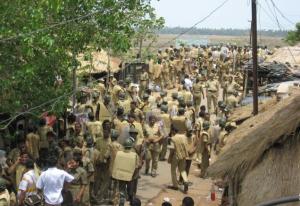
The following is the statement issued by the POSCO PRATIRODH SANGRAM SAMITI on the latest decision of the Environment Ministry on POSCO. The image below from an earlier round of land acquisition attempt is a telling illustration of how the ‘free market’ functions. Received via Shankar Gopalakrishnan.

Courtesy The Hindu
Land being acquired for POSCO. Image courtesy The Hindu

Jairam Ramesh and the UPA government have shown their true colours with their decision today on the POSCO project. Ignoring the reports of its own advisory bodies and enquiry committees, violating its own orders and the laws of the land, this Ministry has shown that the naked face of corporate greed – it is not the “rule of law”, the “aam aadmi”, “inclusive growth” or any of these other lies – that rules this country. The decision today can be summarised in one sentence:”Repeat your lies, give us promises that we all know are false, and then loot at will.”

We repeat: we will not give up our lands, our forests and our homes to this company. It is not the meaningless orders of a mercenary government that will decide this project’s fate, but the tears and blood of our people. Through the road of peaceful demonstrations and people’s resistance we have fought this project, in the face of torture, jail, firings and killings. If this project comes it will come over our dead bodies.
Continue reading A “Green Signal” for The Rape of Justice and the People: POSCO Pratirodh Sangram Samiti

Niyamgiri, You Are Still Alive

This 17 minutes long film won the Vasudha, Environment Award at the International Film Festival of India in Goa, 2010.

The Republic of Exploitation

On this Republic Day, while armoured tanks muscle across Rajpath in New Delhi, little ossified museums of culture called tableaux charm the assembled pass-holding citizenry and the Prime Minister sits like a barely-sentient caricature of himself behind a bullet-proof screen, it may do well to think about the other republic that remains hidden within the bosom of Superpower India – the republic of unfree labour.

This is a world where the laws of the upside world are inverted – where the more you work, the less you are paid, the more your company profits, the poorer you end up and if you find yourself the victim of an injustice and god forbid complain about it, the police put your family in jail. It’s a great irony of our times that we believe the choice before us is between loving the Nation and loving the Corporation, not realising that most of the time its the same person wearing two grotesque masks.  All those who believe that the world begins with their newspapers and television sets and ends at their white picket fences (and all those who don’t), please take a minute to go through the excellent documentation of the war that is raging for workers in this country, put together by the Gurgaon Workers’ Solidarity Group, the Faridabad Mazdoor Sangathan and several other exemplary organisations.

GurgaonWorkersNews – Newsletter 35 (February 2011)

Continue reading The Republic of Exploitation

Apocalypse in Our Time: Ravikumar

Guest post by RAVIKUMAR

Waking is Another Dream: Poems on the Genocide in Eelam, a slim anthology edited by Ravikumar, will be launched by Navayana on Wednesday, 8 December 2010 at 6 p.m. at The Attic, 36 Regal Building, Connaught Place, New Delhi.

[At a time when the Eelam issue is the news again owing to Channel 4’s coverage leading to the cancellation of Mahinda Rajapaksa’s talk at Oxford, citing emerging evidence of his war crimes, Navayana presents a volume of powerful poetry translated for the first time from Tamil into English. Says poet Cheran, “The lack awareness in a city like Delhi on the fallout of the genocidal war in Sri Lanka is appalling. People here who seem concerned about Palestine or even Kashmir seem utterly indifferent to the problem in India’s own backyard.”

Continue reading Apocalypse in Our Time: Ravikumar

Volunteers needed to transcribe all 104 Radia tapes

See Reading Radia

As you know, Open and Outlook magazines have put out legally taped telephone conversations of several people with lobbyist Niira Radia. Open put out only a few audios, and transcribed them all, where as Outlook put out a somewhat different set. However, Outlook was kind enough to put out all the audios they had on their website. There’s a lot of muck in there, and it’s not just about Barkha Dutt and Vir Sanghvi, it’s not just about the 2G scam. It’s very crucial that we transcribe ALL these tapes so that the words are on Google, se we can access the content of all tapes more easily. The media should have done this by now but the media is silent to save the skin of their own. So we need to become the media, you and I. Just 15 minutes of your time needed. To volunteer, please leave a comment on any post which says a volunteer is required to transcribe this one.

Thanks!


The Return of Daya: Prasanta Chakravarty

Guest post by PRASANTA CHAKRAVARTY

A close friend of mine—a fine political scientist with nuanced literary sensibilities, once suggested that he is inherently suspicious of carefreeness and gaiety in relationships, friendships and in public exchanges. One must take time, let matters marinate (‘jaarano’ he proposed in Bangla) and not be prematurely upbeat and exuberant while forging bonds and taking actions. The deficient modes of resting and concealment are important preconditions in order to take on varieties of political manipulation, social one-upmanship and literary cleverness that besets our time.

Continue reading The Return of Daya: Prasanta Chakravarty

The Japanese are telling you something, MMS

Manmohan Singh is in Tokyo, trying to conclude yet another nuclear deal with yet another country. As the deal is under a cloud, many Japanese citizens have written an open letter to him:

It is true, as India has repeatedly pointed out, that the Nuclear Non-Proliferation Treaty (NPT) is an unequal treaty. However, looking at India now, one cannot help thinking that India believes power and prestige derive from the possession of nuclear weapons. India might have adopted a nuclear no-first-use strategy, but seen from the perspective of the experience of the Hibakusha, the possession of nuclear weapons is by no means a source of power and prestige. Rather, it is the epitome of immorality.

India reaffirmed its moratorium on nuclear testing when the Nuclear Suppliers Group (NSG) amended its guidelines to allow a special exemption permitting nuclear cooperation with India, which is not a member of the NPT. However, India has not promised never again to conduct a nuclear test. Nor has it agreed to IAEA safeguards that would prevent it from using domestically produced material to produce nuclear weapons. Under these circumstances, given that India has not promised not to produce nuclear weapons in future, if Japan were to proceed with cooperation on nuclear technology with India, this would be interpreted by other countries, including Pakistan and other Islamic countries, as meaning that Japan, the victim of nuclear weapons, is cooperating in India’s development of nuclear weapons. [Read the full letter]

Reading the Ayodhya Judgement: Biswajit Roy

Guest post by BISWAJIT ROY

In this piece, I would like to share my reading of judgments on Ayodhya. I have only managed to go through the judgment of Justice Khan in detail and parts of justice Agarwal and Sharma’s expositions. Though the Lucknow bench of Allahabab High Court accepted the Hindu faith-based claims about Ram’s birth at the disputed site and the 2-1 verdict went for its three-way partition, all the three judges differed in their takes on the issues related to claims and counter-claims reflecting not only their individual subjectivity but also social loci. To be more candid, they hardly hide their community background and their stakes as insiders.

The bench has anchored its verdict it by referring to religious scriptures, medieval memoirs, foreigners’ travelogues, colonial records, and history books well as folklore and oral tradition. But the judges’ reading of these texts differed much less on legal nuances and more on interpretations and inferences based on their own religio-political understanding and beliefs.
Here is what I found interesting in Justice Khan’s judgment. He differed with other two judges on substantial points: the acceptance of disputed site, to be precise, the area under the central dome of the demolished mosque as Ram’s birthplace, Babar’s demolition of a pre-existing Hindu temple and the mosque’s validity as a proper mosque.

Continue reading Reading the Ayodhya Judgement: Biswajit Roy

A Twist in the Tale, Or, the New Copernican Revolution

Even as the rejection of Vedanta’s application to mine in Niyamgiri is being widely hailed as a victory for tribal rights, there is of course one set of very predictable voices, which has leapt in to start damage control for their corporate heroes. Thus one such cheerleader of Capital tells us that the ‘real twist’ in the script is that the ‘denial of bauxite mining in Niyamgiri’ can mean disaster for the future of a poor region and a poor state!

On the other hand, a statement by the Campaign for Survival and Dignity – a platform of tribal and forest dwellers’ organizations from all over the country has hailed the decision, arguing that: “The project’s main problem was that it violated the Forest Rights Act’s provisions requiring ‘recognition of habitat and community forest rights’ and the consent of the gram sabha prior to taking forest land. This sounds like technical legalisms. But the basic point is that, under the law, the Dongria Kondhs have the power to protect and manage their forests and lands. Simple, but unprecedented; it has never happened before.”

For our scribe however, the “really nuanced” stories of Niyamgiri are not those of the tribals and forest dwellers. They come from “the likes of Raju Sahu who came from Bihar to Kalahandi 10 years ago and runs four tea/food stalls on the state highway that links Lanjigarh – where Niyamgiri and the Vedanta factory are situated – to Bhawanipatna, the district HQ”.  Sahu apparently told our journalist-investigator that his business has more than trebled in the last four years since Vedanta started operations there. This is true for any big economic enterprise that gets set up – a large number of small businesses sprout up around it. There would be as many stories about poor people who benefited from the life that grew up around say, giant public sector units – the end of which is celebrated by these cheerleaders of Capital.  Will the perishing of those small businesses as a fall-out of the closure of PSU’s be accepted by our nuanced story-teller as a justification for the continuation of PSU’s? Never. For we know that there are always different standards for judging the merits of corporate marauders. You can tell even before you start reading a column by a Shekhar Gupta or a Tavleen Singh or a Saubhik Chakrabarti, what is coming – be it Niyamgiri, Bhopal and Union Carbide, the loot of the Commonwealth Games or the studied silence on matters relating to DIAL and GMR. And sometimes, just sometimes, we happen to know why…

Continue reading A Twist in the Tale, Or, the New Copernican Revolution

Socialism of the New Century: Sunil

Guest post by SUNIL

[Sunil is the national vice-president of Samajwadi Jan Parishad. This  article was written for a special issue of Janata weekly. The essay is an important statement from one of the leading activist-theorists of the socialist movement (i.e. non-Marxist socialism) which does not simply disavow the marxist legacy but engages with that experience as an essential component of socialist practice. AN]

The tussle between capitalism and socialism as alternative visions of human society is not yet over. It is like the old fable of the race between a hare and a tortoise. At times one seems to be the winner. At other times the other seems to be leading. Capitalism is like the hare of the story. It looks fast, impressive and dynamic but after some time it is tired and resting with its own contradictions. In the end, we know it is the tortoise of socialism which will prevail. But that end is yet to be arrived at.

Capitalism looked supreme and unchallengeable in the later decades of the past century. With the disintegration of USSR, reverting of China, Vietnam and many other communist countries to the path of capitalism, and downfall of social democracy in Europe, there was no challenge to capitalism. Thus ‘end of history’ was arrogantly announced. Market fundamentalism of Reagan and Thatcher varieties started ruling over the world. But soon many crises arrived. Ecological crisis with the dangers of climate change and global warming on the one hand, and the global financial crisis with the worst recession since the thirties on the other, shook the faith in the supremacy and immortality of capitalist civilization. Added to these were the growing crises of hunger, malnutrition, homelessness, violence and war. The number of hungry people in the world kept growing and crossed the figure of 100 cores in the first decade of the twenty first century i.e. every sixth person on the earth today remains underfed and starved. This is perhaps the biggest and the most glaring failure of capitalism. Even after more than two centuries of the industrial revolution and miraculous progress of science and technology, it is unable to fulfill even the most basic need of the humankind.

Continue reading Socialism of the New Century: Sunil

POSCO Pratirodh Sangram Samiti to Jairam Ramesh

This is a press release issued last week by PPSS, pointing out the illegalities   being committed by the Orissa government and the Central Ministry of Environment and Forests in connection with the POSCO project.

POSCO PRATIRODH SANGRAM SAMITI

Dhinkia, Nuagaon, Gadkujang; Jagatsinghpur District, Orissa

11.08.2010

To:

Shri Jairam Ramesh

Minister of Environment and Forests

Paryavaran Bhavan

New Delhi

Sub: Regarding POSCO project – need for withdrawal of illegal final clearance; new Meena Gupta Committee clearly aimed at delaying matters Continue reading POSCO Pratirodh Sangram Samiti to Jairam Ramesh

The Desertification of Punjab and the Liability of Opinion Makers

In August last year, we had drawn attention to a piece by Indian Express editor Shekhar Gupta on the remarkable edit page piece he had penned on what he claimed was the ‘absence of drought’, in the Green Revolution region and provided his ‘explanation’ of why it had been possible. It had been possible, Gupta had opined, because all the great things had been accomplished in decades when the most retrograde environmental and jholawala movements in the history of mankind had not yet arrived on the scene. And with no evidence whatsoever and with nothing but his blind ideological faith, Gupta had even misled his readers that ‘underground aquifers were being constantly recharged’. This when just a few days ago, NASA satellite pictures had shown the extent of groundwater depletion in this region. Continue reading The Desertification of Punjab and the Liability of Opinion Makers

‘The Making of a Modern Indian Artist-Craftsman – Devi Prasad’: Naman Ahuja

This is a guest post by NAMAN AHUJA, who teaches in the School of Art and Aesthetics, JNU and has recently put together this fascinating exhibition that is on in Lalit Kala Academy, Delhi till 21 May

Tempera, Santiniketan / Dehradun, 1944 (painted on the artist's 23rd Birthday)
Horse in a fit
The Making of the Modern Indian Artist-Craftsman is intended to be a biographical and critical insight into the work of the potter, painter and photographer Devi Prasad. Apart from the making of his personal history and his times, it leads us to why the act of making (art) itself takes on such a fundamental philosophical significance in his life. This, I feel, derives directly from his absorption of Gandhi’s philosophy that looked at the act of making or doing as an ethical ideal, and further back to the impact of the Arts and Crafts Movement  on the ideology of ‘Swadeshi’ and on the milieu of Santiniketan.
The exhibition and the accompanying book examine Devi’s art along with his  role in political activism which, although garnered on Indian soil made him crisscross national borders and assume an important role in the international arena  of war resistance. Devi Prasad graduated from Tagore’s Santiniketan in 1944 when he joined the Hindustani Talimi Sangh (which espoused the concept of Nayee Taleem) at Gandhi’s ashram Sevagram as Art ‘Teacher’. His political consciousness saw him participate actively in the Quit India Movement in 1942, in Vinoba Bhave’s Bhoodan and later from 1962 onward as Secretary General (later Chairman) of the War Resisters’ International, the oldest world pacifist organisation based in London. From there he was able to extend his Gandhian values internationally. All of this, while continuing with his life as a prolific artist. Rather than view them as separate worlds or professions, Devi harmonises them within an ethical and conscionable whole. He has written widely on the inextricable link between peace and creativity, on child /basic education, Gandhi and Tagore, on politics and art, in English, Hindi and Bangla. In 2007 he was awarded the Lalit Kala Akademi Ratna and in 2008, the Desikottama by Visva Bharati University, Santiniketan.

Continue reading ‘The Making of a Modern Indian Artist-Craftsman – Devi Prasad’: Naman Ahuja

The Oblique Strategies of Trickster City

It’s midnight: An aspiring model cooks up a batch of Fem Bleaching Cream; an actor rehearses his dialogues to the sounds of manic laughter, “Oh tell them all it is I who is God,”; a fourteen year old feigns sleep as his father looks on, wondering what has prompted his son to abandon his studies and look for work; a woman throws her abusive husband to the floor and whips him with his belt.
In the morning, a young man will awaken at the crack of dawn and walk down to the slaughterhouse; an empty street shall bear witness to a middle aged woman’s defiant declaration, “I will work. I don’t care what you think! I don’t care what the world thinks.” The muezzin will call the faithful to prayer.  A bulldozer will plow through the heart of this twenty five year old settlement: clearing space for the 2010 Commonwealth Games, altering these lives forever.
In February 2006, the residents of Nangla Maanchi, a working class settlement of migrants in Delhi, were confronted by a signboard: “This land is the property of the government. It should be vacated.” By August that year, Nangla was bulldozed to make way for an “athlete’s village” to house this year’s Commonwealth Games.

Bt brinjal – understanding the issues involved: Sunita Narain

In the prevailing arguments and counter arguments on the baingan gaatha, I found the following brief piece in Times of India by Sunita Narain, Director, Centre for Science and Environment, Delhi, invaluable for outlining the critical issues involvedevaluation of risks to health, control over seeds, threat to biodiversity, consumer choice and independence of research.

Jairam Ramesh, the Union minister for environment and forests, has agreed to put Bt brinjal on hold. I believe this is the right and only decision that he could have taken.

The fact is that we are not talking about a new technology of genetic modification here. We are talking about its use in a daily-use vegetable, cooked in our homes. Let us understand that Bt brinjal, if permitted would have been the world’s first genetically modified vegetable. It is therefore completely erroneous to argue that Bt brinjal should be cleared because the world is already growing genetically modified plants and believe these are safe.

Royal Purple with a Green Crown

There is a story about Birbal and Akbar that goes something like this:

One day Akbar invited Birbal to join him at Lunch, one of the dishes served was the Brinjal, called Baigan in Hindustani, akbar liked the preparation and said as much, Birbal not only agreed but also praised the vegetable to high heavens, talking about its great qualities and about its ancient roots in the Indian lore.  Several days later he was invited for another meal with the Emperor and this time too Brinjal was on the Menu, Akbar did not like the preparation said that Baigan was an affront to finer sensibilities, Birbal promptly agreed and added that it had no taste of its own, had the consistency and colour of mud and destroyed anything that it was cooked with. Akbar remembered the fulsome praise that Birbal had just a few days earlier heaped upon the vegetable and reminded him. Birbal bowed his head and said, my lord, I am beholden to you, not to the Brinjal. Continue reading Royal Purple with a Green Crown

Green Hunt: The Anatomy of An Operation

An operation is underway in Central India, but no one really knows what it is. Variously described as a media myth, a comprehensive hearts and minds strategy, and an all-out offensive by paramilitary forces and the state forces along the borders of Chhattisgarh, Jharkhand, Andhra Pradesh and Maharashtra, Operation Green Hunt has become a shoebox of news clippings, police reports, public demonstrations and armed encounters.

Depending on the definition, Green Hunt either began in July 2009, September 2009 or November 2009. Speaking off record, senior policemen confirmed that the intensification of “search and comb” operations in Chhattisgarh began as early as July last year. In September 2009 the press reported on the progress of “Operation Green Hunt”: a massive 3 day joint operation in which the central CoBRA force and state police battled Naxal forces in Dantewada. Continue reading Green Hunt: The Anatomy of An Operation

Drop A Beat, Turn Up My Symphony

This is a guest post by John Bevan

Nearly half the 8 million population of Haiti, (the size of Wales, Belize and El Salvador— seems that was one of the standard sizes for countries at the time) lived in the Capital Port-au-Prince.  So the elimination of the Capital approximates to the loss of half the country’s entire infrastructure, limited as it was.  The loss of many of its intellectuals and elected politicians, few enough in the first place, given the brain-drain northwards, with some third of Haitians living in the US, adds to the knock the country has taken.

In 2006, the main Port-au-Prince daily proudly lead with the story- “Haiti there at World Cup Final”- referring not to their football team but Wyclef  Jean who sang a duet with Shakira before the France-Italy final in Berlin.  Wyclef boosted the image and self-image of Haitians a few years earlier when he won a Grammy for the 1996 Fugees album, The Score, and accepted it while wearing a Haitian flag, Haitians still being at the bottom of the pile of all US immigrant groups.  He rarely appears on videos without the flag somewhere about his body. Continue reading Drop A Beat, Turn Up My Symphony

Bhopal Disaster, Corporate Responsibility and Peoples’ Rights

2 December 2009 will mark the 25th anniversary of the Bhopal disaster. It was the night of 2nd December 1984 when over 35 tons of toxic gases leaked from a pesticide plant in Bhopal, owned by the US based multinational Union Carbide Corporation (UCC)’s Indian affiliate Union Carbide India Limited (UCIL). In the next 2-3 days more than 7,000 people died and many more were injured. Over the last 25 years at least 15,000 more people have died from illnesses related to the gas exposure. Today, more than 100,000 people continue to suffer from chronic and debilitating illnesses, for which treatment is largely ineffective. The disaster shocked the world and raised fundamental questions about government and corporate responsibility for industrial accidents that devastate human life and local environments. Yet 25 years later, the survivors and various organisations are still fighting for justice. Issues of plant site, toxic wastes and contaminated water have not been resolved. And strikingly, no one has been held to account for the leak and its appalling consequences. Bhopal is not just an incident of industrial disaster and human suffering from the last century. It is very much an issue of the present century of corporate accountability, peoples’ rights and government responsibility. The lack of mandatory laws and norms governing multinationals, legal complexities, and government failures are serious obstacles in ensuring justice for the people of Bhopal, and for the victims of corporate complicity in crimes against environment, peoples’ lives and safety. Continue reading Bhopal Disaster, Corporate Responsibility and Peoples’ Rights

The curses of Paikdev. A lament for water: Hartman de Souza

My very old and lovely friend Hartman sent me the following:

To keep the blues at bay I am back to carving logs. This one attached is titled ‘The Curses of Paikdev, A Lament for Water’. It was a birthday present for my sister and is planted on her farm [in Goa]. It faces Paikeachi Zor (Paik’s Spring), which will disappear very shortly hanks to the rampant mining in the area. My sister plans to court arrest again, and this time refuse bail. She hopes that at least will get the Goans out.

In the thickly forested hills between the villages of Maina and Kawrem, to the south east of Quepem Town, a poignant story once fortunate enough to have had a happy ending, is now destined to end more sadly than it could ever have begun.

800 overloaded trucks groaning through the town throughout the day barring a few hours respite to let schoolchildren in the area to scamper to and from school is testament to this. It is this very same business, though ‘greed’ may be a better term, that is ‘legally’ destroying a myth of almost epic proportions, and with it, again ‘legally’, the water sources and bodies of the area.
Continue reading The curses of Paikdev. A lament for water: Hartman de Souza

WHOSE LAND IS IT ANYWAYS? Public Meeting organized by National Alliance of People’s Movements

An open discussion on the relevance and implications of Land Acquisition (Amendment) Bill  and Rehabilitation and Resettlement Bill 2009
Saturday, November 21, Gandhi Peace Foundation, Deen Dayal Upadhyay Marg, New Delhi 2 – 6 pm.

Friends,

The current economic model of growth prevalent in India , with strong neo-liberal leanings, needs to be re-assessed in the wake of increasing alienation and dispossession of vast populations from their land and the wave of resistance, both violent and non-violent, against such activities that are being played out in many parts of the country.

In the wake of an armed operation against escalating Maoist insurgency; adivasis, particularly in Chhattisgarh, Jharkhand, West Bengal Orissa, Andhra Pradesh and Maharashtra are stiffly resisting the industrial development that threaten their traditional way of life; farmers around the country raging against acquisition of their lands in the name of growth and development – the importance of revisiting the proposed Land Acquisition (Amendment) Bill, 2009 (LAA) and Rehabilitation and Resettlement Bill 2009 (R&R) is paramount, if not imperative.

We the struggling communities from different regions of the country have resisted the government’s machinations of enacting a faulty Resettlement and Rehabilitation Act and introducing amendments to the Land Acquisition Act, promoting private and corporate interests over public good. We gathered recently in Delhi in July 2009 and our struggle gained a significant boost when the Acts could not be passed in the Budget session of the Parliament. We have been in Delhi since 18th November and held meetings at Kanjhawala, Jantar Mantar and JNU and explained our concerns on these two Bills but also on the fires raging in the country and the path of growth on which the country is being pushed today.

It is in this context that we invite you to discuss the relevance and implications of these half hearted measures for the millions of people who are struggling to retain their means of livelihood and seek meaningful rehabilitation from a system in which they no longer seem to have faith.

The panelists for this meeting are :

K B Saxena, Former Secretary, Ministry of Rural Development and Agriculture, Union of India now at Council for Social Development, New Delhi

Ramaswamy Iyer, Former Secretary, Ministry of Water resources, Union of India and Government’s nominee on the Sardar Sarovar review Committee now at Centre for Policy Research, New Delhi

Sanjay Parikh, Senior Counsel, Supreme Court of India.

Roma, Kaimur Kshetra Mahila Mazdoor Kisan Sangharsh Samiti, NFFPFW  (Sonbhadra)

Gautam Bandopadhyay, Nadi Ghati Morcha , Chattisgarh

Dayamani Barla, Adivasi Mulnivasi Astitva Raksha Manch, Jharkhand, INSAF [to be confirmed]

Sandhya Devi, Kalahandi Mahila Mahasangh, Orissa

Praffula Samantray, NAPM Orissa

Medha Patkar, Narmada Bachao Andolan & NAPM

MODERATOR : Anand Mazgaonkar, Paryavaran Suraksha Samiti, NAPM Gujarat