Category Archives: Everyday Life

Waiting for Guddo: Farid Alvie

Guest post by FARID ALVIE

Three miles west of nowhere, I wait atop a grassy knoll landscaped with deliberate carelessness by the authorities of this semi-dilapidated amusement park. She said she will meet me here at the appointed time but as luck would have it, neither one of us owns a watch. Ravenous crows with their wings a-stretched and eyes a-bulged circle overhead: a dark, black ring set against a grey sky. I scan my surroundings and find myself alone… as alone as the day I was born. As I shoo my mother, the doctor and his two nurses away, I wonder where she might be at this very moment: caught in a jam full of traffic or confined to her room by the elders of her household, barred from meeting the man she loves and his lustrous, well-coiffed do.

Creepily crawling ants dodge my sneakered soles as they make their way home for the day. Leaves rustle and droop as they emit whiffs of carbondioxide that make my blood pressure plunge. City lights flicker in the distance as a rickshaw throttles by on the road below, polluting my environs and coating the withering leftovers of a despondent spring with soot and non-biodegradable petrol fumes. Continue reading Waiting for Guddo: Farid Alvie

Let’s march faster towards the metric system: Subhash Chandra Agrawal

Guest post by SUBHASH CHANDRA AGRAWAL

Even after half-a-century of introduction of metric measure in India, certain commodities like cloth, paper, furniture, land, time etc are being traditionally manufactured/measures in old units or their metric-converts. For example, cloth is usually manufactured in widths like 36” (91 cms), 48” (122 cms), 50” (127 cms), 54” (137 cms), 120” (305 cms) etc which should now be woven in metric-measures in multiples of 10 cms. It is time that measuring tapes may be available only in metric units after some specified date.

Continue reading Let’s march faster towards the metric system: Subhash Chandra Agrawal

Suggestions for India Post: Subhash Chandra Agrawal

Guest post by SUBHASH CHANDRA AGARWAL

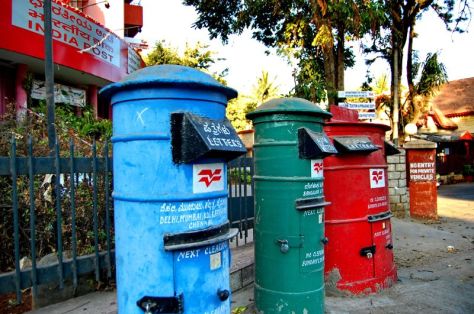
Photo credit: Aditya Bhelke

1.      All postal-tariffs should be generally in multiples of rupees five with Speed Post tariff being universal at rupees fifteen or twenty for every 50-gms rise in weight abolishing differential tariff of rupees 12 for local and rupees 25 for non-local mail-articles. Considering sharp decline in use of inland-letter-cards and post-cards, sponsored Meghdoot post-card should be priced at rupee one abolishing loss-giving Inland-Letter card and ordinary post-cards altogether. Continue reading Suggestions for India Post: Subhash Chandra Agrawal

The Year of the Coup D’état: Fawzia Naqvi

Guest post by FAWZIA NAQVI

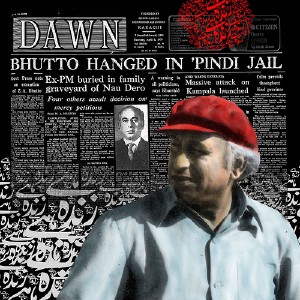
Imran Khan was not the first one to be obsessed with both cricket and politics. Saira and I beat him to it 20 years ago. We spent 50% of our time swooning over him and the other 50% worshipping Mr. Bhutto. 20 years later I believe it was I who got over Imran Khan and Saira who got over Mr. Bhutto. Although I must confess, it was Imran who adorned every inch of wall and closet space in my dressing room, the “shrine” as my brother labelled it. And it was Imran’s picture which popped out of the inside cover of my high school notebook. During moments of boredom and droning lectures I would stare at his picture for an hour straight and muse and sigh over the fact that one could see his house from the balcony of our school and perhaps today might be the day when he would come to pick up his sister from our school. The God, the Adonis, Imran was it for both of us.

I don’t know how Saira became an Imran groupie. I do recall well how I did. I was taken to my first ever live cricket match in 1976. My brother’s best friend pointed toward the field from high up in the spectator stands to what looked to me like white dots, and told me with much seriousness in his voice, “there over there is the most handsome man you’ll ever see…” and then he made his most remarkable claim, “he’s so handsome you’ll forget about Izzy!” Continue reading The Year of the Coup D’état: Fawzia Naqvi

Why ban just a Facebook page when you can erase a holy book or two (or more)?

Following in the wake of the declarations of the well known Internet idiot, who doubles as the honorable minister of telecommunications of the Union of India, an esteemed additional civil judge of a Delhi court has also decided to issue an ex-parte order commanding Social Media networks, Facebook and Youtube to remove 21 (or is it 22?) ‘objectionable’ websites that ‘offend religious sentiments’.

This has been done in response to please entered by a ‘journalist’, a certain Mr. Vinay Rai, and a certain Mufti Aijaz Arshad Qasmi, who also delivers online fatwas on a variety of subjects, ranging from the very intimate to the magnificently cosmic. It is wonderful to behold the learned court acting with such sensitivity to the joint plea of two honorable Hindu-Muslim worthies. Hindu-Muslim-Sikh-Isai – busybodies of every stripe seem to have little other work to do than police and control what can and cannot be said online, shown in a film, performed in a play or depicted in an art work. And our ‘secular’ civil society, and the lower ranks of the judiciary faithfully acquiesce to their every demand. Continue reading Why ban just a Facebook page when you can erase a holy book or two (or more)?

Bangla rocks: Jyoti Rahman

Guest post by JYOTI RAHMAN

Lagaan was a groundbreaking film, but a Bollywood film nonetheless. My favorite song-dance sequence is the one where the villagers, well Gauri and Bhuvan and friends, celebrate Krishna’s birthday. In the song, the girl complains that Radha is anxious about Krishna’s philandering ways and the boy replies that Radha should be understanding because there’s no one else in Krishna’s heart but Radha.

When the meaning of the song is explained to her, Elizabeth asks Gauri: Is Radha Krishna’s wife?

Oh no, Krishna’s wife is Rukmini! 

Of course Radha-Krishna are anything but married. Imagine the shock the Victorian girl would have felt upon realizing that the villagers were celebrating an extra-marital affair with such fanfare.

It is not just that Bollywood village in the high noon of Raj. Gita Govinda and other songs celebrating Radha-Krishna are sung in every modern Indian language. And not just in India. Songs on the theme were thriving in an unexpected place, in an unexpected time. Among Bangladeshi youth, in the early years of this century, when the country seemed to increasingly Islamicising. Partly influenced by the music coming out of the diaspora in Londonistan, songs like this one, celebrating the union of Radha-Krishna in the Nikunja Temple became massive hits.

Over the fold, let me note a few examples of Bangla rock – and let’s not be pedantic here, I’ll use rock as a shorthand for western-influenced urban music, including pop, reggae, hip hop and other genres.

Continue reading Bangla rocks: Jyoti Rahman

Shivraj Patil hath no mercy! Why could he not pardon an old, ailing Ram Kumar?: PUCL

This statement has ben issued by the PEOPLE’S UNION FOR CIVIL LIBERTIES

Ram Kumar died of cancer in Jaipur Central Jail, waiting for the Governor to grant him mercy and Dr. Khalil Chishty waits in Ajmer Jail while his file sits with the Governor for several weeks now!

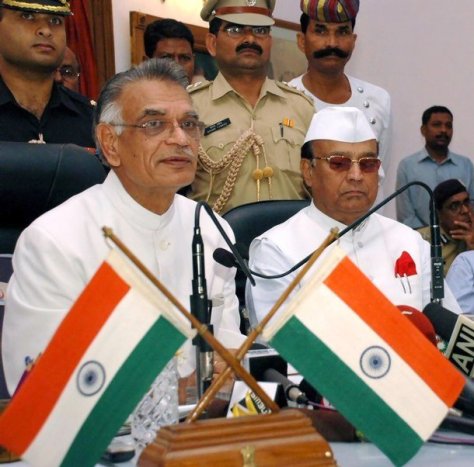
The Governor of Rajasthan Sh. Shivraj Patil’s attitude towards exercising his powers of granting mercy to convicted prisoners is absolutely negative. Article 161 of the Constitution of India confers “on the Governor of a State the right to grant pardons, remissions, reprieves or commute the sentence of any person convicted of any offence against any law relating to a matter to which the executive power of the State extends.” Continue reading Shivraj Patil hath no mercy! Why could he not pardon an old, ailing Ram Kumar?: PUCL

A woman in Delhi Metro, two women in a bus

Many years ago, I was travelling in a DTC bus – or was it a private-run Blueline? – in which the usual sense of calm-with-commotion was disturbed by a sudden act of strategic, small-scale violence, followed by a moment of stunned silence, then some bickering.

Two women were travelling in a bus full of men, and one of them had slapped a man. The man tried to argue and claim innocence, but to no avail. It was obvious to everyone in the bus that the woman would not slap him without a reason. He must have molested her. Most passengers watched silently, eager to closely observe the tamasha so they could relate it to others, like I’m doing now. But quite a few voiced their support of the women, and the bus conductor asked the man in question to get down at the next stop, returning his entire fare. Continue reading A woman in Delhi Metro, two women in a bus

What Kapil Sibal does not understand: the internet

A  few days ago a friend asked me if I knew someone who had the ability and inclination to help out a certain department of the central government with using social media. My friend did not name who the prospective employer was, but clearly, with even Digvijay Singh on Twitter, the Congress party is worried about social media. No surprise that this should happen in a year when the UPA government’s popularity has taken a nose-dive.

The New York Times revealed on 5 December that Kapil Sibal summoned Facebook officials and showed them a Facebook page that allegedly maligned Congress president Sonia Gandhi and said that this was unacceptable. While HRD officials refused to reveal much in that NYT copy, they must have realised that shit has hit the fan, because the next morning’s Indian Express the spin doctoring was clear: there was now a mention of allegedly derogatory pictures of Prophet Mohammed along with the Prime Minister and the Congress President (who are no doubt as sacred in his books as Prophet Mohammed).By the time he held his press conference yesterday, it became about things that Hurt Our Religious Sentiments. On the 19th anniversary of the Babri Masjid demolition, it is very interesting to see a Congress minister using religion to cover up power politics.  Continue reading What Kapil Sibal does not understand: the internet

When Openness is Unfreedom (alternatively, when data is unfreedom) – Part II

This is the second post in the series that I began in October. I want to thank Rasagy Sharma for prompting me to put down the second post in this series.

This evening, Rasagy raised a question on twitter about whether the effort of a developer to make the database of the Indian railways downloadable is ‘official’ or not? As Rasagy later explained, the downloadable database is a list of trains, stations and the railway timetable. This list has has been made available in various downloadable formats (such as .csv, .pdf, etc) to encourage developers/interested persons to make web/mobile based applications. Rasagy’s question was more in the nature of checking the legality of  the act of putting this information/database on another website when it is explicitly copyright of the Indian Railways (as declared on their website). He argued that cities such as New York and some countries across the world have made this information ‘open’, meaning available to the ‘public’. Hence, it is unreasonable for this government entity i.e., the Indian railways, to be ‘closed’ about reuse of this information by private entities and individuals.

Continue reading When Openness is Unfreedom (alternatively, when data is unfreedom) – Part II

Dilli

Dilli, the name most people of Delhi use for their city, is “a multiple-award winning documentary that has played in over 50 international film festivals across North America, South America, Africa, Europe and Asia”. Recently released online.

Continue reading Dilli

तिलिस्म-ए-होशरुबा, उर्फ़ पूंजी की अनकही कहानी

[यह लेख हाल में प्रभात खबर के दीपावली विशेषांक में छप चूका है  और मेरी हालिया किताब डिजायर नेम्ड डेवेलपमेंट के कुछ अंशों पर आधारित है.]

एक ज़माना था जब इंसान जिंदा रहने के लिए पैदावार किया करता था. बहुत पुरानी बात नहीं है – यही कोई सौ डेढ़ सौ बरस पहले का किस्सा है. आज जब हम जिंदा रहने के लिए नहीं बल्कि ‘जीडीपी’ या ‘सेंसेक्स’ जैसे कुछ अदृश्य देवताओं का पेट भरने के लिए पैदावार करते हैं, तब यह बात हमारी याद्दाश्त से तकरीबन गायब हो चुकी मालूम होती है की ये देवता दरअसल बहुत नए हैं. ‘जीडीपी’ की उम्र बमुश्किल अस्सी साल होगी, और ‘सेंसेक्स’ तो हमारे यहाँ १९७९ में ही वजूद में आया है. याद रखने काबिल बात है की इन दोनों का लोगों के वास्तविक जीवन से कोई रिश्ता नहीं है और यह बिलकुल मुमकिन है कि लोगों के जीवन-स्तर में लगातार गिरावट के साथ साथ आंकड़ों में हमें दोनों में अच्छी खासी बढोतरी दिखाई दे. मसलन, यह संभव है कि आप जंग के वक़्त लगातार जीडीपी में इज़ाफा देखें जब वास्तव में लोगों कि ज़िंदगियाँ बद से बदतर होती जा रही हों.

Continue reading तिलिस्म-ए-होशरुबा, उर्फ़ पूंजी की अनकही कहानी

The Last International: Occupy New York, Occupy the Night, Occupy Earth.

Facebook Found Image of the Occupation of Foley Square, New York

Sometimes just a few images, and a few facebook update texts tell you all you need to know.

New York, 18th November 2011, NYPD estimates say that approximately 36,000 people voted with their feet to take back their city, and their planet. Could this be the beginning of the end of Capitalism, at least as we know it? Continue reading The Last International: Occupy New York, Occupy the Night, Occupy Earth.

Sexting no more: Pakistan’s hilarious list of 1,795 expletives to be banned on SMS

Whoever made the English and Urdu lists deserves an award, though I did find some Pakistanis who knew expletives that were not on the lists.

Thanks to this helpful compendium many Pakistanis are finding their expletive vocabulary enhanced. @UroojZia asked what “BUMBLEFUCK” and “LADYBOOG” meant. @Zakoota said the lists should be required reading in schools to give children the vocabulary to describe politicians and cricketers. With the amount of phrases that include the word “BUTT”, @KhaLeak wondered if Aijaz Butt was banned as well. [My story for FirstPost.com]

A Rickshaw Ride in Kolkata: Waled Aadnan

Guest post by WALED AADNAN

“Amar naam Chatterjee!” My name is Chatterjee! sounds like a proclamation from a fiery leader of the masses at a public rally, but it came from a rickshaw wallah plying his trade in the dusty bylanes of North Calcutta and addressed to no one in particular.

As I sat on his rickshaw, the frail old man launched into an indignant tirade against the ruling political party, whom he branded as a group of turncoats, insisting vehemently and repeatedly to nothing but the evening breeze that he had always been a Congressman.

Yes, he defended, petrol prices have been rising, but surely the bosses in Delhi would admit to that! What is the point of protesting about that in an insignificant meeting of rickshaw wallahs’ union? His tone of uncompromising understanding of world affairs drew me to listen to him, rather than plug in my earphones and switch off the world. Continue reading A Rickshaw Ride in Kolkata: Waled Aadnan

Esther’s Story – Battling the Land Mafia in Hardwar: Sumantra Maitra

Guest post by SUMANTRA MAITRA

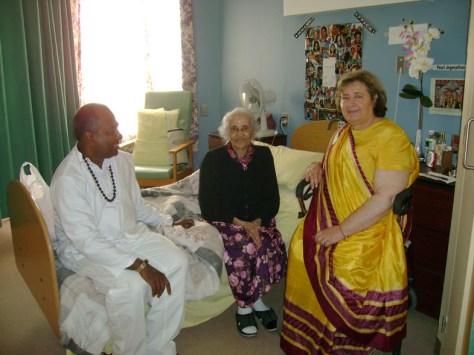
When you are in journalism, something that slowly builds up in you is your immunity to suprise. You can feel fear, sadness, hopelessness, impatience, and even joy, though the last emotion is increasingly becoming a rare thing in this field. But whatever you feel, one thing is for sure, that you generally don’t get surprised. So when I initially heard about a lone Canadian woman of advanced age and energetic spirits, who had come to India at the age of 19 in the 1960s, fighting the land mafia in Hardwar, without any help from anyone, I was intrigued, but NOT surprised.

I decided to chase the story.

Continue reading Esther’s Story – Battling the Land Mafia in Hardwar: Sumantra Maitra

Kathmandu to Peshawar

Himal Southasian editor Kanak Mani Dixit and his wife Shanta Dixit, an educator, are driving from Kathmandu to Peshawar, via Lucknow, Delhi and Lahore, to raise money for Nepal’s only Spinal Injury Rehabiliation Centre, which he started after Kanak’s own miraculous recovery from a spinal injury. The journey was flagged off yesterday by Nepal President Ram Baran Yadav. Do join them!

Naming the Seven Billionth Child: Mitu Sengupta

Photo via The Hindu / Subir Roy

Guest post by MITU SENGUPTA

Last Monday, Nargis Yadav was declared the world’s symbolic seven billionth resident by Plan International, a child rights group. She was born to a family of farmers in a sleepy little village in Uttar Pradesh.

Nargis is surely an unwelcome child, given the grim projections that surrounded the UN Population Fund’s declaration last month, that the world’s population was about to breach seven billion.  Experts have issued sombre warnings of the devastating impact of the growing number of humans on earth. We face a bleak future of environmental distress and scarcity, they say, in which even the basics of food and water will be in short supply.

One wonders why, on October 31st – Halloween, to be precise – the UN did not name a blue-eyed baby boy from Washington, Bonn, Sydney or Toronto as our uncertain world’s symbolic seven billionth? To be sure, this would be politically incorrect, for we live in times when the well-meaning, in their bid to be representative and inclusive, scramble to push women and minorities to the forefront.  But here is an instance where keeping to pedantic liberal pieties has suppressed an honest portrayal of things as they are.

Continue reading Naming the Seven Billionth Child: Mitu Sengupta

What ails Pakistan?

Op-eds. Yes.

Bad things only happen so that columnists may write Op-eds about them. Before the advent of newspapers there were no terrorists, no sectarian divide, nothing was on the brink, nobody was at a crossroads; the insidious Op-ed writers have invented all these things to scare us under our beds, like parents who tell their children ghost stories because they don’t want them wandering around in the dark lest they flip the light switch at an inappropriate time. [Read the full post by Haseeb Asif]

From Kafila archives:

25 Years of Delhi’s Lotus Temple

On a hot Sunday morning, tourists wait 30 minutes in a queue to get inside the House of Worship of the Bahá’í in Kalkaji, better known by its unofficial name, the Lotus temple. Once inside, they spend less than 30 seconds. The tourists, who include burqa-clad women and sadhus in saffron, don’t seem to be in need of a multi-faith prayer hall. The multi-faith prayer service, held thrice a day, is also sparsely attended. People are apparently disappointed there’s only a large hall inside that beautiful white Lotus building, and they can’t even take photos of this hall.   Continue reading 25 Years of Delhi’s Lotus Temple

Crime redefined in Bihar: Ibne Ali

Guest post by IBNE ALI

John Emerich Edward Dalberg Acton is said to have said in 1887, “Power tends to corrupt, and absolute power corrupts absolutely.” After 124 years it is being felt that Lord Acton could have added one more thing; Power gives you the exclusive right to define and redefine things according to your convenience. The ‘all-possible-awards-winner’ chief minister of Bihar Mr. Nitish Kumar could have prompted Lord Acton to enrich this famous quotation for a couple of reasons.

Continue reading Crime redefined in Bihar: Ibne Ali