Category Archives: Everyday Life

Cancer I can’t Afford – Erica Rex

Finding out I had breast cancer came as a shock. But the really rude awakening was learning I’m not middle class anymore.

I found a lump in my breast last March. This wasn’t like the lumps of my youth. Those earlier iterations had been hard as pebbles, painful, nested between my sternum and the base of my breast. They had come and gone with my monthly cycle.  This new lump, a lima bean in size and shape, lay recumbent, a half-inch south of my right nipple, just under the skin. And it didn’t hurt. At all. When I pressed on it, it seemed to dip, as though
bobbing on water.

Click here to read the rest of this article by the marvellous Erica Rex.

Rakhi Sawant Ka Swayamvar!

“Yeah yeah, take a good show and spoil it by theorizing” said my labour lawyer/bollywood-gossip-junkie flat mate. All I said was that I thought Rakhi Sawant Ka Swayamvar was an “Interesting phenomenon that comments on the articulations of the notion of marriage within the context of fixed notions of culture among upper middle class north Indian families and within that the tropes of gender, normativity and melodrama! And so I should write about it on Kafila”.

Her comment wasn’t entirely unjustified.

The way in which one watches these shows in itself raises a range of questions. The show has taken over my life as of now. The final decision of who she will marry will be made soon and the restlessness and anxiety about it is immense and requires effort to contain. Continue reading Rakhi Sawant Ka Swayamvar!

Of Bhoomiputra and Housing

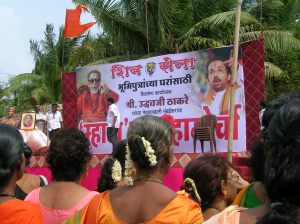
DSCN8740I was moving around Mumbai city on that weekend, mainly in the western suburbs. Several posters and banners were put up all over, announcing a call to a mass rally by Shiv Sena chief Uddhav Thackeray. Thackeray’s clarion call for that meeting was: “Housing for the bhoomiputra“. Bhoomiputra literally means son of the land. On an overt reading of the poster and slogan, one could conclude that the Sena is back to its advocacy of the sons of the soil theory which originally raised it to prominence in the 1960s. But when I attended the rally and noticed the people who attended it, I asked myself, so who exactly is this son of the soil that the Sena is talking about? Is it the Marathi manoos, the local underdog who the Sena argues has no social and economic space in his/her own city? If it is truly the Marathi manoos, then how do I interpret the presence of North Indian women, Bohra muslim women, perhaps even Dalit women, and many other women who I tried to mark but could not classify as either Hindu or Christian or any other particular else.  Hmmm …. Continue reading Of Bhoomiputra and Housing

Teachers and Academics Against 377

University teachers, researchers and academics from all over India issued a strong statement in support of the recent Delhi High Court judgement decriminalizing consensual sex among adults and challenged the legitimacy of “religious leaders” to speak for the whole of society.

180 signatories from institutions and universities in Allahabad, Calicut, Peechi, Punalur, Thiruvananthapuram, Kottayam, Sonipat, Goa, Jammu, Nanded, Mumbai, Pune, Pondicherry, Kolkata, Ahmedabad, Baroda, Chennai, Chandigarh, Delhi, Bangalore, Hyderabad, Guwahati and Shillong endorsed a statement that said:

Continue reading Teachers and Academics Against 377

My son Jane: Moira McDonald

Guest post by MOIRA MCDONALD (Written three years ago).

“I want to be Jane,” repeats my two year old, this time bringing his face very close to mine for special emphasis.  “He has to be Michael. Michael is the boy” says his nearly four year old sister Naomi who is oh-so aware of her budding gender identity.  “Honey, you know in our family, anyone can pretend to be anything.  Someday you may want to pretend to be boy, or a cow for that matter,” I explain. She shrugs agreeing to his choice as long as she can be Mary Poppins.   I wish the contradictions surrounding gender identity were as easily resolved for the other adults in our lives.

Continue reading My son Jane: Moira McDonald

A Month and a Half after Aila: Jadavpur Academics

This is guest post sent by DEEPTANIL RAY from Jadavpur University

Seven weeks after the cyclone Aila hit West Bengal, the situation in the Sunderbans remains alarming. Some of us, teachers, research scholars and students at JU, without any affiliation tags, have tried over the last month and are still trying to reach out to some of the remote areas with materials and distribute them first hand, though our efforts are feeble and insignificant compared to the magnitude of the crisis. Last weekend, we had gone to one of the remotest villages of the Hingalgunj island in the Sunderbans— with the forests on one side, and the Bangladesh border on the other.

As most of you know, Hingalgunj is a Sundarban island on the south-eastern tip of the North 24 Parganas District of West Bengal, with the Sundarban Tiger Reserve Forest on one side, and a small river separating this country from Bangladesh on the other. It is one of the block areas to suffer most from Aila— with over 28,000 families and more than 1,26,000 people affected, according to modest government reports.
Continue reading A Month and a Half after Aila: Jadavpur Academics

‘My friends have always urged me to come out’

These situations haven’t changed much. My identity is still a threat to me. It may effect my promotions, appraisals, friendships and relationships. I live every moment of my life in this fear. I feel that there will be many like me who will be leading such dual lives… we deceive ourselves, trying to hide our identities.

No, that’s not another post about 377 on Kafila. It’s about something else, on a fantastic new blog that you should immediately add to your feedreader.

The Amul girl comes out of the closet

Via amul.com
Via amul.com

Home, house

I entered Yunus’s house. He was allotted 150 square meters of land to build his home. Parts of the house were done up with brick and cement. The roof was still kutcha, raw – in the process of construction. You could see the incompleteness of the roof from the opening around the right hand side from which rain likely comes into the house (as does sunshine). I asked Yunus,

Ghar mein barsaat ka pani aata hai kya? Baarish se pareshaani nahi hoti? Continue reading Home, house

“The Magic of the Human Spirit and of a Nation’s Passion”: Three Queers for the Delhi High Court!

So – here we are folks, in a historic judgement this morning, Delhi High Court has read down Section 377 of the Indian Penal Code to exclude consensual sex among adults. Congratulations to the group of tireless activists who have helped to bring this about, and congratulations to all of us who count ourselves as part of the queer community. Continue reading “The Magic of the Human Spirit and of a Nation’s Passion”: Three Queers for the Delhi High Court!

Gaon chodab nahin

Nandi’s divine wrath strikes BJP leader: Rukun Advani

This is a news flash from rainy Ranikhet, from RUKUN ADVANI of Permanent Black.

Balbir Punj owns a hotel called ‘Windsor Lodge’ on Ranikhet’s outskirts. (When it comes to personal money-making, BJP ideologues seem to have no problems naming their properties after the Queen of England.) Last week Punj came to his Lodge and went to the Kalika temple opposite the property. He did not notice a large bull there, but the bull noticed him: it charged straight for him and before Punj knew what was happening he had been thrown up in the air and gouged in the front. His arm is now in a sling. It being specially embarrassing for a BJP Hindu to be thus cast aside by a cow, Punj has been desperately downplaying his injuries. However, he asked Khanduri to immediately pen the bull, and the bull has been removed from the Kalika temple.

इतिहास से साक्षात्कार की घड़ी;

लालगढ़ मुक्त कराया जा रहा है. पिछले आठ महीने से जिस इलाके में पश्चिम बंगाल की मार्क्सवादी सरकार की पुलिस नही घुस पा रही थी , उस पर केन्द्र सरकार के सशस्त्र बल की सहायता से अब बंगाल की पुलिस धीरे–धीरे कब्जा कर रही है. केन्द्रीय गृह मंत्री पी. चिदंबरम ने कहा ज़रूर था कि यह कोई युद्ध नहीं हो रहा है क्योंकि कोई भी राज्य अपनी ही जनता से युद्ध नहीं करता लेकिन लालगढ़ में अभी चल रहे सैन्य अभियान की रिपोर्ट दे रहे पत्रकार लगातार यह बता रहे है कि वहां स्थिति किसी युद्ध क्षेत्र से कम नहीं है. गांव के गांव वीरान हो गए हैं.हजारों की तादाद में आदिवासी शरणार्थी शिविरों में पनाह ले रहे हैं. ध्यान देने की बात है कि ये शिविर भी राज्य सरकार नहीं चला रही है. पहले दो बडे शिविर तृणमूल कांग्रेस के द्वारा स्थापित किए गए. लालगढ़ की जनता के लिए शिविर स्थापित करने के बारे में बंगाल की सरकार अगर नहीं सोच पाई तो ताज्जुब नहीं क्योंकि उसके हिसाब से वह उसकी जनता नहीं है, वह तो शत्रु पक्ष की जनता है!दूसरे शब्दों में वह गलत जनता है. सही जनता वह है जो मार्क्सवादियों के साथ है.

लालगढ़ में पिछले आठ महीने से एक विलक्षण जन आंदोलन चल रहा था. बुद्धदेव भट्टाचार्य के काफिले पर हमले के बाद पुलिस ने जिस तरह लालगढ़ के आदिवासियों को प्रताड़ित किया, उसने साठ साल से भी ज़्यादा से असह्य गरीबी और अमानुषिक परिस्थितियों को झेल रही आदिवासी जनता के भीतर सुलग रही असंतोष की आग को भड़का दिया. लेकिन ध्यान दें, इन पिछड़े आदिवासियों ने कितनी राजनीतिक परिपक्वता का परिचय दिया! उन्होंने ‘पुलिस संत्रास विरोधी जनसाधारण समिति’ बनाई और लगभग हर संसदीय राजनीतिक दल से सहयोग मांगा. वह उन्हें मिला नहीं. लालगढ़ ने कहा , यहां हमारा अपमान करने वाली पुलिस और हमारी उपेक्षा करने वाले प्रशासन का स्वागत नहीं है. पुलिस और प्रशासन की उनके जीवन में अप्रासंगिकता का आलम यह है कि राज्य विहीन आठ महीनों में इस समिति ने ट्य़ूबवेल लगवाया जो बत्तीस साल के जनपक्षी वाम शासन में नहीं हो सका था, स्कूल चलाया, सड़क बनाई जो बत्तीस साल से नहीं थी और इस बीच अपराध की किसी घटना की कोई खबर नहीं मिली. एक तरह से यह जनता का स्वायत्त शासन था.
Continue reading इतिहास से साक्षात्कार की घड़ी;

The Snub

[Part of  Series. Introduction: For Movement]

Tanger, Morroco, June 2009

Sometimes you just have to seek the travel moment. Yes, the best moments are unexpected, everyday, hidden. Sometimes though, the textbook travel guide moments, mass produced as they are, still work. Try this for a classic travel guide must-do: you drive down to the south of Spain, get to a ferry, put your car in the hold and cross the water in an hour long ride from Europe to Africa. West to.. well… not West. Continent to Continent. Universe to Universe. It’s a [good] travel writer’s worst nightmare and a travel publisher’s wet dream.

Continue reading The Snub

Spaces of Forgetting

[Part of a Series. Introduction: For Movement]

Lisbon, June 2009

From the outside, it looks like a lovely building. Broad and imposing, with a certain faded but still palpable elegance. Like all buildings are at some point in their lives in all cities, it is surrounded by construction gates. The sign says that it is to become, like more and more buildings in more and more cities, luxury condominiums. I think of a friend’s words at a conference a few days before. In the contemporary, he said, inequality is made through making the city. The Portuguese word for “building” is edificio, from the Latin aedis, or dwelling, which itself comes from the Sanskrit inddhh – to burn. Aedis and facere [to make] together make aedificium, to build a dwelling around a hearth, around fire. The word is close to aedes, or temple. It also skirts around aedificare and hence the English “edify” – to improve spiritually. A lot is built in building a building. Continue reading Spaces of Forgetting

For Movement

Reading Fernando Pessoa in Portugal [being the good traveller I am], I get chided on page three itself. Writing about Soares, one of Pessoa’s heteronyms, and Pessoa himself, the translator writing the preface says to me as I sit on the train from Porto to Lisbon staring at the country going by:

“Like Pessoa, Soares never goes anywhere, for he can journey to the infinite in a ride across town on the tram. “If I were to travel,” he says, “I’d find a poor copy of what I’ve already seen without taking one step.”

I look up from The Book of Disquietitude to my laptop screen where I’ve begun writing the first of a series of pieces for Kafila on travel, the cities that I have just left behind and those I am headed towards. I think of a boy in another city by another bay who once said the same thing to me. I think of the hours I spent planning this trip. I realize that I’m already dreaming of the next one even as I’m on this one. I sulk for a moment. I feel bereft of imagination; a victim-consumer of a Lonely Planet travel guide that I do not even own. The backpack on the luggage rack above stares at me accusingly. I plead guilty.

It occurs to me that there is a need for another preface. A because. An I travel because. To silence Pessoa’s baleful glare at me that has become my baleful glare at myself. So here goes.
Continue reading For Movement

Faith, religion, ritual, identity, dogma – how do I understand this?

I walked into Anjali’s  house. She lives in one of the Rehabilitation and Resettlement colonies in Bombay which were developed to provide housing for slum dwellers and railway slum dwellers affected by the creation of roads infrastructure in Mumbai. Her house is a one-room tenement. She has created a litte bedroom space by placing a large showcase unit which separates the living room and the bedroom. I sat down to talk with her when my eyes fell on the Mecca-Medina mosque photograph which was placed on the wall facing her kitchen, above her newly purchased washing machine. For a moment, I was not sure if I had seen correct. Then, while continuing the talking, I glanced carefully again. It was the Mecca-Medina mosque photograph which is usually found in the homes of Bohra Muslims, Shias, Iranis and Sunnis as some kind of a visible mark of religion or show of faith and practice (or perhaps something else, I am not sure). I was both intrigued and amused. Continue reading Faith, religion, ritual, identity, dogma – how do I understand this?

Lakshman Seth and the Sheriff of Nandigram: Raghu Karnad

NOTES FROM NANDIGRAM

This is a guest post by RAGHU KARNAD

May 17, 2009
Beauty is all about the details, and these beautiful election results keep parading out sweet new details for our appreciation. What I’m currently delighted about is the voters of Tamluk in West Bengal dispatching their Communist MP, Lakshman Seth.

Seth has been in the Lok Sabha since 1998, stashin’ away the crores and adding fortifications to his eerie headquarters in Haldia. People say he did a good job of developing the Haldia port. Sure enough, if the business of America is business, then the industriousness of Lakshman Seth is directed purely towards industrialization. How come? Seth is also Chairman of the Haldia Development Authority. Because he allegedly gets a cut out of every industrial operation on his turf (what we dissertation-writers call ‘rent-seeking’). There’s a theory that this is why Nandigram was chosen as the site for the Salim plant, and why the resistance was so bitterly punished when the siege fell (but this is just very plausible hearsay).

Continue reading Lakshman Seth and the Sheriff of Nandigram: Raghu Karnad

A desk of her own. Farewell to Kamala Das

Kamala Das (Madhavikutty, Kamala Suraiya), died this morning, May 31, 2009, aged 75.

Virginia Woolf wrote in A Room of One’s Own (1929):

“A woman must have money and a room of her own if she is to write fiction; and that, as you will see, leaves the great problem of the true nature of woman and the true nature of fiction unsolved.”

In an interview in 1996, the interviewer Shobha Warrier reminds Das of something she had once said “about the pathetic condition of a woman writer who does not even have a writing table. The dining table has to serve as her writing table once it is cleared.”
Kamala Das replies:

Continue reading A desk of her own. Farewell to Kamala Das

साधारण की उदात्तता यानि जनादेश 2009

2009 के लोकसभा चुनाव के नतीजों ने कुछ लोगों को हतप्रभ किया है और अनेक को चमत्कृत. इस जनादेश की व्याख्या इस रूप में की जा रही है कि भारत की जनता ने विकास को तरजीह दी है और इस बडी मंदी के दौर में अपेक्षाकृत सुरक्षित चुनाव किया है. हमारे एक मित्र का कहना है कि इस असुरक्षा के समय में जनता जो हाथ में है , उसे ही संजोए रखना चाहती थी. भारतीय जनता पार्टी और तथाकथित तीसरे मोर्चे के ऊपर कांग्रेस के नेतृत्व वाले गठबंधन को चुनने के पीछे बिजली-पानी –सडक और जान-माल की हिफाजत की रोज़मर्रा की चिंताएं ज़रूर रही होंगी, लेकिन क्या यह इतना ही था? साधारण जनता क्या सिर्फ मामूली सवालों में ही उलझी रहती है और कभी अपने रोज़मर्रेपन से ऊपर नहीं उठती? बार-बार उसे इसी हद में बांधकर देखने की कोशिश की जाती हैहालांकि उसने कई बार यह बतलाया है कि उसके मुद्दे सिर्फ वही नहीं हैं जो व्याख्याकार बताते रहे हैं. साधारण जनता की उदात्तता की आकांक्षा आखिर किस रूप में व्यक्त होती है?

भारत में मोहनदास करमचंद गांधी ने शायद सबसे पहले साधारण के भीतर छिपी इस उदात्तता को ठीक-ठीक पहचाना था और उसका आदर किया था. क्रांतिकारियों या फिर कम्युनिस्ट विचार रखने वालों को साधारणता पर सन्देह ही था.
क्रांतिकारियों ने इसीलिए चुने हुए लोगों के दस्ते बनाए और कम्युनिस्ट खुद को जनता के एक अगुआ दस्ते के रूप में पेश करते रहे. शास्त्रकारों या सिद्धांतकारों को भी साधारणता को समझने में काफी दिक्कत होती रही है. इसलिए उनकी दिलचस्पी उन कोटियों के निर्माण में रहती है जो आसानी से सामूहिक आचरण की व्याख्या करने में सहायक हों. पिछले बीस वर्षों में भारतीय जनता के सारे निर्णयों को पहचान की कोटि के आधार पर समझने की कोशिश की गई है. यहां यह नहीं कहा जा रहा कि यह कोटि या इस तरह की सैद्धांतिक कोटियां बिलकुल अप्रासंगिक हैं, सिर्फ यही कहने की कोशिश की जा रही है कि इस प्रकार की किसी एक कोटि में किसी समूह को शेष कर देने से हम उसके भीतर छिपी सारी सम्भावनाओं को नज़रअंदाज़ देते हैं.
Continue reading साधारण की उदात्तता यानि जनादेश 2009

Making Sense of the Ravi Dasis: Surinder S. Jodhka

The recent attack on the head of Dera Sachkhand Ballan in one of their gurudwaras in Vienna and the ensuing shoot-out between Dalit and non-Dalit Sikhs, spilling over in India into angry street demonstrations in Jalandhar by followers of Dera Sachkhand and other Dalit bodies, forces us to confront the question of caste in contemporary Punjab. We asked SURINDER S. JODHKA, sociologist and Director, Institute of Dalit Studies, who works in this area, to give us a background note.

The Dera Sachkhand Ballan is one of the most important Guru Ravi Das Deras in Punjab today. Ravi Das was a 15th century saint of the Chamar caste whose message is constructed by his contemporary followers in a modern language that foregrounds questions of caste oppression and the  fight against the prevailing structures of authority and the Brahmanical moral order.  In his piece here, Surinder gives us a historical background to the emergence of this movement, and brings us to the point of the 1990s, when the “diasporic energy” of Ravi Dasis who had emigrated to the UK and Europe, gave a boost to the movement both at home as well as in the diaspora, where Ravi Dasis had found things to be no different. In the alien context, with no systemic justification for caste ideology, the Punjabi Dalits did not expect to be reminded of their “low” status in the caste hierarchy, says Surinder, but facing systematic discrimination from wealthy Jat Sikhs, were forced to set up their own autonomous organizations and their own gurudwaras. Continue reading Making Sense of the Ravi Dasis: Surinder S. Jodhka