I walked into Anjali’s house. She lives in one of the Rehabilitation and Resettlement colonies in Bombay which were developed to provide housing for slum dwellers and railway slum dwellers affected by the creation of roads infrastructure in Mumbai. Her house is a one-room tenement. She has created a litte bedroom space by placing a large showcase unit which separates the living room and the bedroom. I sat down to talk with her when my eyes fell on the Mecca-Medina mosque photograph which was placed on the wall facing her kitchen, above her newly purchased washing machine. For a moment, I was not sure if I had seen correct. Then, while continuing the talking, I glanced carefully again. It was the Mecca-Medina mosque photograph which is usually found in the homes of Bohra Muslims, Shias, Iranis and Sunnis as some kind of a visible mark of religion or show of faith and practice (or perhaps something else, I am not sure). I was both intrigued and amused. Continue reading Faith, religion, ritual, identity, dogma – how do I understand this?
Category Archives: Everyday Life
Lakshman Seth and the Sheriff of Nandigram: Raghu Karnad
NOTES FROM NANDIGRAM
This is a guest post by RAGHU KARNAD
May 17, 2009
Beauty is all about the details, and these beautiful election results keep parading out sweet new details for our appreciation. What I’m currently delighted about is the voters of Tamluk in West Bengal dispatching their Communist MP, Lakshman Seth.
Seth has been in the Lok Sabha since 1998, stashin’ away the crores and adding fortifications to his eerie headquarters in Haldia. People say he did a good job of developing the Haldia port. Sure enough, if the business of America is business, then the industriousness of Lakshman Seth is directed purely towards industrialization. How come? Seth is also Chairman of the Haldia Development Authority. Because he allegedly gets a cut out of every industrial operation on his turf (what we dissertation-writers call ‘rent-seeking’). There’s a theory that this is why Nandigram was chosen as the site for the Salim plant, and why the resistance was so bitterly punished when the siege fell (but this is just very plausible hearsay).
Continue reading Lakshman Seth and the Sheriff of Nandigram: Raghu Karnad
A desk of her own. Farewell to Kamala Das

Kamala Das (Madhavikutty, Kamala Suraiya), died this morning, May 31, 2009, aged 75.
Virginia Woolf wrote in A Room of One’s Own (1929):
“A woman must have money and a room of her own if she is to write fiction; and that, as you will see, leaves the great problem of the true nature of woman and the true nature of fiction unsolved.”
In an interview in 1996, the interviewer Shobha Warrier reminds Das of something she had once said “about the pathetic condition of a woman writer who does not even have a writing table. The dining table has to serve as her writing table once it is cleared.”
Kamala Das replies:
साधारण की उदात्तता यानि जनादेश 2009
2009 के लोकसभा चुनाव के नतीजों ने कुछ लोगों को हतप्रभ किया है और अनेक को चमत्कृत. इस जनादेश की व्याख्या इस रूप में की जा रही है कि भारत की जनता ने विकास को तरजीह दी है और इस बडी मंदी के दौर में अपेक्षाकृत सुरक्षित चुनाव किया है. हमारे एक मित्र का कहना है कि इस असुरक्षा के समय में जनता जो हाथ में है , उसे ही संजोए रखना चाहती थी. भारतीय जनता पार्टी और तथाकथित तीसरे मोर्चे के ऊपर कांग्रेस के नेतृत्व वाले गठबंधन को चुनने के पीछे बिजली-पानी –सडक और जान-माल की हिफाजत की रोज़मर्रा की चिंताएं ज़रूर रही होंगी, लेकिन क्या यह इतना ही था? साधारण जनता क्या सिर्फ मामूली सवालों में ही उलझी रहती है और कभी अपने रोज़मर्रेपन से ऊपर नहीं उठती? बार-बार उसे इसी हद में बांधकर देखने की कोशिश की जाती हैहालांकि उसने कई बार यह बतलाया है कि उसके मुद्दे सिर्फ वही नहीं हैं जो व्याख्याकार बताते रहे हैं. साधारण जनता की उदात्तता की आकांक्षा आखिर किस रूप में व्यक्त होती है?
भारत में मोहनदास करमचंद गांधी ने शायद सबसे पहले साधारण के भीतर छिपी इस उदात्तता को ठीक-ठीक पहचाना था और उसका आदर किया था. क्रांतिकारियों या फिर कम्युनिस्ट विचार रखने वालों को साधारणता पर सन्देह ही था.
क्रांतिकारियों ने इसीलिए चुने हुए लोगों के दस्ते बनाए और कम्युनिस्ट खुद को जनता के एक अगुआ दस्ते के रूप में पेश करते रहे. शास्त्रकारों या सिद्धांतकारों को भी साधारणता को समझने में काफी दिक्कत होती रही है. इसलिए उनकी दिलचस्पी उन कोटियों के निर्माण में रहती है जो आसानी से सामूहिक आचरण की व्याख्या करने में सहायक हों. पिछले बीस वर्षों में भारतीय जनता के सारे निर्णयों को पहचान की कोटि के आधार पर समझने की कोशिश की गई है. यहां यह नहीं कहा जा रहा कि यह कोटि या इस तरह की सैद्धांतिक कोटियां बिलकुल अप्रासंगिक हैं, सिर्फ यही कहने की कोशिश की जा रही है कि इस प्रकार की किसी एक कोटि में किसी समूह को शेष कर देने से हम उसके भीतर छिपी सारी सम्भावनाओं को नज़रअंदाज़ देते हैं.
Continue reading साधारण की उदात्तता यानि जनादेश 2009
Making Sense of the Ravi Dasis: Surinder S. Jodhka
The recent attack on the head of Dera Sachkhand Ballan in one of their gurudwaras in Vienna and the ensuing shoot-out between Dalit and non-Dalit Sikhs, spilling over in India into angry street demonstrations in Jalandhar by followers of Dera Sachkhand and other Dalit bodies, forces us to confront the question of caste in contemporary Punjab. We asked SURINDER S. JODHKA, sociologist and Director, Institute of Dalit Studies, who works in this area, to give us a background note.
The Dera Sachkhand Ballan is one of the most important Guru Ravi Das Deras in Punjab today. Ravi Das was a 15th century saint of the Chamar caste whose message is constructed by his contemporary followers in a modern language that foregrounds questions of caste oppression and the fight against the prevailing structures of authority and the Brahmanical moral order. In his piece here, Surinder gives us a historical background to the emergence of this movement, and brings us to the point of the 1990s, when the “diasporic energy” of Ravi Dasis who had emigrated to the UK and Europe, gave a boost to the movement both at home as well as in the diaspora, where Ravi Dasis had found things to be no different. In the alien context, with no systemic justification for caste ideology, the Punjabi Dalits did not expect to be reminded of their “low” status in the caste hierarchy, says Surinder, but facing systematic discrimination from wealthy Jat Sikhs, were forced to set up their own autonomous organizations and their own gurudwaras. Continue reading Making Sense of the Ravi Dasis: Surinder S. Jodhka
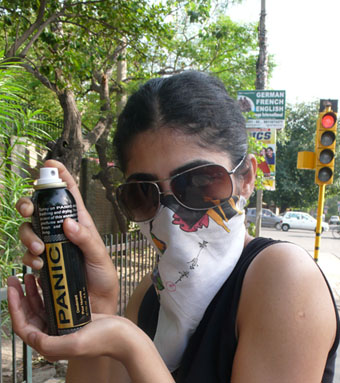
An Ounce of Panic is Worth a Quintal of Surveillance!
Did you know terrorists are running amok in Delhi University??
Continue reading An Ounce of Panic is Worth a Quintal of Surveillance!
Why Delhi voted and Mumbai didn’t
These have been doing the rounds on Facebook.
Ten reasons why South Mumbai did not vote
by Abhinav Dhar
10. Clashed with Salsa class
9. Election whites not drycleaned
8. No candidate a hottie
7. Tony Jethmalani contesting from suburbs. Sigh
6. No valet parking at booth
5. Spotted servant in queue ahead of us
4. Driver not come
3. “Elections over dude, Obama won!”
2. No party tackling real issues, eg, reduce Gold Gym rates
1. No home delivery!
Why Delhi turned up to vote
By Madhavan Narayanan
1. They loved the Tata Tea ad
2. They saw the Chopras go out, and thought they must overtake the Lancer from left
3. Bunty’s girlfriend wanted it when they were going out for some Chinese
4. Diwan Saheb on second floor persuaded them. He is jaaaint saactry in DPCC
5. Without stable government, real estate will not revive
6. Election Commission directly asked Pappu. So nice of them
7. Grandfather started talking on Partition, and they had to run
8. Auntyji hoped some TV crew will come and take a soundbite
9. Baba Ramdev said it is good for health
And finally
10. They had to beat the Bambaiyaas. Izzat ka sawaal hai, hainji?
Barter – is that what they’re calling it now?
It’s a world on the downturn out there.
And new and creative ways of handling the situation emerge. Imagine a journalist accepting some old jeans (in very good condition), some rice, atta and vegetables (and also sugar) from the newspaper proprietor in exchange for her reporting. Meanwhile, an ad agency employee opts for day-old newspapers and fruits for every successful slogan he coins.
Impossible?
Continue reading Barter – is that what they’re calling it now?
Another sort of touch
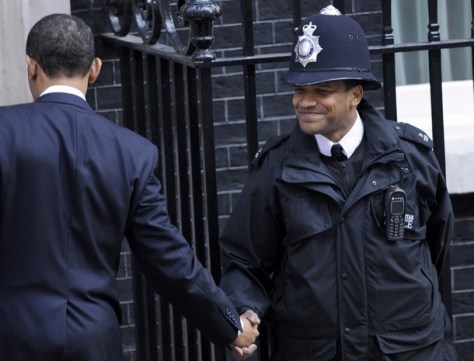
The British queen placed a royal hand around the American First Lady’s waist, who graciously reciprocated, and a million words and images were launched in the world media on that historical moment.
How come we never got to see this other Touching Moment in London involving another Obama? Thanks to Dilip Simeon, who was sent this by a friend, I received this picture of what happened when Barack Hussein was entering 10, Downing Street on April 1, 2009.
There he is, a British police officer joyously breaching protocol while ushering a black American president into the British corridors of power. As the caption in the forwarded message said – “the two brothers couldn’t resist the historic moment!”

(Reuters/Toby Melville)
That’s it for now, folks.
A sham called election reporting
A ‘Kashmiri’ ‘Gurjar’ ‘Muslim’ is contesting the Dausa Lok Sabha seat. As an independent. For the simple reason that after delimitation, Dausa became a reserved constituency. Rerseved for the Scheduled Tribes. Meenas are ST’s. Gurjars wanted to be ST’s. Not only didn’t they not get that, they were deprived of Dausa, where the feudal PIlots had been Gurjar kings.
So someone thought of this simple idea: get a Kashmiri Gurjar. Kashmiri Gurjars are ST’s.
That candidate is campaigning around Dausa, and I gather that even the Brahmins of the area are supporting him! Him! A Kashmiri Muslim Gurjar! Continue reading A sham called election reporting
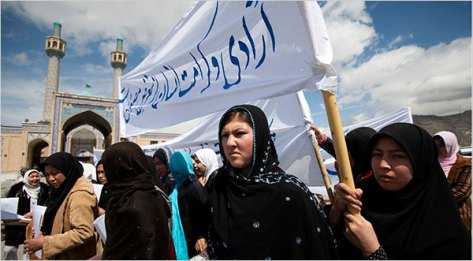
Afghan Women Protest New Law on Home Life
About 300 Afghan women, facing an angry throng three times that number, walked the streets of Kabul on Wednesday to demand that Parliament repeal a new law that introduces a range of Taliban-like restrictions on women, and permits, among other things, marital rape.

‘The young women stepped off the bus and moved toward the protest march just beginning on the other side of the street when they were spotted by a mob of men.’
‘”Get out of here, you whores!” the men shouted. “Get out!”….It was an extraordinary scene. Women are mostly illiterate in this impoverished country, and they do not, generally speaking, enjoy anything near the freedom accorded to men. But there they were, most of them young, many in jeans, defying a threatening crowd and calling out slogans heavy with meaning.’ Read the full story by Dexter Filkins here.
[Courtesy: SACW]
Dignifying Jade Goody, or, What Jade Goody actually connotes: D. Parthasarthy
guest post by D. PARTHASARTHY
When newspaper columnists become self-righteous, it is usually because they see a good way of capturing reader interest by moralizing about an issue. After all, tabloids around the world regularly make fortunes by generating a false sense of moral outrage and indignation through stories of the indiscretions and ineptitudes, sufferings and misfortunes of celebrities and of not so famous people. It is a sign of irony as well as an indication of the way in which neo-liberal capitalist media works, that the consequences of alienation engendered by an individualist ideology is fodder for sensationalist reporting, but also a tool for mobilizing collective conscience against alienated individuals, and for preventing communities from understanding the real reasons for alienation.
Continue reading Dignifying Jade Goody, or, What Jade Goody actually connotes: D. Parthasarthy
Cultural Policing in Dakshina Kannada: Vigilante Attacks on Women and Minorities
[This summary comes to us from ARVIND NARRAIN (ALF) of a report brought out by the People’s Union for Civil Liberties, Karnataka (PUCL-K) in the wake of the attacks on women in Mangalore by cadres of the Hindu right-wing Sri Ram Sene.]
It was only after the continuous telecast of the images of the women who were subjected to an horrific assault by cadres of the Sri Ram Sene in a pub in Mangalore on January 24, 2009, that public attention gravitated towards what was happening in Mangalore. Self styled vigilante groups in Dakshina Kannada have begun to police social interactions between members of different religious communities such as boys and girls drinking juice together or sitting together on a bus merely because they come from different religious communities. Cultural policing also targets women in particular and lays down norms with respect to public spaces they can occupy and the clothes which they can wear. Cultural policing has as its primary target, young people. From Shefantunde (16) who was attacked for talking to a Hindu girl to a college student Shruti and Shabeeb for talking on a bus to Anishwita (23), Akeel Mohammmad (24) and Pramilla(22) for drinking a juice together, its the young which has come under vicious attack. Perhaps we also need to think of the young not just as victims but indeed as agents of social transformation who through their everyday acts of fraternal living are fulfilling the promise of the Indian Constitution and thereby imperiling the ideological agenda of those who see India differently. Cultural policing aims to punish all those who try to live out the meaning of the Preamble’s promise of ‘fraternity’ and is a fundamental attack on the very Constitutional order. The promise of fraternity held out in the Preamble is what is contested at its very roots by cultural policing. What cultural policing wants to produce are monolithic self-enclosed communities with no form of social interaction between them. It is antithetical to the idea of ‘We, the people of India’ and insists that India is no more one nation, but rather a collection of separate peoples. This Report documents how sixty years after independence, the vision of the framers of the Constitution is sought to be so completely repudiated by organizations which are bent on ripping out the heart of Indian Constitutionalism.
The full report is available on the Alternative Law Forum website and can be accessed here.
The Great House Hunt
A rather fierce debate has been raging at Kafila, the instigator is Zainab, a “Muslim” married to a “Telugu Brahmin” who discovered how deep is the hold of antediluvian ideas and practices in a city that has for sometime been touted as the hub of 21st century India.
She wrote a simple account of her experiences while searching for a house on rent in Bangalore. The piece also touched upon issues like communal profiling, stereotyping entire communities and such like. Some of those commentating on the piece have made ‘clever’ attempts at obfuscation by raising issues like loan quotas for Muslims and such other totally extraneous arguments. Never having studied economics, banking and/or commerce, never having had the resources to apply for a bank loan and not having my life enriched by the immensely educational experience of house hunting in Bombay and Bangalore, I will not try to take on Ipsita or comment on the secular practice of discrimination against all house hunters if they do not belong to the caste, religion, region, gender or economic status of the landlord. Continue reading The Great House Hunt
The Rise of the Underground – A New Discovery?
Believe it or not, experts at the World Bank and the IMF are disovering the virtues of something we at Kafila have been, off and on, debating: the so-called ‘underground economy’, the ‘informal sector’ or what has also been called the sphere of ‘noncorporate capital’.
“Economists have long thought the underground economy — the vast, unregulated market encompassing everything from street vendors to unlicensed cab drivers — was bad news for the world economy. Now it’s taking on a new role as one of the last safe havens in a darkening financial climate, forcing analysts to rethink their views”, states a recent Wall Street Journal report from Ahmedabad. Continue reading The Rise of the Underground – A New Discovery?
The Shame of A Name
This has never happened to me before. But then, there is always a first time for everything in life.
My name is Zainab Bawa.
“Are you Punjabi?”
“Are you Parsi?”
“What are you?” Arjun bhai, the hawker outside VT station had once asked me. “Muslim,” I had replied. And then, very bashfully, he said to me, “Just asking. Could not make out. You speak such good Marathi. And then, after all, we are all of the humanity kind – you cut my finger, the blood that oozes out will be the same as yours.” Continue reading The Shame of A Name
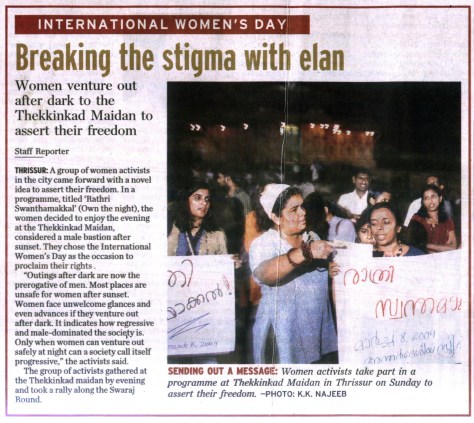
Women’s Day 2009, Thrissur

Smile Pinki, Pinki Sonkar
If you’ve recovered from your Post-Slumdog Stress Disorder, may I dare to write a short post about Smile Pinki, the short documentary that also won an Oscar and that is also set in India? Continue reading Smile Pinki, Pinki Sonkar
Civility, Harmuniya Bajaiyke: Prasanta Chakravarty
This guest post was sent to us by PRASANTA CHAKRAVARTY
A recent exchange in a congregation addressing the nature of contemporary civil society caught my attention. This was a formal gathering where there was supposed to be a pitch on an idea tentatively christened civility index: that is, whether it was possible to empirically measure civility and come up with some conceptual conclusions, as well as have more practical usages once such indicators will have been developed. A searching question came from someone who had spent a lifetime fighting liberal centrism and opportunism. “Why do you call the whole thing civility index,” she inquired, “civility connotes propriety and manner and etiquette, when you are interested to scale human capacities, right?”
This is a fundamental and worthy question, especially keeping in mind that certain variants of civil society discourse has caught the imagination of many invested in democracy right now, even as they wish to steer clear of old leftist certainties and eschew easy liberal pluralism at once. Are propriety and etiquette wholly irrelevant to our understanding of modern civil society? Is manner rudimentary to civil society, counterproductive to doing anything worthwhile? Does civility dilute the associational potential of civil society—human capacities being robbed off by issues of mere conduct and comportment? Are traditional societies uncivil by definition? And does civility, more than just civil, civic or public, betray fashionable elitism unabashedly?
Continue reading Civility, Harmuniya Bajaiyke: Prasanta Chakravarty
The Arrest of Shamim Modi at Industrialists’ Behest
Activist Working for Rights of Tribal People Arrested
Ms Shamim (nee Meghani) Modi, a law graduate working among the tribals in Betul district, Madhya Pradesh, has had to pay a heavy price for taking up the cause of tribal people and other industrial workers. Shamim, who works with the Samajwadi Jan Parishad (an organization of socialist-Gandhian orientation) has been put behind bars in Hoshangabad jail for exposing the corrupt nexus between politicians and the mining mafia. She was arrested in gross violation of democratic rights on 10th February 2009 from her residence at Harda, M.P. The process of attempting to secure bail from M.P High Court is now on.
The arrest was made on false charges, one of instigating tribals to ‘attack forest officials’ and another of ‘kidnapping with the intention to kill’ these officials! These charges were brought against her (and her husband) two years ago in 2007. Subsequently no enquiries were conducted, and no follow-up was done but the fact that these charges hung over their heads was presumably meant to cow them down. These charges have suddenly been resurrected because the administration has been under pressure from industrialist lobbies. Earlier, the trial court had rejected her bail plea despite the fact that the person supposed to have been ‘kidnapped’ was said to be present in court and denied any such thing. Another evidence, if any was still required, of the deep nexuses of power that operate at these levels. Continue reading The Arrest of Shamim Modi at Industrialists’ Behest
A Kingdom of Crabs…
A kingdom of crabs ascends
here on stones
heavy enough to sink our faith
if we tie it to them.
But a mile away
from this promenade
my friend sucking a succulent crab leg
quips, the only way to pin
these bastards down
is to press with the index finger
their carapace to the ground.
Ah! The heavist thing
these legs carry
makes them a morsel
for a sea screaming I’m hungry!
Cheers!