Category Archives: Frontiers

National contestation, not religion, responsible for the plight of Myanmar’s Rohingyas: Ayesha Siddiqa

Guest post by AYESHA SIDDIQA
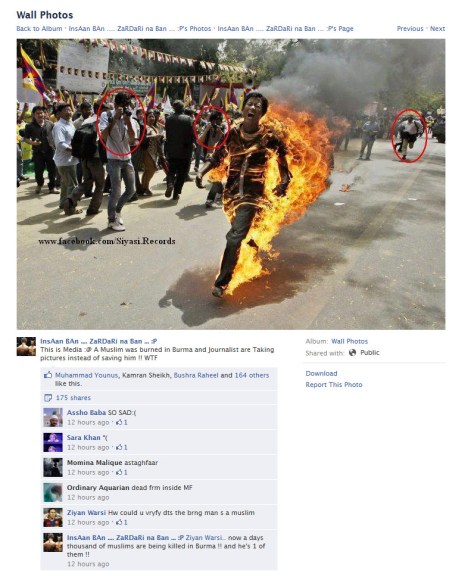
This photo is a screenshot of a Facebook page that incorrectly shows the self-immolation of a Tibetan activist in Delhi as an image of Rohingya persecution in Myanmar. This is one of countless such images circulated in social media. Image credit: Express Tribune, Pakistan.

These days, the social media is abuzz with discussion on Myanmar. Interestingly, it is not even a constructive discussion but one which is meant for point scoring. The nature of the discourse has complicated the issue even more and thus calls for at least a couple of articles: one on the issue and another one meant to be an analysis of the situation of Burmese Muslims. It is important at this stage to disentangle the two dimensions to make sense of what is actually happening. Continue reading National contestation, not religion, responsible for the plight of Myanmar’s Rohingyas: Ayesha Siddiqa
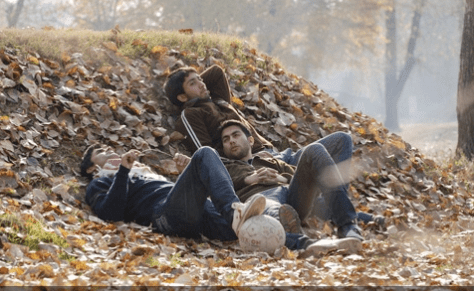

APDP statement on Supreme Court’s suo-moto cognizance on Amarnath pilgrim deaths

This press release was issued by the ASSOCIATION OF PARENTS OF DISAPPEARED PERSONS on 31 July 2012
 
Today, 31 July 2012, Association of Parents of Disappeared Persons (APDP), held its regular monthly meeting where various issues confronting the struggle of the family members of the disappeared were discussed. Besides other issues, the recent suo-moto cognizance of the Supreme Court of India regarding the deaths of Amarnath pilgrims and its continued indifference towards the sufferings of the family members of the disappeared were raised.
On 15 July 2012, the Supreme Court took suo-moto cognizance of the deaths of 67 Amarnath pilgrims over the first 17 days of the Amarnath Yatra. Referring to a clear disregard for human life, the Supreme Court cited the constitutional rights to life [Article 21] and freedom of movement [Article 19(1) (d)] in India and issued notices to the Central Government, Government of Jammu and Kashmir and the head of the Amarnath Shrine Board. Subsequently, a high powered committee was constituted to investigate the reasons behind the deaths. Continue reading APDP statement on Supreme Court’s suo-moto cognizance on Amarnath pilgrim deaths

Iranian filmmaking in Kashmiri autumn

Set in 2002, shot in 2009, Aamir Bashir’s film Harud will be in select PVR cinemas on Friday, 27 July. Harud is clearly inspired by Iranian films which manage to say a lot without saying much. Like a lot of Iranian cinema, a child is at the centre of the film. The brilliant acting by Shahnawaz Bhat, who plays the protagonist Rafiq, makes the film. In the expressions on his face there is ambiguity and wonderment as much as there is humiliation, helplessness and a desire to do something to change things around him. Here is a film about Kashmir that does not begin with beautiful landscape and does not end with a big encounter between militants and forces. This is not a film that seeks to explain the Kashmir conflict – rather, it takes you inside the lives of ordinary people and how they faced the madness of a conflict. Regardless of what your views on Kashmir are, Harud succeeds in making you empathise with Rafiq and others around him. That, for any narrative on Kashmir, is no small achievement.

Read more about the film in Time Out and ArtViewBlog. Here are some interesting interviews of the director.

In Solidarity with Oprah

I recently read a scathing article on Oprah Winfrey. I was quite shocked. The journalist made such fuss about her honest observations as if it’s criminal to not know something. However, what were more astonishing were the serendipitous parallels between her journey to Indian and mine to US. And when I read the article, I almost felt as if someone was mocking at me. I felt outraged and decided that I’ll write this note in solidarity with Oprah. Perhaps then, people will see the injustice done to her. Well, I am a celebrity too, here in this country. Not as big as Oprah but it doesn’t matter. It doesn’t matter even if you’re not able to place me at all. The real celebrities don’t publicize themselves anyway. They’re obscure, consigned to oblivion, with some quaint looking academic in some foreign university (probably US) fawning at the greatness of their work. These days all it takes to be a celebrity is to be notorious with your face pasted everywhere. You’d be surprised by the lack of work backing most people you take for celebrities. Anyway, I am notorious enough for the people who’ve suffered me on stage, I really don’t have much work to support me, and I guess I have had had enough presence in media to statistically pass off as a celebrity. Continue reading In Solidarity with Oprah

Is the Hurriyat divorcing democracy and freedom?: Gowhar Geelani

Guest post by GOWHAR GEELANI

By any stretch of imagination, the All Parties Hurriyat Conference [APHC] has ceased to be an amalgam of ‘all parties’. It seems that this conglomerate of several pro-freedom political, social and religious parties is actually being run by a chosen few in a dictatorial manner. It is no secret now that the fissures in the Hurriyat ‘M’, the one led by the popular head-priest based in Srinagar, Mirwaiz Umar Farooq, run neck deep.

The APHC was formed on 10 March 1993 to find a political solution to Kashmir dispute after a large-scale armed rebellion since 1989 had successfully highlighted the need for a resolution to the long-standing dispute. Essentially, this conglomerate was formed with the clear aim of achieving the “right to self-determination” for Kashmiris in accordance with the United Nations’ Security Council Resolutions vis-à-vis Kashmir.

But all is not well with the Hurriyat (M). One of its prominent leaders, Professor Abdul Gani Bhat has openly challenged group’s constitution by declaring that the UN resolutions on Kashmir have become “irrelevant”.

Continue reading Is the Hurriyat divorcing democracy and freedom?: Gowhar Geelani

If ‘temporary’ meant special, what would ‘special’ mean?: Gazala Peer

Guest post by GAZALA PEER

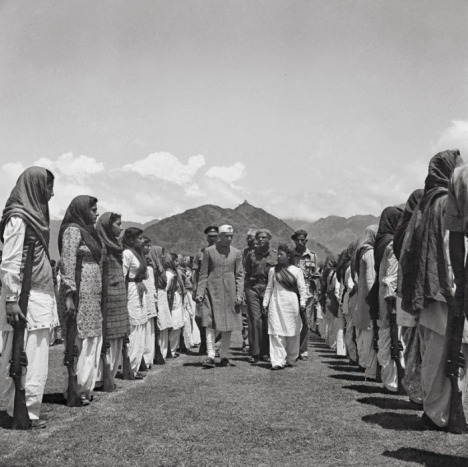
Circa 1948, this photograph shows Jawaharlal Nehru inspect a women’s militia in Kashmir. Via andrewwhitehead.net

On 13, October 2010 a team of interlocutors was appointed by the Government of India to hold dialogue with all the sections of the society in Jammu and Kashmir. The team of interlocutors consisted of journalist Dileep Padgonkar, educationist Radha Kumar and the former Information Commissioner M. M. Ansari. After almost one and a half years the report was released on 24 May 2012 by the Ministry of Home Affairs (.pdf here). The report calls for formation of a Constitutional Committee to review the extension of central laws to the state of J&K from 1952 onwards. Some of the major recommendations are: changing the temporary nature of Article 370, dividing the state into three Regional Councils and appointment of the Governor but after consultation with the state legislature. The Report further says that the findings of this Constitutional Committee shall be binding on all the ‘stake holders’ in the State. Continue reading If ‘temporary’ meant special, what would ‘special’ mean?: Gazala Peer

Dr Khalil Chishty is back home – three cheers for candle-light peaceniks

The 80 year old Pakistani virologist Dr Khalil Chishty just reached Pakistan. His son Tariq called me from Islamabad. “Sorry we couldn’t meet, it was all so rushed.” Tariq Chishty was worrying about getting a PIA ticket – President Zardari sent his special PAF plane to get them! Contrast this with the rank indifference with which the Indian government treats the issue of Indian prisoners in Pakistan.

Just a few days ago, Tariq Chishty was convinced his father is not going to be freed in the hearing on Thursday and was ready to return to Pakistan alone. But the Supreme Court of India, in an unprecedented judgement, allowed him to go home, on the condition that he must return by 1 November for the next hearing. Some months ago when his grandson had met him in jail, Dr Chishty had bid him goodbye as though it was the last time. This is not the end yet – the Supreme Court may uphold his conviction and god knows if he’ll again have to spend time in jail. 20 years in India have been jail-like for him even when he’s not been in jail. For details of his case, whether and why he should be granted mercy and so on, please see this article by me. Continue reading Dr Khalil Chishty is back home – three cheers for candle-light peaceniks

Family chronicles

Jamal Kidwai tells the (continuing) story of the Partition through family memories:

As children we would invariably be divided into Pakistani and Hindustani groups. We would have long arguments about who would win the next war, whether Imran Khan was a better all-round cricketer than Kapil Dev; we would even divide ourselves into Indian and Pakistani teams when it came to playing cards, scrabble, cricket or antakshari. These competitions and arguments brought small but interesting victories. Like once when in the course of an argument, a Pakistani cousin pulled out a tube of Colgate toothpaste, a far slicker plastic tube than our usual Indian toothpaste which came in tin tubes and was easily rusted. He was taunting us about the quality of the toothpaste tube which, of course, proved how backward India was compared to Pakistan. At this point one of us from the Indian team noticed that ‘their’ tube had a mark ‘Made in India’. Nothing gave us more joy than that and the Pakistani team was not only defeated but was left embarrassed for the rest of the holidays. (Material wealth and consumer goods was one area where Pakistan, with its imported goods from the US, was far more ‘developed’ than India and it gave us great pleasure to puncture that aspiration.) [Read the full article.]

…and now Judicial Impunity?: JKCCS

This release comes from the JAMMU KASHMIR COALITION OF CIVIL SOCIETY
2 May 2012: The recent Supreme Court judgment in the Pathribal case is very disappointing.
Fake encounters, along with various other human rights violations, have been a reality for the people of Jammu and Kashmir over the last twenty two years. In 2008, according to media reports, Supreme Court Justices Aftab Alam and G.S. Singhvi made observations in court in relation to the practice of fake encounters for rewards in Jammu and Kashmir. With about 8000 persons disappeared, 70,000 persons killed, numerous cases of torture, rape and other human rights violations, Jammu and Kashmir has seen institutional denial of justice. Continue reading …and now Judicial Impunity?: JKCCS

Pathribal ruling a setback for justice in Jammu and Kashmir: Amnesty International

This press release comes from AMNESTY INTERNATIONAL

1 May 2012

Special powers that allow India’s armed forces suspected of involvement in extra-judicial killings to sidestep the civilian courts have been reinforced in a disappointing court ruling over the notorious killings of five Kashmiri civilians 12 years ago.

India’s Supreme Court has contradicted a reported statement by its Justices in February 2012 that army personnel suspected of murder should be placed in front of a civil judge.

Instead it opted to give military authorities eight weeks to bring about the court martial of eight army officials allegedly responsible for the unlawful killing of five youths in Pathribal, in March 2000. Failing that, the Central Bureau of Investigation (CBI), may apply to prosecute the army personnel. Continue reading Pathribal ruling a setback for justice in Jammu and Kashmir: Amnesty International

A meeting with Deepak Perwani

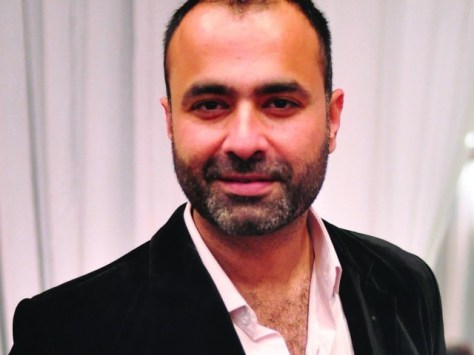
At the Lifestyle Pakistan trade exhibition that concluded in Delhi on Sunday, one stall stands out from a distance for just its name – Deepak Perwani, one of Pakistan’s most famous fashion designers. This was the first of its kind exposure for Perwani outside the Indian fashion circuit, of which he has long been a friend and fellow traveller. The humble Perwani, though, has long been used to facing Indian surprise. “People keep asking me, ‘Oh you guys didn’t migrate?’, ‘How are you treated there?’ and so on. The questions show a lack of awareness.” Pakistani Hindus do not exist in the Indian imagination, but Perwani is part of Karachi’s flourishing Hindu community, which is small but visible and influential even today. One lakh of Karachi’s 1.3 crore population is Hindu.

Continue reading A meeting with Deepak Perwani

On the India hand in Nepal

In an interview with this writer for The Hindu newspaper last week, Maoist chairman Prachanda explained the sudden decision to send the Nepal Army to the cantonments, revealed the possible meeting points on constitutional issues, said that he would have no objection to an NC-led government promulgating the constitution, and declared his personal ambition of wanting “5-10 years” to “implement his vision”. But the bit that has drawn the most attention here in Kathmandu is his public acknowledgment of India’s role in Nepal’s political transformation—from the 12-point agreement, to the CA elections, to the declaration of republic and the progress in the peace process.

Expectedly, ultra-nationalist websites have latched onto this as proof of Prachanda’s “subservience”; right wing stalwarts have the “We told you so” smug look about how they were right all along that this was an external plot. In a different context, there has also been commentary projecting India’s current phase of engagement with the Maoist as somewhat opposed to the Nepali people’s aspirations for peace and democracy.

It would be useful to look at the several issues enmeshed here separately, based on the evidence currently available. Continue reading On the India hand in Nepal

A turning point in Nepal

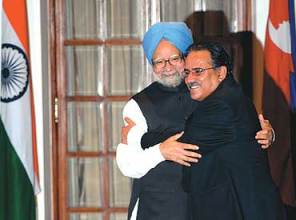
Manmohan Singh with Prachanda, circa 2008

Prashant Jha interviews the Nepali Maoist leader Prachanda:

All of us reviewed the situation. I presented a document in my party last April stating that the 12-point agreement must be the basis, and we must conclude the peace and the constitution process. India then changed the way it viewed Maoists, and realised it must help the process succeed. It was a realisation that we must revert to the environment of trust that existed during the 12-point pact.

Would it be right to say that Nepal’s peace process and the constitution would not have been possible without Indian support?

Definitely. Saying that the 12-point understanding was signed in Delhi means that there was India’s active support — otherwise it was not possible. CA elections would not have been possible. There could have been problems with the declaration of a republic. Now also, to take peace and the constitution to a logical conclusion, without Indian support, it will be very complex and difficult. [Full interview]

Kanak Mani Dixit critiques such a conclusion of the peace process: Continue reading A turning point in Nepal

Why does Ratan Tata have a diplomatic passport?

Update: Tata Sons has clarified that Mr Ratan Tata does not hold a diplomatic passport. See comments section.

*

Is he an Indian diplomat?

“After all, you have given Ratan Tata a diplomatic passport. He always travels with the red passport,” the American continued.

[…]

The American told him that he had once travelled first class with the industrialist, he had seen Tata’s diplomatic passport and when they both alighted at New York, Tata went to the special immigration enclosure for diplomatic passport-holders .

When S.M. Krishna became external affairs minister in May 2009, one of his earliest discretionary decisions was to issue a diplomatic passport to Tata, recognising his emergence as a global investor and industrialist who has to travel extensively worldwide, some of those trips on behalf of the government or representing his country. [KP Nayar]

And that is not the only shocking thing there. There’s also the revelation that the Maharashtra government allowed an American government group to fly out without security check!

The Indian state is India’s biggest embarrassment.

क्या खलील चिश्ती अपने जीवन में पाकिस्तान वापिस जा पाएंगे?: आशीष महर्षि

आशीष महर्षि
पी.यू.सी.एल. के सदस्य डॉक्टर खलील चिश्ती को बैल मिलने के बाद उनके साथ
बीस साल बाद भले ही डॉक्टर खलील चिश्ती खुली हवा में सांस ले रहे हों लेकिन उन्हें अभी भी सरकार की दया की दरकार है। उम्र के ८क् बरस गुजार चुके डॉ. खलील अब अपने वतन लौटना चाहते हैं। खलील साहब की जमानत भले ही हो गई हो लेकिन उन्हें और उनके परिवार को इंतजार है संपूर्ण रिहाई का। Continue reading क्या खलील चिश्ती अपने जीवन में पाकिस्तान वापिस जा पाएंगे?: आशीष महर्षि

India must reciprocate Pakistan by sending back Dr. Chishty and Pakistani fishermen

This is a statement put out by some of us; names of signatories is given at the end

We, the undersigned, welcome the decision of Pakistan government to release 26 Indian fishermen on humanitarian grounds. They were in Pakistani prison for more than two years for allegedly violating territorial border. The Pakistani gesture came in the background of a meeting, which took place in New Delhi, between the Indian Prime Minister Manmohan Singh & the Pakistani President Asif Ali Zardari on last Sunday. The poor Indian and Pakistani fishermen find it extremely difficult to recognize other country’s territorial border in the mid-sea.

We appeal to the Government of India to reciprocate Pakistani gesture by sending Dr. Khaleel Chishty and Pakistani fishermen back home. This will be a major confidence building measure. It will help in creating a conducive atmosphere in taking forward peace process. Continue reading India must reciprocate Pakistan by sending back Dr. Chishty and Pakistani fishermen

On the Supreme Court granting bail to Dr Khaleel Chishty: PUCL statement

Given below is the statement of the PEOPLE’S UNION FOR CIVIL LIBERTIES on the Supreme Court’s decision yesterday to grant bail to Dr Khaleel Chishty. Given below the statement is the full text of the court order
The PUCL is extremely relieved that the SC decided to set free from the Prison 80 year old Dr. Khalil Chishty serving a life sentence in Ajmer Central Jail for a murder case. This is an extremely significant step but not sufficient as bail for Dr. Chishty as seen earlier when the trial was underway for 19 years, was like house arrest. he had to report regularly to the police and could not step out of his house and area. We hope that the next step of sending Dr. Chishty back home happens soon as it would be better for all that we send him back alive, when he can be with those who care for him and love. The PUCL appreciates the wisdom of the Supreme Court for this judgement.
While Judicial remedy would be pursued in the Supreme Court, we would like to remind all that the executive remedy as provided in the Indian Constitution of President and the Governot of a State granting Mercy to an individual at any stage of the judicial process, was stalled by the Governor of Rajasthan, who despite being recommended twice by the Chief Minister of Rajasthan that Dr. Chishty be pardoned, the Governor only let the file gather dust. Continue reading On the Supreme Court granting bail to Dr Khaleel Chishty: PUCL statement

Bring home the crew of MV Albedo: Yusra Askari

Guest post by YUSRA ASKARI

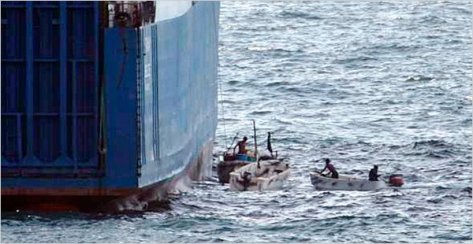
Karachi: The MV Albedo and its crew; 7 Pakistanis, 7 Bangladeshis, 6 Sri Lankans, 2 Indians and 1 Iranian national have been held hostage by pirates off the coast of Somalia, for over 17 months now. With the final deadline fast approaching, last ditch efforts are underway in Pakistan to ensure the safe return of all 22 sailors. Continue reading Bring home the crew of MV Albedo: Yusra Askari

Who killed four foreign tourists in Kashmir in 1995?

Given below is the text of a petition submitted to the Jammu & Kashmir State Human Rights Commission by the INTERNATIONAL PEOPLE’S TRIBUNAL ON HUMAN RIGHTS AND JUSTICE IN INDIAN-ADMINISTERED KASHMIR (IPTK) together with the ASSOCIATION OF PARENTS OF DISAPPEARED PERSONS. A Division Bench of the SHRC will hear the case on 17 April 

To,
Mr. Tariq Ahmad Banday,
Secretary,
Jammu and Kashmir State Human Rights Commission,
Srinagar

Date: 6 April 2012

Dear Mr. Banday,

The International People’s Tribunal on Human Rights and Justice in Indian-administered Kashmir [IPTK] (a brief on the Tribunal’s premise and objectives may be found here) and the Association of Parents of Disappeared Persons [APDP], present before you the following submission:

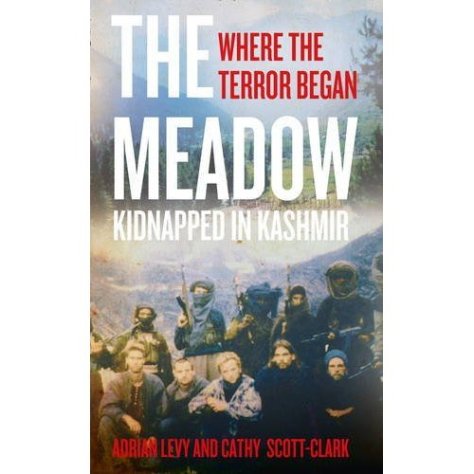
  1. In July 1995, during a trekking expedition, six persons were reportedly kidnapped by a group that referred to itself as “Al-Faran” [a front of the Harkat-ul-Ansar]. The six persons kidnapped were: John Childs [Simsbury, Connecticut, USA], Dirk Hasert [Bad Langensalza, Germany], Don Hutchings [Spokane, Washington State, USA], Keith Mangan [Teesside, Middlesbrough, England], Hans Christian Ostrø [Oslo, Norway], and Paul Wells [Blackburn, Lancashire, England]. Continue reading Who killed four foreign tourists in Kashmir in 1995?

Who are the real stakeholders of Indo-Pak peace?: Ayesha Siddiqa

This guest post by AYESHA SIDDIQA is the text of a speech delivered by her at a recent civil society review of the India-Pakistan peace process, organised by the Centre for Policy Analysis in Delhi.

This time it seems better then last time! I suppose this is what we said the last time as well. India–Pakistan relations have a cycle of ups and down: a crest followed by a trough and then a crest again. Although there is increased frustration on both sides for not being able to solve the ‘relationship’ mystery, the leadership and people in general remain eager to have peace rather than war. However, we also remain elusive regarding our threshold of peace, or what would be the cut-off point in settling for peace with each other. This cyclic peace of war and peace has remained primarily due to the peace process being elitist and confined to the strategic/security community. Therefore, I would like to argue three points: Continue reading Who are the real stakeholders of Indo-Pak peace?: Ayesha Siddiqa

Will Sri Lanka now get on with the job?: Kusal Perera

Guest post by KUSAL PERERA

Its now post-Geneva in Sri Lanka. Prime Minister of neighbouring Bharat Ganarajya, the Republic of India, Dr. Manmohan Singh thus wrote to His Excellency the President of Sri Lanka on 24 March, to say, “Your Excellency would be aware that we spared no effort and were successful in introducing an element of balance in the language of the resolution”  and the Indian delegation to the UNHRC had been advised to keep close contact with its Sri Lanka counterparts “in an attempt to find a positive way forward”. The implied message is that New Delhi played its role to hook Sri Lanka to a US sponsored resolution in Geneva, over post war reconciliation and rehabilitation and on accountability during war.

The resolution in short, requires the SL government to, Continue reading Will Sri Lanka now get on with the job?: Kusal Perera