Category Archives: Frontiers

Oru Kili Iru Kili – A Party in Dubai: Alia Allana

Guest post by ALIA ALLANA

For the Pilipino there was no escaping the Indian song and dance.

A tube-light flickered as loud music blared from a room at the far end of the corridor. The flickering light and the ensuing cacophony gave the corridor in Sonapur Labour Camp a surreal discotheque feel: one that the Pilipino was no longer game to. Nearer the door, voices of men dipped low and then travelled high past the room in which the tired labourer from Cebu lived.

“Oru Kili Iru Kili,” they bellowed in Malayalam and the tune filtered through the flimsy plywood door. The tired looking Pilipino pulled a face as he described the scene he had once encountered when the door was left ajar. The “party” room was clouded over with smoke and six Indian labourers from Kerala lounged cross-legged in a circle, smoking cigarettes and drinking from steel cups, writhing their bodies and shaking their hands up in the air. A bottle with no label was passed around and the brouhaha escalated to a feverish pitch. Once again the merry men burst out, “Oru Killi Iru Killi”. Continue reading Oru Kili Iru Kili – A Party in Dubai: Alia Allana
Artists protest against coup in Maldives

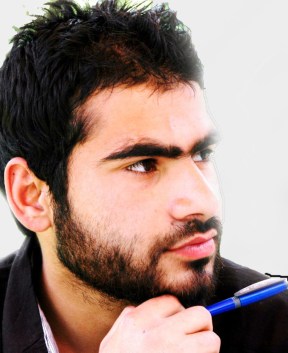
Here is a report on artists protesting against a coup in our neighbourhood that landed in my inbox recently. You would have thought that the Indian media would be as interested in what happens in the Maldives as it is in what happens in some of our other neighbouring countries. But sadly, that is not the case, and so, one gets to hear little of what happens in the Maldives, even though you get to see it often as an unnamed exotic locale or a little beach side remance in Bollywood films.

Continue reading Artists protest against coup in Maldives

Free Waqar Ahmad

The text below comes from the FREE WAQAR CAMPAIGNfreewaqar.org

Waqar Ahmad Moharkan was born in Indian-held Kashmir in 1990. Currently, he is a final year student of Bachelor’s in Commerce at Srinagar’s Islamia College of Science and Commerce. Waqar was arrested on 4 October, 2011, during a raid on his house in Lal Bazaar on charges of participating in protests in the Downtown area of Srinagar. Waqar was arrested by police personnel from MR Gunj station. The court allowed his bail application on 23 October, 2011. Instead of being released, he was rebooked by same police station and shifted to Central Jail under judicial remand on 15 December, 2011 and suddenly slapped with the draconian Public Safety Act (PSA). Continue reading Free Waqar Ahmad

Why Geneva and not Matara, Jaffna or Batti?: Kusal Perera

Guest post by KUSAL PERERA

English: Photo of Mahinda Rajapaksa, president...
Mahinda Rajapaksa, President of Sri Lanka

Thousands of Tamils from across Europe protested in front of UN headquarters in Geneva Monday demanding the creation of an international tribunal to try “war crimes” committed in Sri Lanka…. [AFP report, 6 March 2012]

The battle is raging. It will go on till about the 23rd of March, 2012. In Geneva. The battle is against the Rajapaksa regime in Sri Lanka and not against Sri Lanka itself. It’s a battle over “war crimes and accountability” during the Sri Lankan war, in particular its final stages. Delhi’s vacillating position of “not right to interfere on a country basis” as regards the US Resolution to the United Nations Human Rights Council’s Session 19, is being challenged firmly in Chennai by the two major political parties in Tamil Nadu, the DMK and the AIDMK firm. Beijing and Moscow are clear about the issue. They will vote against the US Resolution, and also muster up support amongst other countries to vote with them. If they could collect 24 votes in total, they will have had their say and the Sri Lankan regime will not have to worry about Geneva anymore. Continue reading Why Geneva and not Matara, Jaffna or Batti?: Kusal Perera

A Hundred Years of Manto

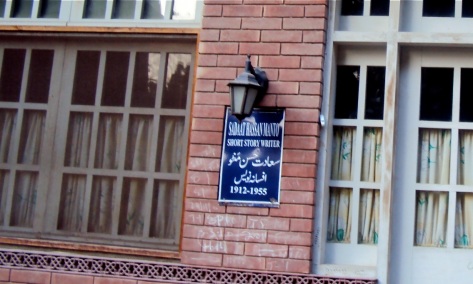
31, Laxmi Mansions, Hall Road, Lahore

“Here lies buried Saadat Hasan Manto in whose bosom are enshrined all the secrets and art of short story writing. Buried under mounds of earth, even now he is contemplating whether he is a greater short story writer or God.”

May 2012 will mark the hundredth birth anniversary of the man who wrote that epitaph for himself, Saadat Hasan Manto (1912-1955). One cannot help but compare Manto’s centennial to Faiz Ahmed Faiz’s last year, preparations for which had begun much in advance. There seems to be an odd silence about Manto. Continue reading A Hundred Years of Manto

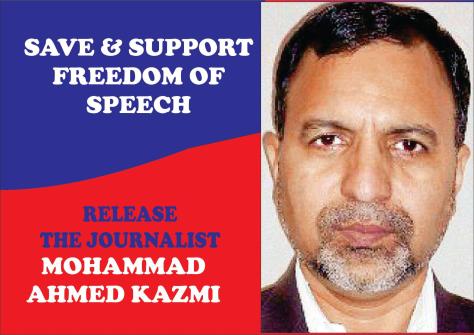
On the arrest of Mohammad Ahmad Kazmi

On 7 March, Delhi Police arrested Delhi-based journalist Mohammad Ahmad Kazmi on charges of being part of the plot to kill an Israeli diplomat’s wife in Delhi on 13 February. Many have expressed concern that Kazmi is being falsely implicated. Give below is the text of a letter to the Delhi Police Commissioner by the DELHI UNION OF JOURNALISTS, followed by a statement from the INTERNATIONAL FEDERATION OF JOURNALISTS, and thereafter by a statement issued by a group of citizens.

    9 March 2012 

The Commissioner of Police,
Delhi Police,
New Delhi

Sir: Continue reading On the arrest of Mohammad Ahmad Kazmi

What does Gunnar Toresen know about children?: Suranya Aiyar

Gunnar Toresen (Photo credit: Marie von Krogh / http://www.rogalandsavis.no/)

Guest post by SURANYA AIYAR

Much has been made of the differences between Indian and western parenting in the wake of the removal of two small children from their Indian family in Norway by the Norwegian Child Welfare Service. But there is something more invidious than racism at work here?

The children were two and a half and four months old at the time of their removal to foster care. Observe any mother with children, babies rather, of this age, and you will see that the mother is the centre of a small child’s world. For a young breast-fed infant of the age of four months, as was Aishwarya, the mother is almost her entire world. That is how infants and toddlers experience the world. So let us, first and foremost bring to centre stage this very un-adult, unscientific, but immutable truth of a baby’s reality before we start to speak of its rights.

Let us also make a distinction between adults and babies. Babyhood has its own unique set of needs – physical and emotional; its own personality, quite separate from adult needs and perceptions. You cannot apply adult co-ordinates of well-being to an infant or young child. Continue reading What does Gunnar Toresen know about children?: Suranya Aiyar

Anatomy of an allegedly thwarted coup: Anwar Dayal

Prime Minister Sheikh Hasina

Guest post by ANWAR DAYAL

Bangladesh has seen more coups than Pakistan. It probably came close to one recently, by alleged Islamists in the army. I say probably because when it comes to military intervention in Bangladesh, who-what-why-when have often been unclear. For example, a few majors seized the country’s tanks and killed the founding president and his family in August 1975. Was it a few disgruntled officers with personal disputes, as was claimed by the contemporaneous foreign media? Or was it part of the complicated and brutal Cold War geopolitics, with the involvement of senior officers and politicians, as many believe? Even though the perpetrators of the massacre have been convicted, and a few hanged, Bangladeshis still debate these questions.

It’s been like that for all military interventions over the years. What may have happened in recent weeks is unlikely to be the exception. As such, one should not necessarily conclude that Saleem Samad’s officially sanctioned account in India Today is the full story.

Samad’s narrative goes something like this. Continue reading Anatomy of an allegedly thwarted coup: Anwar Dayal

Why Kashmiri Pandits May Never Return to Kashmir: Raju Moza

Guest post by RAJU MOZA

It was in the month of January in 1990 that the onset of militancy in Kashmir resulted in the exodus of Kashmiri Pandits to Jammu, Delhi and elsewhere. Every year since then, January brings back the question of their return to their homes, in the press and increasingly on the internet.

There was something different about it this year. Several recent incidents have given the question of return a new impetus. Continue reading Why Kashmiri Pandits May Never Return to Kashmir: Raju Moza

India, Pakistan and the Snow Leopard: Javed Naqi

Guest post by JAVED NAQI

Photo Credit: Flickr User Tambako the Jaguar

Amongst the lesser known casualties of the conflict between India and Pakistan is wild life. In times of war, we hear of the loss of life and property but seldom notice the huge impact on wildlife. Animals found in the vicinity of the disputed India-Pakistan border in Jammu and Kashmir are on the verge of extinction. One such is the snow leopard in the border district Kargil.

Kargil, a district in the state of Jammu and Kashmir is a remote, arid-cold and high altitude area. The region gained in prominence to the outer world after the Kargil War of 1999. Kargil serves as a suitable habitat for many endangered wildlife species like snow leopard, Tibetan wolf (Canis lupus langier), Himalayan brown bear (Ursus arctos isabellinus), Asiatic ibex (Capra ibex), Ladakh urial (Ovis vignei vignei), musk deer (Moschus spp.), pikas, and hares (Maheshwari et al 2010). A joint study by J&K Department of Wildlife Protection and WWF reports 16 direct and indirect evidence of Snow Leopard in Kargil and Drass (Maheshwari et al 2010). Continue reading India, Pakistan and the Snow Leopard: Javed Naqi

In the name of sovereignty: APDP

This release comes from the ASSOCIATION OF PARENTS OF DISAPPEARED PERSONS, the Bund, Amira Kadal, Srinagar – 190001, Jammu and Kashmir

Press Statement, 25th January 2012: On 17th October 2011, Association of Parents of Disappeared Persons (APDP) submitted an application for information under Right to Information Act 2009 to the office of the Public Information Officer of State Department of Home. The application was regarding unmarked graves and mass graves in all the districts of Jammu and Kashmir. The State Home Department vide its letter no: Home/RTI/2011/1659 dated: 24th October 2011, transferred the application to the office of Director General of Police, Jammu & Kashmir. Later Director General of Police, Mr. Kuldeep Khoda sent communiqué vide no. legal/RTI/III/98/2011-5590-91 dated 10th December 2011 to the SSP CID Headquarters, asking him to furnish a detailed report on this issue.

Today, on 25th January 2012, we have received a response from the SSP CID Headquarters vide letter no: CID/GB/RTI/2011/8756-58, in which the CID Department has informed us that the information regarding the unmarked graves and mass graves in all the districts of Jammu and Kashmir cannot be shared as the disclosure of the information, according to Jammu and Kashmir Police would be “prejudicial to the maintenance of public peace and tranquility, as the anti-national elements may use the same for incitement of commission of offence in the state”. The SSP CID Headquarters further states, “In the present security scenario it is quite imminent that consequences of such a situation would be highly prejudicial to the sovereignty, integrity and security of the state”. Continue reading In the name of sovereignty: APDP

The BSF as Pornographer: Bravehearts with Bluetooth

So, this is how the borders of the Republic of India are also defended. With sticks, ropes and bluetooth enabled mobile phones. Eight soldiers of the Border Security Force, hold down a young Bangladeshi man accused of cattle smuggling. He is stripped naked, hogtied and then thrashed. He screams in agony and humiliation. The soldiers act as if they are out on a picnic. They discuss whether or not to give him some tea. Where to hurt him, on which body parts. How big a stick to use on him. Someone says “cut his ear off”. They stroll casually around him as he is humiliated. They laugh. He cries, as people usually do in these circumstances, and seems to call for his mother. Someone, probably one of the soldiers, records it all on video, on the 9th of December, 2010, somewhere along the Indo-Bangladesh border in Murshidabad, West Bengal

Continue reading The BSF as Pornographer: Bravehearts with Bluetooth

The inter-connected destinies of strangers across an international border

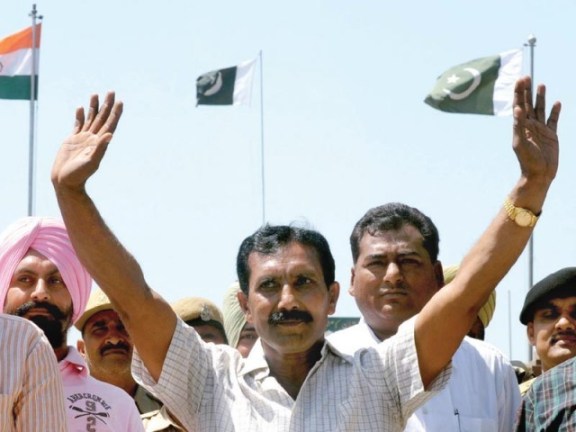
Gopal Das at Wagah border. AFP photo

The central government wants him to do it, the Rajasthan government wants him to do it, but Rajasthan’s acting Governor Shivraj Patil wouldn’t sign on a file for several months now. His obstinacy could become a major hurdle for many Indians and Pakistanis lodged in each others’ prisons.

In an unusual order, the Supreme Court of India quoted William Shakespeare and Faiz Ahmed ‘Faiz’ to directly appeal to the government of Pakistan to pardon and release Indian prisoner Gopal Das. Pakistan President Asif Ali Zardari signed the papers within 16 days, ahead of Prime Minister Yusuf Raza Gilani’s visit to Mohali to witness the cricket world cup semi-final with his Indian counterpart. On 7 April, Gopal Das crossed into India. There were those in Pakistan who had opposed his release, arguing he had a few months left to complete his sentence, and that he should not be shown mercy because he had been found guilty in 1984 by a Pakistani military court on charges of being a an Indian spy. He and his family claimed this was not true, and wanted him pardoned because now 52, he had spent the last 27 years in several Pakistani prisons. Continue reading The inter-connected destinies of strangers across an international border

Amitav Ghosh on Goa

Some musings here about the liberation of Goa from Portugese rule by India:

But the interaction between Portugal and India also produced vibrant cultural hybrids in architecture, music and food. Among the state’s most famous dishes is the spicy vindaloo, a curry whose name is thought to be a contraction of the Portuguese phrase “vinho de alho,” or garlic wine. Besides, as Mr. deSouza pointed out, Goa was where the influence of the Enlightenment and the Renaissance in Europe was felt much before it reached other parts of India. As a result, the practice of sati – or widows immolating themselves on their husbands’ funeral pyres – was abolished in Goa 200 years before the British banned it in the rest of India. [Naresh Fernandes]

And on Portugese language, 50 years after the Portugese were sent back to Portugal:

The popular history of the Portuguese period in Goa has largely been restricted to the gory tales of the initial conquest of the island of Goa, of the Inquisition, and the dramatization of the anti-colonial episodes in the territory’s history. To a large extent, this nationalist history dissuades Hindus from subaltern castes from studying the language. This has ensured that it is solely dominant-caste narratives that are incorporated into the histories of the territory, preventing alternative and liberatory narratives to emerge from a re-reading of the texts and narratives of the period of Portuguese sovereignty over the territory.  It is little known for example, that the knowledge of Portuguese is critical to the bahujan challenge to Hindu upper-caste groups’ monopolistic control of the Goan temples. This monopolistic control of the temples was forged in particular through these latter groups’ knowledge of Portuguese. [Jason Keith Fernandes]

Human Rights Review – Jammu and Kashmir in 2011: JKCCS

This release comes from the JAMMU AND KASHMIR COALITION OF CIVIL SOCIETY, the Bund, Amira Kadal, Srinagar 190001, (www.jkccs.net)

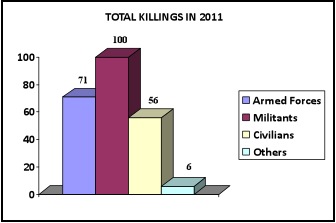
TOTAL KILLINGS

Year 2011 has just passed, and many have declared this year, a peaceful year in Jammu and Kashmir. Of course assertions of peace by various quarters are relative. Enforced silence cannot be construed as peace. Despite the hype of peace, people of Jammu and Kashmir have witnessed unabated violence, human rights abuses, denial of civil and political rights, absence of mechanisms of justice, heightened militarization and surveillance. The figures of violent incidents suggest that 2011 as usual has been the year of loss, victimization, mourning and pain for the people. Continue reading Human Rights Review – Jammu and Kashmir in 2011: JKCCS

When the Wandering Falcon came to Delhi: Pragya Tiwari

Guest post by PRAGYA TIWARI

Nilanjana Roy moderating the prize ceremony; Jamil Ahmad in the background via Skype. Photo courtesy: The Shakti Bhatt Foundation

There is this world among the many worlds of Delhi, the world of book events. You show up for a reading followed by a conversation between the author and some other prominent member of the fraternity. Afterwards you drink wine and exchange news with everyone you know there. And you know everyone there. The scale of some of these events would make you think books actually sell. But the greater riddle for those of us who show up is this: Why do we show up? To see friends, to socialise and occasionally to celebrate books, or perhaps the very existence of books irrespective of quality; to register our support for words and stories bound by charming jackets; to toast these objects of desire in a simulated bubble where they shine on undeterred. Debatable as their meaning might be, for most part these events are mere rituals. On the 21st of December, however, for a brief moment I was made to see that they could be more than that. The man who made that apparent was not even physically present in the room. Continue reading When the Wandering Falcon came to Delhi: Pragya Tiwari

Z for Zalim: Semiotics and the Occupation of Kashmir

Ours was the marsh country, down by the river, within, as the river wound, twenty miles of the sea. My first most vivid and broad impression of the identity of things, seems to me to have been gained on a memorable raw afternoon towards evening. At such a time I found out for certain, that this bleak place overgrown with nettles was the churchyard; and that Philip Pirrip, late of this parish, and also Georgiana wife of the above, were dead and buried; and that Alexander, Bartholomew, Abraham, Tobias, and Roger, infant children of the aforesaid, were also dead and buried; and that the dark flat wilderness beyond the churchyard, intersected with dykes and mounds and gates, with scattered cattle feeding on it, was the marshes; and that the low leaden line beyond, was the river; and that the distant savage lair from which the wind was rushing, was the sea; and that the small bundle of shivers growing afraid of it all and beginning to cry, was Pip. – Charles Dickens, Great Expectations

A for Apple and Z for Zebra. Children are taught the alphabet with the help of images. And the association of images with sound. It helps them associate the sound of A with the sound of Apple, and associate that in turn with the image of an apple. The alphabet book depends on images that may be familiar to children. The word Apple is a signifier, and the apple itself is the signified. This is, most simply, what semiotics or the study of signs and sign processes.

In a future world, if there are no zebras, alphabet books may have to replace the last entry with something else. What could it be? Zebra crossing? Zimbabwe?

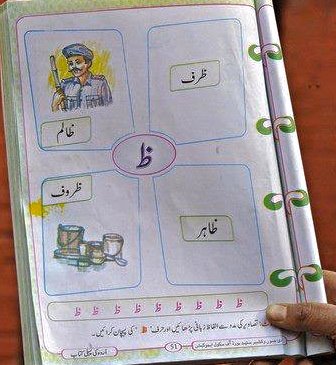
Last week, the Jammu and Kashmir Police registered a case of sedition, defamation and criminal conspiracy against six officials of BoSE, the government’s very own Board of School Education, for this:

This is a page from a book called Baharistaan-e-Urdu. This attempt to teach Kashmiri children the Urdu alphabet (note to self: this is what I need to learn Nastaliq!) makes them say, “Zoi se Zalim,” Z for Zalim, meaning cruel. That is only one of four examples. The other two are: zaroof (utensils), zahir (visible) and zarf (ornamental cup holder).

Continue reading Z for Zalim: Semiotics and the Occupation of Kashmir

Pakistan ki Tareef: Haseeb Asif

This guest post by HASEEB ASIF is in Urdu, in Roman script

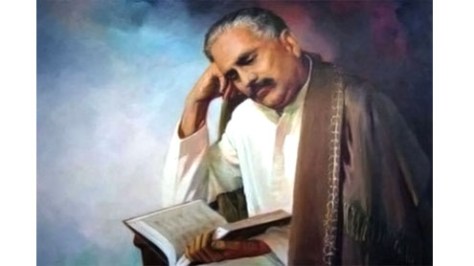
Allama Iqbal (1877-1938)

Islami Jamhooriya Pakistan ki tareekh Hindustan se bohut purani hai. Balkay Islam se bhi purani hai. Jab aathveen sadi mein Muhammad Bin Qasim Islam phelane bar-e-sagheer tashreef laye tau ye jaan ker sharminda huwe ke yahan tau pehle hi Islami riyasat maujood hai.

Yahan kufr ka janam tau huwa Jalaaludin Akbar ke daur mein, jo Islam ku jhutla ker apna mazhab banane ko chal diya; shayid Allah-ho-Akbar ke lughwi maani le gya tha.

Baharhal, in kafiron ne butparasti aur mehkashi jaisay gheir munaasib kaam shuro kerdiye aur apne aap ko Hindu bulaane lage. Sharaab ki aamad se Pakistan ke Musalmanon ki woh taaqat na rahi jo tareekh ke tasalsul se honi chahiye thi. Iski vaja ye nahin thi ke Muslaman sharaab peene lag paray the, balkay ye kay unki saari quwat-e-nafs sharab ko naa peene mein waqf hojati thi, hukmarani ke liye bachta hi kya tha.

Is ke bawajood Musalmanon ne mazeed do sau saal Pakistan per raaj kiya, phir kuch dinon ke liye angrezon ki hakoomat agayi (hamari tafteesh ke mutabiq yehi koi chalees hazaar din honge).

San 1900 tak Pakistan ke Musalmanon ki haalat nasaaz hochuki thi. Is dauran aik ahem shakhsiat hamari khidmat mein hazir huwi, jis ka naam Allama Iqbal tha. Continue reading Pakistan ki Tareef: Haseeb Asif

Who’s afraid of Veena Malik?

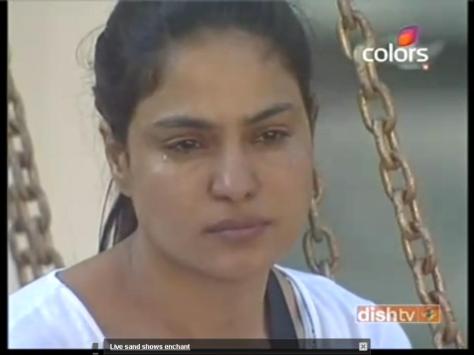
News broke of Veena Malik’s “nude” – more accurately, implied nude – photographs in FHM India magazine when the image of the magazine’s cover went viral on Twitter, even before the magazine was on newsstands. The media in India and all over the world reported “outrage” in Pakistan, in keeping with the international image of Pakistan as a country taken over by Islamists who would wreak havoc over a Pakistani woman posing without clothes for an Indian magazine with ISI tattooed on her arm.

FHM India itself magazine emphasised Malik’s nationality, calling her a “Pakistani WMD” and discussing burqas with her, even mentionining the word burqa on the cover, to reinforce the stereotype of a hot Pakistani model defying a country riven with Islamic extremism.

But in reality, there hasn’t been as much backlash in Pakistan as the world outside would expect or believe. Says Islamabad-based journalist Shiraz Hassan, “I am surprised that except a few news channels and papers nobody has been bothering about Veena Malik, as though they don’t care what she did. Haven’t seen anything from hardliners also.” Continue reading Who’s afraid of Veena Malik?

Bangla rocks: Jyoti Rahman

Guest post by JYOTI RAHMAN

Lagaan was a groundbreaking film, but a Bollywood film nonetheless. My favorite song-dance sequence is the one where the villagers, well Gauri and Bhuvan and friends, celebrate Krishna’s birthday. In the song, the girl complains that Radha is anxious about Krishna’s philandering ways and the boy replies that Radha should be understanding because there’s no one else in Krishna’s heart but Radha.

When the meaning of the song is explained to her, Elizabeth asks Gauri: Is Radha Krishna’s wife?

Oh no, Krishna’s wife is Rukmini! 

Of course Radha-Krishna are anything but married. Imagine the shock the Victorian girl would have felt upon realizing that the villagers were celebrating an extra-marital affair with such fanfare.

It is not just that Bollywood village in the high noon of Raj. Gita Govinda and other songs celebrating Radha-Krishna are sung in every modern Indian language. And not just in India. Songs on the theme were thriving in an unexpected place, in an unexpected time. Among Bangladeshi youth, in the early years of this century, when the country seemed to increasingly Islamicising. Partly influenced by the music coming out of the diaspora in Londonistan, songs like this one, celebrating the union of Radha-Krishna in the Nikunja Temple became massive hits.

Over the fold, let me note a few examples of Bangla rock – and let’s not be pedantic here, I’ll use rock as a shorthand for western-influenced urban music, including pop, reggae, hip hop and other genres.

Continue reading Bangla rocks: Jyoti Rahman

Three Years After 26/11: Raza Rumi

Guest post by RAZA RUMI

As a Pakistani it is difficult for me to talk about the ghastly attacks on Mumbai three years ago and the response of its vibrant citizens. This is not simply due to the nationality of Ajmal Kasab, the lone terrorist captured after the 26/11 Mumbai terror attacks. What happened in Mumbai was a sad reminder of how easy it has become for a handful of militants to wreak havoc, to hold an entire city hostage and undermine humanity. A vast majority of Pakistanis felt the pain and condemned the Mumbai attacks; targeting innocent civilians is heinous and unacceptable.

The Mumbai attacks changed the atmosphere created by President Asif Ali Zardari’s unprecedented offers of peace and cooperation. A few weeks before the carnage in Mumbai, Mr Zardari made historic remarks in a conclave organised by an Indian newspaper, which represented a consensus within Pakistan’s political class: “I do not feel threatened by India and India should not feel threatened from us… today we have a Parliament which is already pre-agreed upon a friendly relationship with India. In spite of our disputes, we have a great future together.” Mr Zardari also declared that Pakistan will not be the first country to use its nuclear weapons, thus altering a carefully constructed Pakistani nuclear doctrine of first-use. Continue reading Three Years After 26/11: Raza Rumi