Category Archives: Genders

What happens when a woman decides to walk to the sea in Karachi, all by herself?: Hira Nabi

This video post comes from HIRA NABI

http://vimeo.com/58865627

(Hira Nabi is a visual artist in Pakistan.)

Even you are very beautiful: Nikitha Suryadevara

Guest post by NIKITHA SURYADEVARA

Bhopal: Janata Dal (United) President Sharad Yadav today stunned many at a press conference in Bhopal when he called a woman reporter “beautiful.”

The journalist asked him whether he prefers Madhya Pradesh or Bihar – he has represented both in Parliament.

The chief of the Janata Dal (United) dodged a bullet by saying, “The whole country is beautiful.”

Then came the unexpected remark – “Even you are very beautiful,” he said.

Read the complete article here at NDTV


So I figuratively raised an eyebrow when I first read this (raising just one eyebrow is much harder than it looks, trust me I’ve tried). The reporter asked him a question designed to make the man fumble, but Mr Sharad Yadav is just too suave. When asked to pick between one of his two constituencies, he swiftly pointed to the reporters beauty instead. Well that seems like a logical conclusion. Continue reading Even you are very beautiful: Nikitha Suryadevara
People’s Watch Over Parliament: Bekhauf Azadi Campaign

20130220-235633.jpg

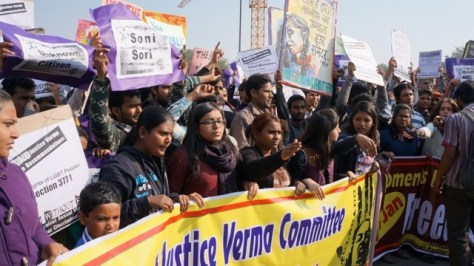
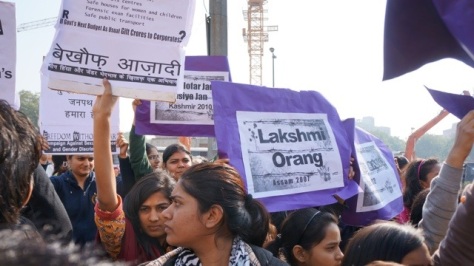
  • Protestors at the ‘Freedom Parade’ Rally of the Bekhauf Azadi Campaign, New Delhi, 26 January, 2013

Guest Post by Bekhauf Azadi (Freedom Without Fear) Campaign.

People’s Watch Over Parliament: February 21, 1st Day of the Budget Session, Jantar Mantar
Gather in large numbers – 12 PM onwards at Jantar Mantar, New Delhi.
Are Our Lawmakers Ready to Listen to the Voice of the Movement Against Sexual Violence?

Continue reading People’s Watch Over Parliament: Bekhauf Azadi Campaign

Dear Sisters (and brothers?) at Harvard

Letter from  Indian feminists VRINDA GROVER, MARY E JOHN, KAVITA PANJABI, SHILPA PHADKE, SHWETA VACHANI, URVASHI BUTALIA and others, to their siblings at Harvard

We’re a group of Indian feminists and we are delighted to learn that the Harvard community – without doubt one of the most learned in the world – has seen fit to set up a Policy Task Force entitled ‘Beyond Gender Equality’ and that you are preparing to offer recommendations to India (and other South Asian countries) in the wake of the New Delhi gang rape and murder. Not since the days of Katherine Mayo have American women – and American feminists – felt such a concern for their less privileged Third World sisters. Mayo’s concern, at that time, was to ensure that the Indian State (then the colonial State) did not leave Indian women in the lurch, at the mercy of their men, and that it retained power and the rule of the just. Yours, we see, is to work towards ensuring that steps are put in place that can help the Indian State in its implementation of the recommendations of the Justice Verma Committee, a responsibility the Indian State must take up. This is clearly something that we, Indian feminists and activists who have been involved in the women’s movement here for several decades, are incapable of doing, and it was with a sense of overwhelming relief that we read of your intention to step into this breach. Continue reading Dear Sisters (and brothers?) at Harvard

What is wrong with this picture? Carole Vance

Guest post by CAROLE VANCE

Two faculty members at Harvard, associated with gender studies, convene a Policy Task Force, designed to “to offer recommendations to India and other South Asian countries in the wake of the New Delhi gang rape and murder” and in this semester “to produce a working paper that advises on the implementation of the recommendations from the Verma Committee”.   This is not a student initiative, though a meeting with students is scheduled to invite their input, along with that of the larger Harvard community. Continue reading What is wrong with this picture? Carole Vance

Unintended consequences of feminist action: Prabha Kotiswaran

Guest post by PRABHA KOTISWARAN

Taking off from the debate here on the Harvard Task Force, I’d like to flag some  disagreements among feminists on law reforms. There are many strains to this debate – I will only engage with a few.

No feminist, whether of Indian origin or not, whether primarily located in India or not, is insecure about feminists/lawyers around the world working on rape in India. Circuits of feminist scholarship and activism become so inter-disciplinary and transnational that maintaining and policing turf (if at all that were possible) is an utterly useless endeavour. Continue reading Unintended consequences of feminist action: Prabha Kotiswaran

Harvard to the rescue!

Some good news for embattled and weary Indian feminists. All those endless submissions to the Verma Committee prepared and submitted, all those critiques of the Ordinance written and disseminated, all those street protests, all those meetings with students and the public, all those delegations to government officials, ministers…not to mention decades of efforts to amend the rape laws.

It’s been a long hard haul, so it’s a great relief that the Harvard Law School has stepped in to take this burden off our shoulders. Continue reading Harvard to the rescue!

Raining Rape-Speech in Kerala

It is hardly news in Kerala by now that its been raining misogynists, rape-talkers, and swollen-rotten masculine egos in these early days of 2013. The PJ Kurien controversy has been a trigger of course. But I am astounded at the collective frenzy of Congress stalwarts. Kerala today is like a coconut garden taken over by a bunch of supremely drunken … well .. simians. Here we are, helplessly watching the tipsy horde ascend the fruit-laden coconut palms, pulling down ripe fruit and raw ones, tender leaves and drying ones, with  nary a care for all of us down here! Everyone, from senior leaders,  many insecure dumb ass-males on FB and Youtube, to minor lawyers in small-town courts with sadly dessicated minds but hugely swollen male-egos, to elected MLAs on the floor of the Kerala State Assembly, and judges whose guardian-angelic misogynist aura glints a bit more menacingly in private conversations,each of them seem to be up their own coconut tree throwing down various half-witted, asinine comments,venting their immense distrust of women who don’t fit into the homely-comely-motherly stereotype. Continue reading Raining Rape-Speech in Kerala

Why the Delhi rapists should not be hanged

The shameless and cynical Manmohan Singh government has found an easy way out to appear strong, deflect attention from its failures and save itself from the opposition’s questioning. Just hang a death row convict before every Parliament session! It is very likely that if the 16 December Delhi rape-and-murder accused are placed on death row by this time next year, the UPA government will hang them just in time for the 2014 general elections.

I am opposed to death penalty in principle, and there are good reasons why so many democracies have abolished death penalty. But even if you do not agree that death penalty should be abolished, please consider why it should not be applied to the five accused in this case.

About a month ago I visited the Ravi Das “camp”, a slum colony near RK Puram where four of the six accused lived. I met the mother of one of them. Champa Devi’s son Vinay Sharma was the first to plead guilty and say he should be hanged; his father agreed on television. Continue reading Why the Delhi rapists should not be hanged

The Languages of Sexual Violence: Anupama Mohan

Guest post by ANUPAMA MOHAN

I teach a big word in my critical theory classes: phallogocentrism. It is the idea that our societies are centred by the phallus and language (logos) and is a word that often scares, perplexes, and disturbs my students, but I unpack it using an example. In English, the word seminal, which means something important and path-breaking, derives from “semen” and in contrast, the word hysterical or hysteria, which is a word that has for long been associated with peculiarly female physical and mental disorders (and often used for recommending women’s confinement), derives from “hystera” or the womb. What does such loading of the language – what a 20th century Russian thinker, Mikhail Bakhtin, called the formation of the verbal ideological world  – in terms of the perspective, validation, and supremacizing of one gender over the other do to/in our varied lives? Think of the word vanilla that, at least since the 1970s, has meant the ordinary and bland: its etymology derives from the Latin word for vagina (vaina) or “little vagina” for the pods of the plant that reminded someone of women’s genitals. The word porcelain – a thin, fragile kind of clay – too comes from the word for “cowrie shell” whose Italian links to porcella or young sow (a female pig) for someone recalled the shape of a piglet’s orifice. One more: the word amazon which refers to a legendary race of female warriors and has come to mean a strong woman derives possibly from many sources: from the Classical Greek a-mazos or breastless to the Iranian *ama-janah or “virility-killing” – a meaning that interprets the idea of women’s strength as both a mutilation of her physical self and/or as a threat to men. Continue reading The Languages of Sexual Violence: Anupama Mohan

When women ask for it: Veena Venugopal

Guest post by VEENA VENUGOPAL

To me, the most memorable scene in Dev D is the one where Paro takes a mattress from home and ties it to her cycle. When she reaches the edge of the field, she abandons the cycle, lifts the mattress on her shoulder and marches to the clearing where she lays it down and waits for her lover. There are no words spoken and the camera holds her face close. Her expression is one of intense seriousness. You can see her desire is a field force of intensity that fuels every step. She is determined to see it through, to let that desire take over herself completely; not surrender to it but to let it explode out of her. You know that when she meets Dev, the sex would be passionate and powerful.  And yet, in the south Delhi multiplex where I was watching the film, most of the audience burst into rapacious laughter. The women smiled embarrassedly at each other. Which made me wonder, why is female desire a laughing matter? Continue reading When women ask for it: Veena Venugopal

Child sexual abuse in India: the police blames the victims

This is a press release put out by HUMAN RIGHTS WATCH on 7 February; link to full report towards the end


India: Child Sex Abuse Shielded by Silence and Neglect Police, Doctors, Courts Need to Change Policies and Mindset to Support Victims

New Delhi, February 7, 2013:  The Indian government should improve protections for children from sexual abuse as part of broader reform efforts following the gang rape and murder of a student in New Delhi in December 2012, Human Rights Watch said in a new report released today. Continue reading Child sexual abuse in India: the police blames the victims

Azaadi (Freedom) for ‘Pragaash’, an All Female Band from Kashmir

20130206-113749.jpg

In the last month the streets of Delhi have echoed with a slogan familiar to many in Kashmir – ‘Hum Kya Chahtey ? – Azaadi !’ (‘What do we want ? – Freedom !’). Thousands of young women and men have chanted this slogan in Delhi while protesting against rape and sexual violence, and while doing so, they have also spoken out, with great courage and integrity, and carried explicit banners and signs about the fact that women in Kashmir have had to face rape and sexual assault by the AFSPA protected armed forces (the army, police, irregular counter-insurgents and paramilitary forces) of the Indian state. And no, the young people carrying these signs, and chanting these slogans, that talk about Nilofar and Aasiya Jaan, that name the atrocities and rapes that took place in Shopian and Kunan Poshpora have not been all Kashmiris. Some of them are Kashmiri students studying in Delhi University, JNU and Jamia Millia Islamia. But along with them, several of the young people who have been weaving the reality of Kashmir into the fabric of the protests in Delhi are not from Kashmir. Each time that they have walked with these signs and chanted these slogans – (and I have seen them in every gathering and every demonstration – their numbers are growing – as more young people in Delhi use the protests as sites of learning about the many complex realities of power and oppression) – they risk being branded as ‘traitors’ by the mainstream of Indian nationalist opinion, which can never question the Indian state’s conduct in Kashmir. They have tempered their sense of justice and deepened it with the substance of solidarity. Continue reading Azaadi (Freedom) for ‘Pragaash’, an All Female Band from Kashmir

A rare victory for freedom of speech and expression in India

Times of India photo

In a country where freedom of speech and expression is under assault every day, where scholars and cartoonists increasingly have to regularly face the law to defend their statements and works of art,  where the government gives in to anyone and everyone demanding censorship, where the government conduct stealth censorship of online speech, finally comes a rare piece of good news.

For once the police is not asking to shut down an exhibition citing ‘law and order’ issues to appease protestors, but instead giving protection to the exhibition.

The Times of India reports: Continue reading A rare victory for freedom of speech and expression in India

A petition demanding the ‘Grand Mufti’ of Kashmir to step down

This petition has been put out by OMAR BASHIR

This is in context with your recent fatwa against the girl band Pragaash. This is less a fatwa and more a direct threat to silence young girls who have chosen for themselves a career path untrodden by women of Kashmir because of your misogynist approach. Your nefarious and illogical fatwas have caused more harm than they have done any good.

Mr Grand Mufti you have forgotten that Kashmir has a long tradition of Kashmiriyat and Kashmiriyat is an expression of solidarity and resilience regardless of religious differences. It embodies an ethos of harmony and a determination of survival of the people and their heritage. Women in music industry is nothing new in Kashmir, we have stalwarts like Raj Begum, Shameema Azad, Kailash Mehra and Mehmeet Syed singing for the past so many years. You must be aware that Raj Begum has been awarded the Padma Shri award in 2002. Continue reading A petition demanding the ‘Grand Mufti’ of Kashmir to step down

“The impunity of every citadel is intact” – the taming of the Verma Committee Report, and some troubling doubts

Legal activist Vrinda Grover said in the FeministsIndia e-list about the Ordinance: “The impunity of every citadel is intact – family, marriage, public servants, army, police.” In effect, she said, the Ordinance is simply the pending Criminal Law Amendment Bill 2012, widely criticized by women’s organizations, which has been sneaked in as law without debate or consultation, in Parliament or outside. Feminists activists are rightly suspicious of the sudden sense of “emergency” that has gripped the government, when it has ignored our demands for criminal law reform on sexual violence for over twenty years.

Here I will document two press releases issued by women’s groups, and draw attention to some troubling and unresolved debates within the women’s movement in India today. The post will conclude with a useful table comparing the Ordinance and the JVC Report, issued by the Ministry of Home Affairs. Continue reading “The impunity of every citadel is intact” – the taming of the Verma Committee Report, and some troubling doubts

Sexual Violence, Consumer Culture and Feminist Politics – Rethinking the Critique of Commodification : Sreenanti Banerjee

Guest Post by SREENANTI BANERJEE

I will begin with the by now well-known interview of author and social activist Arundhati Roy, conducted by Channel 4 (a British Media House), about the widespread protests after the horrific December 16th incident of the brutal gangrape of the 23 year old medical student in Delhi. Permit me to quote Roy at length as I do not wish to take bits and pieces from her talk, and pluck them out of their context.

We are having an unexceptional reaction to an event which isn’t exceptional […] But the problem is that why is this crime creating such a lot of outrage is because it plays into the idea of the criminal poor, the vegetable vendor, the gym instructor, the bus driver actually assaulting a middle-class girl. But when rape is used as a means of domination by upper castes, by the army or the police it’s not even punished. Continue reading Sexual Violence, Consumer Culture and Feminist Politics – Rethinking the Critique of Commodification : Sreenanti Banerjee

Why the Govt’s Ordnance is Fraud & Mockery of the Justice Verma Committe Recommendations: Bekhauf Azaadi Campaign

Guest post by BEKHAUF AZAADI CAMPAIGN

The UPA Govt, in a Cabinet meeting held on 1 February, has introduced an ordinance that it claims will address the most urgent concerns on sexual violence. In fact, the Government has been completely reluctant to acknowledge and implement the Justice Verma Committee recommendations: the PM refused to accept it from Justuce Verma, the Ministry of Home Affairs removed it from their website, the Govt never adopted any transparent process of discussion to decide the way forward on implementing the recommendations, rather they said Justice Verma ‘exceeded his brief’. Now, they claim that their ordinance has ‘implemented’ the Justice Verma recommendations. Is this true?

The fact is that the Government’s ordinance is a mockery of the letter and spirit of the Justice Verma recommendations. Why? Let us take a closer look.

Continue reading Why the Govt’s Ordnance is Fraud & Mockery of the Justice Verma Committe Recommendations: Bekhauf Azaadi Campaign

Water Cannons, Tear Gas, Ordinance: How the State Responds to Protests Against Rape and the Justice Verma Committee

20130203-075541.jpg

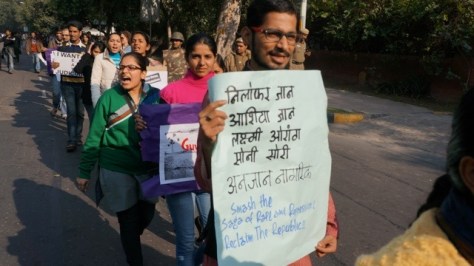
  • [ Protestors from the Bekhauf Azaadi/Freedom Without Fear Campaign Demanding Complete Implementation of the Justice Verma Committee Recommendations during the Freedom Parade to Reclaim the Republic on Republic Day, 26 January, 2012 in New Delhi. ]

So, first they come with water cannons and tear gas, and then they come with an ordnance.

Yesterday, the Union Cabinet decided to rush drafting an ordinance in response to the massive protests against rape and sexual violence that have been occurring ever since the 16th of December, 2012. According to preliminary reports, the ordnance, which will be signed into law by the President of India before Parliament even meets, flies in the face of the detailed and exhaustive list of recommendations made by the Justice Verma Committee (JVC) which had been hailed by the protesting young people and a large number of women’s organisations. In other words, the government feels no need to discuss the JVC in parliament. It feels no need to even give time and an opportunity for its recommendations to sink in, for there to be more thinking, more ideas, more awareness of the issues and questions at stake. No wonder, the government had so hastily pulled down the JVC report from its own websites after it had been released. Continue reading Water Cannons, Tear Gas, Ordinance: How the State Responds to Protests Against Rape and the Justice Verma Committee

The Justice JS Verma committee report

For a summary with commentary, see this guest post by Arvind Narrain.

Patriarchy, Women’s Freedom and Capitalism: Kavita Krishnan

Guest post by KAVITA KRISHNAN

(This article began as a rejoinder to Hindi columnist Raj Kishor [Vaam se dakshin tak ek hi tark, (‘The same argument from Left to Right’), Rashtriya Sahara, January 13 2013], but it has also provided an occasion to address some common misconceptions about women’s freedom and capitalism.)

When women demand ‘freedom,’ why does it immediately raise the spectre of ‘licentiousness’?
Why, in other words, is women’s freedom automatically taken by many as equivalent with ‘licence,’ whereas the similar freedom on the part of men is never branded as ‘licence’?

This question arose in my mind after reading a piece by Hindi columnist Raj Kishor. Raj Kishor’s argument is that those – from Left leaders like I, to those whom he sees as representatives of the market – who are calling for women’s freedom are ‘consigning women into the fire of capitalism.’ When he hears me use the word ‘azaadi’ (freedom) he calls such freedom ‘utshrnkhalta’ (literally ‘unbridled-ness’, or licentiousness). He says and I, and the capitalist market alike, are calling for women to be free to ‘break all bounds of licentiousness’ if they so choose. Of course, Raj Kishor anticipates my criticism of his use of the word ‘utshrnkhalta’, since he says that is a word that ‘has feminists up in arms, demanding with red (infuriated) eyes the definition of ‘utshrnkhalta’.

Continue reading Patriarchy, Women’s Freedom and Capitalism: Kavita Krishnan