Category Archives: Government

The Many Uses of a U.P Election

I live in Noida, which is the child of an extra-legal union between Delhi and Uttar Pradesh. Noida is not-quite Delhi, not-quite U.P, not quite itself on most days. Living in a cusp has several advantages, however, the main one being that one can look either way, up at Delhi and right down over U.P’s scruffy head. I found myself doing both in the recently-concluded U.P election. Curiously it seemed, for Delhi people, U.P’s 2012 elections were flush with new meaning. For decades the favourite whipping boy of Delhi, U.P had overnight become its favourite gap-toothed angel. For Pratap Bhanu Mehta of the Delhi-based Centre for Policy Research, the U.P election was a historic battle between empowerment and patronage, the future and the past, performance and rhetoric, sincerity and cynicism, and (this is my favourite) ‘rootedness over disembodied charm’. Mehta believes that while voters ‘carefully assessed’ candidates through the ‘prism of local circumstances’, they were no longer prisoners of their identity. Most confounding is Mehta’s view of democracy, “In a democracy, where you are going should be more important than where you are coming from”. These U.P elections “redeemed that promise” according to Mehta, since they were “without a trace of community polarisation: no one felt on the edge or under siege, all could exercise options without being unduly burdened by the past.”

Continue reading The Many Uses of a U.P Election

The King and I: Dispatches from Morocco

Rapper El Haked, or The Spiteful One, with translator Maria Karim in Casablanca

Last month, I spent a fortnight in Morocco speaking to people about the aftermath of the Arab Spring. The Moroccan establishment has spoken often of “The Moroccan Exception” – where the King acted quickly to usher in reforms and  defuse the protests.

Yet, many – such as the two young people in this photograph – feel that the reforms were largely superficial.

El Haked – or The Spiteful One – is young rapper from Casablanca’s working class neighbourhood of Oukacha. He was arrested yesterday for singing and uploading songs critical of the King and the establishment. My article on him, His songs on Youtube

Happy Kapil Sibal’s Day

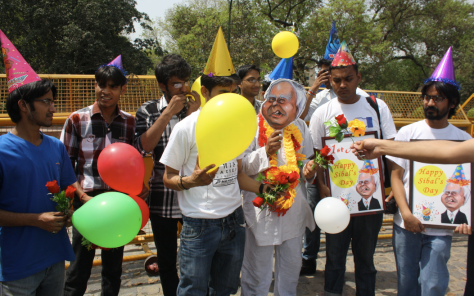
Aseem Trivedi is a cartoonist in Kanpur. Or was. He has, for some months, been a full-time activist against internet censorship in India. As 2011 was turning into 2012, the Maharashtra police got his domain registrar to suspend his domain, http://cartoonsagainstcorruption.com, which was in support of the Anna Hazare-led Lokpal movement. His website wasn’t blocked, but the domain name suspended – the equivalent of shutting down a printing press. This was done in no time, and he wasn’t given an opportunity to defend his content. This was done thanks to the IT Rules 2011, a simple FAQ about which can be found here. Today, 1 April, Trivedi celebrated “Kapil Sibal’s Day,” calling the Communications minister the fool that he is. In the image below, taken at Delhi’s Rajghat today, Trivedi is standing on the extreme right. For more on Trivedi’s campaign, see http://www.saveyourvoice.in.

Hindi Press Release:

पुलिस प्रशासन के अवरोध के बावजूद राजघाट पर मनाया गया सिब्बल्स डे, पहुचे ब्लोगर्स और सोशल एक्टिविस्ट
1 अप्रैल के दिन पर राजघाट पर सेव योर वाइस की टीम ने आईटी मिनिस्टर कपिल सिब्बल को प्री सेंसरशिप पर दिए गए उनके बयानों के लिए  मूर्ख दिवस की शुभकामनाएं दीं. राजघाट परिसर में बड़ी संख्या में पुलिस बल, आईबी, सीआईडी और सीबीआई के लोग मौजूद थे और सेव योर वाइस के सदस्यों को बापू की समाधि पर जाने से रोका गया. केवल कुछ गिने चुने लोग ही चुपचाप राजघाट पर पहुच पाए. पुलिस ने पूर्व अनुमति होने के बावजूद सिब्बल दिवस का आयोजन नहीं होने दिया. कारण पूछने पर उच्चस्तरीय आदेशों का हवाला दिया गया और कहा गया कि उन्हें पीएमओ . और आईटी मिनिस्ट्री से आदेश दिए गए हैं. काफी गहमागहमी के बाद टीम के सदस्य राजघाट के बाहर समता स्थल पर एकत्र हुए.  Continue reading Happy Kapil Sibal’s Day

Politics, ‘Political Society’ and ‘the Everyday’

Politics, ‘Political Society’ and ‘the Everyday’

 Book Review 

Lineages of Political Society, by Partha Chatterjee, Permanent Black, Ranikhet, 2011. Pages: 278, hardcover, Rs 750.


Lineages of Political Society

 Over a decade ago, political theorist Partha Chatterjee embarked on what was a novel journey in the history of political thought in India and perhaps, in the postcolonial, non-Western world. Bringing together the results of decades of his own intellectual engagement with Indian politics and the question of subalternity in particular, Chatterjee began articulating a concept that has now acquired wide currency: his concept of ‘political society’. ‘Political society’, in Chatterjee’s hands, was a way of recuperating a sphere of politics that had been a permanent source of anxiety for theorists of Indian (and postcolonial) modernity and democracy – the vast domain that existed outside the designated spheres of modern politics, where the untutored masses made claims on the state and formed their own associations and organizations, unmindful of the formal grammar of rights and citizenship. A crucial part of what defines activities in this domain is ‘illegality’, or, at any rate, non-legality, where the state itself places the law in suspension in order to recognize the claims of the governed. Thus for instance, squatting by the poor on government land that is strictly speaking, encroachment in legal terms and can never acquire the status of a ‘right’, is nevertheless allowed by governments to continue through the recognition of some kind of moral claim of the poor on governments and society at large.

Continue reading Politics, ‘Political Society’ and ‘the Everyday’

Oru Kili Iru Kili – A Party in Dubai: Alia Allana

Guest post by ALIA ALLANA

For the Pilipino there was no escaping the Indian song and dance.

A tube-light flickered as loud music blared from a room at the far end of the corridor. The flickering light and the ensuing cacophony gave the corridor in Sonapur Labour Camp a surreal discotheque feel: one that the Pilipino was no longer game to. Nearer the door, voices of men dipped low and then travelled high past the room in which the tired labourer from Cebu lived.

“Oru Kili Iru Kili,” they bellowed in Malayalam and the tune filtered through the flimsy plywood door. The tired looking Pilipino pulled a face as he described the scene he had once encountered when the door was left ajar. The “party” room was clouded over with smoke and six Indian labourers from Kerala lounged cross-legged in a circle, smoking cigarettes and drinking from steel cups, writhing their bodies and shaking their hands up in the air. A bottle with no label was passed around and the brouhaha escalated to a feverish pitch. Once again the merry men burst out, “Oru Killi Iru Killi”. Continue reading Oru Kili Iru Kili – A Party in Dubai: Alia Allana

Will Naveen Patnaik please wake up to atrocities against Dalits in Odisha?

This memorandum was submitted on 22 March 2012; see full list of signatories at the end

A Memorandum of Demands Seeking Chief Minister’s Immediate Intervention to stop the Ongoing Brutal Atrocities/ Crimes against Dalit Communities in Odisha

Date: 22/03/12

Dear Sir,

We, the undersigned victims of human rights violation, representatives of various mass organisations, Non-Governmental Agencies, Community Based Organisations, Human Rights Activists, journalists and citizens belonging to the marginalised communities would like to draw your attention to the ongoing atrocities against Dalit Communities in Odisha. Continue reading Will Naveen Patnaik please wake up to atrocities against Dalits in Odisha?

How India made it easy for everyone to play internet censor: A primer from SFLC.in

This FAQ has been put out by the Delhi-based SFLC.in

The Central Government notified the Information Technology (Intermediaries Guidelines) Rules, 2011 in April, 2011.  The rules which seek to control the intermediaries end up controlling the actions of users. As these rules attempt to cover a wide range of activities through a duplicate, complicated structure, neither the industry nor the end users are able to understand the boundaries of their rights and duties.

This FAQ aims at making these rules easy to understand and at sensitising the beneficiaries to the problems that the rules raise.

Who are intermediaries? Continue reading How India made it easy for everyone to play internet censor: A primer from SFLC.in

On Sri Sri Ravi Shankar’s views about government-run schools

This press statement comes via Kavita Srivastava; see full list if signatories at the end.

PRESS RELEASE

Jaipur, 21st March, 2012: We are shocked and strongly condemn the statement made by the Global Corporate Brand “Art of Living” businessman, Ravi Shankar in Jaipur on 20th March, 2012, wherein he states that “Government schools are breeding grounds of violence and Naxalism ….that is why Government run schools and colleges must be handed over to private bodies….and that ‘Adarsh schools’ must reach all areas”. We would like to demand evidence from Ravi Shankar that Government schools, in which 16 crore children of the age group 6 to 14 years are studying are breeding grounds for violence and Naxalism. An army of Indian engineers, doctors, nurses, computer professionals, government servants army and police personnel and factory workers come from government schools. It would appear that this human resource that is the backbone of this country is wholly ‘Naxalite’ in the eyes of this completely irrational guru.

Continue reading On Sri Sri Ravi Shankar’s views about government-run schools

Kudankulam: A brief history and a recent update

These are moments when spaces like Kafila become so important.

On the 19th of March, news came in that Tamilnadu Police men of six districts led by the ADGP for Crime of the Tamilnadu Police, Mr. O.S.George were sent to Kudankulam. This meant 6000 armed police men, 3 DIGs and 20 SPs were in Kudankulam. The TV reports, when they were still possible, showed police violence and extensive police presence in the village. We also saw women from Kudankulam, the backbone of the movement, declaring that there will be a strong people’s response to this violence and that they cannot be taken peaceful protest cannot be taken for granted. The first project taken up by the police seems to have bee to block off the village from any outsiders.  Nearby villagers who tried to approach the villages by sea were also arrested by the police. As of now, all roads to the village have been blocked. Communication systems have been tampered with.  Continue reading Kudankulam: A brief history and a recent update

Let’s not count the poor (seriously)

As someone recently commented on a Kafila post, we live in a post-fact world where there are no facts. Everyone believes what they want to. So depending on your  ideology, poverty in India has reduced or increased. But such is the debate on poverty that the definition of poverty itself is subject to debate. How poor do you have to be, so that the government will say you are poor? This poverty debate has been on around the same lines for about ten years now, with the economic left arguing that India isn’t shining, and the economic centre-right arguing that millions of people have been lifted out of poverty by India’s super-successful economic growth. The debate will go on forever, there will be no certainty in numbers, and perhaps there shouldn’t be – perhaps counting the poor cheapens the issue of poverty. Counting the poor leads us to ask, what about the only -slightly-better-than-the-poor? Counting the poor leads us to compare poverty numbers and give us relief. Ah, only 30% Indian poor now, as opposed to 50% in such and such decade, nice! Great job India! No, this is not what the poor deserve, whether they are 30% or 50%. Perhaps we should stop counting the poor. Continue reading Let’s not count the poor (seriously)

On the low morale of Gujarat Police: RB Sreekumar

This guest post by former Gujarat DGP RB SREEKUMAR is a letter to the Union Minister of Home Affairs.

Dear Shri P. Chidambaram,

I belonged to Gujarat cadre of Indian Police service (IPS)-1971 batch-and retired from service on 27.2.2007 in the rank of Director General of Police (DGP), Gujarat state.

2. As a senior citizen (age-65 years) staying in Gujarat since 1970s, I am constrained to write the following for your kind consideration and urgent remedial action.

3. The morale, self esteem and image of the Gujarat Police in general and of IPS officers giving leadership to police force in the state in particular, have been in steady decline since 2002 anti-minority genocide. The media, reputed human rights activists and national bodies like the National Human Rights Commission, the National Commission for Minorities and the National Commission for Women have thrown light on serious intentional acts of commission and omission by Gujarat government functionaries (except in cities like Surat, Bhavnagar and a few districts in South Gujarat and Saurashtra), that facilitated extensive and gruesome mass violence against minorities.

Continue reading On the low morale of Gujarat Police: RB Sreekumar

FDI In Retail – What Does the Government’s Own Data Say? Shankar Gopalakrishnan

Guest post by SHANKAR GOPALAKRISHNAN

In his budget speech, Finance Minister Pranab Mukherjee declared that the government’s “decision” to allow FDI in multi-brand retail outlets “has been held in abeyance” until there is a “broad based consensus.”  In other words, it’s already a decision, but it’s just being held back until the government feels it can go ahead safely.  The question though is: why is the government so convinced of its decision?  How does Mr. Mukherjee so firmly declare that “organised retail helps in reducing costs of intermediation… benefiting both consumers and producers”?  Has the government done the homework to justify its actions?  This note looks at the government’s own data to find out.

As far as is known, there was only one study commissioned by the government in this regard (Business Standard 2007)  This was done by ICRIER in 2007, first published as a Working Paper in 2008 (Joseph et al 2008), and subsequently converted into a book – Retail in India: A Critical Assessment – in 2009, with one chapter added by other authors.[i]

Continue reading FDI In Retail – What Does the Government’s Own Data Say? Shankar Gopalakrishnan

The Final Countdown in Nepal

Five years after a peace accord marked the end of a decade long civil war, Nepal’s political transformation has entered its final phase.

On May 27, 2012, the term of the Constituent Assembly — extended four times beyond its original two-year term — will expire. And this time, politicians will not find it easy to give the CA another lease of life due to a judicial stricture. The Supreme Court (SC) has declared that the current extension is final, and if the constitution is not promulgated, there should be another election or referendum. There is also rising popular pressure to wrap up the prolonged transition, which has been accompanied by abysmal service delivery.

That gives the political forces less than three months to wrap up the peace process and write a constitution. Together, this will shape the nature of Nepal’s political institutions and security apparatus. Continue reading The Final Countdown in Nepal

A Flawed Democracy – The Case for Proportional Representation in India: Srinivasan Ramani

Guest post by SRINIVASAN RAMANI

Times of India graphic

For all the chest thumping and tomtoming about the Samajwadi Party’s emphatic victory – winning 224 seats out of 403 in the UP Assembly elections – a true reflection of the mandate is to be seen in the individual vote shares of the four main (“effective”) parties in the elections (the Bahujan Samaj Party – Bhartiya Janata Party, the Samajwadi Party, and the Congress – in alliance with the Rashtriya Lok Dal). Data from the Election Commission of India website shows the following in terms of vote shares:

Continue reading A Flawed Democracy – The Case for Proportional Representation in India: Srinivasan Ramani

Why Geneva and not Matara, Jaffna or Batti?: Kusal Perera

Guest post by KUSAL PERERA

English: Photo of Mahinda Rajapaksa, president...
Mahinda Rajapaksa, President of Sri Lanka

Thousands of Tamils from across Europe protested in front of UN headquarters in Geneva Monday demanding the creation of an international tribunal to try “war crimes” committed in Sri Lanka…. [AFP report, 6 March 2012]

The battle is raging. It will go on till about the 23rd of March, 2012. In Geneva. The battle is against the Rajapaksa regime in Sri Lanka and not against Sri Lanka itself. It’s a battle over “war crimes and accountability” during the Sri Lankan war, in particular its final stages. Delhi’s vacillating position of “not right to interfere on a country basis” as regards the US Resolution to the United Nations Human Rights Council’s Session 19, is being challenged firmly in Chennai by the two major political parties in Tamil Nadu, the DMK and the AIDMK firm. Beijing and Moscow are clear about the issue. They will vote against the US Resolution, and also muster up support amongst other countries to vote with them. If they could collect 24 votes in total, they will have had their say and the Sri Lankan regime will not have to worry about Geneva anymore. Continue reading Why Geneva and not Matara, Jaffna or Batti?: Kusal Perera

All you need is Visa power

The great thing about the free movement of peoples and cultures is that it is so easy to prevent.

From the newspapers these last few months:

The government has revoked the visa of Japanese Maya Kobayashi, who was scheduled to visit India to share her experiences as a resident of Fukushima, the site of the nuclear disaster caused by an earthquake and tsunami last March…

“Your application for Business Visa does not match with the stated purpose of your proposed visit and is tantamount to factual misrepresentation,” said the letter from Sanjay Panda, Deputy Chief of Mission at the Indian Embassy in Tokyo. Continue reading All you need is Visa power

The Unique Identity of a Standing Committee – The UID in Parliament: Taha Mehmood

This long guest post by TAHA MEHMOOD, who has been independently  researching surveillence, biometrics and identification techonologies for a long time dissects the discussion and discourse around the Unique Identification Database scheme of the Government of India

  1.   The Discreet Charm of UID

The January 2012 issue of The Economist, a magazine published from London, has an article on India’s national ID card scheme, titled, The Magic Number. The article focuses on how UID is progressing. The  brave hero of the story is of course Nandan Nilekani and villain is ‘India’s stubborn home minister, P. Chidambaram,’ who ‘is now blocking a cabinet decision to extend the UID’s mandate, which is needed for the roll-out to continue’. According to the unnamed author of the article, ‘Indian politics hinge on patronage—the doling out of opportunities to rob one’s countrymen. UID would make this harder. That is why it faces such fierce opposition, and why it could transform India.’ This article appeared in The Economist days after the report of Standing Committee of Finance was released. What went on in the deliberations of this standing committee?

Continue reading The Unique Identity of a Standing Committee – The UID in Parliament: Taha Mehmood

Stop the Cycle of Revenge and Violence in West Bengal

This public statement is for immediate release. Please see the names of the signatories at the end. 

The news of continuous violence on a daily basis coming from West Bengal is deeply disturbing. Journalists have been attacked by the members of the ruling party, school teachers are being asked to prove their loyalty to the new ruling dispensation failing which they are being barred from doing their duty and are made target of systematic physical violence.

People suspected of affiliation with the CPM  are facing extortion threats and cases have been reported where they have been denied access to the means of their livelihood. Legitimate oppositional politics is not tolerated. Not only are ordinary members of the CPM  being attacked, even senior leaders are not spared . Recently an ex-MLA of the CPM along with another leader was killed in a mob-violence led by the members of the ruling  Trinamul Congress. Processions are not allowed. There have been incidents of intimidation by the ruling party to the supporters of the recent bandh call given by different trade unions. Continue reading Stop the Cycle of Revenge and Violence in West Bengal

Defending Narendra Modi: An Exercise in Obfuscation

In Outlook magazine last week, its web editor Sundeep Dougal asked 25 questions of Narendra Modi about the 2002 Gujarat pogrom and the subversion of justice since then. Predictably, the army of Narendra Modi Defenders began to spill outrage at such blatant compilation of true charges against Mr Modi. Doing the rounds of the internet is a point by point rebuttal to Dougal’s questions by a blogger, Shashi Shekhar, who goes by the name Offstumped, and is a known online Modi defender. Offstumped’s answers have been responded to by Dougal, and yet Offstumped’s rejoinder is being circulated all over the internet by Modi defenders in the hope of persuading public opinion that Mr Modi is a spotlessly clean man whose actions and inactions did not result in any loss of life, property or dignity of anyone in 2002 and later. The rather large army of Narendra Modi Fans on the internet hopes that by repeating their standard lies again and again, they will one day become accepted truth. Continue reading Defending Narendra Modi: An Exercise in Obfuscation

The Gulberg Memorial

The photograph above is that of a small protest by People’s Watch yesterday, in Madurai, for justice and reparations in Gujarat. Such demonstrations were held across India. Nothing irks the Narendra Modi Fan Brigade than remembering. Move on, they say, move on, forget it. It happened. The struggle of man against power, said Milan Kundera, is the struggle of memory against forgetting.

The short film below, about making a memorial at Gulberg Society in Ahemdabad, was put out by the Teesta Setalvad-led Sabrang Trust in 2008. Yesterday, tenth anniversary of the day Gujarat began to burn for a few weeks in 2002, Sabrang Trust held a meeting at what is now the Gulberge Memorial. Given below the film is the text read out by Justice Hosbet Suresh read out at the Memorial meeting, which was webcast live by Sabrang Trust.

Continue reading The Gulberg Memorial

A decade on, Gujarat justice incomplete: Human Rights Watch

This release was put out on 24 February 2012 by HUMAN RIGHTS WATCH

(New York) – Authorities in India’s Gujarat state are subverting justice, protecting perpetrators, and intimidating those promoting accountability 10 years after the anti-Muslim riots that killed nearly 2,000 people, Human Rights Watch said today. The state government has resisted Supreme Court orders to prosecute those responsible for the carnage and has failed to provide most survivors with compensation.

The violence in Gujarat started on February 27, 2002, when a train carrying Hindu pilgrims was attacked by a Muslim mob and caught fire, killing 59 people. In a retaliatory spree by Hindu mobs, hundreds of Muslims were slaughtered, tens of thousands were displaced, and countless Muslim homes were destroyed. Continue reading A decade on, Gujarat justice incomplete: Human Rights Watch