Category Archives: Law

Many authors missing at Jaipur Lit Fest: Sajan Venniyoor

Guest post by SAJAN VENNIYOOR, our cultural correspondent

Threats from Hindu, Muslim and other cultural organizations may derail the Jaipur Literature Festival set to begin on Thursday, 24 January.

The BJP and RSS have threatened not to allow seven Pakistani authors to attend the event. “Looking at present Indo-Pak relations, it is unacceptable to allow Pakistani writers to be here as guests. We will make sure they are not allowed to enter Rajasthan. If they come, they will meet the fate of many others who have met similar fates,” said Suman Sharma, BJP state vice-president.

The Pakistani authors included in this blanket ban are British-Pakistani Nadeem Aslam, Canadian-Pakistanis MA Farooqi and Sharmeen Ubaid Chinoy and plain old garden variety Pakistanis Mohammed Hanif, Jamil Ahmad, Fahmida Riaz and Ameena Saiyid. Continue reading Many authors missing at Jaipur Lit Fest: Sajan Venniyoor

On the Karnataka Police’s charges against KK Shahina: IFJ

This release was put out by the INTERNATIONAL FEDERATION OF JOURNALISTS on 15 January 2012

The International Federation of Journalists (IFJ) is extremely concerned to learn of the criminal charges filed against investigative reporter K.K. Shahina by police in the southern Indian state of Karnataka.

Shahina, who currently works with the weekly magazine Open, faces charges under various sections of the Indian Penal Code, including criminal conspiracy and intimidation of witnesses with intent to commit a crime. The chargesheet filed in the sessions court in the district of Kodagu in Karnataka state, also indicts her under sections of the Unlawful Activities (Prevention) Act, which is most commonly invoked to deal with terrorist offences.

These charges stem from a story published under Shahina’s byline in the weekly magazine Tehelka in December 2010, which appeared to cast doubt on the prosecution of a prominent Islamic cleric and political figure on terrorism charges. Continue reading On the Karnataka Police’s charges against KK Shahina: IFJ

This Troll Has a Very Long Nose

Ironically, the random arrest of people for tweets or Facebook postings made some of us happy—happy that, at last, citizens have started showing concern about internet censorship. But lock-up gates had to clang at night on the faces of a few people before we realised that, in our pompous democracy, the might of the state is Ctrl-Alt-Deleting opinion with such serious zeal. The arrests have been made under Section 66A of the Information Technology (Amendment) Act, 2008, notified in October 2009. This section makes punishable with up to three years’ imprisonment anything that is perceived as “grossly offensive” but does not set out the parameters of how to decide on that—even if we were to believe that could at all be done. Questions about these arrests are deflected: the government blames the police, the police says a vague law is the problem, and those who file the complaints that lead to such arrests say that they are free to seek enforcement of an existing law.
Anyone can see that the section is not designed to nudge a case towards a conviction verdict. It is designed only to harass. Arrests, courtwork, bail. You are ground down, but the government spokesman is able to say, “The law is taking its own course.” The implication: “Aren’t you grateful you have obtained bail?” But the recent arrests have caused outrage. Taking up a PIL against the section, the Supreme Court had said in December that had it not been filed, it would have taken up the matter anyway. Despite this, the government defended the section in the Rajya Sabha, refusing to repeal it and merely adding guidelines that such arrests should be made by an officer of a higher rank—as if that would make it better.

Read more, here.

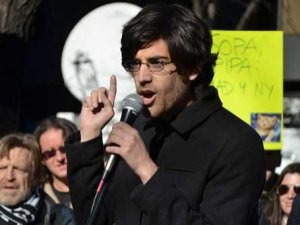
Aaron Swartz, R.I.P: Swaraj Paul Barooah

Reposting a tribute by Swaraj Paul Barooah which originally appeared on Spicy IP to Aaron Swartz. Aaron Swartz hung himself on January 11th 2013 and had been facing extensive legal charges for having downloaded 4 million articles from JSTOR which he intended to  make available for free online

aaron-swartz


Some of us in India may not have heard of Aaron Swartz, a 26 year old activist who was heavily involved in copyright policy issues and issues surrounding technology freedom. He committed suicide on Jan 11th, 2013 and his story is a sad one which is certainly worth sharing. However, what’s also important to note, are the circumstances which may have led his eventual suicide.

While it cannot be confirmed, it appears that his arrest and indictment for charges of downloading academic papers from MIT and JSTOR resulting in possible jail time of over 50 years and 4 million dollars in fines may have been the cause. JSTOR apparently had dropped the charges, but the US government continued the case and racked up a total of 14 counts of felony against him. (Note: it is unclear whether MIT pursued the charges or not). Clearly he was seen as very troublesome by the government and his online activism must’ve had a lot to do with that.
Continue reading Aaron Swartz, R.I.P: Swaraj Paul Barooah

Stalking, Delhi Police and Memory – Another Encounter: Kavita Krishnan

Guest Post by Kavita Krishnan

I have been wanting to post about an experience with Delhi police since yesterday, but haven’t found the time yet… Here goes.

Some days ago, (early this month if I recall rightly), I got a call from a woman worker living in Usmanpur near Seelampur. She got my number through the son of one of our Trade Union comrades, who is a friend of her brother’s. She said she was being stalked by a man who made calls to her thretening an acid attack. She has 3 children and was concerned for their safety too. She told me she was scared to complain to the police, and asked for advice. I was reluctant to advice a police complaint without her being fully ready, knowing that it might not yield satisfactory results. So I suggested we meet and talk things over before deciding.

But soon after, she called again: feeling buoyed by a sense of hope arising from the ongoing movement, she had gone to the police station – alone – and written out a complaint, giving the stalker’s mobile number, the number of his bike, and offering to share recordings she had made on her phone of the threat calls. She said, though, that the police had not given her any proof of having received or recorded her complaint (in spite of her asking).

Continue reading Stalking, Delhi Police and Memory – Another Encounter: Kavita Krishnan

Now that Owaisi is in jail, how about Praveen Togadia?: Mahtab Alam

Guest post by MAHTAB ALAM

Akbaruddin Owaisi, an MLA of Andhra Pradesh Legislative Assembly, who belongs to a Hyderabad-based political party All India Majlis-e-Ittihad al-Muslimin, better known as MIM, and its floor leader in the Assembly made an inflammatory speech against Hindus on 24 December 2012 at a public meeting in Adilabad District. The speech attracted widespread condemnation by Muslim activists, rightly so, apart from left, liberal individuals and organizations. Dr. Zafarul Islam Khan, President, All India Muslim Majlis e Mushawarat (AIMMM), an umbrella body of prominent Indian Muslim organizations termed it ‘a hate and rash speech’ arguing, ‘words that should never have been uttered by a responsible person, let alone a political leader, were used’.

Shabnam Hashmi, a prominent social activist and who has been relentlessly working on the issue of minority rights registered an FIR in Delhi against Owaisi stating, ‘the whole speech is highly objectionable, inflammatory and against the values of our constitution, democracy and secular values’. Similarly, FIRs were also registered in the State invoking section 295 A (for deliberate and malicious acts intended to outrage religious feelings) and 153 A (promoting enmity between different groups) of Indian Penal Code (IPC). Owaisi was arrested finally arrested on Tuesday (8th January) and sent to 14-day judicial custody. Continue reading Now that Owaisi is in jail, how about Praveen Togadia?: Mahtab Alam

A review of human rights in Jammu & Kashmir in 2012: JKCCS

This brief has been put out by the JAMMU AND KASHMIR COALITION OF CIVIL SOCIETY

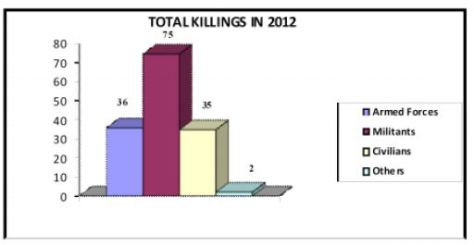
TOTAL KILLINGS

The year 2012 has just passed, and yet again like previous years, the government of Jammu and Kashmir has disgracefully claimed the year to be peaceful. This hyped peace is void of justice & peace and is packed with violence & injustice. In the year 2012 the people of Jammu and Kashmir in routine have witnessed unabated violence, human rights abuses, denial of civil and political rights, absence of mechanisms of justice, heightened militarization and surveillance. The figures of violent incidents suggest that 2012 as usual has been the year of loss, victimization, lies, mourning and pain for the people. Continue reading A review of human rights in Jammu & Kashmir in 2012: JKCCS

Justice for Soni Sori. Gathering at Jantar Mantar, 02/01/13

Protests against Sexual Violence continue in Delhi. Earlier this morning, there was a gathering to protest against the gruesome sexual violence committed on Soni Sori while in custody in Chhattisgarh under the supervision of Ankit Garg, Superintendent of Police, Dantewada. Ankit Garg was awarded with a presidential police medal on Republic Day (January 26) in 2012.

Soni Sori’s petition at the Supreme Court is due to be heard tomorrow. Continue reading Justice for Soni Sori. Gathering at Jantar Mantar, 02/01/13

Fettering the fourth estate: Free Speech in 2012

Fettering the Fourth Estate: Free Speech in 2012

A report of the Free Speech Hub of the Hoot.org

The year 2012 ended with a Kannada TV reporter, Naveen Soorinje, in jail for more than fifty days after the Karnataka High Court denied him bail. Mangalore-based Soorinje, was incarcerated from November 7, 2012 after police charged him under the UAPA and under the Indian Penal Code (IPC) for reporting on the raid on a homestay party by a Hindu fundamentalist group in July. Soorinje’s bail application was rejected on December 26.

The same month, a television journalist, Nanao Singh, was shot dead in a police firing in Manipur.

In 2012, India was a grim place for free speech. It recorded the death of five journalists. Another 38 were assaulted, harassed or threatened.    There were 43 instances of curbs on the Internet, 14 instances of censorship in the film and music industry, and eight instances of censorship of content in the print medium. Continue reading Fettering the fourth estate: Free Speech in 2012

The epiphanic moment of the lathi charge

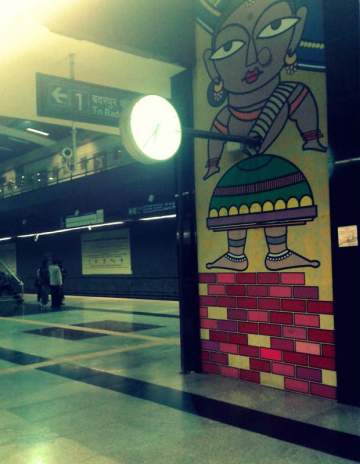
At the Khan Market Metro station

The girl wasn’t aware that the Udyog Bhavan Metro station in central Delhi had been shut down. In the Metro going to Gurgaon, she needed to get down at Udyog Bhavan. Her friend was waiting in a car outside the station. She waited at the door. The train stopped too, but the gates didn’t open. The PA system — the annoying PA system of the Delhi Metro that never stops saying something or the other — – fell silent. The station was deserted. Not a soul in sight.

The girl asked fellow passengers — all of us men around her — which would be the nearest station that would be open. All the options were far off. Ramakrishna Ashram station on one end, for instance, was four kms. away. “Now what?” the girl asked her friend on the phone in a tone that blamed him, in a way only lovers can. “Now what?” she kept repeating. Continue reading The epiphanic moment of the lathi charge

We must resist the cunning of judicial reform: Pratiksha Baxi

Guest Post by PRATIKSHA BAXI

The death of the 23 year old woman following the brutal gangrape rape and assault on a moving bus on 16 December 2012 at a hospital in Singapore early this morning leaves all of us in states of deep mourning. This is a political death. Rape and murder of women is political violence against all women, whether or not, the political class recognises and accepts this. In the course of the last two weeks, many body blows have been endured. We felt a body blow after the political death of the 17-year-old gangrape victim in Patiala who took her life after she was humiliated and pressurised to compromise. The numbing list of such political violence continues.

We have seen the emergence of many kinds of publics. There have been many speeches and writing against the emergence of a retributive public, where the cry for death penalty or castration became a vocabulary of protest, also especially since the media initially focussed largely on this demand. Yet in the last few days there has been a perceptible shift from the focus on forming a retributive public moving towards a passionately reasoned and informed public on what the government needs to do to be accountable to rape survivors, and indeed, to all of us who reject the rape cultures in India.
Continue reading We must resist the cunning of judicial reform: Pratiksha Baxi

This Truth Will Never Be Televised: Saiyed Danish

Guest post by SAIYED DANISH

The death of the police constable Subhash Tomar in the middle of the anti-rape protests at India Gate is eerily reminiscent of the controversial death of Inspector Mohan Chandra during the infamous Batla House encounter in 2008.

 The post-mortem report of Constable Subhash Tomar says that he died of a heart attack which was triggered by internal injuries. The police say those injuries were the result of fatal blows given to him by the angry protestors. However, a protestor named Yogendra had earlier said on national TV that he “saw him running towards the protestors and then collapsing suddenly on his own.” Yet another controversy over the death of a police man,  with a familiar  clash of State vs People’s versions has now begun.

Continue reading This Truth Will Never Be Televised: Saiyed Danish

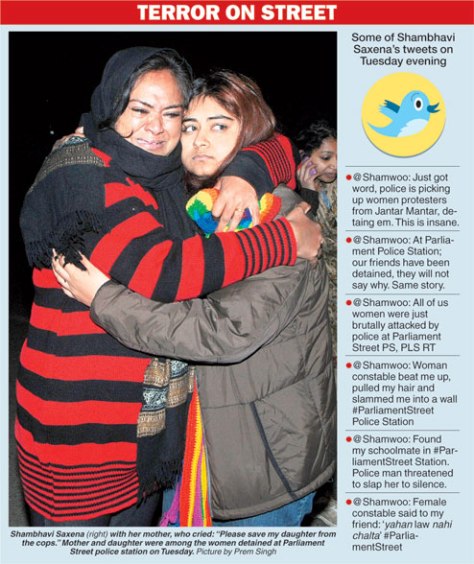
How Delhi police assaulted my daughter on 25 December: Usha Saxena

From The Telegraph

USHA SAXENA writes a letter to Delhi chief minister Sheila Dikshit:

Dear ma’am,

My daughter Shambhavi and I and a colleague of mine Reema Ganguly went to Jantar Mantar today 25th Dec to take part in a peaceful gathering there against the gang-rape.

At around 4pm two girls came running up to us in tears and said that the police had dragged away 2 of their female friends to Parliament Street Police Station and they asked us to help bring them back. The three of us joined 9 other women and we went to the police station. When we reached there we only saw male constables. We demanded to talk to a female senior officer and said that the 3 women must be released immediately. The policemen very rudely and aggressively tried to chase us out. We refused to leave without those 3 women and so one male cop ordered some female cops standing in the courtyard to come in and arrest all of us. Continue reading How Delhi police assaulted my daughter on 25 December: Usha Saxena

Armed Forces Special Powers Act provides impunity for rape: Warisha Farasat

Guest post by WARISHA FARASAT

The protests against the brutal gangrape of a young 23 year-old girl in Delhi have been unprecedented. Finally, it appears that the impunity with which crimes against women in our country are committed is causing outrage, and both men and women are demanding justice. What is encouraging is that although the protests were triggered by the recent incident of rape in Delhi, it has also forced us to reflect on the larger issue of impunity for rape and other crimes against women, particularly when it happens against women belonging to the marginalized communities. Moreover, it is also politicizing an entire generation of young people that are realizing that their voice can create ripples in the political establishment in Delhi.

Shuddhabrata Sengupta in his earlier post has lucidly articulated about how our response to sexual violence should not be selective, and our protests should recognise the brutality of crimes against women in the conflict areas of Kashmir, Manipur and Chhattisgarh. In Kashmir, accusations of rape have been repeatedly made against the security force personnel. It has been alleged that rape and assaults have occurred during crackdowns, cordon and search operations. During these operations the men were held for identification outside their houses, near mosques or in a common ground while the security forces searched their homes. During these search operations, safeguards such as inclusion of a women officer in the search teams were never followed. Continue reading Armed Forces Special Powers Act provides impunity for rape: Warisha Farasat

Rape is allowed because most people don’t know what it is: Anonymous

Guest post by ANONYMOUS

Rape is allowed because most people don’t know what it is.

To say that victims understand it is assuming too much. The immediate affect will be a deep, invisible wound. After years of counselling it will still hurt and terrorise. All the strength in the world, at the individual and existential levels, will fall short. Very often the crime will remain unreported. Rather than empowering women, the legal system will manage so few convictions that it will itself be the greatest perpetrator.

The perpetrators, as in the actual rapists, know as much or as little as the victims. They will go unarrested, unnoticed, unashamed, and this will fuel their psychopathy. They may or may not realise that rape is not about sex but power.

Continue reading Rape is allowed because most people don’t know what it is: Anonymous

Sexual Violence and Sexuality Education – The Missing Link: Ketaki Chowkhani

Guest post by KETAKI CHOWKHANI

Over the last few days there seems to be sudden explosion in talking about sexual violence and other forms of violence on women. A huge discourse is being created around what rape cultures are and how we are part of these cultures which produce and construct these very acts of violence. Sexual violence has been linked to sexist, misogynist attitudes, remarks and behaviour, and ranging from scriptural affirmations to popular songs. The rape cultures are discussed as existing within the spaces of homes, streets, offices, courts, police stations, public transport, universities and so on. Continue reading Sexual Violence and Sexuality Education – The Missing Link: Ketaki Chowkhani

How the God of Death Changed His Mind: Images from the Protest Against Rape at Jantar Mantar

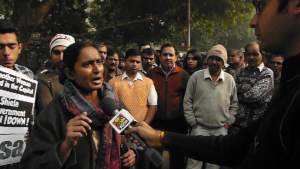
Kavita Krishnan, AIPWA speaking at Jantar Mantar
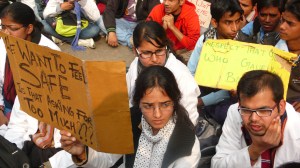
Wanting Safety
Wanting Safety

Protests against sexual violence continued for the third day in Delhi. The venue had shifted from the India Gate-Rajpath environs to Jantar Mantar. Despite the fact that the government had closed metro stops in central New Delhi (from Rajiv Chowk to Khan Market) so that Vladimir Putin was spared the embarrassment of having to encounter protestors against rape, even as he sold gas and guns, a motley crowd of mostly young women and men were able to make their way to Jantar Mantar. Here are a few images and vignettes from this afternoon. Continue reading How the God of Death Changed His Mind: Images from the Protest Against Rape at Jantar Mantar

This is to clarify a small misunderstanding: Anusha Rizvi

Guest post by ANUSHA RIZVI

To,
Ms. Shiela Dixit, Chief Minister Delhi NCR
Mr. Sushil Kumar Shinde, Home Minister, India
Mr. Tejendar Khanna, Lt. Governor, Delhi NCR

This is to clarify a small misunderstanding. I know a part of the protests made you believe that women in Delhi are asking to take policemen away from their VIP duties and put them on Delhi streets. This is incorrect. Many of the protestors are too young to understand
Ma’am and Sirs, the roads are unsafe enough. All Delhi women know – when you see a Delhi policeman, you run. This is what our mothers taught us. This is what we teach our children. I sincerely request you to increase VIP duties for all cops in the Delhi National Capital Region. Please don’t waste your time and energy transferring or suspending any of these gentlemen. All you have to do is ensure no cops are given non-VIP duties. Continue reading This is to clarify a small misunderstanding: Anusha Rizvi

To the Young Women and Men of Delhi: Thinking about Rape from India Gate

Dear young women and men of Delhi,

Thank you for the courage and the honour you have brought to Rajpath, the most dishonorable street in our city. You changed Delhi yesterday, and you are changing it today. Your presence, of all twelve thousand of you, yesterday, on Rajpath, that street that climbs down from the presidential palace on Raisina Hill to India Gate, getting soiled by the excreta of the tanks and missiles on Republic Day each year, was for me a kind of purificatory ritual. It made a claim to the central vista of ‘Lutyen’s Delhi’ as a space for democratic assertion in contravention of the completely draconian, elitist and undemocratic prohibitory orders that make the heart of this republic, a zone of the death, not the life and sustenance, of democracy.

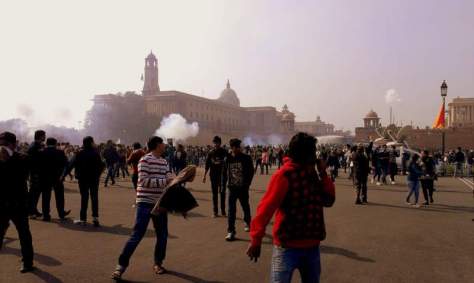
From now onwards, consider the heart of Delhi to be a space that belongs, first of all, to its citizens. Yesterday, when thousands of you gathered peacefully, intending to march up Raisina Hill to the president’s palace, you were charged with batons, tear gas and subjected to jets from water cannons. The violence began, not when protestors threw stones, but when the police started attacking people. Stones were thrown in retaliation. The television cameras that recorded what happened show us the exact chronology. The police were clearly under orders not to let people up Raisina Hill. Why? What is so sacred about Raisina Hill? Why can a group of unarmed, peaceful young people not walk to the gates of the president’s palace? So, lets be clear. Violence began when the state acted. Of course, the protest got hijacked by hooligans. But of course it had to be. When hooligans in uniform are let loose on an unarmed crowed, there can be no possibility of averting the possibility that hooligans out of uniform will respond in kind. Continue reading To the Young Women and Men of Delhi: Thinking about Rape from India Gate

A Day at Raisina Hill: Nilanjana Roy

Guest post by NILANJANA ROY

“We want justice! We want justice!”

I went to the protests at Raisina Hill expecting very little. Despite the anger over the recent, brutal gang-rape of a 23-year-old by a group of six men, who also beat up her male friend, protests over women’s violence in the Capital have been relatively small.

But the crowds walking up the Hill, towards the government offices of North and South Block, from India Gate are unusual. It’s a young crowd—students, young men and women in their twenties, a smattering of slightly older women there to show their solidarity, and it’s a large crowd, about a thousand strong at the Hill itself. There are two small knots representing student’s politicial organisations, but otherwise, many of the people here today are drawn together only by their anger. Continue reading A Day at Raisina Hill: Nilanjana Roy

Passage of Amendments to UAPA – Further erosion of Constitutional Rights: JTSA

This release was put out today by the JAMIA TEACHERS’ SOLIDARITY ASSOCIATION

The pushing through of the amendments to Unlawful Activities Prevention Act (UAPA) in the Rajya Sabha, despite protests and calls for further discussion and deferment, indicates the consensus between Congress and BJP on the issue of civil rights. The passage of the amendments, which now bring economic offences under terrorism, and broaden the definition of person to an extent that will criminalize all forms of associations, will provide sweeping powers to the police and security agencies, and create a regime of suspicion.

False Claims of the Government:

Responding to the debate in the RS, Minister of State for Home stated that, “The Act does not give sweeping powers to the police and there are checks and balances that will prevent misuse of the Act.” He further assured the House that the law was “religion neutral” and would not target any particular community.

This is patently false. Continue reading Passage of Amendments to UAPA – Further erosion of Constitutional Rights: JTSA