Category Archives: Law

Anand Jon wants to be tried in India – I would too, if I were him

Fashion designer Anand Jon has been sentenced by a Los Angeles court to 59 years in prison for violent sexual assault on seven young women, some of them under-age. His defence tried to move for a mistrial on the grounds that one of the jurors had contacted Jon’s sister during the trial, but a new trial was not granted by the judge. The concerned juror delivered a “guilty” verdict along with the other 11 jurors in the case.

A month ago, his sister Sanjana had pleaded with the Indian government to extradite him as he would not get a fair trial in the US, being Indian. She claimed then, and did so again after the verdict on September 1, that Jon is a victim of racist discrimination.

Would Anand Jon have been acquitted of such charges in an Indian court? Almost certainly, yes. In a justice system in which alleged rapists are routinely acquitted for “lack of evidence” and proven rapists given a reduced sentence because of their youth and the promising life ahead of them, Sanjana is right to insist that he be tried in an Indian court. In an Indian court, the testimony of women who had willingly gone to his home on the promise of jobs in the fashion business, and then claimed they were raped, would be dismissed out of hand. Especially if the women are white. Gratuitous references to “western women” and their supposed attitudes to sex, pepper judgements and statements by officials on rape in India.

Continue reading Anand Jon wants to be tried in India – I would too, if I were him

Ai Weiwei’s (Chinese Artist) Statement: Guest Post from Monica Narula

Dear All,

I would like to share with all Kafila readers something that my friend Monica Narula posted recently on the Reader List about the intimidation that the well known Chinese contemporary artist, Ai Weiwei has faced, in connection with his support for the currently detained dissident rights activist Tan Zuoren in Chengdu. This is an introduction to Ai Weiwei in the current context and a text of his recent statement released in the context of the harrassment (including beatings by police) that he has had to go through. Please read and share widely.

best

Shuddha

—————

Avant-garde artist Ai Weiwei, one of China’s foremost public  intellectuals, was recently detained and beaten by police when he  attempted to testify at the show trial of dissident Tan Zuoren in  Chengdu. Harassment and threats are connected, in part, to his “Names  Project,” a performative intervention which aims to compile, publish,  disseminate, and memorialize the names of the thousands of children  who were crushed to death en mass in their “crumbling tofu  construction” schools (the rotten fruits of official corruption and  kickbacks) during the May 12, 2008 Wenchuan Earthquake, while  neighboring government buildings stood intact. The State has strong- armed bereaved parents into silence, refused to investigate government  corruption, and barred the victims’ names from public release. Ai  Weiwei’s vocal defiance has led to his censorship, intimidation,  threats and now arrest and beating.

Having spent the first 2 decades of his life with his father, the  revolutionary poet Ai Qing, in a cadre labor reform camp for errant intellectuals, Ai Weiwei understands that no one in China, no matter  how “high profile” is ever “safe. Thus, he has chosen to push the  State as far as he can in an attempt to reclaim the public sphere for  critical discourse, and champion the cause of free speech and genuine  citizen and human rights in China. As such, he has willingly put  himself in a great deal of danger. His recent statement merits  reposting. I hope that you will pass this on and share it with others  who believe in the need to nurture and support critical public intellectuals, especially in places like China, where there are so few
such clarion and courageous voices.

Ai Weiwei’s Statement

“Watch out! Have you prepared yourself?” —

Ai Weiwei: “I am ready.  Or, perhaps I should say that there is nothing to prepare, no way to  prepare myself. A person–this is all of me–is something that can be  received by others. I offer up all of myself. When the time comes when  it is necessary, I will not hesitate, I won’t be ambiguous about it.  If there is anything that I am reluctant to leave behind it is the  wondrous miracle that life has brought me. And that miracles are that  every one of us is the same, that people are equal in this game, as  well as the fantasies that come along with playing it, and our  freedom. I regard every kind of intimidation, from any kind of  ‘authority or power’ [sic – the character is for quanli as in  ‘rights’, but from the context this appears to be a typo, perhaps?],  as a threat to human dignity, rationality and reason–a threat to the  very possibility of opposition. I will learn to face and confront this.”

Balmiki, Bawaria, Garg, Chauhan: Proclaimed offenders all

haryanapolice1
The Haryana Police website has a list of proclaimed offenders. Great. E-governance and all. But how does it help them to record the caste of every ‘proclaimed offender’? Perhaps because caste is such a valuable marker of identity that it helps nabbing them – after all, where would a Chauhan hide if not in the house?

Or perhaps there is more to it.Is it merely incidental that most proclaimed offenders seem to be Balmiki Dalits in a state known for atrocities against Dalits, in which the upper castes act with impunity in collusion with the Haryana police?

Browse through and you will see, fortunately or unfortunately, that they haven’t been able to find the caste of many, and for very few Muslims have they any caste detail.

Land and Human Rights

There are few more contentious and complex problems in India than those dealing with land and land rights. Rather than just focus on a single issue, a continuum of rights has to be established regarding land, especially in areas of access and reforms, laws and enforcement, use planning and management, administration and information, and its cross-cutting issues. The new and existing initiatives on land should be guided by the core values of pro-poor, conflict resolution, democratic governance, equity, and justice, as well as gender sensitiveness. Although land policy development is taking place, it generally lacks a human rights framework. Land is not simply a resource for one human right. While some rights have been recently established in the legal framework (like work, education, food), they all can be adversely affected by access to land, and the legal implications of it for a broad range of human rights is obvious. The Land Acquisition and Rehabilitation and Resettlement Bills should also be assessed on the basis of several international principles, interpretive documents and legal frameworks. Continue reading Land and Human Rights

‘It will lead to the commodification of homosexuals’

(I had conducted this interview while working on a story on the Delhi High Court judgement on the 377 case. While that story didn’t materialise, I thought I should post this interview now.)

PURUSHOTHAMAN MULLOLI is general secretary of the Joint Action Council, Kannur-India (JACKINDIA) which intervened in the Section 377 case in the Delhi High Court. In an interview he explains his opposition to the case.

What is JACKINDIA? Continue reading ‘It will lead to the commodification of homosexuals’

Striving for Magic in the City of Words

By LAWRENCE LIANG and SIDDHARTH NARRAIN

(Published as Magic in the ‘City of Words’ in the August 2009 issue of Himal)

After agitating for many years against the existence of Section 377 of the Indian Penal Code, which criminalised homosexuality, it is understandable that the Delhi High Court’s 2 July decision in the Naz Foundation case, decriminalising homosexuality, has been welcomed and celebrated by the LGBT (lesbian, gay, bisexual and transgender) community. But to see this decision as a victory of the LGBT community alone would be to do injustice to the Delhi High Court’s remarkably progressive and well-reasoned decision, and the immense potential this judgement has for changing the course of equality jurisprudence in India. It would also display a very narrow understanding of the relationship between constitutional change and social movements striving for a more just and democratic society. Continue reading Striving for Magic in the City of Words

SAHMAT press statement on prayers in protected monuments

SAHMAT
29, Ferozeshah Road, New Delhi -110001
Telephone-2 3070787,23381276
e-mail: sahmat@ vsnl.com

29.7.2009

Press Statement Continue reading SAHMAT press statement on prayers in protected monuments

MILITARIZATION WITH IMPUNITY: A Brief on Rape and Murder in Shopian, Kashmir

This release dated 19 July comes from the International People’s Tribunal on Human Rights and Justice in Indian-administered Kashmir (IPTK)

Enclosed, please find our brief on the events and investigative process in Shopian, Kashmir, connected to the brutalization and death of Asiya Jan and Neelofar Jan in end May 2009, in which the state security forces have been implicated.

While investigations have emphasized the procedural conduct of the police in their handling of the investigation, they failed to focus on the actual crimes that were committed, or the conduct of state institutions. The investigations in Shopian have not focused on the identification and prosecution of perpetrators or on addressing structural realities of militarization in Kashmir that foster and perpetuate gendered and sexualized violences, and undermine rule of law and justice. The investigations have instead concentrated on locating ‘collaborators’ and manufacturing scapegoats to subdue public outcry. ‘Control’ rather than ‘justice’ has organized the focus of the state apparatus, including all processes related to civic, criminal, and judicial matters.

What is the ‘truth’ of the matter, who are in the know, and what is being shielded?

We were compelled to write this brief to mark the inability of the state apparatus to deliver justice. We urge civil society institutions and international human rights groups and those working with issues of social justice to seek accountability.

In writing this, we have visited, and been in contact with, the family of Asiya Jan and Neelofar Jan, and civil society leaders and organizations in Shopian, and in Srinagar. We are grateful for the collegiality extended us, and especially to those that placed themselves at risk to offer us insight.

You can read here the full report.

Right Hand, Wrong Hand

I have two daughters, born 1984 and 1988. As they grew up we noticed that both of them were ambidextrous but gradually the 84 born started favouring her right hand over the left but the 88 born did the exact reverse. She began to rely more and more on her left hand to do things like eating, opening doors, picking up things, writing etc,things that “normal” people including my elder daughter do with their right hand.

A couple of interfering neighbours tried telling us to ‘teach’ our daughter to do things properly and not to eat or touch ‘saraswati’ with her dirty hand. Luckily we told these busy bodies to mind their own business and let her be. Continue reading Right Hand, Wrong Hand

Why I Feel For B.P. Singhal

In the aftermath of the Delhi High Court judgement reading down Section 377, the initial euphoria and celebration is now being increasingly met with an equally strong backlash. Some of this has of course come from the religious right of all denominations (Hindu,Muslim, Sikh, Isayi Apas mein sab bhai bhai), the army, politicians, conservative commentators in the press. Underlying much of the oppositions seems to be a sense that somehow the decriminalization of homosexuality is going to turn everyone gay, a sentiment that sounds bizarre to us.

But now that I have been thinking about this I think I am beginning to understand the fear that is articulated in this “homosexuality-as-contagious-virus” position. Because in one sense they are right. In his post Lawrence speaks of the radical politics of impossibility – the change in the law suddenly makes possible a new set of imaginary possibilities that we could not dream of hitherto. And so BP Singhal and Dominic Emmanuel and everyone else who is saying that the presence of the law performs a stellar function against the rise of a virtual army of gay people and must remain on the books, even if, and indeed especially because, it is never used against actual real gay people, have a point. Continue reading Why I Feel For B.P. Singhal

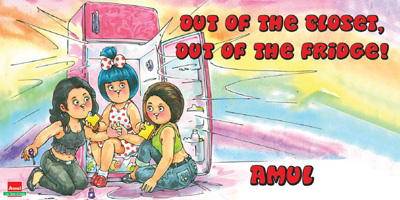
The Amul girl comes out of the closet

Via amul.com
Via amul.com

Home, house

I entered Yunus’s house. He was allotted 150 square meters of land to build his home. Parts of the house were done up with brick and cement. The roof was still kutcha, raw – in the process of construction. You could see the incompleteness of the roof from the opening around the right hand side from which rain likely comes into the house (as does sunshine). I asked Yunus,

Ghar mein barsaat ka pani aata hai kya? Baarish se pareshaani nahi hoti? Continue reading Home, house

BP Singhal: “I don’t have any problem with homosexuals. Do you?”

Photo credit: Salman Usmani

Bharatendu Prakash Singhal, 78, is a Hindutva ideologue, a retired IPS officer and a former BJP Rajya Sabha MP. On a Sunday afternoon I visited him to discuss his opposition to the decriminalization of gay sex by the Delhi High Court. He is preparing to appeal against it in the Supreme Court. Singhal explained that he wasn’t opposed to private consensual sex between same-sex adults, he didn’t want such adults prosecuted or persecuted, but he merely wanted the law to remain on paper as a deterrent. This is the transcript of a recorded interview; a much shorter, edited version has appeared in Open. Continue reading BP Singhal: “I don’t have any problem with homosexuals. Do you?”

Speaking of litigation: Anant Maringanti

Guest post by ANANT MARINGANTI

Speaking of successful litigation, one day after what some may call the makings of India’s rainbow coalition celebrated the Delhi High Court’s final verdict in the Naz Foundation case, agricultural workers in Andhra Pradesh celebrated a favorable interim order in the APVVU (AP Agricultural Workers Union) case. Judge N.Ramamohana Rao of AP High Court ignored the Additional Solicitor General’s objections and ordered that the National Rural Employment Guarantee Scheme wage rates be revised up from Rs 80 per day to the prevailing minimum wage of Rs 119 (111 and 112 in some areas) per day set by the Government of Andhra Pradesh. This will remain in force for 8 weeks. Of course, a favorable interim order does not imply that the final verdict will be favorable. But it bolsters the confidence of the contestants. It is a precious gift of time for solidarity building. And in this particular case, it will put an additional amount of a whopping Rs 31-40 per each of the 100 work days in a year in the hands of those availing work under the NREGA. It did not bring tears to the eyes, but in a general clime of judicial unresponsiveness to the claims of the poor it made many heave a sigh of relief. Continue reading Speaking of litigation: Anant Maringanti

Is the Naz Foundation decision the Roe v. Wade of India?

There are surprisingly few constitutional cases in India which have had the same symbolic power that cases like Roe v. Wade (affirming the right of abortion) or Brown v. Board of Education (dissolving racial segregation in schools) have had in the political history of the United States.  For sure, there are a  number of important constitutional cases which have contributed significantly to the democratic history of India. Kesavananda Bharati’s espousal of the basic structure doctrine, Maneka Gandhi’s introduction of due process in Art.21, but these cases  seem to have an appeal largely within the legal fraternity. They are also cases where the relief sought by the petitioners have had little to do with the final outcome of the case, and it is highly doubtful whether his Holiness Kesavananda Bharati had any investment in the long term impact of the basic structure doctrine (not to mention that Kesavananda Bharati just doesn’t roll of the tongue as easily- in terms of recall value).  Is it possible then that Naz Foundation v. Government of Delhi is the first equivalent of a case whose name conjures up the history of particular struggle, celebrates the victory of a particular moment and inaugurates new hopes for the future.

Continue reading Is the Naz Foundation decision the Roe v. Wade of India?

Why the Delhi High Court judgement on IPC 377 does extend to the rest of India

While expanding the territorial jurisdiction of high courts in such cases, the SC took cognizance of the principle contained in Article 226(2), which empowers a high court to issue directions to entities located outside its territory. [Manoj Mitta]

Report on the Batla House ‘encounter’

The Jamia Teachers’ Solidarity Group has released a report on the Batla House ‘encounter’ which they have requested Kafila to put up.

You can read the report below, and also download it from here.

You can find all of Kafila’s posts on the Batla House incident here.

Synopsis:
This report is based on police statements, press reports, testimonies of families and friends of the accused and other documentary evidence. It highlights the numerous contradictions in the police version(s) about the ‘encounter’ and the accusations.

Continue reading Report on the Batla House ‘encounter’

In the Supreme Court of the Indian Blogosphere

(I had written this article after the Supreme Court’s refusal to quash a defamation case in a Thane court against a student-blogger in Kerala, Ajith D. A shorter version was offered to a newspaper which refused to publish it. So finally I’m posting it here. For a better context, please see Lawrence Liang‘s posts on the subject. Whatever is written below is without prejudice against any of the parties named. For the history of the Shiv Sena encounter with Orkut, I am graetful to Gaurav Mishra for this excellent article.)

If you search “Shiv Sena” on just the communities section of the social networking site Orkut, you get 244 results. There are love-Shiv Sena and hate-Shiva Sena communities (essentially discussion boards), but my favourite is one called “Shiv Sena v/s Anti SS” which seeks to sort out differences between “sainiks and anti-sainkis”. It further states, “If anyone posts hurting a fellow member, that post will be deleted. There must be some amount of respect towards fellow members. The owner being Anti shiv sena will debate for Anti SS.” The community was started by “Madhushree It takes courage to be true.” and has 111 members at the time of writing. Continue reading In the Supreme Court of the Indian Blogosphere

‘Lahoris woke up and joined their son’

What a moment it is, what a moment it must be. Ordinary people on the streets of Lahore on Sunday, countless thousands of them, have forced the Pakistani government to re-instate the deposed Chief Justice of the Supreme Court. What a moment of hope in a country the rest of the world believes is about to ‘implode’. What a resurrection of yourself, Mian Sa’ab, who will now remember how unpopular you were when Mush had ousted you!

Here’s an extremely illuminating account of what happened in Lahore, an anonymous account circulating on some mailing lists. This is apart from some excellent citizen reportage on Twitter by Pakistanis.

The Army, the Presidency, the Americans and the Prime Minister, were all ready to throw peanuts at Nawaz Sharif. The assessment was that 500 will reach constitution avenue (read Salman Taseer). In Pindi, we had halwa puri at a friends house today. A PPP friend who knew my passion for the CJ, at 11-00 am said, looking at me, “Yar Imran, there is a bigger long march in my house than in Lahore.” A PML N friend told me from Lahore, “Punjabis dont get out in the face of danda. The long march will fail.” Continue reading ‘Lahoris woke up and joined their son’

And then Suresh Sankhyan wanted to do the post-mortem

amank1
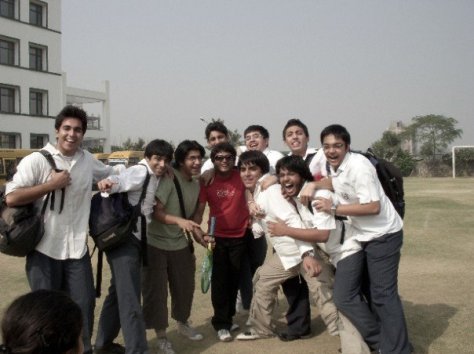
Aman Satya Kachroo, left-most, in his school days. Photo by Vaibhav Chhabra via Facebook

Before he died of brain haemorrhage (and not cardiac arrest as the papers incorrectly claimed), Aman Satya Kachroo wrote a note about who beat him up. In the note he named the four accused who are all now in jail. The note reads like a dying declaration and is signed by 12 witnesses. It seems unlikely that even one of the 12 witnesses will have the courage to say in court that they saw the lynching happening before their eyes. Even as they came down to Gurgaon for the cremation, they must have been getting calls from their parents, ‘Beta, just say you didn’t see anything. Why get into these court hassles and potential threats from the families of the accused?’ Continue reading And then Suresh Sankhyan wanted to do the post-mortem

Why Aman Kachroo’s won’t be the last ragging death, and what his family should do

thumbcms1Update 2: And then Suresh Sankhyan wanted to do the post-mortem

*

Update: Additional Solicitor General Gopal Subramaniam, who is I think the amicus curae in the ongoing case, says he will ask the Supreme Court to take note of the case and charge the Principal and Vice-Chancellor with “contempt, inaction, negligence and failure.” But who will charge whom for lack of implementation of the SC orders on ragging?And Himachal Pradesh has an anti-ragging ordinance too. (The ordinance had expired in 1998 1992, I gather, as it had not been turned into a law within six months)

*

I don’t know why this report does not use the word lynching, because that is what seems to have happened at the Dr Rajendra Prasad Medical College, Tanda. Continue reading Why Aman Kachroo’s won’t be the last ragging death, and what his family should do