Category Archives: Right watch

A blow to reproductive rights in Pakistan: Ayesha Asghar

Guest post by AYESHA ASGHAR

Early in July, Kashmala Tariq, Member of the National Assembly (MNA) of Pakistan, whom Wikipedia describes as “actively involved in women’s rights”, opposed the tabling of the Reproductive Health Bill 2012, saying that it was not in conformity with Islamic laws. The Bill was introduced by another MNA, Atiya Inayatullah, with the purpose of providing reproductive health services, including legal access to abortion,  to women in Pakistan.

Tariq accused the Bill of following the agenda of foreign NGO’s and stated that such proposals that might be in contravention of Islamic injunctions should be sent to the Council of Islamic Ideology and every party’s opinion should be sought. The Bill has been sent to the Cabinet Division for further deliberations.

Does this mean that our women representatives don’t know what reproductive rights include? The responsibility of women parliamentary representatives in Pakistan is more challenging than that of men, as women are more often made victims of oppression either in the name of culture or religion.

Continue reading A blow to reproductive rights in Pakistan: Ayesha Asghar

CPI(M)’s ‘July Crisis’ and Challenges for Rebuilding the Left

In an unprecedented move ,  the JNU unit of the SFI (SFI-JNU) has been dissolved by the ‘Delhi State Committee of the Students’ Federation of India’ [SFI is the CPI(M) student wing]. What is interesting about the press statement issued by the ‘Delhi State Committee’ following this momentous decision, is that it is signed by the Acting President and the Acting Secretary. The state secretary Robert Rahman Raman has since resigned in protest against the decision and the state president, according to him happens to be among those expelled. The state secretary in his statement has protested against the SFI Delhi state committee’s decision, ‘taken with just 12 members present and without adequate consultation or effort to retain the unit.’  The matter then, is far bigger than that of an errant SFI unit.

Clearly, leading state functionaries of the organization too are involved in the heresy that has called forth this action by the high priests of the CPI(M). Anyone who knows the command structure of the CPI(M) and how it works, can see immediately that a decision as important and unprecedented as this cannot have been taken by something as inconsequential as the Delhi state committee of the SFI. Indeed, even the Delhi state committee of the CPI(M) could not have taken this decision without the concurrence of the highest leadership – in this case Prakash Karat, the general secretary, himself. Continue reading CPI(M)’s ‘July Crisis’ and Challenges for Rebuilding the Left

Once There Was Hindutva Terror ..?

Bomb blasts have taken place near the Delhi High Court, in Bombay, Bangalore etc. Within a few hours of such bomb blasts many T V channels started showing news item that Indian Mujahidin or Jaish-e-Mohammed or Harkatul-jihad-e-islam have sent e-mails or SMS claiming responsibility. The names of such alleged organizations will always be Muslim names. Now an e-mail can be sent by any mischievous person, but by showing this on TV channels and next day in the newspapers the tendency is to brand all Muslims in the country as terrorists and bomb throwers…Should the media, wittingly or unwittingly, become part of this policy of divide and rule?

(Justice (retired) Markandey Katju, Chairman of the Press Council of India, October 10, 2011 at a get-together with mediapersons)

1.
Introduction

What is common between the murder of the leader of a private army of landlords at the hands of his own gang members in faraway Bihar over distribution of booty, the felicitation of a terrorist lodged in jail as ‘living martyr’ (zinda Shaheed) in Punjab or the anointment of a hatemonger as the poster boy of the main opposition party ? Formally speaking there are no connections but if one tries to dig further few subterranean linkages become clear. Whether one agrees or not they exhibit the growing legitimacy of authoritarian, fanatic, exclucivist politics in this part of the subcontinent . Continue reading Once There Was Hindutva Terror ..?

Swami Sahajanand Saraswati – A Contested Legacy: Manish Thakur and Nabanipa Bhattacharjee

Guest post by MANISH THAKUR and NABANIPA BHATTACHARJEE

Observers of the political scene in Bihar would have hardly failed to notice a renewed interest in the life and works of Swami Sahajanand Saraswati (1889-1950), the founder president of the All India Kisan Sabha, and arguably the most influential peasant leader of Bihar in the 1930s and 1940s. Over the last decade or so, his birth (22 February, 1889) and death (26 June, 1950) anniversaries have been celebrated with great pomp and show with full attendance of political luminaries of the state including Nitish Kumar, its present Chief Minister. Not only have glowing tributes been paid to his legacy but there has also been a spurt of writings on his life and times.

Swami Sahajanand Saraswati

New biographiesi have been released, and his collected works been published in six volumesii. In fact, there is a Swami Sahajanand Saraswati Foundation based in New Delhi as well as a Swami Sahajanand Saraswati Forum on the internet. Curiously enough, Swami Sahajanand Saraswati figures prominently on the internet in the caste-specific web-portals such as www.bhumihar.com; www.bhumiharmahasangh.com and www.bhumihar.net where his name appears along with Bhagwan Parashuram, Chanakya, Mangal Pande, Sri Babu, Ramdhari Singh Dinkar, C.P Thakur, and so forth in the long list of supposedly Bhumihar icons. Indeed, Saraswati’s legacy has always been the bone of contention between the Bhumihars and the communists. What needs explanation is the BJP’s concerted efforts in appropriating this iconic peasant leader as ‘samajik samrasta ke sant’.

Continue reading Swami Sahajanand Saraswati – A Contested Legacy: Manish Thakur and Nabanipa Bhattacharjee

The Myth of the Muslim Vote Bank

The recently concluded assembly elections in U.P were marked once again by an intensified debate on ‘Vote Bank Politics’. The debate was not provoked by the emergence of any new trends in political mobilization but was the standard fare that is dished out by so called commentators, experts, political analysts and people who not only think that they have inside information about how entire communities think and react, they also claim that there are agencies capable of engineering conditions that programme these communities to go and vote for this or that party.

The essential argument behind this discourse hinges on two presuppositions, one that particular religion or caste based communities can be mobilised and made to move in one pre-determined direction and two that this becomes possible because such communities react and behave as one individual and therefore all that is required is to catch hold of a handful of community leaders and you can as good as have the entire community in your pocket. Continue reading The Myth of the Muslim Vote Bank

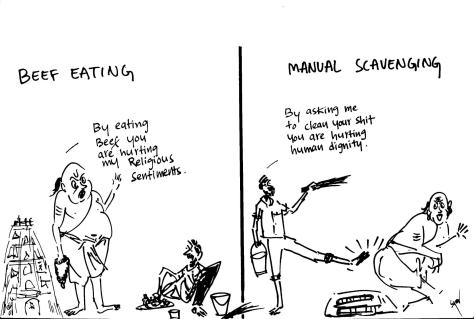
I have a beef with you: Unnamati Syama Sundar

This guest post by UNNAMATI SYAMA SUNDAR is a cartoon

From Kafila archives:


Dalits in Hindurashtra – Time for another sadbhavna fast Modiji!

…27 of the 30 complaints that were addressed to the commission spoke of indifference of police officials towards dalits.These issues were raised immediately after NHRC chairman KG Balakrishnan praised status of scheduled castes (SC) in Gujarat. He said the state’s schemes for development of the marginalised are working well and penetration of education among scheduled caste and scheduled tribes has reached 70%.Almost all dalits and their leaders present in the audience were not in agreement with this statement. [DNA]

 I

Justice Balakrishnan, retired Chief Justice of the Supreme Court of India, and at present Chairman of the National Human Rights Commission (NHRC), – who has remained in news since his retirement altogether for wrong reasons – provided further ammunition to his critics with his recent visit to Gujarat. The manner in which he lauded the state government for its ‘innovative schemes for the upliftment of dalits’ and claims that ‘..[f]uture of the SC community seems to be fairly good in Gujarat as compared to many other states’ is being seen as an attempt to clean chit and whitewash acts of ommission and commission.of a government which is still mired in the controversies surrounding the carnage in 2002

The said two day visit (14-15 th March) was part of the plan envisaged by the Commission to hold “open hearing” sessions on issues related to dalit atrocities in different parts of the country. According to media inputs, this was one of the important recommendattion by the K.B. Saxena committee which had done a painstaking job and brought out a report on dalit atrocities in the country few years back.for the commission itself. Not some time ago the commission had held its first such hearing in the state of Orissa.

Continue reading Dalits in Hindurashtra – Time for another sadbhavna fast Modiji!

The Anti-Politics of Murder

No, this post is not mainly about the ghastly murder of the rebel communist leader T P Chandrasekharan at Vatakara in Kerala early this month. It appears clear now that irrespective of whether the CPM leadership was directly involved or not, local CPM cadre were involved in the conspiracy. Certainly, it is an act gruesome enough to feed nightmares through many nights. And the way the gory details of the planning and execution of the murder continue to appear in the print and visual media, the Malayalee public is almost on its knees, holding on to their stomachs, racked by seemingly never-ending bouts of nausea. But I have my reasons for not wanting to focus on this incident here, reasons more than the sheer irritation felt with sections of the media that demand shrilly that ‘cultural leaders’ have not condemned the murder sufficiently. Continue reading The Anti-Politics of Murder

Resisting Culinary Fascism: Nabanipa Bhattacharjee

 Guest post by NABANIPA BHATTACHARJEE

At the end of last month (March 2012) students of Jawaharlal Nehru University (JNU), New Delhi under the banner of a recently formed group called the New Materialists (NM) organized a public meeting to debate the issue of (dis)allowing certain kinds of food – beef and pork in particular – on the campus. The group, as one of its members Suraj Beri said, intended to petition the university administration to allow the sale of beef and pork in the canteen(s), and fight for inclusion of the same in the hostels’ menus; it was a struggle, as the NM declared, against the Brahmanical dietary impositions on Dalits and other minority community students of JNU. In fact, Francis (JNU students of the 1990’s would remember the man from Kerala) who ran a canteen at the basement of the School of Social Sciences II did serve beef curry on Saturdays, and it would not be an exaggeration to say that there would be more than a mad rush for that. However, he was pressurised – by Hindu right wing groups and other similar forces – to stop the sale of the “forbidden” food, and the canteen was eventually closed down.

Continue reading Resisting Culinary Fascism: Nabanipa Bhattacharjee

NWMI Condemns The Violent Abuse Of Meena Kandasamy

[We at Kafila are absolutely horrified at the abuse directed at poet and activist Meena Kandasamy for expressing her views on twitter regarding the beef-eating festival at Osmania University. That supposedly ‘neutral’ educational institutions replicate upper-caste Hindu dietary taboos, is no surprise, nor that the ABVP reacted with its customary violence to that questions upper caste privilege. What is shocking is the attitude of the Vice Chancellor and the sexist, misogynist, violent speech directed at her on the web. It is telling that those who take such umbrage at the eating of cows, think nothing of advocating the public rape of women. Below is a statement issued by the The Network of Women in Media condemning the hate speech directed at her. We stand in solidarity with Meena Kandasamy.]

The Network of Women in Media, India (NWMI), strongly condemns the violent and sexist abuse unleashed on poet, writer, activist and translator Meena Kandasamy, presumably in response to her posts on Twitter about the beef-eating festival at Osmania University, Hyderabad, on 15 April 2012 and the ensuing clashes between groups of students. Continue reading NWMI Condemns The Violent Abuse Of Meena Kandasamy

Workers Struggle in Dehradun

The following is a statement from Uttarakhand Nav Nirman Mazdoor Sangh and the Inquilabi Mazdoor Sangh received via Shankar Gopalakrishnan

Between 12 and 1 yesterday, 15 April 2012, the Uttarakhand police lathi charged more than 300 workers who have been sitting on a protest in Dehradun for the last ten days. 11 workers who have been on hunger strike (six from April 6th and five who joined them on April 9th) have been forcibly hospitalised in Doon Hospital, where they are resisting attempts to force-feed them. 326 workers have been arrested and detained in various jails in the city.

The workers have been on strike for more than three weeks now. They are employees of the Rockman and Satyam Auto plants in Haridwar, both major suppliers of Hero Motors. As in Manesar, Haryana last year, these workers are being paid extremely low wages for more than 12 hours of work a day; when they sought to form a union to demand respect for labour laws, the five leaders of the union were illegally sacked immediately and the others threatened with a similar fate. On March 19th the majority of permanent workers at Rockman came out on strike in protest at this illegal brutality, and on March 22nd they were joined by all the permanent workers at Satyam. Continue reading Workers Struggle in Dehradun

On Sri Sri Ravi Shankar’s views about government-run schools

This press statement comes via Kavita Srivastava; see full list if signatories at the end.

PRESS RELEASE

Jaipur, 21st March, 2012: We are shocked and strongly condemn the statement made by the Global Corporate Brand “Art of Living” businessman, Ravi Shankar in Jaipur on 20th March, 2012, wherein he states that “Government schools are breeding grounds of violence and Naxalism ….that is why Government run schools and colleges must be handed over to private bodies….and that ‘Adarsh schools’ must reach all areas”. We would like to demand evidence from Ravi Shankar that Government schools, in which 16 crore children of the age group 6 to 14 years are studying are breeding grounds for violence and Naxalism. An army of Indian engineers, doctors, nurses, computer professionals, government servants army and police personnel and factory workers come from government schools. It would appear that this human resource that is the backbone of this country is wholly ‘Naxalite’ in the eyes of this completely irrational guru.

Continue reading On Sri Sri Ravi Shankar’s views about government-run schools

Reflections of a Refugee from Modi’s Gujarat: Reza Noorani

Guest post by REZA NOORANI

Kashana Flats, Paldi, Ahmedabad, as they stand today. Photo credit: Prateek Gupta

When the riots broke out in 2002 in Ahmedabad, after the burning of the Godhra coach, I was in the tenth standard. I remember listening to the news in the morning, just after which my best friend Ketan had called me and asked “Why did you guys do this?” I didn’t know how to respond to that. I think I just laughed it out and we began discussing what was happening in the city. My father took the phone away from me. I was preparing for my board exams and was just about to leave for one of the last days of school, after which we would go on a study leave. My father, who had experience with riots, told my two elder sisters and me to not go to school and stay at home that day. Continue reading Reflections of a Refugee from Modi’s Gujarat: Reza Noorani

On the low morale of Gujarat Police: RB Sreekumar

This guest post by former Gujarat DGP RB SREEKUMAR is a letter to the Union Minister of Home Affairs.

Dear Shri P. Chidambaram,

I belonged to Gujarat cadre of Indian Police service (IPS)-1971 batch-and retired from service on 27.2.2007 in the rank of Director General of Police (DGP), Gujarat state.

2. As a senior citizen (age-65 years) staying in Gujarat since 1970s, I am constrained to write the following for your kind consideration and urgent remedial action.

3. The morale, self esteem and image of the Gujarat Police in general and of IPS officers giving leadership to police force in the state in particular, have been in steady decline since 2002 anti-minority genocide. The media, reputed human rights activists and national bodies like the National Human Rights Commission, the National Commission for Minorities and the National Commission for Women have thrown light on serious intentional acts of commission and omission by Gujarat government functionaries (except in cities like Surat, Bhavnagar and a few districts in South Gujarat and Saurashtra), that facilitated extensive and gruesome mass violence against minorities.

Continue reading On the low morale of Gujarat Police: RB Sreekumar

We, the People of Gujarat: Urvish Kothari

This guest post by URVISH KOTHARI was originally written in Gujarati and has been translated by VISTASP HODIWALA

Associated Press

Some facts are so simple and self-evident that they elude you completely at the time they happen. Digesting them takes time – 2, 3,7, maybe even 10 years. By that time, the passion and the anger has abated a bit and there is a sense of composure that pervades our beings.

Like the fact about the communal violence that gripped the State of Gujarat in 2002.

Of course, a mere mention of this is enough to get the chief minister’s fanboys roll up their sleeves, even as their opponents ready themselves to launch a counter onslaught. But with the passage of ten long years, the first question should not be about whether the Chief Minister was complicit in the crime or not. No, it cannot be.

Continue reading We, the People of Gujarat: Urvish Kothari

75 Years of Bhonsala Military School: Militarising Minds, Hindutvaising the Nation

Image

..to bring about military regeneration of the Hindus and to fit Hindu youths for undertaking the entire responsibility for the defence of their motherland.

to educate them in the ‘Sanatan Dharma’, and to train them “in the science and art of personal and national defence”

– From the aims of ‘Central Hindu Military Education Society,’ NMML, Munje Papers, subject files, n 24, 1932-36)

This training is meant for qualifying and fitting our boys for the game of killing masses of men with the ambition of winning victory with the best possible causalities (sic) of dead and wounded while causing the utmost possible to the adversary.

– Preface to the scheme of the Central Hindu Military Society and Its Military School’NMML, Munje Papers, subject files, n 25, 1935

Nashik: Expressing concern over the dominance of ‘rich and powerful people’ in politics, besides the soaring inflation rate, Rashtriya Swayamsewak Sangh (RSS) chief Mohan Bhagwat said that India’s situation was better during the British rule…Speaking at a function organized by Bhonsala Military School (BMS) to celebrate its platinum jubilee year in Nashik on Monday, Bhagwat …laid stress on the need for imparting military education to students, citing rising threat to the nation.

– ‘India was better off under British rule: Mohan Bhagwat’, Times of India, Feb 22, 2012

Continue reading 75 Years of Bhonsala Military School: Militarising Minds, Hindutvaising the Nation

Three Stories of Resilience from Gujarat: Ayesha Khan

Guest post by AYESHA KHAN, Baroda-based journalist

Bilkis Bano. Photo via a grab from a recent NDTV report

To mine the detritus of the Gujarat pogrom for positive stories may seem like sacrilege. But when memories are dredged up to mark a decade of the horrors of 2002, a little blasphemy could help balance the account books.

Mostly what we recount of Gujarat 2002 is deaths. Yet, more than the murder and mayhem, the pogrom stood out for an unprecedented scale of sexual violence that Muslim women were subjected to. George Fernandese in his capacity as the Union defence minister had explained to the Parliament after a quick tour of Gujarat that women raped or molested during riots was not surprising or exceptional. I will not go here into the polemics of why violating women’s sexuality is considered a means of dishonouring a community,

There’s an untold story about how the community handled sexual violence. If the dominant community legitimised rape driven by its insecurities and politics that stemmed from history and identity issues, it was perhaps for the first time that the persecuted community reacted to rape in a progressive way.

Rape is double-edged sword, first leading to physical violation and second to social ostracisation in most societies. Which is common to mask the identity of rape victims for fear of social stigma. Strangely, during the 2002 riots, Muslim women, some of them burqa clad and most of them from tightly-knit rural communities never betrayed the kind of shame or guilt that rape victims are expected to show. What was their fault? Why should the victim feel shame and guilt? And so it was that many of them did not cloak their identities, and instead chose to come out publicly to demand justice. Continue reading Three Stories of Resilience from Gujarat: Ayesha Khan

The Gulberg Memorial

The photograph above is that of a small protest by People’s Watch yesterday, in Madurai, for justice and reparations in Gujarat. Such demonstrations were held across India. Nothing irks the Narendra Modi Fan Brigade than remembering. Move on, they say, move on, forget it. It happened. The struggle of man against power, said Milan Kundera, is the struggle of memory against forgetting.

The short film below, about making a memorial at Gulberg Society in Ahemdabad, was put out by the Teesta Setalvad-led Sabrang Trust in 2008. Yesterday, tenth anniversary of the day Gujarat began to burn for a few weeks in 2002, Sabrang Trust held a meeting at what is now the Gulberge Memorial. Given below the film is the text read out by Justice Hosbet Suresh read out at the Memorial meeting, which was webcast live by Sabrang Trust.

Continue reading The Gulberg Memorial

Gujarat genocide – the state, law and subversion: R B Sreekumar

Guest post by R B SREEKUMAR, former Director General of Police, Gujarat, who deposed before the Nanavati Commission.

Gujarat riot victims prevented from protesting against Narendra Modi during his sadbhavna fast in September 2011.

The Gujarat genocide in 2002, resulting in killing of nearly 1,500 innocent citizens, mostly from India’s major minority community and subsequent pervasive subversion of governmental machinery to sabotage justice delivery to riot victims, has to be understood as a man-made disaster. A disaster broughtabout by lack of professionalism and lack of integrity and commitment to the letter, spirit and ethos of the Constitution of India, on the part of all officials of the state, from the Chief Minister Narendra Modi to the police constables.

An analysis of the sequence of events from the time of the gruesome killing of 59 Hindu passengers in the train burning incident on 27 February, 2002 to this day, will bring up many unambiguous facts and data on deliberate acts of omission and commission by political leaders, bureaucrats and policemen, aiming at the actualization of the anti-Muslim carnage in Gujarat in 2002, and since then, the lopsided justice delivery to riot victims.

Continue reading Gujarat genocide – the state, law and subversion: R B Sreekumar

A decade on, Gujarat justice incomplete: Human Rights Watch

This release was put out on 24 February 2012 by HUMAN RIGHTS WATCH

(New York) – Authorities in India’s Gujarat state are subverting justice, protecting perpetrators, and intimidating those promoting accountability 10 years after the anti-Muslim riots that killed nearly 2,000 people, Human Rights Watch said today. The state government has resisted Supreme Court orders to prosecute those responsible for the carnage and has failed to provide most survivors with compensation.

The violence in Gujarat started on February 27, 2002, when a train carrying Hindu pilgrims was attacked by a Muslim mob and caught fire, killing 59 people. In a retaliatory spree by Hindu mobs, hundreds of Muslims were slaughtered, tens of thousands were displaced, and countless Muslim homes were destroyed. Continue reading A decade on, Gujarat justice incomplete: Human Rights Watch

Anatomy of an allegedly thwarted coup: Anwar Dayal

Prime Minister Sheikh Hasina

Guest post by ANWAR DAYAL

Bangladesh has seen more coups than Pakistan. It probably came close to one recently, by alleged Islamists in the army. I say probably because when it comes to military intervention in Bangladesh, who-what-why-when have often been unclear. For example, a few majors seized the country’s tanks and killed the founding president and his family in August 1975. Was it a few disgruntled officers with personal disputes, as was claimed by the contemporaneous foreign media? Or was it part of the complicated and brutal Cold War geopolitics, with the involvement of senior officers and politicians, as many believe? Even though the perpetrators of the massacre have been convicted, and a few hanged, Bangladeshis still debate these questions.

It’s been like that for all military interventions over the years. What may have happened in recent weeks is unlikely to be the exception. As such, one should not necessarily conclude that Saleem Samad’s officially sanctioned account in India Today is the full story.

Samad’s narrative goes something like this. Continue reading Anatomy of an allegedly thwarted coup: Anwar Dayal