Category Archives: Technology

The Bitter Truth Regarding Delhi Police’s Womens’ Help-Line: Kavita

Guest post by KAVITA, an activist with the Stree Mukti League

Translated from Hindi by Shuddhabrata Sengupta

It would be natural to expect that in the wake of the barbaric Delhi gang-rape of December 16 and subsequent popular upsurge of anger the police and the state machinery would betray a modicum of sensitivity and alertness. The reality is just the opposite of what you expect. We have heard this from many women in the past few days, and a few evenings ago, came face to face with this sad fact ourselves.

For the last few days, we (activists of the Stree Mukti League) have been going to different places in Delhi to hold meetings, demonstrations and to distribute leaflets against sexual violence. The leaflet has a contact phone number for the Stree Mukti League. Since the evening of the 1st of January this year a perverted male individual has been continuously ringing that number, abusing us, threatening us, using obscene and unprintable language. He even said ‘I know all you girls, and you cannot escape me. What I will do to you will terrify people…’, and several other things which cannot be repeated. Continue reading The Bitter Truth Regarding Delhi Police’s Womens’ Help-Line: Kavita

Merry Copyright to you – A jingle for the Oxford v. Rameshwari Case

A group of publishers (Oxford and Cambridge University Press and Francis & Taylor) have sued Delhi University & its agent, Rameshwari Photocopy Service for compiling short extracts from different textbooks into a digest for students to use as part of their study (commonly referred to as “course packs”).

Naturally, students, teachers and even authors of these text books have protested this aggressive law suit, particularly since this is perfectly acceptable under the Indian Copyright Act, which allows for “fair use” and permits any reproduction of copyrighted works, so long as it is done in the course of educational instruction.


This is not mala fide use, nor is anyone selling these ‘course packs’ for profit. Publishers going after students, many of them from economically disadvantaged communities, despite the high cost of textbooks, really begs the question – whither our constitutionally guaranteed fundamental right to education? Continue reading Merry Copyright to you – A jingle for the Oxford v. Rameshwari Case

‘Media ka self-regulation ka drama expose ho jayega’

Madhu Trehan’s fascinating interview of Ravish Kumar:

Reminds me of Trehan’s interview of the more rebellious Punya Prasoon Vajpayee:

Academic Publishers – An Insider’s perspective: Anonymous Contributor

I am posting an email I received this morning by someone who works at a leading multinational academic publishing house and hence wants to remain anonymous which raises very important points relevant to the ongoing debate about copyright, photocopying and the practices within academic publishing. (Thanks to anonymous contributor for this)

Also for more detailed discussions please see the following posts at spicyip by Amlan Mohanty (1, 2,) Shamnad Basheer (1, 2) and Prashant Reddy 1

Hello Lawrence,

In his Op-Ed in today’s Hindu, Sudhanva Deshpande referred to your work, and soon, I stumbled upon your articles at Kafila and the general discussion on the blogosphere. As someone who worked for a few years in a leading multinational academic publishing company, I thought I might — if this doesn’t sound too pretentious — offer some more ammunition to you. What I have to say may not be immediately relevant to the DU case, but I hope you’ll have the time to read. Continue reading Academic Publishers – An Insider’s perspective: Anonymous Contributor

Shadow Libraries

This is an article that I have written for e-flux which speaks to some of the debates that have taken place in Kafila on the photocopying case at DU. Most of the debates have been framed thus far by  legal questions and  questions of cost and access. While  ideas of cost and access are  useful for pragmatic arguments they fail to capture the delirious thrill  which marks most of our encounters with books (whether purchased, photocopied or  downloaded). In one of the comments to my earlier post Jeebesh Bagchi suggested that we should invoke the idea of shadow libraries and also the fact that our arguments should not be scared of dancing so here goes.

The original article can be found here

Shadow Libraries

Over the last few monsoons I lived with the dread that the rain would eventually find its ways through my leaky terrace roof and destroy my books. Last August my fears came true when I woke up in the middle of the night to see my room flooded and water leaking from the roof and through the walls. Much of the night was spent rescuing the books and shifting them to a dry room. While timing and speed were essential to the task at hand they were also the key hazards navigating a slippery floor with books perched till one’s neck. At the end of the rescue mission, I sat alone, exhausted amongst a mountain of books assessing the damage that had been done, but also having found books I had forgotten or had not seen in years; books which I had thought had been permanently borrowed by others or misplaced found their way back as I set many aside in a kind of ritual of renewed commitment. Continue reading Shadow Libraries

Copyrights versus The Right to Copy – A Normative Perspective: Rajshree Chandra

Guest post by RAJSHREE CHANDRA

For those not familiar with the recent spate of events at Delhi University; and for those who may have missed Lawrence Liang’s post, here’s a bird’s eye view: Impatient with an old gargantuan University’s obsolete ways, the authorities have attempted a make-over. As in all make overs, the old structure is retained but glossed over with cosmetic changes so as to appear ‘new’. So we have new hip courses, new syllabi content for old courses, new reading lists, new reading packages, new exam system, semesters and so on. Making all transitions possible of course, is a team of make-over artists. At one end of the set up are photocopiers like Rameshwari Photocopy Service located within the renowned Delhi School of Economics and Sociology; and at the other end, we the teachers. Reading material – by way of recommended articles, papers, chapters – was provided to the photocopiers by University faculty, who then made copies of them, segregated them year wise and instruction wise. The first page specified the semester for which the reading material was relevant, the ‘max marks’, the course objective and the syllabus all clearly outlined. Only after they were thus meticulously detailed were they spiral bound with the customary blue plastic cover and voila! Teachers and students alike had accessible reading and teaching material for all the new jazzed-up-courses. Emails circulated by departments instructed the college departments to use and recommend these dossiers; phone numbers of relevant photocopiers were given; and before long an entire chain of dissemination of this ‘new knowledge’ was established. It was all ‘official’. But more importantly, it was affordable, effective and terribly efficient. There was just one problem – it was in violation of the copyright law! The Rameshwari photocopiers were the new pirates!

Continue reading Copyrights versus The Right to Copy – A Normative Perspective: Rajshree Chandra

Why is the Indian media building a case for internet censorship rather than against it?

Hundreds of webpages now stand blocked in India, the government has openly been appealing to internet companies to pre- or post-screen content and remove what the government wants it to remove. One Google Transparency Report after another has been revealing how the number one target of the government is criticism of politicians and government. Just imagine what would the Indian media’s response to such censorship have been like had it been hundreds of books or articles we were talking about? Instead of asking Facebook to ‘pre-screen’ our posts, had Kapil Sibal been asking for someone to pre-screen articles in the newspapers, would it not be like the Emergency?

Okay, point taken. Let us not trivialise the Emergency, which entailed jailing of dissidents and forced sterilisation and so on. But still, there’s so much internet censorship in India now that it is surprising that instead of outrage you find the Indian media actually building the case for censorship. What about hate speech, they ask. What about the trolls, Why is there so much abuse on the internet? Continue reading Why is the Indian media building a case for internet censorship rather than against it?

Borderline madness: Sajan Venniyoor


Guest post by SAJAN VENNIYOOR

Now that government agencies in India — some half a dozen of them working with the exceptional coordination we have come to expect from government agencies — have blocked Facebook accounts, Twitter feeds and YouTube videos supposedly originating in Pakistan, perhaps we could contemplate other trans-border electronic transgressions committed by our neighbours.

In August 2011, The Times of India reported that Punjab border farmers still tune into Pak FM radio stations. According to villagers on the fringes of Ferozepur, the limited range of India’s “national radio” broadcasts and the absence of any local FM station have made radio services from Pakistan the most popular source of entertainment in border areas.

About the same time last year, the Indian government had become alarmed by the popularity of Nepal’s FM radio channels in Bihar along the Indo-Nepal border. According to various sources, some half a dozen Nepal FM radio stations are broadcasting programmes – “anti-India advertisements and vulgar songs”, according to one outraged newspaper report – into Bihar, especially Madhepura, Supaul, Madhubani, Kishanganj, Araria, Sheohar, Saharsa, Muzaffarpur, and East and West Champaran districts.  Continue reading Borderline madness: Sajan Venniyoor

Full text: The Indian government’s recent orders to Internet Service Providers to block websites, webpages and Twitter accounts

Joji Thomas Philip has put out these documents in The Economic Times.

18 August:

19 August: Continue reading Full text: The Indian government’s recent orders to Internet Service Providers to block websites, webpages and Twitter accounts

An Analysis of the Latest Round of Internet Censorship in India (Communalism and Rioting Edition): Pranesh Prakash

Guest post by PRANESH PRAKASH

How many items have been blocked?

There are a total of 309 specific items (those being URLs, Twitter accounts, img tags, blog posts, blogs, and a handful of websites) that have been blocked. This number is meaningless at one level, given that it doesn’t differentiate between the blocking of an entire website (with dozens or hundreds of web pages) from the blocking of a single webpage. However, given that very few websites have been blocked at the domain-level, that number is still reasonably useful. Continue reading An Analysis of the Latest Round of Internet Censorship in India (Communalism and Rioting Edition): Pranesh Prakash

The Hooter Marks Time

Each morning, factory hooters call out to India’s 50 million industrial workers, many of whom stand by their stations and repeat a single set of tasks with unerring regularity until the hooter sounds again to signal the end of the first shift and the start of another.  Manufacturing provides employment to just 11 percent of India’s workforce, but the sector and its workers are seen as a bellwether for the economy as a whole.

Last week, a senior general manager in Maruti Suzuki’s Manesar plant was killed and several managers injured in a violent confrontation between workers and management, prompting national dailies to speak of the “bad old days of militant trade unionism”.   Yet, industrial unrest is at historic lows in terms of numbers of incidents and man-days lost. In 1973-74, nearly 3,00,000 strikes were called just prior to the Emergency; 2010 saw just 429 such incidents, according to data from the V.V. Giri National Labour Institute.

What accounts for this shift? Has the Indian factory become a safer, better-paid and more secure workplace?

Data suggests the opposite: Today, Indian workers are paid less in real terms than they were fifteen years ago, have less job security, and yet are less likely to strike. Workers in Haryana’s industrial belt suggest that the incident at Maruti Manesar signals the end of the all-powerful union capable of controlling the factory floor, rather than its return. Instead, industry’s reliance on casual workers has created informal leaderless networks that operate outside the framework of strikes and settlements that undergird union activity. Read more

Creating Happiness – Rijul Kochhar

Guest post by RIJUL KOCHHAR


It is a minute and a half long, and from the moment you see it, you will know that there is something sinister about it—a scenario of forced forgetfulness. It is displacement incarnate, and what is it doing, this aesthetic of obscenity? Is this retribution or charity, or retribution through charity, the developmental discourse of murderous sustainability through erasure? You will be puzzled and worried, harried and then it will make you sleep again in pious numbness, for isn’t the world—its deep blue sky and crystal fluid and cleansing sunlight, and bright flowery faces, its innocent time—just so beautiful! You will find that you cannot respond to it, physically, humanly, for it is not receptive to the organic. It cannot be mediated. It is a ghoul, perched to haunt and hypnotize us out of the memory of its past terrors. You remember, lenore, and wasn’t it to be nevermore? It is an electrical transmission and nothing more, or is it? It is a triumph of pre-postmodern, oily chic, so cloaked in ancient blood, that the blood has caked and turned black and fallen off, revealing the identical colour of the master’s heart, now you see it, now you don’t. The laceration has been hidden by the three-day apoptosis—the extra-cellular matrix, the forgetful memory’s collagen. But you will need to dig outward and inward from here, and very deep. It is there on my screen, this light of blood-lust, “Vedanta: Creating Happiness”, and every time a new or repeated tale from half way across the world is beamed, news every quarter of an hour, this monstrosity accompanies those facts like some leech feeding on reality. You remember Sontag, and isn’t she who had her way with those words: “Now there is a master scenario available to everyone. The color is black, the material is leather, the seduction is beauty, the justification is honesty, the aim is ecstasy, the fantasy is death.”

Continue reading Creating Happiness – Rijul Kochhar

Open Letter from Anonymous to the Government of India

Dear Government of India,

We are Anonymous. It has come to our attention that you have blocked filesharing websites in India. We also know you are in the process of making a Great Indian Firewall, to censor the internet in India. Anonymous believes, however, that pursuing this direction is a sad mistake on your behalf. Not only does it reveal the fact that you do not seem to understand the present-day political and technological reality, we also take this as a serious declaration of war from yourself, the Indian government, to us, Anonymous, the people. Continue reading Open Letter from Anonymous to the Government of India

Anonymous, India and the Blackhat Spectacle: Oxblood Ruffin

Guest post by OXBLOOD RUFFIN

If there be time to expose through discussion the falsehood and fallacies, to avert the evil by the process of education, the remedy to be applied is more speech, not enforced silence.
— Justice Louis D. Brandeis, Whitney v. California

Any discussion of Anonymous is problematic. One is never sure which Anonymous is being referenced: the meme, the group as a whole, or an individual operation. And the press doesn’t appear to know or care. It has gone into a rapturous fap over the loose knit collective, declaring them, inter alia, the most influential group in the world, terrorists, and – wait for it – very dangerous hackers. This last descriptor is particularly amusing. There are, in fact, so few real hackers within Anonymous that they could petition the U.N. as an endangered species.
Continue reading Anonymous, India and the Blackhat Spectacle: Oxblood Ruffin

“The more they censor the internet the bigger we become” – An interview of Anonymous India

In which I interview “Anonymous India” who have organised a massive protest against internet censorship across 11 Indian cities on 9 June.
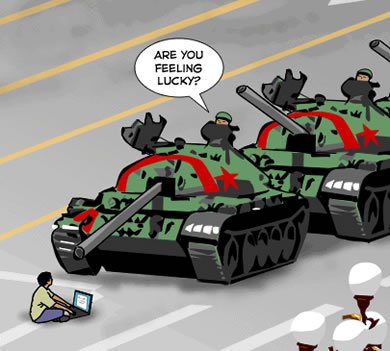
Some say such attacks (hacking and defacement of Web sites) could be used by the political class to actually strengthen their argument in favour of control and regulation of the Internet. What do you say to that?

Anamikanon: People on the ground are vulnerable to people with a lot of power and no problems misusing it. Anonymous can’t be found to defame, threaten, suppress, stall…. wrong means? Ok. Worth it.

Netcak3: I say the more they censor the Internet, the bigger we become. We strive in users from across the world. Pro tip: Once an idea has been made, you cannot kill it.

Anamikanon: In my view, these are the means that can be safely used without risking life, limb, careers, reputations, family…

Gummy: Defacing is like posting a nill which is illegal and can be removed. Like people post their advertisement bill (poster) at the back of buses and other public places.

Anamikanon: Except we post it in inside their drawing rooms! [Read the full interview.]

Net Loss: Sajan Venniyoor

Guest post by SAJAN VENNIYOOR

Image via dailygalaxy.com

Net: noun, verb.

1. a contrivance of strong thread or cord worked into an open, meshed fabric, for catching fish, birds, or  other animals
2. anything serving to catch or ensnare

The other day, in a Parliamentary debate on Internet Rules 2011, the leader of the Opposition in the Rajya Sabha said something so absurd that for a moment I thought he had joined the government. “You can control print and electronic media, but not internet,” he said, only removing his foot from his mouth to add, “If internet had been in existence, Emergency would have been a fiasco.”

Actually, if the Emergency had been in existence, the Internet would have been a fiasco. Continue reading Net Loss: Sajan Venniyoor

India asks Google to remove 2 items every 3 days

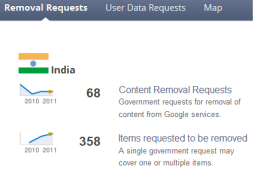
Google’s just released fourth biannual Transparency Report says that between January and June 2011, India asked it to remove 358 different items from various Google-owned web services such as Orkut and YouTube. Google complied in 51% cases. The requests were made by various central and state government departments through 68 different requests. The fourth such report, it goes against communications minister Kapil Sibal’s claims that internet companies are not willing to “self-regulate”.

Worryingly, the report also confirms the allegations that what bothers government officials the most about the internet is not defamation or hate speech but government criticism. Continue reading India asks Google to remove 2 items every 3 days

Meet Ashok Kumar the John Doe of India; or The Pirate Autobiography of an Unknown Indian

The internet has been abuzz with  news of all the major ISPs in India blocking popular websites including piratebay, vimeo, dailymotion and pastebin etc. This is pursuant to a Chennai high court order available here and there are a number of unanswered questions about the validity of the blocking of the websites including whether the DOT were entitled to ask for a blocking of the site on the basis of the orders, how the ISPs chose these particular websites since the order itself does not mention any particular website. This is not to mention the larger question of how the last ten years has seen the dubious rise of John Doe orders as preemptive measure against copyright infringement.

For those unfamiliar with John Doe orders, they are ex parte injunctions ordered against unknown persons. Just to put this in context, ex parte injunctions are not the easiest things to obtain since they are based on the denial of  another person’s right to be heard. So even for cases of violence against women getting an ex parte restraining order is not easy. In contrast the last ten years we have seen the ease with which one can obtain these orders for copyright infringement cases. Continue reading Meet Ashok Kumar the John Doe of India; or The Pirate Autobiography of an Unknown Indian

Press Release Against IT 2011 Rules

PRESS RELEASE

The notification of the Information Technology (Intermediaries Guidelines) Rules 2011 in April 2011 has resulted in the creation of a mechanism whereby intermediaries (such as Google, Facebook, Yahoo, etc) receive protection from legal liability in return for trading away the freedom of expression and privacy of users.

The Rules demand that intermediaries, on receiving a complaint that any content posted online is considered grossly harmful, harassing, blasphemous, defamatory, obscene, pornographic, paedophilic, libelous, invasive of another’s privacy, hateful, or racially, ethnically objectionable, disparaging, relating or encouraging money laundering or gambling, or otherwise unlawful in any manner, have to disable the content within 36 hours of receipt of complaint. The rules also require the intermediaries to provide the Government agencies information of users without any safeguards.
Continue reading Press Release Against IT 2011 Rules

What’s up with India’s IT Rules?

*

The IT Rules of 2011 will come up for discussion in the Rajya Sabha very soon under an annulment motion.

Urge all Rajya Sabha MPs to vote for the motion in a petition here or write directly to Rajya Sabha MPs from your state, in just a few clicks, here.

Here’s an FAQ on the IT Rules by SFLC.in and here’s an analysis of the rules by PRS Legislative Research.

Rajya Sabha to consider repealing Kapil Sibal’s IT Rules

When the Parliament’s budget session re-opens on April 24, the Rajya Sabha will vote on an annulment motion against the IT Rules promulgated in April 2011 that provide for “intermediaries” to remove the online content they are asked to by anyone. The motion has been moved by P Rajeeve, Rajya Sabha member from the Communist Party of India-Marxist.

Speaking on the phone from Thrissur, Rajeeve said, “The IT Rules go against the Fundamental Rights of the Constitution and against the principles of natural justice which are the foundation of our criminal justice system. The rules ask intermediaries to remove content without giving the content owner an opportunity to defend it. They will cause private censorship.”

The Left parties have decided to back the motion and efforts are on to mobilise members of Parliament across party lines. If the motion is accepted by the Rajya Sabha, it will be sent to the Lok Sabha, probably in the monsoon session. Continue reading Rajya Sabha to consider repealing Kapil Sibal’s IT Rules