Category Archives: Violence/Conflict

Some Reflections on Capital and the Workers’ Movement After Manesar

Workers’ Violence and Corporate Violations of Law

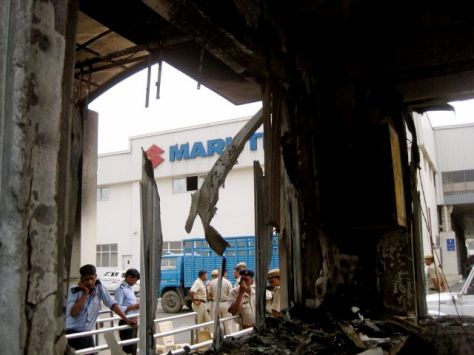
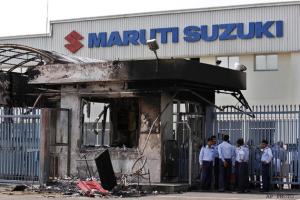
It has been a long time in the making. The violence at Maruti-Suzuki’s Manesar plant on 19 July 2012, that led to the ghastly killing of the general manager, Awanish Kumar Dev was waiting to happen. While the killing was gruesome, I believe this is merely a ‘freeze shot’ of a larger film that has been playing for a very long time now. While it is the media’s wont to focus only on these moments of spectacular violence and then dish out reports from handouts provided by managements and the police, sometimes, such moments of conflagration do illuminate what has been in the dark for so long.

What follows below is an attempt to think through some of the issues that seem to me to lie at the bottom of the violent event. The ‘violent event’ here is not simply what took place in Maruti-Suzuki’s Manesar plant now; it is rather a shorthand for the whole series of such conflagrations that have been taking place over the past few years in the National Capital Region (NCR) – starting with Honda Motors and Scooters 2005,  Graziano Trasmissioni 2008, and many others since – Rico Auto Industries, Pricol Ltd and so on. The struggle in Honda Motors that had been brewing for a long time had eventually spilled over into a series of public protests with severe police violence in the full glare of the media. Things have never been the same in the entire belt since. Rico Auto Industries incident in September-October 2009 subsequently became an important milestone – galvanizing as it did a number of other workers’ strikes. There it had started when the workers struck work after 17 of their colleagues had been dismissed ‘on disciplinary grounds’. Actually, the workers rightly felt that this was to quash their attempt to form a union. And while the workers were protesting at the gate, a group of hired goons attacked them, killing one of the workers and injuring many others. In the Graziano Trasmissioni the issue of contention was the reinstatement of 136 dismissed workers which led to a massive unrest in the unit in Greater NOIDA, leading eventually to an incident not very different from the present one. Continue reading Some Reflections on Capital and the Workers’ Movement After Manesar

What set off the violence at Maruti’s Manesar plant?: Anumeha Yadav

Guest post by ANUMEHA YADAV

Photos by Anumeha Yadav

The year-long industrial conflict at Maruti Suzuki India Limited (MSIL), India’s largest automobile manufacturer’s Manesar plant turned violent on 18 July. At 3:30 pm on Wednesday afternoon, representatives from Maruti Suzuki Workers’ Union and the Maruti management had met to discuss the reinstatement of Jiya Lal, a permanent worker who had been suspended that morning after an altercation with his floor supervisor. Lal is a Dalit and alleges that he had reacted when the supervisor made derogatory casteist remarks against him. The workers were protesting that the management had been unfair, suspending Lal from service while merely sending the supervisor home on leave for a few days. Continue reading What set off the violence at Maruti’s Manesar plant?: Anumeha Yadav

Maruti Suzuki Manesar Workers – Casteist Attack and Repression

The following is a statement issued by the Maruti Suzuki Workers’ Union (MSWU) on 19 July following violence and repression at the Manesar plant yesterday.

The Manesar factory of Maruti Suzuki

The Maruti Suzuki Workers Union (MSWU) is anguished at the recent developments in Maruti Suzuki plant, IMT Manesar where the management has resorted to anti-worker and anti-Union activities in a pre-planned manner leading to violence and the closure of the factory yesterday.

We have had a long tough struggle with the strong unity of our permanent and contract workers to establish and register our Union last year, and had recently as of April 2012 submitted our Charter of Demands to the management of Maruti Suzuki, and the process of negotiation for wages and other demands was underway. However the management has done its utmost to derail the process since long and is trying to break the back of the spirit of unity of the workers and the legitimacy of the Union.

Continue reading Maruti Suzuki Manesar Workers – Casteist Attack and Repression

Once There Was Hindutva Terror ..?

Bomb blasts have taken place near the Delhi High Court, in Bombay, Bangalore etc. Within a few hours of such bomb blasts many T V channels started showing news item that Indian Mujahidin or Jaish-e-Mohammed or Harkatul-jihad-e-islam have sent e-mails or SMS claiming responsibility. The names of such alleged organizations will always be Muslim names. Now an e-mail can be sent by any mischievous person, but by showing this on TV channels and next day in the newspapers the tendency is to brand all Muslims in the country as terrorists and bomb throwers…Should the media, wittingly or unwittingly, become part of this policy of divide and rule?

(Justice (retired) Markandey Katju, Chairman of the Press Council of India, October 10, 2011 at a get-together with mediapersons)

1.
Introduction

What is common between the murder of the leader of a private army of landlords at the hands of his own gang members in faraway Bihar over distribution of booty, the felicitation of a terrorist lodged in jail as ‘living martyr’ (zinda Shaheed) in Punjab or the anointment of a hatemonger as the poster boy of the main opposition party ? Formally speaking there are no connections but if one tries to dig further few subterranean linkages become clear. Whether one agrees or not they exhibit the growing legitimacy of authoritarian, fanatic, exclucivist politics in this part of the subcontinent . Continue reading Once There Was Hindutva Terror ..?

जेल डायरी: अरुण फेरेरा

Guest post by ARUN FERREIRA

Translated from English by Anil Mishra

नागपुर जेल की उच्चसुरक्षित परिसीमा में स्थित अंडा बैरक बग़ैर खिड़कियों वाली कोठरियों का एक समूह है। अंडा के प्रवेशद्वार से दूसरी अधिकतर अन्य कोठरियों में जाने के लिए लोहे के पाँच दरवाज़ों, [और पैदल] एक संकरा गलियारा पार करना होता है। अंडा के भीतर कई अलग अहाते हैं। हरेक अहाते में कुछ कोठरियाँ हैं, और हर पहली कोठरी दूसरी से सावधानीपूर्वक अलगाई गई है। कोठरियों में बहुत कम रोशनी होती है और आप यहाँ कोई पेड़ नहीं देख सकते। आप यहाँ से आसमान तक नहीं देख सकते हैं। मुख्य निगरानी टॉवर के ठीक ऊपर से अहाते में एक बड़ा भारी, ठोस अंडा हवा में लटकता रहता है। लेकिन इसमें (और अन्य अडों में) एक बड़ा फ़र्क़ है। इसे तोड़कर खोलना असंभव है। बल्कि, यह क़ैदियों (के हौसलों) को तोड़ने के लिए बनाया गया है।

 अंडा वो जगह है जहाँ सबसे ज़्यादा बेलगाम क़ैदियों को, अनुशासनात्मक क़ायदों के उल्लंघन करने की सज़ा के लिए क़ैद किया जाता है। नागपुर जेल के अन्य हिस्से इतने ज़्यादा सख़्त नहीं है। अधिकतर क़ैदी पंखे और टीवी वाली बैरकों में रखे जाते हैं। बैरकों में, दिन के पहर काफ़ी इत्मिनान वाले, यहाँ तक कि आरामतलब भी हो सकते हैं। लेकिन अंडा में, कोठरी के दरवाज़े ही हवा के आने जाने का एकमात्र ज़रिया है, और ये भी कुछ ख़ास आरामदायक नहीं, क्योंकि ये किसी खुले प्रांगण में नहीं, एक ढंकेमुंदे गलियारे में खुलता है। Continue reading जेल डायरी: अरुण फेरेरा

Terrorism in India – Between Facts and Fiction: Imran Khan

Guest post by IMRAN KHAN

More and more concerns are being expressed by human rights activists in India today on the question of fabricated and false charges on innocent people. When Dr. Binayak Sen spent his time in jail on such charges, activist groups all over the country and abroad came out and protested. For the first time in the history of human rights movement in India, around two dozen Nobel Prize Winners came out to defend him. It should also be noted that there were even protests against such fabrication in front of Indian embassies in different parts of the world.

However, with the arrest of Binayak Sen, the contemporary history of `fabricating false cases’ by the Indian state took a new turn. The arrest took place while Dr. Sen was a national leader of India’s pioneering human rights organization, People’s Union for Civil liberties (PUCL).  The activists felt that the message was loud and clear: That even human rights defenders can be imprisoned for no reason under repressive laws of the post-independent India.

Dr. Sen was released due to public pressure. But thousands are still languishing behind bars, waiting for justice. The nameless adivasis who were arrested like Sen from different parts of Chhattisgarh, speak of an unknown territory even to the best of our human rights activists. And new messages are given. Even journalists can be grilled. Thus, K.K. Shahina, Azmi, Seema Azad, Advocate Naushad Kasimji and others have become victims of attacks on freedom of expression. Fabricating false cases has become a norm today rather than an exception, according to human rights groups. Minorities, dalits, adivasis,  people’s movements and self determination movements become an easy prey to false charges. Continue reading Terrorism in India – Between Facts and Fiction: Imran Khan

False Charges and Brutality in Prison: Mohd Amir Khan

Guest post by MOHD. AMIR KHAN

[ Mohd. Aamir Khan has spent 14 years in prison and was acquitted earlier this year]

I am in deep pain today. As though terrible, terrible memories, locked away in the deep recesses of my mind have been pried open. Heard on news that an accused in terror case was killed in judicial custody in Yerwada jail. That too in his high security cell.

I had read that the British rulers unleashed physical and mental torture on prisoners in colonial jails, but have never heard that they carried out killings of hapless convicts or undertrials in their custody. The naked truth of Abu Ghraib and Guantanamo has been brought before the world. But who will illumine the dark secrets of the netherworld of our prisons? Brutalisation and torture are routine in our jails.

I speak from experience, having lived for fourteen long and seemingly unending years in prisons in three states. There was a near fatal attack on me twelve years ago while I was lodged in the model prison of India, Tihar Jail. But when I survived the attack, a case was slapped on me. While I was thankfully acquitted in the case, not one of those who attacked me was charged until my father – who was still alive then—appealed to the court to intervene. Mercifully, the Court accepted his complaint and registered a case, which still goes on in Tees Hazari court. Continue reading False Charges and Brutality in Prison: Mohd Amir Khan

Response to “In defense of the democratic struggle against Shankar’s cartoon”

This is a longer version of an article published today in The Hindu. This version includes a section with illustrative examples that refute the contention of the petition that there is “inadequate representation of the role of Ambedkar” in the new textbooks.

At the end of this, I respond to the points raised by K. Satyanarayana and Anoop Kumar in their response to my article, also published today in The Hindu, to which I have linked below.

The petition against the Ambedkar – Nehru cartoon published in the Hindu makes for sad reading. Sad, because it bears the signatures of some of our best scholars, universally admired for their rigorous scholarship, who nevertheless chose to sign a petition short on facts. The petition asks the Thorat Committee to “reconsider the Ambedkar cartoon (and possibly other such insensitive material)”and urges “Kapil Sibal, the Union HRD Minister, to desist from seeking any major overhaul of the basic National Curriculum Framework on which the textbooks are based.” Perhaps the petitioners are not aware that the particular cartoon is now beyond the purview of the committee. A decision to remove it had already been taken by the Minister himself, and a commitment made to this effect on May 11 by Kapil Sibal on the floor of the Rajya Sabha. It was after this announcement that the parliamentarians intensified their attack and targeted other cartoons in all the textbooks claiming that they mocked and ridiculed the political class in general. It was in response to this outrage that the government announced the formation of a review committee to be chaired by Prof. S K Thorat to find out if there is any ‘educationally inappropriate’ material in the textbooks. Continue reading Response to “In defense of the democratic struggle against Shankar’s cartoon”

Cartoon controversy – In conversation with Satyanarayana: Sharmila Rege

Guest post by SHARMILA REGE

Satyanarayana’s interview addresses the crucial issue of a sharp division between the dalit and the left/liberal viewpoint on the NCERT textbook cartoon controversy. Clearly, Satyanarayana’s foregrounding of this difference is not a denial of the differences between the positions taken by dalit intellectuals in this debate. Further, Satyanarayana is referring not just to responses by dalit academicians but to the presence of critical viewpoints in the larger dalit public sphere – the very perspective/viewpoints that Liberal/Left/feminists have in a sense not seriously engaged with, equating them to ‘manipulations by opportunistic dalit leadership’ or /and ‘always and already emotional iconisation of Ambedkar’.  In fact, despite   important differences between the arguments put forth by Satyanarayana, Gopal Guru, Anoop Kumar, Harish Wankhede, Raj Kumar and other dalit intellectuals; all of them interrogate these hasty conclusions about irrational or manoeuvred dalit publics. Gopal Guru  contends   that the controversy has created a field of power in which even the supporters of Ambedkar and Dalits have ended up reproducing the compounded insult  through two assumptions –that Ambedkar belongs to the dalits and that dalits are pathologically emotional and thus not capable of rational independent views.

Continue reading Cartoon controversy – In conversation with Satyanarayana: Sharmila Rege

Ambedkar’s Cartoon and the Caste question: Rajkumar

Guest post by RAJKUMAR

A harrowing monologue is in vogue in the popular media and academic forums apropos a cartoon of Dr. Ambedkar in a Political Science textbook prepared by NCERT for its Class XI students. Apparently, in the cartoon, Ambedkar is depicted being whipped by Jawaharlal Nehru for delaying the framing of the constitution. The cartoon was first published in 1949 and was drawn by cartoonist Shankar Pillai. Though in interior Dalit circles, the cartoon was being despised for denigrating ‘Baba Saheb’ as they lovingly call him, no heed was paid to their sentiments till the issue was raised in the Parliament and taken up by Bahujan Samaj Party chief Mayawati. Government had to concede and the cartoon was removed from the textbook and HRD minister made a public apology for the goof-up followed by resignation of two academicians involved with the curriculum committee.

Continue reading Ambedkar’s Cartoon and the Caste question: Rajkumar

Is the Hurriyat divorcing democracy and freedom?: Gowhar Geelani

Guest post by GOWHAR GEELANI

By any stretch of imagination, the All Parties Hurriyat Conference [APHC] has ceased to be an amalgam of ‘all parties’. It seems that this conglomerate of several pro-freedom political, social and religious parties is actually being run by a chosen few in a dictatorial manner. It is no secret now that the fissures in the Hurriyat ‘M’, the one led by the popular head-priest based in Srinagar, Mirwaiz Umar Farooq, run neck deep.

The APHC was formed on 10 March 1993 to find a political solution to Kashmir dispute after a large-scale armed rebellion since 1989 had successfully highlighted the need for a resolution to the long-standing dispute. Essentially, this conglomerate was formed with the clear aim of achieving the “right to self-determination” for Kashmiris in accordance with the United Nations’ Security Council Resolutions vis-à-vis Kashmir.

But all is not well with the Hurriyat (M). One of its prominent leaders, Professor Abdul Gani Bhat has openly challenged group’s constitution by declaring that the UN resolutions on Kashmir have become “irrelevant”.

Continue reading Is the Hurriyat divorcing democracy and freedom?: Gowhar Geelani

If ‘temporary’ meant special, what would ‘special’ mean?: Gazala Peer

Guest post by GAZALA PEER

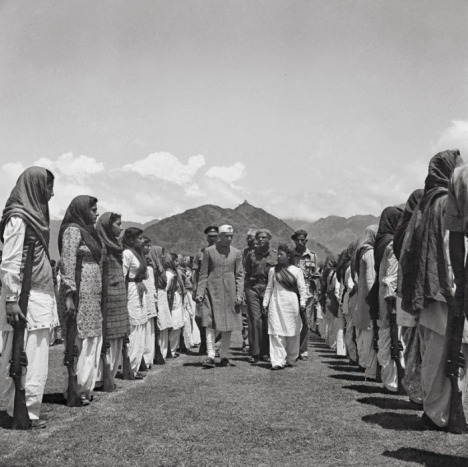
Circa 1948, this photograph shows Jawaharlal Nehru inspect a women’s militia in Kashmir. Via andrewwhitehead.net

On 13, October 2010 a team of interlocutors was appointed by the Government of India to hold dialogue with all the sections of the society in Jammu and Kashmir. The team of interlocutors consisted of journalist Dileep Padgonkar, educationist Radha Kumar and the former Information Commissioner M. M. Ansari. After almost one and a half years the report was released on 24 May 2012 by the Ministry of Home Affairs (.pdf here). The report calls for formation of a Constitutional Committee to review the extension of central laws to the state of J&K from 1952 onwards. Some of the major recommendations are: changing the temporary nature of Article 370, dividing the state into three Regional Councils and appointment of the Governor but after consultation with the state legislature. The Report further says that the findings of this Constitutional Committee shall be binding on all the ‘stake holders’ in the State. Continue reading If ‘temporary’ meant special, what would ‘special’ mean?: Gazala Peer

How Essar, Teamwork Productions and the Chhattisgarh government changed the lives of Dantewada’s children

Any moment now I expect India’s litfest mafiosi to describe this article on the ‘Essar Kahani Utsav’ by Akshay Pathak as an ‘attack on free speech’:

Money was not the only thing coloured there. Long pieces of cloth in different colours hanging outside the venue— in classic Teamwork Productions style (the event management company organising this festival)—conjured a sense of celebration. The packaging was good. It mostly is—like that of the DSC Jaipur Literature Festival, also organised by the same company.

The mood inside, though, didn’t match. That is, if you set aside the sight of visibly uninterested festival organisers and district administrators finding ways to pat their backs. And there was certainly no festive air around the 600-odd Adivasi children who had travelled hours on foot and buses to hear stories on an empty stomach—“the district administration miscalculated the numbers”, the organisers explained to me later, and so they had run out of food for the children. [Read the full article.]


The Anti-Politics of Murder

No, this post is not mainly about the ghastly murder of the rebel communist leader T P Chandrasekharan at Vatakara in Kerala early this month. It appears clear now that irrespective of whether the CPM leadership was directly involved or not, local CPM cadre were involved in the conspiracy. Certainly, it is an act gruesome enough to feed nightmares through many nights. And the way the gory details of the planning and execution of the murder continue to appear in the print and visual media, the Malayalee public is almost on its knees, holding on to their stomachs, racked by seemingly never-ending bouts of nausea. But I have my reasons for not wanting to focus on this incident here, reasons more than the sheer irritation felt with sections of the media that demand shrilly that ‘cultural leaders’ have not condemned the murder sufficiently. Continue reading The Anti-Politics of Murder

Dr Khalil Chishty is back home – three cheers for candle-light peaceniks

The 80 year old Pakistani virologist Dr Khalil Chishty just reached Pakistan. His son Tariq called me from Islamabad. “Sorry we couldn’t meet, it was all so rushed.” Tariq Chishty was worrying about getting a PIA ticket – President Zardari sent his special PAF plane to get them! Contrast this with the rank indifference with which the Indian government treats the issue of Indian prisoners in Pakistan.

Just a few days ago, Tariq Chishty was convinced his father is not going to be freed in the hearing on Thursday and was ready to return to Pakistan alone. But the Supreme Court of India, in an unprecedented judgement, allowed him to go home, on the condition that he must return by 1 November for the next hearing. Some months ago when his grandson had met him in jail, Dr Chishty had bid him goodbye as though it was the last time. This is not the end yet – the Supreme Court may uphold his conviction and god knows if he’ll again have to spend time in jail. 20 years in India have been jail-like for him even when he’s not been in jail. For details of his case, whether and why he should be granted mercy and so on, please see this article by me. Continue reading Dr Khalil Chishty is back home – three cheers for candle-light peaceniks

Family chronicles

Jamal Kidwai tells the (continuing) story of the Partition through family memories:

As children we would invariably be divided into Pakistani and Hindustani groups. We would have long arguments about who would win the next war, whether Imran Khan was a better all-round cricketer than Kapil Dev; we would even divide ourselves into Indian and Pakistani teams when it came to playing cards, scrabble, cricket or antakshari. These competitions and arguments brought small but interesting victories. Like once when in the course of an argument, a Pakistani cousin pulled out a tube of Colgate toothpaste, a far slicker plastic tube than our usual Indian toothpaste which came in tin tubes and was easily rusted. He was taunting us about the quality of the toothpaste tube which, of course, proved how backward India was compared to Pakistan. At this point one of us from the Indian team noticed that ‘their’ tube had a mark ‘Made in India’. Nothing gave us more joy than that and the Pakistani team was not only defeated but was left embarrassed for the rest of the holidays. (Material wealth and consumer goods was one area where Pakistan, with its imported goods from the US, was far more ‘developed’ than India and it gave us great pleasure to puncture that aspiration.) [Read the full article.]

Koodankulam – Anti-nuclear Struggle Continues: Deepa Rajkumar

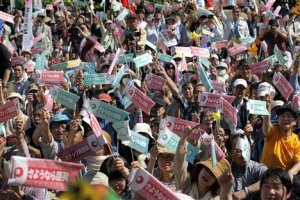
As Japan shut down its last reactor, the Koodankulam project is to go critical in ten days.  Because Japan depends on local consensus for its nuclear decisions, unlike the World’s Largest Democracy, the views of Japanese people counts for something. Thousands of Japanese marched in celebrations to celebrate  the switching off of the last of Japan’s 50 nuclear reactors on Saturday May 5th. 
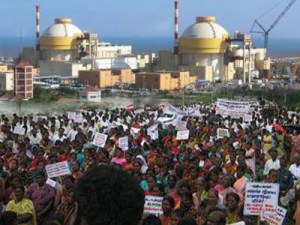
Traditional ‘koinobori’ fish-shaped banners for Children’s Day have become a potent symbol of the Japanese anti-nuclear movement, symbolizing the commitment to leave a safe and clean earth to children.

Meanwhile, back home in Koodankulam, as  this guest post by DEEPA RAJKUMAR reminds us, unrelenting state repression continues of the massive, non-violent struggle against the proposed nuclear plant there.

6,800 people in Koodankulam face charges of sedition and/or waging war against the state, possibly the largest number so charged ever, in colonial or independent India, in just one police station.

Sathish Kumar and R. S. Muhilan began an indefinite hunger strike from 25th April in Tiruchirapalli prison, Tamil Nadu. They were demanding a fair trial, stoppage of new charges being filed against them and the withdrawal of existing false charges against them. Continue reading Koodankulam – Anti-nuclear Struggle Continues: Deepa Rajkumar

Delhi 1803-2012: A Brief Biography

Delhi, Or Dilli has been a city and a capital for a long time and even when it was not the capital, during the Lodi and early Mughal period, and later between 1858 and 1911, it continued to be an important city. We are of course talking of what is historically established and not of myths and legends. During this period there have been 7 major and several minor cities within the territories now identified as the National Capital Territory of Delhi (NCR-Delhi). New Delhi is the eight city. This piece marking the hundred years of the shifting of the colonial capital to Delhi from Calcutta in 1912, will talk about both Shahjahanabad and New Delhi. We will see how  Shahjahanabad the once most powerful and rich city of its time and the last capital of the Mughals was gradually  ruined, plundered and virtually reduced to a slum  while next door arose, a new enclave of Imperial grandeur known now as New Delhi. Continue reading Delhi 1803-2012: A Brief Biography

…and now Judicial Impunity?: JKCCS

This release comes from the JAMMU KASHMIR COALITION OF CIVIL SOCIETY
2 May 2012: The recent Supreme Court judgment in the Pathribal case is very disappointing.
Fake encounters, along with various other human rights violations, have been a reality for the people of Jammu and Kashmir over the last twenty two years. In 2008, according to media reports, Supreme Court Justices Aftab Alam and G.S. Singhvi made observations in court in relation to the practice of fake encounters for rewards in Jammu and Kashmir. With about 8000 persons disappeared, 70,000 persons killed, numerous cases of torture, rape and other human rights violations, Jammu and Kashmir has seen institutional denial of justice. Continue reading …and now Judicial Impunity?: JKCCS

Pathribal ruling a setback for justice in Jammu and Kashmir: Amnesty International

This press release comes from AMNESTY INTERNATIONAL

1 May 2012

Special powers that allow India’s armed forces suspected of involvement in extra-judicial killings to sidestep the civilian courts have been reinforced in a disappointing court ruling over the notorious killings of five Kashmiri civilians 12 years ago.

India’s Supreme Court has contradicted a reported statement by its Justices in February 2012 that army personnel suspected of murder should be placed in front of a civil judge.

Instead it opted to give military authorities eight weeks to bring about the court martial of eight army officials allegedly responsible for the unlawful killing of five youths in Pathribal, in March 2000. Failing that, the Central Bureau of Investigation (CBI), may apply to prosecute the army personnel. Continue reading Pathribal ruling a setback for justice in Jammu and Kashmir: Amnesty International

The Semiotics of Happiness

Guest post by ABHIJIT DUTTA

MC Kash - Photo by Ashish Sharma / Openthemagazine.com

It is not every day that you wake up to find your Twitter timeline flooding with the assertion that Kashmir – of all places – is happy. Dangerous? Of course. Beautiful? well, yes, the postcards are pretty enough. Angry? Sure, they look it. Radical? Oh god, yes. Happy?

If you ask Manu Joseph, author of Serious Men and editor of Open, the answer is yes. In this article, he talks about his interactions with “regular” people in the valley – the non elite, the non journalist, the non artist, the non writer – and is convinced that Kashmir is ready to move on. That it has already moved on. That Kashmir is happy. As proof, he offers these exhibits: (a) record high tourism numbers, (b) 2010 IAS topper Shah Faesal (who tells him “commonsense is finally winning”), (c) a meeting of a District Magistrate with elected leaders of a village (“not a word about politics”, says the DM to Mr. Joseph, “They want to talk about things that matter to them and their families”) and (d) the desire for city life (“we want KFC”).

Continue reading The Semiotics of Happiness