
Lahore-based journalist-singer ALI AFTAB SAEED explains how we can classify news into three kinds, and how doing so helps us make better sense of the world. He says at the end this is true not just of Pakistan – indeed, this is a very useful classification to understand the Indian medial landscape as well!
Let’s Meet – On Ajay Bharadwaj’s ‘Milange Babey Ratan De Mele Te’: Virinder S Kalra
Guest post by VIRINDER S KALRA
Milange Babey Ratan De Mele Te (Let’s Meet At Baba Ratan’s Fair); Length: 95 minutes, Year 2012; Directed and Produced by Ajay Bhardwaj
Ajay Bhardwaj’s third documentary film based in East Punjab, India, takes us into a deeper exploration of some of the themes touched upon in his previous works: Kitte Mil Ve Mahi and Rabba Hun Ke Kariye. Indeed, at one level Milange Babe Ratan De Mele Te is about a journey of an impossible return to a pre-Partition Punjab in which religious identity was fluid and the sacred and profane intermingled and fused. Continue reading Let’s Meet – On Ajay Bharadwaj’s ‘Milange Babey Ratan De Mele Te’: Virinder S Kalra
This Troll Has a Very Long Nose
 Ironically, the random arrest of people for tweets or Facebook postings made some of us happy—happy that, at last, citizens have started showing concern about internet censorship. But lock-up gates had to clang at night on the faces of a few people before we realised that, in our pompous democracy, the might of the state is Ctrl-Alt-Deleting opinion with such serious zeal. The arrests have been made under Section 66A of the Information Technology (Amendment) Act, 2008, notified in October 2009. This section makes punishable with up to three years’ imprisonment anything that is perceived as “grossly offensive” but does not set out the parameters of how to decide on that—even if we were to believe that could at all be done. Questions about these arrests are deflected: the government blames the police, the police says a vague law is the problem, and those who file the complaints that lead to such arrests say that they are free to seek enforcement of an existing law.
Anyone can see that the section is not designed to nudge a case towards a conviction verdict. It is designed only to harass. Arrests, courtwork, bail. You are ground down, but the government spokesman is able to say, “The law is taking its own course.” The implication: “Aren’t you grateful you have obtained bail?” But the recent arrests have caused outrage. Taking up a PIL against the section, the Supreme Court had said in December that had it not been filed, it would have taken up the matter anyway. Despite this, the government defended the section in the Rajya Sabha, refusing to repeal it and merely adding guidelines that such arrests should be made by an officer of a higher rank—as if that would make it better.
Read more, here.
Israeli repression at The Gate of the Sun
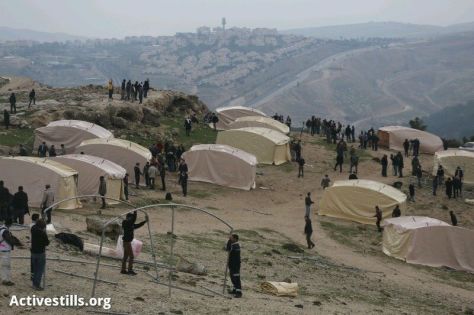
On January 11, 2013, 250 men and women from across Palestine established a new Palestinian village named “Bab Al shams” (Gate of the Sun).
They declared:
We, the sons and daughters of Palestine from all throughout the land, announce the establishment of Bab Alshams Village (Gate of the Sun). We the people, without permits from the occupation, without permission from anyone, sit here today because this is our land and it is our right to inhabit it.
A few months ago the Israeli government announced its intention to build about 4000 settlement housing units in the area Israel refers to as E1. E1 block is an area of about 13 square km that falls on confiscated Palestinian land East of Jerusalem between Ma’ale Adumim settlement, which lies on occupied West Bank Palestinian land, and Jerusalem. We will not remain silent as settlement expansion and confiscation of our land continues. Therefore we hereby establish the village of Bab Alshams to proclaim our faith in direct action and popular resistance. We declare that the village will stand steadfast until the owners of this land will get their right to build on their land.
Pawns In, Patrons Still Out!
The Strange Trajectory of Investigations in Cases of Hindutva Terror
Many office bearers of RSS are also under scanner of the investigating agencies for their alleged involvement in the Samjhauta bomb blast. The NIA (National Investigating Agency) has already interrogated one amongst them. Many have been issued notices also…There are many workers of RSS from Malwanchal who are under scanner of the agency…According to informed sources a senior office bearer of the Kendriya Karyakarini (central executive) of RSS would also be questioned….Rakesh Dubey, a Vibhag Karyavah of RSS has confimed that he has received notice and is cooperating with the investigating agency.
..Seven suspected terrorists whose names find mention in the list prepared by NIA. They are Mehul alias Mafat Bhai, Bhavesh Patel, Suresh Nair, Mohan alias Ramesh Gohil, Jayantibhai Gohil aliast Ustad,. Sandeep Dange alias Parmanand, Ramji Kalasangra alias Ramchandra and Ashok alias Amit Hakla. (Bhaskar, 30 Dec 2012)
I
Mass movements or spontaneous outbursts of people on the streets to express their anger and anguish over the state of affairs in the country and outside have their own dynamic. While they are able to highlight/emphasise key concern(s) which inform their emergence, help us look at linkages with other issues and are able to raise many structural aspects which could have never received the attention earlier, it also happens that many other contemporary issues get relegated to the background. Continue reading Pawns In, Patrons Still Out!
In Multiples of Ten Ravanas
Some (more) thoughts on Indian and Pakistani soldiers beheading each other at the ceasefire line in Jammu & Kashmir
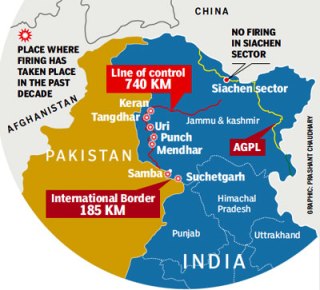
In the early hours of 10 January 2013, I published a post here that asked, “Was an Indian soldier decapitated at the Line of Control or not?” Soon thereafter, the family of Lance Naik Hemraj Singh of 13 Rajputana Rifles cremated his body and went on a hunger strike, demanding the government get the head. Several readers commented that now that it was clear a beheading did take place, I owe them an apology. I do not see why I owe them such an apology considering I never said that an Indian soldier wasnot beheaded. I only pointed to the conflicting reports, the absence of official mention about whether or not a soldier was beheaded, a quoted a Reuters report that categorically said that according to the official spokesperson of the Northern Command, no soldier was beheaded, though the two soldiers’ bodies were mutilated. Despite such an official denial quoted in a trusted news source, I had written, “It is possible the anonymous sources are right, because this is not the first time both sides are blaming each other of showing disrespect to bodies of dead soldiers in violation of the Geneva convention.” Continue reading In Multiples of Ten Ravanas
Dear Barkha Dutt: The Buck Stops Where?
On the of latest edition, (telecast a few hours ago, on the evening of the 15th of January, 2013) of ‘The Buck Stops Here’, (a flagship news show on NDTV anchored by Barkha Dutt) – ‘India-Pakistan:Another Tipping Point‘, Admiral (Retd.) Ramdas, former chief of the Indian Navy said he knew that Indian forces have beheaded Pakistani soldiers in the past. Gen. (Retd.) V.P. Malik, former chief of the Indian Army contradicted him, and said this had never happened. Barkha Dutt was silent on this matter.
Below is a summary of some highlights of the discussion. Continue reading Dear Barkha Dutt: The Buck Stops Where?
Schools of Discrimination
 The village of Majure, in Chitradurga district, Karnataka, is once again in the news. It made the national headlines in 1998 when dalits in the village lodged a police complaint against members of the dominant Vokkaliga and Lingayat castes for an attack on their hamlet. As a consequence, several people were put behind bars.
This time round, however, no formal complaint was lodged. Not that things have improved (rather, one could say the situation is deteriorating) but, as the dalits put it, they want to live in “harmony” in the village. For around two months, they’ve been facing a social boycott. The immediate provocation would appear to be the appointment of Lakshmamma, a member of the Madiga community, as cook in the anganwadi. Upper-caste politicians from the village did not want a dalit woman to cook food and feed their children and they succeeded in getting her to resign from the post. Despite a dalit in the Shettar cabinet contacting them, there has been no response. Interestingly, there are three dalit officers — a deputy commissioner, a superintendent of police and a tehsildar — in the district. Continue reading Schools of Discrimination
Letting Go of Fear: Tenzing Choesang
Guest post by TENZING CHOESANG
Nine years ago, on a hot summer day, I was sitting in the New Delhi railway station waiting for a train to Dharamsala where I had planned to do my summer internship in a human rights organisation. There, I met a person who used to live in the same locality as I did when I was a child. He asked me where I was headed and I excitedly told him about the summer internship I was going for. He gave me a sympathetic look and said in Nepali “God, what all, daughters have to do these days”. I was taken aback by his statement but I knew where it was coming from. I come from Sikkim, a beautiful state in the foothills of the Himalayas. Students from Sikkim generally come to Delhi for graduation and after completing their higher studies most of them return back. After their return, they either start their own businesses or get into comfortable government jobs and live with their parents. This is how things work there. So, I think he felt bad for me since he thought that I was being made to “face the big bad world” when I could have gone back home happily. I didn’t agree to his logic then and have not till date. Continue reading Letting Go of Fear: Tenzing Choesang
An open letter to Madhu Purnima Kishwar: Zahir Janmohamed
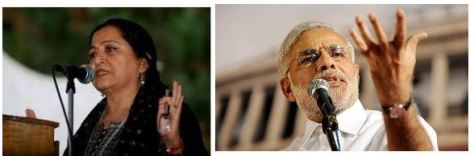
Dear Madhu ji,
I was very excited when I learned you were coming to Ahmedabad and I was honoured that you expressed interest in possibly meeting with me.
I was sitting with a journalist friend when I read your Tweet about visiting Ahmedabad and he told me you are a “pioneering feminist who did ground breaking work.” He also told me that in 2005 you signed a very strong petition calling for Gujarat Chief Minister Narendra Modi’s dismissal because of Modi’s role in the 2002 Gujarat riots. He also added that you have been very vocal on behalf of Kashmiri Pandits. After I witnessed the Gujarat riots in 2002, I returned to the United States—where I was born and raised—and I gave lectures for six months about the violence I saw. In each lecture, an audience member would inevitably shout at me that I have ignored the plight of the Kashmiri Pandits. It is true. I know very little about Kashmir, and for that matter Kashmiri Pandits, and I would have enjoyed and benefited from listening to your views on the conflict there.
I understand from your Twitter feed that you have left Ahmedabad. I know your days in Ahmedabad were limited and I fully understand that you were not able to meet. Therefore in this letter I will try to convey some of the things I had hoped to tell you in person, in particular about your Tweets. Continue reading An open letter to Madhu Purnima Kishwar: Zahir Janmohamed
From Delhi to Djakarta, Protests Against Sexual Violence Across Borders: Bonojit Husain
Guest post by BONOJIT HUSAIN
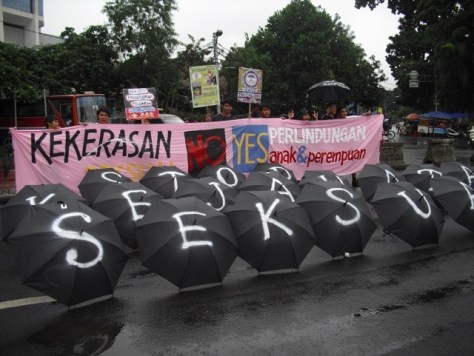
(Photographs courtesy: Pipit Apriani who is a Jakarta based activist and a blogger)
Protests against sexual violence are spreading across Asia. Last week demonstrations against rape and sexual violence were held in Nepal, Bangladesh, Pakistan and Sri Lanka.
Inspired by the protests held in Delhi for last three weeks, hundreds of university students and activists march on the streets of Jakarta few hundred meters away from the Presidential Palace for a world free of sexual violence. The call for the protest march was given by a coalition of University Students’ Unions and civil society organizations in response to the death of RI, a 11-year-old girl, who died last week after suffering severe vaginal and rectal injuries due to repeated sexual assaults. Continue reading From Delhi to Djakarta, Protests Against Sexual Violence Across Borders: Bonojit Husain
Against Castration: Himika Bhattacharya and Deepti Misri
Guest post by HIMIKA BHATTACHARYA and DEEPTI MISRI
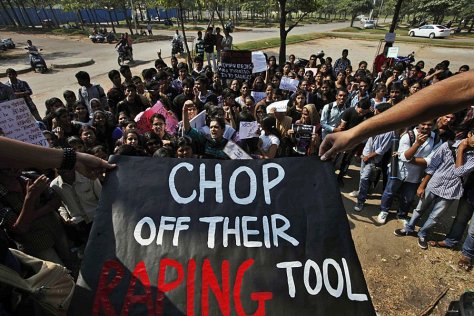
The public preoccupation with both the death penalty and castration as punishment for rape continued last week, with the Pakistani activist Asma Jahangir reportedly suggesting that the rapists of the Delhi rape case be either punished with castration or else face the death penalty.[1] The consistent demand for punitive castration in India may be somewhat boosted by the Indian media reporting the following developments – last week, the South Korean court ordered Asia’s first chemical castration[2]; the Malaysian bar is pushing for castration[3] as a punishment for repeat sex offenders; and that such punishment has reportedly been long used in other countries[4]such as Germany, Denmark, and some states in the U.S. Continue reading Against Castration: Himika Bhattacharya and Deepti Misri
A petition to end tensions at the Line of Control from citizens on both sides of the LoC
Signatures given at the end. Should you want to add your signature to this petition, write to Anuradha Bhasin at anusaba[at]gmail[dot[com]. The petition with the final list of signatories will be sent to the heads of state in both India and Pakistan.
To,
Indian Prime Minister Manmohan Singh and Pakistan President Asif Ali Zardari,
Dear Sirs,
We, the people of Jammu and Kashmir on both sides of the Line of Control, have been observing with great concern the escalation of tensions at the LoC that have been building up gradually since June 2012 and have suddenly taken an ugly turn since the first week of January, 2013.
We express grave concern at the loss of lives of the soldiers and any casualties to civilians on both the sides. At the same time, we are also concerned about the safety and security of the people of Jammu and Kashmir, particularly the people living at the borders, who are directly hit by sporadic incidents of shelling and firing. Continue reading A petition to end tensions at the Line of Control from citizens on both sides of the LoC
Aaron Swartz, R.I.P: Swaraj Paul Barooah
Reposting a tribute by Swaraj Paul Barooah which originally appeared on Spicy IP to Aaron Swartz. Aaron Swartz hung himself on January 11th 2013 and had been facing extensive legal charges for having downloaded 4 million articles from JSTOR which he intended to make available for free online
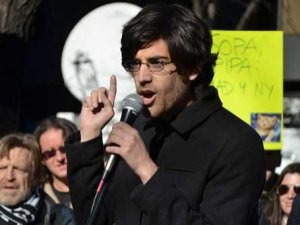
Some of us in India may not have heard of Aaron Swartz, a 26 year old activist who was heavily involved in copyright policy issues and issues surrounding technology freedom. He committed suicide on Jan 11th, 2013 and his story is a sad one which is certainly worth sharing. However, what’s also important to note, are the circumstances which may have led his eventual suicide.
While it cannot be confirmed, it appears that his arrest and indictment for charges of downloading academic papers from MIT and JSTOR resulting in possible jail time of over 50 years and 4 million dollars in fines may have been the cause. JSTOR apparently had dropped the charges, but the US government continued the case and racked up a total of 14 counts of felony against him. (Note: it is unclear whether MIT pursued the charges or not). Clearly he was seen as very troublesome by the government and his online activism must’ve had a lot to do with that.
Continue reading Aaron Swartz, R.I.P: Swaraj Paul Barooah
Stalking, Delhi Police and Memory – Another Encounter: Kavita Krishnan
Guest Post by Kavita Krishnan
I have been wanting to post about an experience with Delhi police since yesterday, but haven’t found the time yet… Here goes.
Some days ago, (early this month if I recall rightly), I got a call from a woman worker living in Usmanpur near Seelampur. She got my number through the son of one of our Trade Union comrades, who is a friend of her brother’s. She said she was being stalked by a man who made calls to her thretening an acid attack. She has 3 children and was concerned for their safety too. She told me she was scared to complain to the police, and asked for advice. I was reluctant to advice a police complaint without her being fully ready, knowing that it might not yield satisfactory results. So I suggested we meet and talk things over before deciding.
But soon after, she called again: feeling buoyed by a sense of hope arising from the ongoing movement, she had gone to the police station – alone – and written out a complaint, giving the stalker’s mobile number, the number of his bike, and offering to share recordings she had made on her phone of the threat calls. She said, though, that the police had not given her any proof of having received or recorded her complaint (in spite of her asking).
Continue reading Stalking, Delhi Police and Memory – Another Encounter: Kavita Krishnan
Suran: A poem by Uzair
This guest post is a poem by UZAIR, who grew up near the Indian side of the ‘Line of Control’ in Poonch
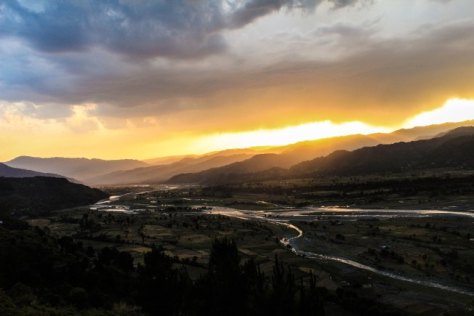
The river carries with it
Snow of distant peaks,
Floating memories
Twigs, leaves.
Only a few miles west
it would be stripped
at the border, asked
to produce a permit,
shot dead or may be not.
Waters were negotiated upon;
so the river travels seamlessly
only a few miles west
to another country.
On its bank, I heard
a cuckoo speak
“The sun shines during day
and stars illuminate the night sky
even across the border”
“And a few collect the twigs
like memories of childhood;”
“smell of dead wood, so familiar
grief and longing, so natural
decades of hope; still alive,
even across the border”
One day the river would flow
eastwards, said the old man
whose corpse floated across,
only a few miles west
and met his children
across the border.
(Uzair blogs at Untitled Untitled.)
See also:
Breaking the Collective – Notes from Jantar Mantar & Koodankulam: Vivek Vellanki
Guest Post by Vivek Vellanki
The death of the young girl brought incommensurable grief for the ‘Indian’ people. A national angst ensued with divergent voices seeking divergent ends: justice, death penalty, fast track courts, end to patriarchy, chemical castration, and a long list that cannot be spelt out here. There was a glimmer of hope that the discursiveness would ensue a quintessentially democratic process of debate, discussion, and deliberation amongst the people. The Indian state with its long-standing reputation wouldn’t allow for that to happen. It had to continue on its pet peeve of Breaking the Collective! The people’s movement in Koodankulam, the anti-corruption movement, the movement for seperate Telangana are some of the many instances that remind us of this pet avocation of the Indian state being pursued in recent times, almost, vocationally. However cynical it may sound, amidst the entire candle lighting and sloganeering, we failed to realise that the protest in Delhi was happening on the terrain that the government decided, in a manner that it wished for it to play out, and was party to the people it wanted to see there. I wish to argue that the closing down of the metro stations has a relation to the nature of the protests at Jantar Mantar. Furthermore it concurs with the tactics of chocking people’s movements logistically and stifling the collective by pathologizing the everyday life of masses. The tragedy of this lies in the fact that such actions of the state have become so recurrent that they have entered our common sense and they present themselves as normal and logical responses. Albeit they have been rationalized by invoking a specious reference to law, order, and safety, there is a need to unpack such a rationalization. My attempt is to extract these actions from that location of common sense and present them for public scrutiny. Through this essay, I would like to draw the connections between the democratic protests happening in locations across the country and state action in dealing with them. In doing so, I hope to bring to notice how the Indian state uses its machinery to purge protests of their democratic tenor and eventually, at least, attempts to break the collective. Continue reading Breaking the Collective – Notes from Jantar Mantar & Koodankulam: Vivek Vellanki
Harassment by Times Now: Statement by Shabnam Hashmi
[The following is a public statement issued by Shabnam Hashmi regarding her harassment by Times Now. The report is truly alarming and shows the extent to which this form of ‘media vigilantism’ – Arnab Goswami/ Times Now style can go. It is of course, another matter that when confronted by a Raj Thakre, the same macho anchor can turn into a small and helpless mouse. We are reproducing this statement in public interest.]
I was in Gujarat for over six months and returned to Delhi two weeks ago. While in Gujarat I was asked to appear on different television channels constantly. On one such talk show on Times Now I felt that I was especially being pushed into a corner and it was an absolutely unbalanced panel, I told the Times Now guest coordinator that I will not come on the channel any longer. It continued for about a week or so. Then a representative came from Mumbai and met me in Gujarat office and ensured that it will not happen in future and requested me to come for the Talk Shows.
I agreed and went again whenever I was called.
On December 28, 2012 I released a public statement in Delhi regarding the Gujarat Verdict 2012 and resigned from various UPA committees that I was part of. On the same day I was invited to Times Now and I found the same attitude of being highly aggressive towards me.
January 2, 2013, I filed a police complaint against Mr Akbaruddin Owaisi in Parliament Street Police Station against the hate speech which he made in Andhra Pradesh. I was called on Times Now and met the same uncivilized and aggressive behavior.
Continue reading Harassment by Times Now: Statement by Shabnam Hashmi
The Country With A ‘Balancing Office’: Suvaid Yaseen
Guest Post by Suvaid Yaseen
Of late there has been a rising trend of Kashmiris – professionals, artists, writers, musicians et al presenting their works on Kashmir on a much wider level than before. The larger impression that comes out of it all is that the narrative has been taken up by the people for themselves. A welcome contrast to outsiders flying in and telling us what we want, how we think, and what is actually good for us.
So, every time a Kashmiri artist is presenting his/her work on Kashmir, the expectations among Kashmiris tend to go up. People start feeling that finally their narrative, of how they saw the things, what they went through, would be told to the world, bereft of the lenses of security paradigm through which Kashmir has been usually viewed – a strategic territory, with not-so-strategic, dispensable people.
This can be fortunate as well as unfortunate. On one hand there is a ready audience to appreciate and applaud your work. On the other hand there are expectations to ‘perform’. For the artists themselves, there are additional pressures of ‘balancing’ and having a ‘non-biased’ view from the other side.
Continue reading The Country With A ‘Balancing Office’: Suvaid Yaseen
Some thoughts on rape, sexual violence and protest – responding to responses: Devika Narayan
Guest Post by Devika Narayan
Rarely does a city experience the sort of upheaval that Delhi is witnessing. Everyone is talking about it. Everyone has an opinion. It is impossible to walk down the street without overhearing snatches of conversation. Issues that usually find brief mention in some obscure corner of the newspaper are now being subject to analysis by every passer-by. A rickshaw driver refuses to take any money when he realises I am on my way to a protest. I remember the old man at a photocopy shop who had looked up and asked no one in particular: do you think she will die? The receptionist at the doctor’s clinic is distraught, providing waiting patients her explanation for the recent events. Men huddled around tiny fires littered across the foggy city carp on about the state of politics, the police and the government. Everyone is invested in this moment of reckoning.
An opportunity, in the most brutal manner, has been thrust upon us to challenge, critique and reconstruct unjust social relations. This is an opportunity to pledge our commitment to a vision of a gender just society. Unless we assert in powerful ways that women are autonomous beings and equal citizens it will not end. Continue reading Some thoughts on rape, sexual violence and protest – responding to responses: Devika Narayan
Engendering the Sovereignty of the Islamic Republic of Pakistan: Afiya Shehrbano Zia
Guest post by AFIYA SHEHRBANO ZIA
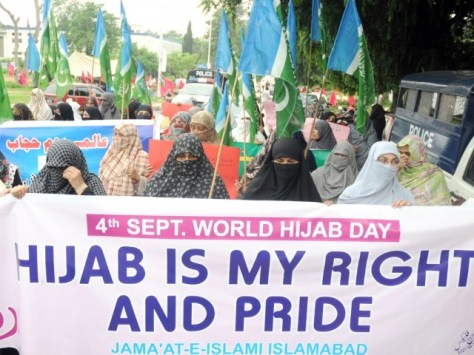
The Islamia College in Karachi is the hub of the Islami Jamiat-e-Tulba (IJT) [1]. Last year, the nationalist banners displayed near the college to mark Pakistan Defense Day (6th Sept), were strategically flanked by two complementary gendered messages. One such banner publicized the event (in Urdu) as ‘Hejab Numaaish’ (Parade of the Hejab – 4th Sept) and below it, in English ran the claim ‘Hejab is My Right and Pride’. The other banner declared simply, ‘Afia[2] is our Pride’. Both messages are signifiers and comments on the re-visitation of the themes of religious and nationalist agendas, played out across the body politic of women, in a post 9/11-Pakistan.
This essay discusses the resurgence of a new form of religious nationalism and its impact on the narrative of gendered politics in Pakistan. It also examines the worth of a recent body of Pakistani scholarship[3]that opposes the misguidedness of liberal-secular resistance to religious politics. Instead, such academic work invests hope in something termed, ‘Islamist secularization’. Continue reading Engendering the Sovereignty of the Islamic Republic of Pakistan: Afiya Shehrbano Zia
 KAFILA - COLLECTIVE EXPLORATIONS SINCE 2006