Ai Weiwei’s (Chinese Artist) Statement: Guest Post from Monica Narula

Dear All,

I would like to share with all Kafila readers something that my friend Monica Narula posted recently on the Reader List about the intimidation that the well known Chinese contemporary artist, Ai Weiwei has faced, in connection with his support for the currently detained dissident rights activist Tan Zuoren in Chengdu. This is an introduction to Ai Weiwei in the current context and a text of his recent statement released in the context of the harrassment (including beatings by police) that he has had to go through. Please read and share widely.

best

Shuddha

—————

Avant-garde artist Ai Weiwei, one of China’s foremost public  intellectuals, was recently detained and beaten by police when he  attempted to testify at the show trial of dissident Tan Zuoren in  Chengdu. Harassment and threats are connected, in part, to his “Names  Project,” a performative intervention which aims to compile, publish,  disseminate, and memorialize the names of the thousands of children  who were crushed to death en mass in their “crumbling tofu  construction” schools (the rotten fruits of official corruption and  kickbacks) during the May 12, 2008 Wenchuan Earthquake, while  neighboring government buildings stood intact. The State has strong- armed bereaved parents into silence, refused to investigate government  corruption, and barred the victims’ names from public release. Ai  Weiwei’s vocal defiance has led to his censorship, intimidation,  threats and now arrest and beating.

Having spent the first 2 decades of his life with his father, the  revolutionary poet Ai Qing, in a cadre labor reform camp for errant intellectuals, Ai Weiwei understands that no one in China, no matter  how “high profile” is ever “safe. Thus, he has chosen to push the  State as far as he can in an attempt to reclaim the public sphere for  critical discourse, and champion the cause of free speech and genuine  citizen and human rights in China. As such, he has willingly put  himself in a great deal of danger. His recent statement merits  reposting. I hope that you will pass this on and share it with others  who believe in the need to nurture and support critical public intellectuals, especially in places like China, where there are so few
such clarion and courageous voices.

Ai Weiwei’s Statement

“Watch out! Have you prepared yourself?” —

Ai Weiwei: “I am ready.  Or, perhaps I should say that there is nothing to prepare, no way to  prepare myself. A person–this is all of me–is something that can be  received by others. I offer up all of myself. When the time comes when  it is necessary, I will not hesitate, I won’t be ambiguous about it.  If there is anything that I am reluctant to leave behind it is the  wondrous miracle that life has brought me. And that miracles are that  every one of us is the same, that people are equal in this game, as  well as the fantasies that come along with playing it, and our  freedom. I regard every kind of intimidation, from any kind of  ‘authority or power’ [sic – the character is for quanli as in  ‘rights’, but from the context this appears to be a typo, perhaps?],  as a threat to human dignity, rationality and reason–a threat to the  very possibility of opposition. I will learn to face and confront this.”

Go, Fly A Kite !

Dear all,

Here is the slightly longer, original version of a text by me on ‘Kite Flying’ (among other things) that appeared in the latest issue of Outlook, to mark the 15th of August. The version published in Outlook is titledFreedom on A String.
Apologies for cross posting on Reader List.
best
Shuddha
————————-

Go, Fly a Kite !

There is almost nothing about rituals of statehood that appeals to me. The speeches leave me cold and patriotic anthems are the worst, most ponderous form of music ever performed or invented. As for the pomp and circumstance of parades and other solemn but pathetic attempts at grandeur – they only repeat their lessons in how distant the apparatus of the state actually is from the lives of citizens. Continue reading Go, Fly A Kite !

Balmiki, Bawaria, Garg, Chauhan: Proclaimed offenders all

haryanapolice1
The Haryana Police website has a list of proclaimed offenders. Great. E-governance and all. But how does it help them to record the caste of every ‘proclaimed offender’? Perhaps because caste is such a valuable marker of identity that it helps nabbing them – after all, where would a Chauhan hide if not in the house?

Or perhaps there is more to it.Is it merely incidental that most proclaimed offenders seem to be Balmiki Dalits in a state known for atrocities against Dalits, in which the upper castes act with impunity in collusion with the Haryana police?

Browse through and you will see, fortunately or unfortunately, that they haven’t been able to find the caste of many, and for very few Muslims have they any caste detail.

Cancer I can’t Afford – Erica Rex

Finding out I had breast cancer came as a shock. But the really rude awakening was learning I’m not middle class anymore.

I found a lump in my breast last March. This wasn’t like the lumps of my youth. Those earlier iterations had been hard as pebbles, painful, nested between my sternum and the base of my breast. They had come and gone with my monthly cycle.  This new lump, a lima bean in size and shape, lay recumbent, a half-inch south of my right nipple, just under the skin. And it didn’t hurt. At all. When I pressed on it, it seemed to dip, as though
bobbing on water.

Click here to read the rest of this article by the marvellous Erica Rex.

“China should break up India”

That’s the view of a Chinese strategic expert. The funniest part is:

China can give political support to Bangladesh enabling the latter to encourage ethnic Bengalis in India to get rid of Indian control and unite with Bangladesh as one Bengali nation; if the same is not possible, creation of at least another free Bengali nation state as a friendly neighbour of Bangladesh, would be desirable, for the purpose of weakening India’s expansion and threat aimed at forming a ‘unified South Asia’. [DS Rajan]

Land and Human Rights

There are few more contentious and complex problems in India than those dealing with land and land rights. Rather than just focus on a single issue, a continuum of rights has to be established regarding land, especially in areas of access and reforms, laws and enforcement, use planning and management, administration and information, and its cross-cutting issues. The new and existing initiatives on land should be guided by the core values of pro-poor, conflict resolution, democratic governance, equity, and justice, as well as gender sensitiveness. Although land policy development is taking place, it generally lacks a human rights framework. Land is not simply a resource for one human right. While some rights have been recently established in the legal framework (like work, education, food), they all can be adversely affected by access to land, and the legal implications of it for a broad range of human rights is obvious. The Land Acquisition and Rehabilitation and Resettlement Bills should also be assessed on the basis of several international principles, interpretive documents and legal frameworks. Continue reading Land and Human Rights

Search and destroy: Google and the online ad market

Google spokesperson, Adam Kovacevich’s favourite example of a well-researched article on the now-aborted Yahoo-Google deal is “The Plot to Kill Google” that appeared in Wired Magazine in January 2009.  The lengthy article takes great pains to reveal Microsoft’s attempts to scupper “a small deal that it [Google] was convinced would benefit consumers, the two companies and the search-advertising market as a whole” and paints Google a company of well-meaning nerds whose only fault is their inability to schmooze with powerbrokers in Washington.  Towards the end however, one gets the feeling that Google seems to have a robust team of lobbyists itself.  The article is co-written by a member of the New America Foundation – a think-tank chaired by Google CEO Eric Schmidt.
Continue reading Search and destroy: Google and the online ad market

‘It will lead to the commodification of homosexuals’

(I had conducted this interview while working on a story on the Delhi High Court judgement on the 377 case. While that story didn’t materialise, I thought I should post this interview now.)

PURUSHOTHAMAN MULLOLI is general secretary of the Joint Action Council, Kannur-India (JACKINDIA) which intervened in the Section 377 case in the Delhi High Court. In an interview he explains his opposition to the case.

What is JACKINDIA? Continue reading ‘It will lead to the commodification of homosexuals’

The Old Fort

(First published in Landscape. Photographs by HIMANSHU JOSHI.)

sized3
The South Gate as seen from within the fort. This became the back drop for the staging of Tughlaq

The Old Fort, popularly known as Puraana Qila, was known to both the Author of Asaar-us-Sanadeed- Syed Ahmad Khan and the author of Waqeyat-e-Daar-ul-Hukoomat Dehli- Bashir Ahmad as Qila-e-Kuhna. The three terms Old Fort, Puraana Qila and, Qila-e-Kuhna mean exactly the same thing, The first is English, the last is Persian and the second is Urdu. Somehow the Hindi equivalent Pracheen Durg has never been in use despite the popular, though as yet historically unsubstantiated claim that this is the site of the legendry Indraprasth or Inderpat built by the mythological Pandavas. Continue reading The Old Fort

Striving for Magic in the City of Words

By LAWRENCE LIANG and SIDDHARTH NARRAIN

(Published as Magic in the ‘City of Words’ in the August 2009 issue of Himal)

After agitating for many years against the existence of Section 377 of the Indian Penal Code, which criminalised homosexuality, it is understandable that the Delhi High Court’s 2 July decision in the Naz Foundation case, decriminalising homosexuality, has been welcomed and celebrated by the LGBT (lesbian, gay, bisexual and transgender) community. But to see this decision as a victory of the LGBT community alone would be to do injustice to the Delhi High Court’s remarkably progressive and well-reasoned decision, and the immense potential this judgement has for changing the course of equality jurisprudence in India. It would also display a very narrow understanding of the relationship between constitutional change and social movements striving for a more just and democratic society. Continue reading Striving for Magic in the City of Words

Deora Uncle, this ain’t fair

Read this post by Girish Shahane before it’s removed under the threat of a legal notice:

At the start, I reported to a gentleman on deputation from Intel, but he was soon replaced by a gang of four youngsters whose designations were never made clear. Three of them had a parent on the board of Reliance Industries, while the fourth, Milind Deora, was the son of the politician Murli Deora. Continue reading Deora Uncle, this ain’t fair

The horror, the horror: India’s new IT act

An article from last week’s Outlook magazine on the new cyber law makes the following points:

Rakhi Sawant Ka Swayamvar!

“Yeah yeah, take a good show and spoil it by theorizing” said my labour lawyer/bollywood-gossip-junkie flat mate. All I said was that I thought Rakhi Sawant Ka Swayamvar was an “Interesting phenomenon that comments on the articulations of the notion of marriage within the context of fixed notions of culture among upper middle class north Indian families and within that the tropes of gender, normativity and melodrama! And so I should write about it on Kafila”.

Her comment wasn’t entirely unjustified.

The way in which one watches these shows in itself raises a range of questions. The show has taken over my life as of now. The final decision of who she will marry will be made soon and the restlessness and anxiety about it is immense and requires effort to contain. Continue reading Rakhi Sawant Ka Swayamvar!

SAHMAT press statement on prayers in protected monuments

SAHMAT
29, Ferozeshah Road, New Delhi -110001
Telephone-2 3070787,23381276
e-mail: sahmat@ vsnl.com

29.7.2009

Press Statement Continue reading SAHMAT press statement on prayers in protected monuments

Anger Aftermath: ‘Encounter’ killings escalate in the Tarai

On Sunday night, around 10.30 pm, Chandrashekhar – a leader of the Madhes Rashtriya Janatantrik Party (MRJP), Revolutionary – called me up. An old acquaintance who had shifted from social activism to the armed movement, he was committed to the cause of Madhesi autonomy.

He was panic-stricken, and said, “Our chairman, Ram Narayan alias Manager Mahato, was arrested by Jaynagar police in Bihar this afternoon. They have just handed him over to a Siraha police team, which came to pick him up. We want to spread the news because they may kill him.” Continue reading Anger Aftermath: ‘Encounter’ killings escalate in the Tarai

Eclipsed by Western News Orientalism

In the apparently historic ongoing battle of the Asian Tigers that generates so much interest and anxiety amongst corporate types and policymakers all over the world, the recent solar eclipse may have ruined the chances of the Indians. Here’s a video on the eclipse that leaves no doubt as to who’s leading the race for the twentieth century. Please note the difference in reactions within India and China to the eclipse. If msn news is to be believed, when the sun turned black, an all-Hindu India erupted in a frenzy of religious and superstitious activity, while the Chinese and Japanese calmly took their children out to parks to see the celestial event through those cute eclipse goggles – a kind of pleasantly scientific national pastime. Enjoy this little snippet of orientalist reporting… Or is it the truth about ‘us’?

MILITARIZATION WITH IMPUNITY: A Brief on Rape and Murder in Shopian, Kashmir

This release dated 19 July comes from the International People’s Tribunal on Human Rights and Justice in Indian-administered Kashmir (IPTK)

Enclosed, please find our brief on the events and investigative process in Shopian, Kashmir, connected to the brutalization and death of Asiya Jan and Neelofar Jan in end May 2009, in which the state security forces have been implicated.

While investigations have emphasized the procedural conduct of the police in their handling of the investigation, they failed to focus on the actual crimes that were committed, or the conduct of state institutions. The investigations in Shopian have not focused on the identification and prosecution of perpetrators or on addressing structural realities of militarization in Kashmir that foster and perpetuate gendered and sexualized violences, and undermine rule of law and justice. The investigations have instead concentrated on locating ‘collaborators’ and manufacturing scapegoats to subdue public outcry. ‘Control’ rather than ‘justice’ has organized the focus of the state apparatus, including all processes related to civic, criminal, and judicial matters.

What is the ‘truth’ of the matter, who are in the know, and what is being shielded?

We were compelled to write this brief to mark the inability of the state apparatus to deliver justice. We urge civil society institutions and international human rights groups and those working with issues of social justice to seek accountability.

In writing this, we have visited, and been in contact with, the family of Asiya Jan and Neelofar Jan, and civil society leaders and organizations in Shopian, and in Srinagar. We are grateful for the collegiality extended us, and especially to those that placed themselves at risk to offer us insight.

You can read here the full report.

Of Bhoomiputra and Housing

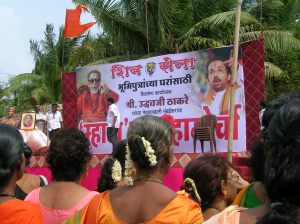
DSCN8740I was moving around Mumbai city on that weekend, mainly in the western suburbs. Several posters and banners were put up all over, announcing a call to a mass rally by Shiv Sena chief Uddhav Thackeray. Thackeray’s clarion call for that meeting was: “Housing for the bhoomiputra“. Bhoomiputra literally means son of the land. On an overt reading of the poster and slogan, one could conclude that the Sena is back to its advocacy of the sons of the soil theory which originally raised it to prominence in the 1960s. But when I attended the rally and noticed the people who attended it, I asked myself, so who exactly is this son of the soil that the Sena is talking about? Is it the Marathi manoos, the local underdog who the Sena argues has no social and economic space in his/her own city? If it is truly the Marathi manoos, then how do I interpret the presence of North Indian women, Bohra muslim women, perhaps even Dalit women, and many other women who I tried to mark but could not classify as either Hindu or Christian or any other particular else.  Hmmm …. Continue reading Of Bhoomiputra and Housing

Teachers and Academics Against 377

University teachers, researchers and academics from all over India issued a strong statement in support of the recent Delhi High Court judgement decriminalizing consensual sex among adults and challenged the legitimacy of “religious leaders” to speak for the whole of society.

180 signatories from institutions and universities in Allahabad, Calicut, Peechi, Punalur, Thiruvananthapuram, Kottayam, Sonipat, Goa, Jammu, Nanded, Mumbai, Pune, Pondicherry, Kolkata, Ahmedabad, Baroda, Chennai, Chandigarh, Delhi, Bangalore, Hyderabad, Guwahati and Shillong endorsed a statement that said:

Continue reading Teachers and Academics Against 377

Fanatic Dalits, Empowered Dalits? The Not-So-Fascinating World of Dalit-Hindutva Engagement

Fascinating Hindutva: Saffron Politics and Dalit Mobilisation
Badri Narayan, 2009, Sage, pages 195

—the Negro is a sort of seventh son, born with a veil, and gifted with second-sight in this American world, —a world which yields him no true self-consciousness, but only lets him see himself through the revelation of the other world. It is a peculiar sensation, this double-consciousness, this sense of always looking at one’s self through the eyes of others, of measuring one’s soul by the tape of a world that looks on in amused contempt and pity. One ever feels his twoness,—an American, a Negro; two souls, two thoughts, two unreconciled strivings; two warring ideals in one dark body, whose dogged strength alone keeps it from being torn asunder. Continue reading Fanatic Dalits, Empowered Dalits? The Not-So-Fascinating World of Dalit-Hindutva Engagement

धारा 377, यौनिकता और नेहरू – संतानोत्पत्ति से परे

[अगर आप मोज़िल्ला फायरफ़ॉक्स के ज़रिए नेट देखते हैं तो पढ़ते वक़्‍त फ़ॉंट बढ़ाने के लिए Ctrl + का इस्‍तेमाल करें]

धारा 377 अब स्वेच्छा से यौन संबंध बनाने वाले समलैंगिकों पर लागू नहीं होगी. दिल्ली उच्च न्यायालय के इस निर्णय ने भारतीय समाज की नैतिकता की परिभाषाओं की चूल हिला दी है. फैसला आने के बाद हिन्दू , मुस्लिम और अन्य धार्मिक समूहों के कई नेताओं ने इसे खतरनाक बताया है और इसके खिलाफ उच्चतम न्यायालय तक जाने की धमकी दी है. कुछ तो जा भी चुके हैं। सरकार को भी कहा जा रहा है कि वह इस फैसले को चुनौती दे. अब तक के सरकार के रुख से ऐसा कुछ नहीं लग रहा कि वह इस दबाव के आगे झुकेगी.

फैसला ऐतिहासिक है. इसका सबसे महत्वपूर्ण पहलू यह है कि यह एक विशेष संविधान को स्वीकार करके अपने-आपको एक राष्ट्र-राज्य के रूप में गठित करने वाले जन-समुदाय के रहने-सहने और जीने के तौर-तरीकों को निर्णायक रूप से उसके पहले के सामाजिक आचार-व्यवहार से अलगाता है. यह आकस्मिक नहीं है कि न्यायाधीश ने अपने फैसले के लिए जिन राष्ट्रीय नेताओं के दृष्टिकोण को आधार बनाया , वे हैं जवाहरलाल नेहरू और भीमराव  अम्बेडकर.  नेहरू औपनिवेशिक शासन से मुक्ति के बाद एक नए भारत के लिए आवश्यक  नैतिक और सांस्कृतिक बुनियादी तर्क खोजने की कोशिश कर रहे थे. इस खोज में सब कुछ साफ–साफ दिखाई दे रहा हो, ऐसा नहीं था और हर चीज़ को वे सटीक रूप से व्याख्यायित कर पा रहे हैं, ऐसा उनका दावा भी नहीं था. नेहरू के जिस वक्तव्य को फैसले में उद्धृत किया गया है, उसमें  भी शब्दों की   जादुई ताकत के  उल्लेख करने के साथ यह भी कहा गया है कि वे पूरी तरह से एक नए समाज की सारी आकांक्षाओं को व्यक्त कर पाने में समर्थ नहीं. वे निश्चितता से भिन्न विचार और मूल्यों के एक आभासी लोक की कल्पना करते हैं. राजनेता का विशेष गुण माना जाता है, फैसलाकुन व्यवहार. नेहरू, इसके बावजूद कि एक तानाशाह बन जाने के लिए उनके पास सारी स्थितियां थीं , हमेशा इससे बचते रहे कि चीज़ों को साफ-साफ और  अलग-अलग खाचों में डाल दिया जाए.
Continue reading धारा 377, यौनिकता और नेहरू – संतानोत्पत्ति से परे

DISSENT, DEBATE, CREATE