Tag Archives: Kashmir

Pushing the Kashmiri to the wall, again

[An edited, shorter version of this article by me appeared last week in The Friday Times, Lahore.]

In the first week of June, I sat at a shopfront with a group of shopkeepers of Kalarus, a small town in Kupwara district in north Kashmir. In 1999, they collected money and bought land for a martyrs’ graveyard, one of many such in Kashmir. Whenever the Indian army killed militants trying to infiltrate from Pakistan to the Indian side of the Line of Control, they would hand over the bodies to the Kupwara police, who would give it to these people to bury after the autopsy.

“Look up at the mountain peak,” said one of them, “It is snow clad all twelve months. It is the LoC, 70 kms from here. Do you think anyone would cross that wearing the traditional Kashmiri Khan dress?” And yet, most of the hundred odd bodies in the graveyard had come wearing clothes unfit for snow. And, most of them had so many bullet marks on the face that they were unidentifiable. Continue reading Pushing the Kashmiri to the wall, again
In Kashmir, everyone’s losing the plot: Peerzada Aashiq

Guest post by PEERZADA AASHIQ

Everyone is losing its plot in Kashmir — be it separatists, mainstream political parties, New Delhi or Pakistan. The biggest losers in the unarmed but stone-laden street uprising are Pakistan and separatists.

The failure of Pakistan in shifting paradigm of new realities in Kashmir can be gauged from its dwindling influence over separatists’ spectrum. It failed to unite fractured separatists to its 1992-like unified forum politics despite placing in half-a-dozen interlocutors between warring factions of the All Parties Hurriyat Conference led by Sayed Ali Shah Geelani and Mirwaiz Umar Farooq.

Its influence over separatists’ spectrum has been wavering and waning. It was after former Pakistan President Pervez Musharraf pick-and-choose policy that saw separatists cocooning and ensconcing their politics as per the public mood in Kashmir. If Musharraf’s four-point formula convinced moderate Mirwaiz Umar Farooq, many hard-liners like Sayed Ali Shah Geelani and United Jehad Council chief Sayed Salahuddin rejected it. Continue reading In Kashmir, everyone’s losing the plot: Peerzada Aashiq

Curbs continue on Kashmir media; is it martial law in Srinagar?

Media persons stage protest at Press Enclave in Srinagar against Government’s decision to gag media. Habib Naqash/GK

Update 2 on 11 July: As was being feared, the state has begun to crackdown on Facebook users for ‘anti-India activiies’. I can already spot one Facebook account missing. Very soon they will ban eating, drinking, breathing and shitting and offer curfew passes to some for these activities.

Update: Appeals to the Indian government by the Committee to Protect Journalists and IFJ.

In a clear signal that it continues to dictate what we get to know about the ground situation in Kashmir, curbs on the local media in the Valley continue despite government claims that they have been lifted. At the same time, Delhi journalists are able to freely move around and report in Srinagar. This is yet another blatant example of how the Indian state considers Kashmir its private property and the rights of its residents are secondary. As the Delhi media continues to do the bidding of the Home Ministry, the best sources of news on what’s happening on the ground remain Twitter and Facebook. Those updating their profiles and pages with information are doing so with the apprehension of censorship, state reprisal, blocking of these sites and suspension of internet services altogether in Kashmir. Continue reading Curbs continue on Kashmir media; is it martial law in Srinagar?

If you’re still wondering why Kashmir is protesting and demanding azadi…

‘Mother I will make you cry today’

Dr. SYEDA HAMEED has sent us this poem

‘Mother I will make you cry today’

(On June 30th 2010, Asif Rather age nine ran out of his home in Baramulla in Kashmir to look for his older brother. As he left, he told his mother ‘I am going to make you cry today’. Minutes later he fell victim to shooting by the forces. At the time he was 150 meters from his house. – The Indian Express)

He stood at the sunlit door
A nine-year old with tousled hair
Asif Rather, student of class four,
Baramulla, 55 kms from Srinagar

‘Where is Touqeer?’
He sought his older brother.
‘Nowhere! You come back now
Here’s tea and last night’s bread
My baby, let me comb your hair’

Outside, the sounds Allah o Akbar
Chanting at once, one thousand strong Continue reading ‘Mother I will make you cry today’

A conversation in Sopore and other stories

The street that connects that Malaknag and Chheni Chowk areas of Islamabad/Anantnag in south Kashmir. Photo by Nasir Patigaru, via Facebook, posted on 27 June.

Which Indian has not heard of General Dyer? General Dyer opened fire on unarmed protesters. Hundreds died, the figures are disputed between Indian and British version to this day. A commission of enquiry was set up by the English. General Dyer told the Hunter Commission, “I think it quite possible that I could have dispersed the crowd without firing but they would have come back again and laughed, and I would have made, what I consider, a fool of myself.” Continue reading A conversation in Sopore and other stories

IPTK Statement on Military Governance in Indian-administered Kashmir

Military Governance in Indian-administered Kashmir

STATEMENT: FOR IMMEDIATE RELEASE
Srinagar, June 29, 2010

INTERNATIONAL PEOPLE’S TRIBUNAL ON HUMAN RIGHTS AND JUSTICE IN INDIAN-ADMINISTERED KASHMIR (IPTK) | www.kashmirprocess.org


The People’s Tribunal feels morally obligated to make this statement today. Sustained alliances between local communities and IPTK have enabled us to bear witness to the escalating conditions induced by militarized governance, and the severity of psychosocial dimensions of oppression in Indian-administered Kashmir. From our work since being instituted in April 2008, from the reports and briefs we have authored, investigations we have undertaken and are in the process of completing, we find it ethically imperative to comment on the direction in which the Governments of India and Jammu and Kashmir, and the Indian Armed Forces, appear to be headed, and the consequences they will likely effect. Continue reading IPTK Statement on Military Governance in Indian-administered Kashmir

Kashmir: The Hidden Occupation

Guest post by YASMIN QURESHI

Yasmin Qureshi grew up as a member of India’s Muslim minority before moving to the San Francisco Bay Area. She is a social justice activist who traveled to Palestine in 2007 and to Kashmir last year. This article is a reflection on her trip to Kashmir.

I wanted to go to Kashmir ever since I visited Palestine in 2007. There are many similarities in the nature of the occupation as well as the struggles, both being nearly 63 years old.

One difference is that while Israel is seen as an external occupying force in Palestine, the Kashmir issue is considered an “internal” matter or a conflict between Pakistan and India, and the voice of Kashmiris is often lost. As a result, there are fewer international organizations monitoring the region, and little information about the extent and impact of the occupation gets out.

A layoff from my company in August 2009 gave me the opportunity to visit the region, called “a paradise on earth” by Mughal emperor Shah Jahan. The unanimous message I heard as I traveled and spoke to journalists, taxi drivers, pony riders, waiters, students and teachers was that they want “azadi,” independence from the occupation by India. Continue reading Kashmir: The Hidden Occupation

Mohamad Junaid: What Does the Chatham House Poll in Kashmir Tell Us?

Guest post by MOHAMAD JUNAID

The Chatham House poll conducted in the autumn of 2009 in Jammu, Ladakh, Kashmir and Azad Kashmir has revealed an interesting pattern of opinions held across these regions on issues ranging from the perception of major problems people face to effective solutions to the Kashmir issue and the best means to achieve them. Robert Bradnock, under whose supervision the poll was conducted, however presented the results somewhat shoddily leading to confusion over the real import of the opinion poll. This confusion has prompted media in India and Pakistan to portray the polls selectively or in a self-serving manner, largely reflecting their nationalist stances on the Kashmir question. The poll, in reality, points to some interesting developments in Kashmir and indicates a way toward an eventual, mutually agreeable solution.

Consistent with every other poll on the issue, Chatham House poll has shown again that an overwhelming number of people (74—95 percent) in Kashmir region demand independence. This figure comes as no surprise because the support for independence for Kashmir over accession to Pakistan has been steadily growing over the last 20 years. This feeling is more concretely reflected in the fact that most Kashmiris (more than 90 percent) support withdrawal of Indian troops from Kashmir, while a similar figure (around 80 percent) want Pakistan to withdraw its troops from Azad Kashmir. Along with demilitarization, there is a clear demand for de-weaponization (more than 80 percent) and an end to militant violence (around 90 percent) in the Kashmir region. The Line of Control in its present form is uniformly rejected in both Kashmir and Azad Kashmir. Continue reading Mohamad Junaid: What Does the Chatham House Poll in Kashmir Tell Us?

‘The Moral Obligation of Indian Civil and Political Society’: Rekha Chowdhary on Fake Encounters in Kashmir

Guest post by REKHA CHOWDHARY

With another incident of fake encounters in Kashmir, it is a moment of introspection for the political and civil society of India. For all those who are proud of Indian democracy, it is a moment to reflect as to how this democracy fares for the people in Kashmir. It is important to note that democracy does not remain limited to the electoral choices and the extent and intensity of competition in the formation of government – it also involves the political and civil rights of people. Even when democracy has been restored in Kashmir in its procedural form and is kicking in the form of intensely competitive politics, its substantive effect is missing. The right to life is the minimum that is provided by any democracy, the range of rights however goes much beyond this and involves the basic civil liberties as well. However, the way the hapless innocent persons were cruelly murdered in Nadihal in north Kashmir and declared as militants – it is the denial of the minimum. It is not only the murder of three people, it is also the murder of Indian democracy! Continue reading ‘The Moral Obligation of Indian Civil and Political Society’: Rekha Chowdhary on Fake Encounters in Kashmir

‘Non-violent terrorism’ and India’s dirty war in Kashmir

Guest post by MOHAMAD JUNAID

Dozens of young boys have been arrested across Kashmir under draconian laws over the last few weeks. The charges that have been filed against them range from “waging war against the state” to defiling “state honor”. In recent months Indian military and police commanders have described protests in Kashmir as “agitational terrorism” and “non-violent terrorism” in order to justify violent clampdown on protests by Kashmiris.

As the headlines go, Stone-pelting an act of war: J-K gov.

In the same period around 8 people, mostly teenagers, have been either shot to death or fatally injured by indiscriminate use of tear-gas shells. Over the last two years the number of dead in shootings is more than a hundred. Meanwhile thousands of people have been injured. Many of them will be left with permanent physical disabilities. The police authorities have banned any peaceful assembly of people. Many places in downtown Srinagar and other towns have reported police brutalities. Even the villages are not being spared. Only yesterday, mourning villagers were attacked by CRPF troopers in Redwani in South Kashmir. Dozens of them were injured by CRPF’s indiscriminate firing. Most of the injuries were inflicted above the waist showing an intention to kill Continue reading ‘Non-violent terrorism’ and India’s dirty war in Kashmir

IWIJ Report on Shopian

After months of uncertainty in which the entire political and state machinery has been galvanized to ensure that the perpetrators of the horrific rape and murder of two young women in Shopian go scot free, the Central Bureau of Investigation has produced a report that gives a clean chit to the indicted policemen and claims that the two women drowned in a stream. Below we carry a report by the Independent Women’s Initiative for Justice. Do circulate as widely as possible.

The IWIJ comprising of Uma Chakravarti, Usha Ramanathan, Vrinda Grover, Anuradha Bhasin Jamwal, Seema Misra and Dr. Ajita – are conducting a case watch on the Shopian rape and murder of 2 women in May 2009. The first case watch report was released by IWIJ on 10 December 2009, at New Delhi.


‘Only 35% Indians say freedom for Kashmir unacceptable’

Believe it or not, that is one of the findings of a new survey on Kashmir, conducted in both India and Pakistan.

And some more disbelief here:

A majority of Pakistanis say Pakistan’s government does not provide support to militant groups that conduct attacks against civilians in India, while a majority of Indians tend to believe it is providing support. Continue reading ‘Only 35% Indians say freedom for Kashmir unacceptable’

When a Guinness world record isn’t news

Every little entry from India in the Guinness Book of World Records makes it to our Delhi papers. But, a recent one didn’t. News editors are proud patriots.

Kitnay Kashmir

To the growing voices of peace, return and reconciliation amongst young, exiled Kashmiri Pandits, Rashneek Kher has a revealing response:

I have neither been a votary nor a detractor of the idea or concept of Panun Kashmir but truth be told I have always found it as a perfect counterweight to the secessionists policy of Azad Kashmir. Continue reading Kitnay Kashmir

The nationalist Delhi media and elections in Kashmir

How free can an election under the gun be?

There are times when nationalism supercedes journalistic objectivity. Such interesting times are often witnessed in the Delhi media’s relationship with that ‘integral’ part of India called the Kashmir valley, as we have seen before.

And this time:

If the participation of the people in the J&K assembly elections was a vote for India why is the non-participation this time being attributed to broken promises… [Naser A. Ganai]

On April 30 the turnout in the Anantnag constituency as in many other parts of the country was low, but the contrast in how the story was reported (and framed) in the national press, and in the local English press in Srinagar is significant. [Sevanti Ninan]

Kashmir Tribunal Memorandum to CM Omar Abdullah

To: Mr. Omar Abdullah
Chief Minister
Jammu and Kashmir

From: The International People’s Tribunal on Human Rights and Justice in Kashmir Continue reading Kashmir Tribunal Memorandum to CM Omar Abdullah

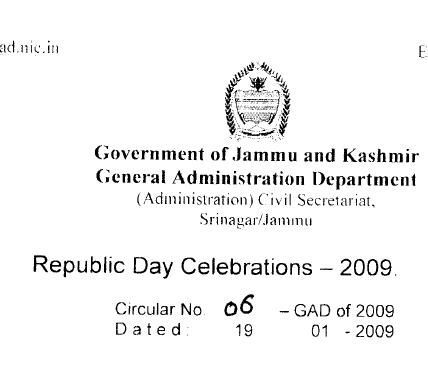
Republic Day in Srinagar

rdayorder1

By the way, belated Happy Republic Day! Say it loud and clear brother, lest you also get an order like this one of these days!

(Thanks, Chandni Parekh.) Continue reading Republic Day in Srinagar

Army wanted Abdullah, who’s surprised?

Ashish Sinha in Mail Today:

Any political decision on Kashmir — especially when the ball is in the Congress’s court — cannot afford to ignore the sentiments of lakhs of troops stationed here because, at least for now, they appear to be a more permanent fixture than any party, even the National Conference (NC). [Full text]

I told you so…

And Siddharth Varadarajan asks the right question:

But if these motives propelled the ISI to either mount or at best turn a blind eye to the Mumbai plot, why did the same agency — which essentially manages Rawalpindi’s links with militant groups active in Jammu and Kashmir — not seek to disrupt the assembly elections? [Here]

Oranges in Kashmir

Guest post by K

In the summer of 2008, something impossible happened. To a number of Indians, Kashmir was no longer an atoot ung, an inseparable part of the Indian body politic. That image of Kashmir treacherously manufactured by the Indian state through lies, deceit and the media, was wearing down.

The atoot ung no longer seemed atoot to many voices in India and against all odds the people of Kashmir were changing many hearts and minds in India. The loss of soldiers does not worry India as much as the change in its public opinion on Kashmir. This had to be undone, and undone fast before it spread its tentacles. The evil image of Kashmiris had to emphasized and the  non-violent protests discredited. What better than an election to do the task?

So the results will be out tomorrow, but do they matter? Continue reading Oranges in Kashmir

A cruel joke called elections in Kashmir

The Indian media has been expressing surprise about the high voter turnouts in the Kashmir elections. The expression of surprise sounds genuine. I am not sure how genuine it is. Is patriotism coming in the way of truth? How can we not see what a Wall Street Journal reporter can?

In the village of Samboora, residents said that Indian Army troops went from house to house on Saturday morning, rounding up families and taking them to a polling station. As a reporter drove into the village Saturday afternoon, an army vehicle with several soldiers stopped by the walled compound of Ghulam Mohammad, pulling the 59-year-old retiree onto the road. Seeing a foreign reporter, the soldiers jumped into their vehicle and quickly drove off. “They asked me why I’m not voting, and I said that’s because I don’t like any of the candidates,” Mr. Mohammad said moments later. “They said, if I don’t vote, I’ll be sorry later.” [Must Read]

And wasn’t this predicted anyway? Didn’t we tell you about Gentle Persuasion? Oh, and they already know who the CM is going to be.