Tag Archives: Kashmir

JTSA responds to Delhi Police’s comments on their report “Framed, Damned, Acquitted”

This guest post by the JAMIA TEACHERS’ SOLIDARITY ASSOCIATION is a response to the Delhi Police’s comments on their report, “Framed, Damned, Acquitted”

Did you think that the Special Cell or the Delhi Police would introspect on its ways after the publication of Framed, Damned, Acquitted? How wrong you were. It is now attempting desperately to defend the indefensible by hiding behind a maze of statistics, ignoring the real questions that the report has raised: namely the brazen and systematic violation of all established legal norms and due process. Continue reading JTSA responds to Delhi Police’s comments on their report “Framed, Damned, Acquitted”

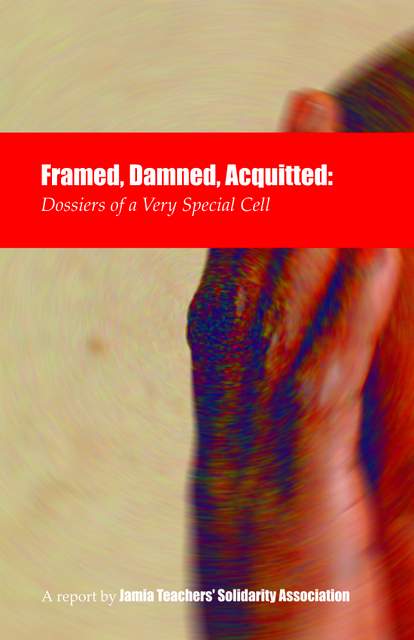
Framed, Damned, Acquitted: Dossiers of a ‘Very’ Special Cell

Given below is the report Framed, Damned, Acquitted: Dossiers of a ‘Very’ Special Cell, released yesterday in Delhi by the JAMIA TEACHERS’ SOLIDARITY ASSOCIATION.

When human rights activists, or families of those arrested on charges of terrorism, allege foul play on part of the investigating agencies, the usual response is this: Surely, there must have been some involvement, or else why would the police arrest him, and not me? Continue reading Framed, Damned, Acquitted: Dossiers of a ‘Very’ Special Cell

Will there be justice in the Bhaderwah triple murder case?

This press release was put out by the JAMMU KASHMIR COALITION OF CIVIL SOCIETY on 13 September

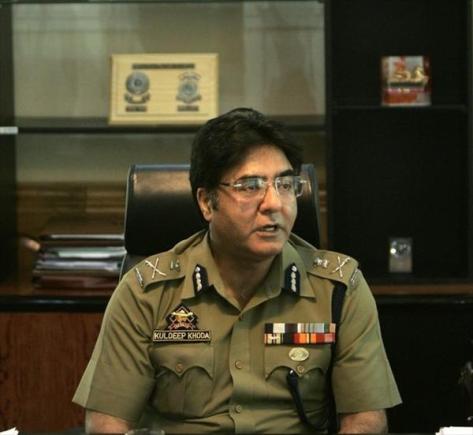
Kuldeep Khoda, former Director General of Police, Jammu and Kashmir
On 12 September 2012, a little less than five months after the son of one of the victims of the infamous Bhaderwah triple murder case filed a complaint before the State Human Rights Commission [SHRC]. The SHRC dismissed the case implicating Kuldeep Khoda, ex-Director General of Police, Jammu and Kashmir [retired from service on 31 May 2012]. No notice was given to the complainant or his advocate to appear for the hearing. On 13 August 2012, the advocate for the complainant had sought an opportunity to advance further arguments on 22 August 2012. While this request was granted, no hearing was held on 22 August 2012. Instead of providing notice for the subsequent hearing on 12 September 2012, the SHRC chose to dismiss the case. Continue reading Will there be justice in the Bhaderwah triple murder case?

On the International Day of the Disappeared: APDP

This press statement was issued yesterday, 30 August 2012, by the ASSOCIATION OF PARENTS OF DISAPPEARED PERSONS, the Bund Amira Kadal, Srinagar – 190001, Jammu and Kashmir
 
Today on the occasion of the International Day of the Disappeared, the Association of Parents of Disappeared Persons (APDP) organized a seminar on the International Convention for the Protection of all Persons from Enforced or Involuntary Disappearances and Institutional Violence and Denial of Justice by India. Various members of the Civil Society addressed the importance of the ratification of the international Convention against Disappearances.
Further, the Association of Parents of Disappeared Persons (APDP) today submitted 507 cases of enforced or involuntary disappearances from Baramulla and Bandipora districts to the State Human Rights Commission (SHRC) for conducting investigations. Continue reading On the International Day of the Disappeared: APDP

Borderline madness: Sajan Venniyoor


Guest post by SAJAN VENNIYOOR

Now that government agencies in India — some half a dozen of them working with the exceptional coordination we have come to expect from government agencies — have blocked Facebook accounts, Twitter feeds and YouTube videos supposedly originating in Pakistan, perhaps we could contemplate other trans-border electronic transgressions committed by our neighbours.

In August 2011, The Times of India reported that Punjab border farmers still tune into Pak FM radio stations. According to villagers on the fringes of Ferozepur, the limited range of India’s “national radio” broadcasts and the absence of any local FM station have made radio services from Pakistan the most popular source of entertainment in border areas.

About the same time last year, the Indian government had become alarmed by the popularity of Nepal’s FM radio channels in Bihar along the Indo-Nepal border. According to various sources, some half a dozen Nepal FM radio stations are broadcasting programmes – “anti-India advertisements and vulgar songs”, according to one outraged newspaper report – into Bihar, especially Madhepura, Supaul, Madhubani, Kishanganj, Araria, Sheohar, Saharsa, Muzaffarpur, and East and West Champaran districts.  Continue reading Borderline madness: Sajan Venniyoor

Kashmir civil society express concern over Amarnath construction plans

The press release below has been jointly issued by a number of eminent citizens and civil society members in Kashmir. Full list of signatories at the end.

Srinagar, 18 August 2012: Civil society groups of Kashmir express their serious concern over the recent Supreme Court directions to the J&K government for undertaking civil engineering works leading to construction of roads and other infrastructure in the environmentally fragile Himalayan habitat around the Amarnath cave shrine in the valley of Kashmir. This move comes even as the committee formed by the Hon’ble court for recommending ways and means to promote safe journey of pilgrims to the cave shrine is yet to submit its report.

At a joint meeting of various civil society groups held on 16 August at Srinagar, the following resolution was adopted: Continue reading Kashmir civil society express concern over Amarnath construction plans

Celebrating Tyranny and Victimisation in Kashmir: JKCCS

This press statement comes from the JAMMU AND KASHMIR COALITION OF CIVIL SOCIETY

Srinagar, 15 August 2012: It is despicable that the police officers responsible for serious human rights violations are receiving awards despite the crimes they have perpetrated. Today’s awards to some of the Jammu and Kashmir Police officers are an act of celebrating tyranny and victimization.

Superintendent of Police, Altaf Ahmad Khan is one of the officers who has been awarded with the President’s Police Medal for Gallantry. Altaf Ahmad Khan is notoriously known for perpetrating human rights violations in the areas where he has served. Continue reading Celebrating Tyranny and Victimisation in Kashmir: JKCCS

Of Nationalism and Love in South Asia

The predominant emotion with which jingoistic Indians and Pakistanis view each others’ misfortunes is schadenfreude. They count each other’s conflicts and rebellions to keep score. The Indian will talk about sectarian violence in Pakistan, and the Pakistani will ask about the treatment of Dalits in India. The Pakistani will complain against Indian atrocities in Kashmir  and the Indian will point fingers at Balochistan.

When I see such Indo-Pakistani interactions online, I am reminded of these words: Continue reading Of Nationalism and Love in South Asia

APDP statement on Supreme Court’s suo-moto cognizance on Amarnath pilgrim deaths

This press release was issued by the ASSOCIATION OF PARENTS OF DISAPPEARED PERSONS on 31 July 2012
 
Today, 31 July 2012, Association of Parents of Disappeared Persons (APDP), held its regular monthly meeting where various issues confronting the struggle of the family members of the disappeared were discussed. Besides other issues, the recent suo-moto cognizance of the Supreme Court of India regarding the deaths of Amarnath pilgrims and its continued indifference towards the sufferings of the family members of the disappeared were raised.
On 15 July 2012, the Supreme Court took suo-moto cognizance of the deaths of 67 Amarnath pilgrims over the first 17 days of the Amarnath Yatra. Referring to a clear disregard for human life, the Supreme Court cited the constitutional rights to life [Article 21] and freedom of movement [Article 19(1) (d)] in India and issued notices to the Central Government, Government of Jammu and Kashmir and the head of the Amarnath Shrine Board. Subsequently, a high powered committee was constituted to investigate the reasons behind the deaths. Continue reading APDP statement on Supreme Court’s suo-moto cognizance on Amarnath pilgrim deaths

Iranian filmmaking in Kashmiri autumn

Set in 2002, shot in 2009, Aamir Bashir’s film Harud will be in select PVR cinemas on Friday, 27 July. Harud is clearly inspired by Iranian films which manage to say a lot without saying much. Like a lot of Iranian cinema, a child is at the centre of the film. The brilliant acting by Shahnawaz Bhat, who plays the protagonist Rafiq, makes the film. In the expressions on his face there is ambiguity and wonderment as much as there is humiliation, helplessness and a desire to do something to change things around him. Here is a film about Kashmir that does not begin with beautiful landscape and does not end with a big encounter between militants and forces. This is not a film that seeks to explain the Kashmir conflict – rather, it takes you inside the lives of ordinary people and how they faced the madness of a conflict. Regardless of what your views on Kashmir are, Harud succeeds in making you empathise with Rafiq and others around him. That, for any narrative on Kashmir, is no small achievement.

Read more about the film in Time Out and ArtViewBlog. Here are some interesting interviews of the director.

India must deliver on its repeated commitments to the human rights council: Amnesty International

This release was put out by AMNESTY INTERNATIONAL on 1 June

On 24 May 2012, India’s human rights record came under renewed international scrutiny during its second Universal Periodic Review (UPR) at the UN Human Rights Council. Amnesty International welcomes the recommendations made to India by the reviewing states, many of which reflect concerns raised previously by the organization.

Amnesty International is disappointed, however, that despite India’s assertion that it sees the UPR mechanism as one of “constructive engagement,” the government did not immediately accept any of the recommendations made, some of which were put forward in 2008 during India’s first UPR. Amnesty International urges India to demonstrate by September 2012, a genuine resolve to deliver on its outstanding human rights commitments and the UPR recommendations, when the report on India’s second UPR is formally adopted at the 21st session of the Human Rights Council. Continue reading India must deliver on its repeated commitments to the human rights council: Amnesty International

Is the Hurriyat divorcing democracy and freedom?: Gowhar Geelani

Guest post by GOWHAR GEELANI

By any stretch of imagination, the All Parties Hurriyat Conference [APHC] has ceased to be an amalgam of ‘all parties’. It seems that this conglomerate of several pro-freedom political, social and religious parties is actually being run by a chosen few in a dictatorial manner. It is no secret now that the fissures in the Hurriyat ‘M’, the one led by the popular head-priest based in Srinagar, Mirwaiz Umar Farooq, run neck deep.

The APHC was formed on 10 March 1993 to find a political solution to Kashmir dispute after a large-scale armed rebellion since 1989 had successfully highlighted the need for a resolution to the long-standing dispute. Essentially, this conglomerate was formed with the clear aim of achieving the “right to self-determination” for Kashmiris in accordance with the United Nations’ Security Council Resolutions vis-à-vis Kashmir.

But all is not well with the Hurriyat (M). One of its prominent leaders, Professor Abdul Gani Bhat has openly challenged group’s constitution by declaring that the UN resolutions on Kashmir have become “irrelevant”.

Continue reading Is the Hurriyat divorcing democracy and freedom?: Gowhar Geelani

If ‘temporary’ meant special, what would ‘special’ mean?: Gazala Peer

Guest post by GAZALA PEER

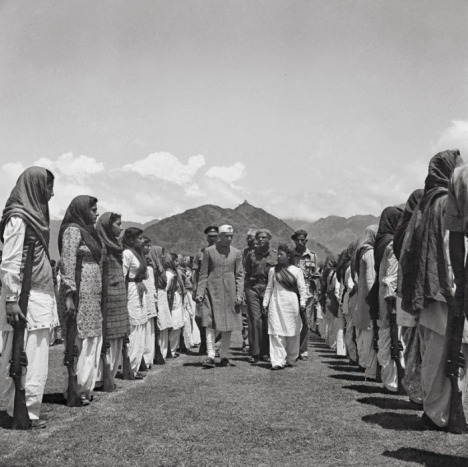
Circa 1948, this photograph shows Jawaharlal Nehru inspect a women’s militia in Kashmir. Via andrewwhitehead.net

On 13, October 2010 a team of interlocutors was appointed by the Government of India to hold dialogue with all the sections of the society in Jammu and Kashmir. The team of interlocutors consisted of journalist Dileep Padgonkar, educationist Radha Kumar and the former Information Commissioner M. M. Ansari. After almost one and a half years the report was released on 24 May 2012 by the Ministry of Home Affairs (.pdf here). The report calls for formation of a Constitutional Committee to review the extension of central laws to the state of J&K from 1952 onwards. Some of the major recommendations are: changing the temporary nature of Article 370, dividing the state into three Regional Councils and appointment of the Governor but after consultation with the state legislature. The Report further says that the findings of this Constitutional Committee shall be binding on all the ‘stake holders’ in the State. Continue reading If ‘temporary’ meant special, what would ‘special’ mean?: Gazala Peer

…and now Judicial Impunity?: JKCCS

This release comes from the JAMMU KASHMIR COALITION OF CIVIL SOCIETY
2 May 2012: The recent Supreme Court judgment in the Pathribal case is very disappointing.
Fake encounters, along with various other human rights violations, have been a reality for the people of Jammu and Kashmir over the last twenty two years. In 2008, according to media reports, Supreme Court Justices Aftab Alam and G.S. Singhvi made observations in court in relation to the practice of fake encounters for rewards in Jammu and Kashmir. With about 8000 persons disappeared, 70,000 persons killed, numerous cases of torture, rape and other human rights violations, Jammu and Kashmir has seen institutional denial of justice. Continue reading …and now Judicial Impunity?: JKCCS

Pathribal ruling a setback for justice in Jammu and Kashmir: Amnesty International

This press release comes from AMNESTY INTERNATIONAL

1 May 2012

Special powers that allow India’s armed forces suspected of involvement in extra-judicial killings to sidestep the civilian courts have been reinforced in a disappointing court ruling over the notorious killings of five Kashmiri civilians 12 years ago.

India’s Supreme Court has contradicted a reported statement by its Justices in February 2012 that army personnel suspected of murder should be placed in front of a civil judge.

Instead it opted to give military authorities eight weeks to bring about the court martial of eight army officials allegedly responsible for the unlawful killing of five youths in Pathribal, in March 2000. Failing that, the Central Bureau of Investigation (CBI), may apply to prosecute the army personnel. Continue reading Pathribal ruling a setback for justice in Jammu and Kashmir: Amnesty International

The Semiotics of Happiness

Guest post by ABHIJIT DUTTA

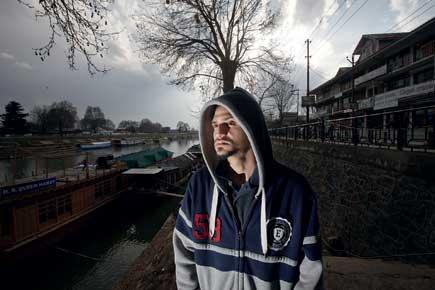
MC Kash - Photo by Ashish Sharma / Openthemagazine.com

It is not every day that you wake up to find your Twitter timeline flooding with the assertion that Kashmir – of all places – is happy. Dangerous? Of course. Beautiful? well, yes, the postcards are pretty enough. Angry? Sure, they look it. Radical? Oh god, yes. Happy?

If you ask Manu Joseph, author of Serious Men and editor of Open, the answer is yes. In this article, he talks about his interactions with “regular” people in the valley – the non elite, the non journalist, the non artist, the non writer – and is convinced that Kashmir is ready to move on. That it has already moved on. That Kashmir is happy. As proof, he offers these exhibits: (a) record high tourism numbers, (b) 2010 IAS topper Shah Faesal (who tells him “commonsense is finally winning”), (c) a meeting of a District Magistrate with elected leaders of a village (“not a word about politics”, says the DM to Mr. Joseph, “They want to talk about things that matter to them and their families”) and (d) the desire for city life (“we want KFC”).

Continue reading The Semiotics of Happiness

A Brief Summary of the Interlocutors’ Report on Kashmir: Shoaib Rafiq

This guest post by SHOAIB RAFIQ is an analysis of the Home Ministry-appointed group of interlocutors’ report on Kashmir 

We swear by the fundamentals of absurdism
of that all we have learned
our solutions will mimic the ludicrousness
that we employ in our education, research, and other related shit. Continue reading A Brief Summary of the Interlocutors’ Report on Kashmir: Shoaib Rafiq

Who killed four foreign tourists in Kashmir in 1995?

Given below is the text of a petition submitted to the Jammu & Kashmir State Human Rights Commission by the INTERNATIONAL PEOPLE’S TRIBUNAL ON HUMAN RIGHTS AND JUSTICE IN INDIAN-ADMINISTERED KASHMIR (IPTK) together with the ASSOCIATION OF PARENTS OF DISAPPEARED PERSONS. A Division Bench of the SHRC will hear the case on 17 April 

To,
Mr. Tariq Ahmad Banday,
Secretary,
Jammu and Kashmir State Human Rights Commission,
Srinagar

Date: 6 April 2012

Dear Mr. Banday,

The International People’s Tribunal on Human Rights and Justice in Indian-administered Kashmir [IPTK] (a brief on the Tribunal’s premise and objectives may be found here) and the Association of Parents of Disappeared Persons [APDP], present before you the following submission:

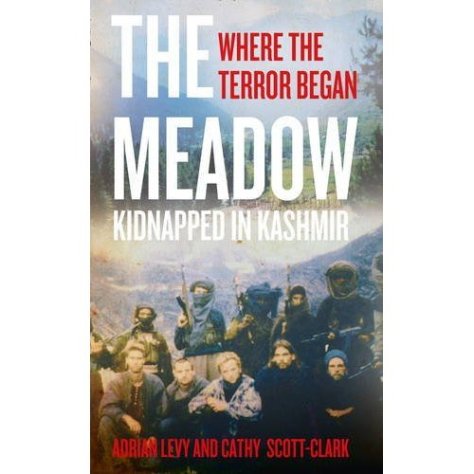
  1. In July 1995, during a trekking expedition, six persons were reportedly kidnapped by a group that referred to itself as “Al-Faran” [a front of the Harkat-ul-Ansar]. The six persons kidnapped were: John Childs [Simsbury, Connecticut, USA], Dirk Hasert [Bad Langensalza, Germany], Don Hutchings [Spokane, Washington State, USA], Keith Mangan [Teesside, Middlesbrough, England], Hans Christian Ostrø [Oslo, Norway], and Paul Wells [Blackburn, Lancashire, England]. Continue reading Who killed four foreign tourists in Kashmir in 1995?

Free Waqar Ahmad

The text below comes from the FREE WAQAR CAMPAIGNfreewaqar.org

Waqar Ahmad Moharkan was born in Indian-held Kashmir in 1990. Currently, he is a final year student of Bachelor’s in Commerce at Srinagar’s Islamia College of Science and Commerce. Waqar was arrested on 4 October, 2011, during a raid on his house in Lal Bazaar on charges of participating in protests in the Downtown area of Srinagar. Waqar was arrested by police personnel from MR Gunj station. The court allowed his bail application on 23 October, 2011. Instead of being released, he was rebooked by same police station and shifted to Central Jail under judicial remand on 15 December, 2011 and suddenly slapped with the draconian Public Safety Act (PSA). Continue reading Free Waqar Ahmad

Jashn-e-Azadi successfully screened at Delhi University despite right-wing threats & police pressure: AISA

Guest post by ALL INDIA STUDENTS’ ASSOCIATION (AISA)

AISA and Students of Sociology Department (DU) Successfully Screen Jashn-e-Azaadi in DU, Braving Attacks and Threats by ABVP and ‘Bhagat Singh Kranti Sena’! Hundreds of Delhi University Students Participate in Film Screening and Discussion with Sanjay Kak, Director of Jashn-e-Azadi!!

Today hundreds of DU students and teachers participated the screening of the documentary film  Jashn-e-Azaadi organized by AISA and students of sociology in the Department of Sociology, Delhi University. “Predictably this screening had to held in the teeth of opposition from right-wing fascist forces like ABVP and the Bhagat Singh Kranti Sena, who tried their level best to stall the screening. Moreover, the DU administration and the Delhi Police also shamefully sided with these forces and tried to pressurize the Sociology department to stop the screening”, said Harshvardhan Tripathi Secretary DU, AISA.

Continue reading Jashn-e-Azadi successfully screened at Delhi University despite right-wing threats & police pressure: AISA

My Abu Talha Moment: Sanjay Kak

Guest post by SANJAY KAK

Last week was my Abu Talha moment. That’s when dubious honours rain on you, unsolicited, undeserved. There I was, charged with wrecking a literary festival in Kashmir; links to the Parliament attack case; racism against Kashmiri pandits; scuttling a film screening in a women’s college in Delhi… And if that doesn’t create a frisson, I was also said to be on the radar of Mumbai’s Anti Terrorist Squad.

Unable to make the Abu Talha connection? Many in Kashmir know the name as a talisman, the kind that security forces brandish when they periodically feel its time to square their books. It doesn’t take much; they just have to produce a fresh corpse before a pliant media, although one with long hair and a beard, fatigues and an AK47, does make things easier. As Abu Talha, this all-purpose corpse can then be held responsible for fidayeen attacks, the murder of innocent civilians, the assassination of political workers, massacres, and explosions, whatever. Crucially, even as Abu Talha is lowered into the ground, all further investigations into those events can be safely laid to rest.

End of story: tamam shudh? Well, only sort of. Because Abu Talha will be called upon to perform again, dusted up and presented afresh to the world. Again. He’s not alone, for with so much happening in Kashmir, Abu Talha is part of a frequent fighters club: Abu Hamza, Abu Shakir, Abu Waqas, Ghazi Baba… The other day a friend from Kashmir invented one to cheer me up: Abu Tamam, he offered, Father of it All.

Continue reading My Abu Talha Moment: Sanjay Kak