Tag Archives: West Bengal

The Paradoxical Figure of Mamata: Monobina Gupta

Guest post by MONOBINA GUPTA

With the coming assembly elections, West Bengal seems to be poised on the edge of a historic upheaval that will, in all probability, enter the collective memory of its people, much like the momentous 1977 elections. The most palpable moment of this churning will manifest in what looks like an unbelievable denouement – that of the thirty-four year old monolithic rule of the Left Front. Equally stunning might be the image of Mamata Banerjee, bringing the red fortress down – a politician, almost bludgeoned to death by CPI-M cadres on 16th August 1990, now transformed into the emblematic face of this extraordinary hour. The 2011 polls may be billed as the great unraveling of West Bengal, its politics and culture – but also, I think, of gender relations. Banerjee is on the verge of acquiring a unique status, becoming the first woman head of a state well known for its misogynist culture, notwithstanding many claims to the contrary.
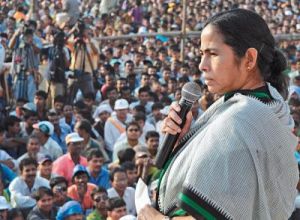
mamata banerjee
Mamata Banerjee. Courtesy The Hindu, Arunangsu Roy Chowdhury

An important aspect of Banerjee’s ascendancy may be lost if we fail to locate her persona within this grid of power and gender relations; if we do not contextualize her in Bengal’s thriving culture of male chauvinism. The association of West Bengal and its ruling Marxists with the autonomy and radicalization of women – who are supposedly respected in Bengal unlike in other parts of the country – is a well preserved myth. Bengal respects its women, but only if they belong to the hallowed league of ‘Mothers and Sisters’. Like elsewhere, ‘deviant’ women have little place in the land of the Renaissance.

Continue reading The Paradoxical Figure of Mamata: Monobina Gupta
Corruption, CPI(M) and Neoliberalism: Sankar Ray

Guest post by SANKAR RAY

Prasenjit Bose, chief of research cell, central committee of CPI(M) deserves kudos for his article Corruption and Forbearance under Neoliberalism, published in the journal of The Centre for Policy Analysis, and reproduced in pragoti.org. However, corruption is not an exclusive phenomenon under the capitalist system. Socialist countries – I mean the social orders encouraged by the Third International – were also afflicted by corruption, not to speak of People’s Republic of China (both in Mao and post-Mao years). Even the CPI(M)-led governments in Kerala and West Bengal never waged a principled war against corruption.  Hence Bose’s inference that “the state under the neoliberal regime has increasingly become a vehicle for capital accumulation and also a site for primitive accumulation, by the established corporate players as well as new entrants to the big business club” – is only half the truth. Continue reading Corruption, CPI(M) and Neoliberalism: Sankar Ray

Hypocrisy beneath hammer-and-sickle sign: Sankar Ray

Guest post by SANKAR RAY

Sankar Ray is a veteran journalist based in Kolkata

[This article presents the sordid tale of land acquisitions for the New Rajarhat Township and the involvement of important CPI(M) personnel in this game. One of them, the key protagonist of the story below, was mentioned by Pranab Mukherjee in parliament yesterday, taunting the CPI(M) over its claims to be a crusader against corruption, arousing the ire of its MPs. – AN]

Calling it a ‘shocking experience”, after a visiting a segment of oustees in the Narmada Valley in mid- August 2002,  Sarla Maheswari, then CPI(M) member of Rajya Sabha member told the media – as if her heart bled, and with revolutionary conscience ablaze:  “How can a development project create a disaster in the lives of the most downtrodden tribal people and also thousands of farmers of a huge area? How can it ravage their lives without any protest by mainstream political parties?  Truth indeed is stranger than fiction as the same fire-eating  ‘communist MP’s demagoguery is now in a hot soup as I-T sleuths raided  at  her residence, as a sequel to  detection of an unaccounted sum of Rs 31 crores and 26 benami companies, belonging to the Canopy Group whose chairman is her husband Arun Maheswari. And the CPI (M) brass at the Muzaffar Ahmed Bhavan, Bengal CPI(M)’s state headquarters keep up their recalcitrance, not even demanding a ‘show cause’ of the cash-rich ‘comrade’ . Former MP and CPI(M) CC member Mohd Selim, a spokesman of state party leadership too, ruled out any punitive step until specific indictment by the I-T department, leave alone criticizing the shady land transactions in the controversial New Town project at Rajarhat fully with the knowledge of ‘comrade Sarla Maheswari’  and her family.

Continue reading Hypocrisy beneath hammer-and-sickle sign: Sankar Ray

Scorched by Blind-spots – Prabhat Babu and the CPI(M): Andaleeb Mondal

Guest post by ANDALEEB MONDAL

[Recently Prabhat Patnaik published an article “Dial M for modernity” in The Telegraph, about what is right about the CPI(M). This piece is a response to that article. There are some very elliptical Bengal-specific references in the piece that have been retained as they add to the flavour. AN]

The CPI(M) regime is alive in West Bengal and Kerala. As the numbers go, it could hardly be more alive in Bengal, its throbbing vitality being underscored by a now-famous comparison of assembly seats between the CPI(M) led Left Front and the principal opposition – “Amra 235, ora 35” ( We are 235, they are 35).This famous phrase was uttered by a self-proclaimed progressive writer with supreme empathy for toiling masses, who incidentally is the nephew of another writer-poet whose progressive credentials and dedication to people’s causes resonated in Bengal and beyond, without having the honour of being propped up by state sponsorship. Of course I am being snide and I do not intend to embark on a comparative literary analysis. To look for evidence of continuity among them is absurd – the filial accident being least of the reasons. However, conjuring up continuities do serve some purpose, occasionally.

Times shape people vice versa and such mutual shaping has always happened – sometimes imperceptibly, sometimes vigorously. They do bear the imprint of past times and ethos and hence in the absence of observable points of radical change, one may fall into the trap of assuming a kind of “historical” continuity. This idea of continuity can obfuscate continuous drifts in time. In the life of political organizations and ideologies , such feigned continuities primarily have a three-pronged way of self-maintainance. Let me call them – rituals, manifestos and lastly, for lack of a better epithet, kula-devatas ( clan deities). This permeates most political formations in the Indian landscape – the present discussion is about the CPI(M). However, a semblance of similarity in these Three Great cliches can be kept up.

Continue reading Scorched by Blind-spots – Prabhat Babu and the CPI(M): Andaleeb Mondal

Lucas Tete, Maoist violence and K Balagopal: Biswajit Roy

Guest post by BISWAJIT ROY

It’s a welcome development that Arundhati Roy, G N Saibaba, Mahasweta Devi, Sujato Bhadra and others have condemned the killing of Maoists’ POW and Bihar policeman Lucas Tete as reported by Bengal Post. The civil society personalities sympathetic to the Maoist cause and human rights groups in general are sometimes criticized correctly for being silent on brutalities by Maoists and other insurgents while opposing the atrocities by the security forces and private armed squads, in case of West Bengal, CPM’s armed cadres. The Maoist leadership’s response to the intellectuals’ criticism is still not known. But the condemnations seemed to have played a role in their decision to free the rest three policemen. In an earlier occasion in Bengal, senior Maoist leader Kisenji had succeeded in extracting a huge media mileage by using the captive officer-in-charge of Sankrail police station as a pawn to bargain with the state government.

It is another matter that the Maoists could not extract much from the government except bail for some tribal and non-tribal women undertrials who had been languishing in jails as Maoist sympathizers. But the high-profile drama over Kisenji’s on-camera vitriol against the Centre and state in full camera glare and the eventual release of the ‘POW’ police officer through the good office of media persons had definitely made Kisenji a household name in Bengal and allowed him to occupy the political center-stage.

Continue reading Lucas Tete, Maoist violence and K Balagopal: Biswajit Roy

The Azad Murder and the CPM: Biswajit Roy

Guest post by BISWAJIT ROY. Biswajit is a journalist based in Kolkata

The recent controversy over the Maoist top gun Cherukuri Rajkumar aka Azad’s killing by AP police has blurred the usual political division between the apostles of state security and human rights groups. P Chidambaram and AP police chief churned out the usual encounter death theory, but the Maoists and Mamata Banerjee as well as union home minister’s emissary to the rebels, Swami Agniwesh called it a cold-blooded murder and demanded judicial inquiry.

In the wake of Chidambaram’s refusal to ask Rosaiah government to go for a judicial probe, the Outlook investigation into Azad’s death and the forensic experts’ opinion on his post-mortem report only reinforced the suspicion about the fake encounter. While it is yet to be clear whether Azad will become Congress’s Sohrabuddin, CPM’s position on the issue is interesting if not unpredictable.

The CPM made a full-throated condemnation of the killing of Sohrabuddin and his wife by the Gujarat-Rajasthan cops and demanded punishment of Narendra Modi’s protégé and former state home minister Amit Shah for masterminding the murder. Also, the party general secretary Prakash Karat condemned the ‘brutal policing’ against the stone-pelting youth in the valley while counting the mounting toll of young lives during his recent visit to Srinagar. He demanded curbing of the ‘draconian’ provisions of Armed Forces Special Power Act which confer licence to kill while asking the Centre to ‘stop repression and start dialogue’.

But when it comes to Maoists, the Marxists heavyweights kept mum over Azad’s mysterious death – in the parliament and outside and virtually accepted the police version about his death. Pressed about the CPM’s stand on Azad death controversy, its leaders spoke with a forked tongue. The party central committee member and Bengal spokesman, Md Selim was evasive.
He said his party always wanted Centre to reveal ‘truth’ about all such deaths. But he stopped short of supporting the police version on Azad’s end arguing that they had ‘no information to counter the police claims’ or buttress the demand for judicial probe.

Continue reading The Azad Murder and the CPM: Biswajit Roy

Naba Dutta of Nagarik Mancha Arrested Under False Charges

[Well known labour and human rights activist and one of the important functionaries of Nagarik Mancha, Naba Dutta was arrested by the West Bengal police in extremely strange circumstances, after he along with his colleagues was returning from a sit-in programme at the Block Development Officer’s office. The following is a press release issued by Kirity Roy of the Banglar Manabadhikar Suraksha Mancha (MASUM) and Programme Against Custodial Torture & Impunity (PACTI).]

Mr. Naba Dutta along with his 3 companions, Ms. Progna Paromita Dutta Roy Chowdhury, Mr. Gautam Ghosh and   Mr. Dipankar Mazumdar – all attached with Nagarik Mancha, a civil society organization mainly focused on environmental and labor issues –  proceeded for a preannounced programme of sit- in in front of the Block Development Officer’s office at Narayangarh block of West Midnapur. The programme was organized by Lodha Shabar Vumij Kalyan Smiti. Mr. Naba Datta and his companions started from Kolkata by a vehicle (Toyota – Qualis 2.4 D Model) with registration number WB-02M-8565. After reaching the place they peacefully completed the meeting and started for Kolkata by the said vehicle. The driver of the car Mr. Ashok Midhya and Mr. Joydeb Singh of Lodha Shabar Vumij Kalayan Samiti was also in the car with the abovementioned activists of Nagarik Mancha. While Mr. Naba Datta and his associates with the driver (names mentioned above) were on their way to Kolkata, one police vehicle intercepted them and asked to follow their vehicle without showing any reasons. When asked about the reason for such illegal act the police personnel who made the said persons captive replied as, ‘we are taking you at Narayangarh Police Station’. Mr. Naba Dutta’s car followed the police vehicle without making any further argument. All the police personnel who had taken the persons in hostage were not in police uniform but were using a police car while being in plain clothes. When the cars crossed the Narayangarh Police Station, Mr. Naba Dutta and his companions sensed some foul play and asked the police personnel about their actual motive and where they wanted to take them but the police personnel declined to give any answer and told the driver of Naba Datta’s car to follow their vehicle.

Continue reading Naba Dutta of Nagarik Mancha Arrested Under False Charges

Who claims responsibility for the Headline?

The Times of India sub-editor who let today’s headline go through should lose his or her job. “Terrorists, not Maoists”, it declared. This before the CPI(Maoist) had claimed responsibility for the derailment of the Gyaneshwari Express. Indeed before there was any clarity regarding how the train was derailed. At least the Hindustan Times, not usually known for its temperance, made some attempt to adhere to journalistic protocol to say “Naxals Blamed”, and not “Naxals did it”. Though it then goes on to say “All fingers point at Maoists, their spokesman denied hand in Bengal Mishap”. Meanwhile the West Bengal police, in other reports, claim that the PCPA have taken responsibility for the derailment, when Chatradhar Mahato has explicitly said the PCPA is not involved. Today the CPIM(Maoist) has also denied any involvement. The Maoists, historically, have not exactly been shy of claiming responsibility for actions they have carried out. Even when, such as with the recently blown up bus in Dantewada, they are likely to be at the receiving end of severe censure. Continue reading Who claims responsibility for the Headline?

Death of the Ignorant

My hand trembles as I write again. To say that it is murder, mass murder and we cannot remain silent when faced with such horror. I do not know who is responsible for this and what caused it. Was it a bomb blast or tempering with the fish plates which derailed the Gyaneshwari Express train near Midnapur in Bengal? Who did it? Was the PCPA involved as claimed by criminally inefficient police of Bengal citing two posters owning the blasts? Or it was not, as claimed by its spokesperson Asit Mahto?  How do we condemn the deaths of ‘innocent civilians’ when we do not know the source of violence? Is it not a possibility that some actors, covertly sponsored by the state did it to further defame theCPI(Moist)? Or could it be the handiwork of the CPI( Marxist) which has an  ability to organize violence in Bengal again to besmirch the revolutionary reputation of the CPI( Maoist) and also to justify a military campaign against them? Continue reading Death of the Ignorant

Three Years of Nandigram Firing: An Appeal

Sumit Sarkar, Tanika Sarkar, Dilip Simeon, Aseem Srivastava, Amita Baviskar, Amit Sengupta, Nandini Sundar, Satya Sivaraman and others

Nandigram: Punish the guilty, Pay compensation to victims now!

On the third anniversary of the horrific police firing in Nandigram, which occurred on 14 March 2007, we strongly condemn the failure of various state institutions to do justice to the victims and survivors of this violent attack on a peaceful mass movement.

Till date not a single police official, government bureaucrat or CPI (M) politician involved in the wanton massacre of peasants resisting forcible takeover of their land has been prosecuted. At least 14 people were killed in the incident and hundreds injured. Several independent inquiries and tribunals found that more than a dozen women had been sexually assaulted or raped. It is a matter of deep shame for Indian democracy that the men who were responsible for the barbaric violence – including persons in uniform and out of it – continue to roam with impunity.

The Calcutta High Court’s direction to the CBI to inquire into the violence in Nandigram on 14 March and to prosecute those responsible has not been carried out under various pretexts. These include litigation in the Supreme Court against this order, launched by the West Bengal government. That no clear judgment has been pronounced on this important issue till now only serves to lower the credibility of our judicial institutions. In light of the aftermath of the anti-Sikh carnage of 1984, we fear that as time goes on, evidence will be lost and witnesses intimidated. After some years, lip service will be paid to judicial procedure and the criminals will go scot-free. Such a sabotage of justice has happened before in West Bengal.
Continue reading Three Years of Nandigram Firing: An Appeal

Jyoti Basu and the Passing of an Era

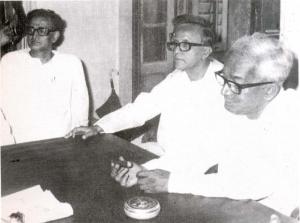
Jyoti Basu, Promode Dasgupta and Saroj Mukherjee

With the passing away of Jyoti Basu, the curtain comes down on an entire chapter of communist history in this country. Basu may have been the last of a generation that learnt its politics in the stormy days of the anticolonial struggle and who lived through the ups and downs of politics – from the underground days of the 1930s and 1940s to the initiation into the ways of parliamentary democracy. The long engagement with parliamentary democracy was to lead to Basu’s – and the communists’ – long stint in power. And Basu was one of those rare communists for whom democracy was not a mere strategic imperative but a value to be internalized.

Basu belonged to a generation of communists who worked their way from the bottom up. Trained in Law in England, Basu returned to India, determined to work in the communist movement. Muzaffar Ahmed, the then secretary of the undivided communist party sent him to work among the railway workers. It was there, working among and organizing the railway workers that Basu entered mass politics.  It was probably in this process that Basu developed his distinctive style of politics – a style that we have yet to understand fully.

Continue reading Jyoti Basu and the Passing of an Era

Remembering Jyoti Basu: Monobina Gupta

This is a Guest Post by MONOBINA GUPTA

Jyoti Basu
Jyoti Basu

While waiting endlessly at the CPI-M headquarters in Delhi, we, the Left-beat reporters, often used to say how incredibly dull the beat would be in the absence of Jyoti Basu, Indrajit Gupta, and Harkishen Singh Surjeet. With their distinctive personalities and distinct style, each one had livened up the tedious job of keeping track of the Left parties and their leaders. Indrajit Gupta would speak in a baritone voice, trotting out gruff answers; the ever-amiable Harkishen Singh Surjeet, never failed to pick up the phone, was always ready to share a laugh with us. But of these three colourful Communist stalwarts, it was Basu who used to keep us most preoccupied, with his ‘read-between-the-line’ one-liners, exasperatingly short, brusque replies, sometimes even with outright sarcasm or rudeness.

Continue reading Remembering Jyoti Basu: Monobina Gupta

Where there is no police: Kumar Rana

This is a guest post by KUMAR RANA

Where there is no police – what a wonderful state that would be. It’s a place that many have dreamt of, at least at some point of time if not all through the life. What a wonderful land that would be where one can eat or fast,  sleep or remain awake,  work or rest, move in or move out  completely freely, where her wishes would not be monitored by the police. So the episodes in Khejuri in East Medinipur and Lalgarh, in West Bengal, had apparently made some of the citizens happy: what a relief, there is no police.

But, alas, it was only a dream. Because there was the state and a state without police is as alive as a dead animal, the khaki was quickly replaced by lungi or jeans, and the gun by perhaps more lethal AK47 and its sort.
Continue reading Where there is no police: Kumar Rana

Don’t do unto others, what they do to you

Do I sound like a liberal simpleton when I criticize or condemn the violence that has been unleashed in Khejuri by the ‘people’ led by the Trinzmul Congress?

Offices belonging to the CPM have been razed to ground, burnt down and vandalized. Photographs of people tearing away grills from the windows of these offices and carrying them as ‘booty’ with smiling faces tell you that the same old story is being repeated. The plot remains the same; only the hunted have turned into hunters and the hunters of the past are now running for cover.

Roads to Khejuri are blocked, ministers and leaders of the CPM turned away, again by ‘the people’. The police as usual stands mute witness as they have been trained in this state not to go against the ‘will of the people’. How does it matter to them that now these people do not belong to the CPM, masters for last three decades? They have learnt to follow, not the law, but the party. And these days in Nandigram Trinamul is ‘The Party’. And the enemy territory of Khejuri has also been annexed. Victory is complete. Continue reading Don’t do unto others, what they do to you

The Collapse of Hegemony: Kumar Rana

[This is a guest post by KUMAR RANA. Kumar Rana is an activist and works with Pratichi]

At last, after 32 years, history repeated itself in West Bengal. It’s the history of routing of a prolonged political hegemony established by the CPIM led Left Front that replaced in 1977 another prolonged reign of the Congress.  The Left Front is now reduced to 15 seats from its 2004 tally of 35. The Trinamool Congress led by Mamata Banerjee, who severed her ties with the NDA to form an alliance with the Congress has swept through the elections to multiply her parties tally by 19 – she was the sole representative of her party in 2004. She made two alliances – one with the Congress that has managed to restore its position by winning six seats, and the other with SUCI, which too has won the seat allotted to it. The BJP has also secured a seat mainly through its bargain with the Gorkha Janmukti Parishad that has been fighting for a separate state of Gorkhaland. In other words, the opposition parties have now secured 27 out of 42 seats – more than two third – in the state.

Not that the change was fully unanticipated. There have been indications in the pre-poll surveys and other discourses that the Left Front was going to loose – but only to some extent (18-19 seats). None, including the opposition parties, did expect such a result. This writer too estimated the opposition seats to be 23-24, and could not imagine that the phrase – era jak (let they be dumped) – could have so routing effect on the ruling front.. Indeed, it’s the people who build up their own phrases, and this time it was “era jak”.
Continue reading The Collapse of Hegemony: Kumar Rana

When Buddha Did Not Smile: Monobina Gupta

This is a guest post by MONOBINA GUPTA

Buddhadeb with Tata building as backdrop, courtesy Calcuttans.com
Buddhadeb with a laterally inverted Tata as backdrop, courtesy Calcuttans.com

As the true magnitude of the West Bengal election results sank in, a sulking Buddhadeb responded, stonewalling the media as if to say that had it not been for them the Party would have romped home victorious! Here is a conversation reported in The Telegraph (May 18,2009). The reporters in Writer’s Building asked the Chief Minister:

Is it true that you have offered to resign?

No reply.

Will you step down as chief minister owning moral responsibility for the party’s debacle?

No reply.

Why didn’t you go to Delhi to attend the CPM politburo meeting?

No reply.

Silence has rarely been so eloquent in the corridors of Writers’ Buildings as when a grim-faced Buddhadeb Bhattacharjee walked out at 1.30 pm for lunch at home.
Faced with a volley of questions whether he had offered to resign, the Bengal chief minister left without replying. The Telegraph had reported that the chief minister had offered to resign but CPM boss Prakash Karat had been trying to make him change his mind.

This is not the first time Bhattacharjee has faced tricky questions but he usually deflects them by saying “I don’t reply to questions flung at me from the corridors’’.
But this afternoon, he opted for silence.

Continue reading When Buddha Did Not Smile: Monobina Gupta

Lalgarh, Media and the Maoists: Monobina Gupta

Guest Post by MONOBINA GUPTA

[As this report is filed, reports have come in that the CPI-M has finally managed to enter Lalgarh and hold its first public meeting since 2 November 2008, when the police first arrested seven young students from Lalgarh, sparking off a revolt. No machine guns were fired, no mines were blasted – even though we are supposed to believe that the area is a ‘liberated area’ of the Maoists. See our earlier report, written soon after the revolt began. Even as we post this, more reports – mostly from West Bengal government and police sources, are being suddenly being published of ‘unrest’ spreading to ‘more Maoist areas’, and an atmosphere is sought to be created for an eventual justification of government and party sponsored violence.]

Assembly in Lalgarh - Armed Maoists? Photo, courtesy sanhati.com
Assembly in Lalgarh – Armed Maoists? Photo: courtesy sanhati.com

For five months now Lalgarh has been practicing a unique form of democratic politics. To the ruling CPI-M in West Bengal and the big media however, it has been nothing but a Maoist-sponsored agitation with portents of Maoist style violence. Except Bengal media, national print and television, have by and large kept Lalgarh out of their ambit of coverage. If at all news has trickled in, it has come tagged with ‘Maoists’ and ‘violence’; as if tribals in this forgotten part of Medinipur, the past five months, have been stocking up arms and laying ambushes to wage a war against the state.

A front-page article in the Times of India (TOI) today (April 22, 2009) sticks to this format describing Lalgarh as “Nandigram II, a liberated zone” where an explosive situation is building up with elections scheduled for April 30 and the Pulishi Santrash Birodhi Janashadharaner Committee (People’s Committee against Police Atrocities) refusing to allow the police to enter Lalgarh. “The police can’t enter here. Nor are other government officials welcome. This has been the situation for the last six months.”

Continue reading Lalgarh, Media and the Maoists: Monobina Gupta

Are the Tatas not to be blamed for the Singur fiasco at all?


Since even the chief minister of Bengal admits that violence was used in Singur to acquire land against the wishes of farmers who owned and/or worked it, there’s virtually nobody who claims otherwise (except our favourite newspaper).

So the line that goes is that it is the state government which botched it up. If only you had allowed the Tatas to acquire land on its own, if only the land acquistion act didn’t require the Evil State to acquire the land… market forces of demand and supply would have prevailed. Continue reading Are the Tatas not to be blamed for the Singur fiasco at all?

Breakthrough in Singur?

Dear all,

(Adapted from a recent post made on the Reader List)

Kafila has in the past discussed the debacle of Nandigram in West Bengal and more recently, Singur.

For the past several days, a peaceful agitation on the Durgapur expressway near the Tata Motors Factory site in Singur in West Bengal has protested against the West Bengal Industrial Development Corporation and the West Bengal Government’s decision not to engage with the demands of the farmers and others who did not voluntarily accept the paltry compensation offered to them by the WBIDC for the loss of their land or their livelihoods.

At the close of last night, the Governor of West Bengal, Gopal Krishna Gandhi announced that a solution acceptable to all (the protesting farmers at Singur and the Government of West Bengal) has been found, and that Ms. Mamata Bannerjee of the Trinamool Congress (one of the key protagonists of the Singur protest) would announce that the agitation at Singur would be suspended.

This is good news, as it demonstrates that hitherto unwilling and insensitive governments that try to ride roughshod over people in the interests of capital can be made on occasion to listen to organized and peaceful  expressions of peoples’ dissent. The CPI(M) led Left Front Government of West Bengal seems to have learnt at least some lessons from the fallout of its earlier shameful and anti-democratic conduct in Nandigram. This is welcome. It can only be hoped that the CPI(M) leadership takes stock,  learns to listen more to people, and indeed to many from amongst their own cadre who have been unhappy about the way in which their party brokered unfair land deals for Capital.

The people of Nandigram had based their struggle on what they had learnt from the earlier phase of the Singur situation. It appears today that the people of Singur have benefited from the restraint shown by a government and ruling party chastened by its mismanagement of the situation in Nandigram. The people of Singur owe their current sense of respite to a great extent to the people of Nandigram and their struggle.

Though it may be premature to call this ‘breakthrough’ a victory for peasants and working people, it is certainly reason to believe that not every struggle conducted by ordinary people over land, resources and livelihood is doomed to failure. This news should raise the hopes of all those committed to protest against unjust land aquisition and transfer moves – be they in Orissa, Haryana, Kerala, Goa, Kashmir or elsewhere.

See a PTI report in the Hindu that gives more details of the agreement.

regards,

Shuddha

Singur, Mediotics and an NGO Called Indian Express

[Note: Television was often referred to as the the idiot-box. For very sound reasons. It produced idiocy on a regular basis. It still does. But in these days, this is no longer the monopoly of the televisual media. Newspapers too are doing pretty much the same. Let us call this specific form of media-generated idiocy, rampant among media persons, mediocy and the phenomenon, mediotics. Those affected by it will then be mediots.]

I know that someone will immediately step in to correct me to say that Indian Express is not an NGO. But if one looks at the completely illiterate use of the term made by the Indian media, then anything that is not ‘governmental’ is ‘non-governmental’ and can, hence, be called an NGO. Except that for the large mass of ignoramuses peopling the media i.e. mediots, this is a safe term to describe an animal that you cannot identify. Continue reading Singur, Mediotics and an NGO Called Indian Express

Nuclear Deal, ‘National Interest’ and the Indian Left – PK Sundaram

It is the Indian left’s concurrence, rather than its disagreement, with the idea of a nuclear future (including nuclear weapons) that has made its case weak and inaudible to the larger masses.

Contextualizing the deal

In a charged atmosphere produced by the backers and opponents of the deal both pitching their positions in terms of ‘national interests’, it would be necessary not to lose sight of its broader meanings and implications.

In its essence, the deal is about opening up of the restrictions over nuclear commerce put on India after its 1974 ‘peaceful nuclear tests’. Though initiated and facilitated by the United States, this move will provide India access to international markets in nuclear fuel, material and technology, in accordance to the safeguards and guidelines of the IAEA and the Nuclear Suppliers Group (NSG). While it would imply huge imports from the US, the deal also removes international fetters on nuclear trade with other countries including Russia, China, France and Australia whose corporations would get major business orders from India once the deal comes into effect.

Read the full article here.