It is widely believed that the Kashmir conflict has its roots in the Partition of India in August 1947. This view perpetuates the understanding of the conflict as one between India and Pakistan. However, recognising that the roots of the conflict lie in an earlier history – indeed, that there was a history before August 1947 – changes our understanding of the ‘intractable’ conflict in Kashmir. This guest post by MRIDU RAI, author of the book, Hindu Rulers, Muslim Subjects: Islam, Rights and the History of Kashmir (2004), discusses the salience of the events in Srinagar on this day, exactly 80 years ago.
While "separatists" were placed under house arrest to prevent commemorative mass gatherings, policemen took part in Kashmir Martyrs' Day ceremonies at the Martyrs' graveyard in Srinagar, July 13, 2011. Photo credit: Reuters
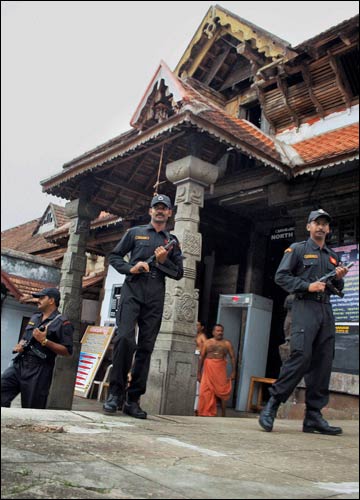
Our fair but humble town of Thiruvananthapuram has been in a tizzy since it was discovered that our benign presiding deity, Lord Sree Padmanabha, had been resting on a huge treasure-trove, so fantastic that no one has been able to stop talking of it since then. This seems to have changed drastically the way we have perceived our past — or rather, the historical amnesia which we have been suffering from has been drastically accelerated. In the decades after independence, very few people, except the upper caste retainers of the Travancore royal family and the accolytes of the regime, thought that rajabharanam was a good thing. There were stories about the days immediately following the accession of Travancore to India, of how people gathered outside the Padmanabhaswamy temple, and when the Travancore Maharajah, Chithira Tirunal Balarama Varma arrived there for his daily visit, reminded him of their equality with him as citizens of India, addressing him personally and intimately … ‘Hey, Balaa’! That seems to have gone for a toss and we are back to His Golden Majesty, Ponnutampuran, though such a tampuran has no place in our political system. Continue reading Can Kingly Mortals Donate to the Gods?→
Giving a historical background of why the Sree Ananta Padmanabha Swamy temple in Thiruvananthapuram came to have these riches, Malavika Velayanikal writes in DNA:
True, the bags of gold coins, diamonds, precious stones, 18-feet-long gold necklaces, jewellery weighing many kilograms, and solid-gold statues of gods and goddesses landed in the vault via the king. But in reality, the temple treasury was nourished by the sweat and blood of the masses as well.
One of the main sources of the royal income was taxes. They were incredibly high for the lower castes, with marriages, childbirth and even death being taxed. Country boats, ploughs, carts, umbrellas, headscarves, why, even a moustache, were taxed. Mothers were allowed to breastfeed their newborns only after they paid the ‘mulakaram’ (breast-tax) to the local lord, who would then grant permission. [Must read]
But you won’t hear this said too often because, as Appu Esthose Suresh reports in Mint:
“If the government makes any move, then the believers will protest and BJP will support the people,” he (a temple staff member) was quoted as saying by news agency PTI.
It is precisely the fear of antagonizing a section of the Hindus that is forcing the state government to be cautious.
“This government does not have the courage to go against Hindu sentiments,” said P.R.P. Bhaskar, a political observer. “It will move in a direction which will accommodate the royal palace.”
“The Left Front gained Hindu votes for two reasons. Firstly, its traditional vote base consists of Hindus and a perception that Christian and Muslim votes are moving towards the Congress and its allies had led to a consolidation of Hindu votes. This might help the government change that perception a bit,” he added. [Link]
Hindu appeasement. That’s what will come in the way of a just, fair, pro-people decision about what should be done wit the temple wealth.
A press release from the JAMMU AND KASHMIR COALITION OF CIVIL SOCIETY
8 JULY 2011: Jammu and Kashmir Coalition of Civil Society (JKCCS), welcomes the recent judgment delivered by the Supreme Court of India in which it has struck down as ‘unconstitutional’ the practice of arming local tribal youth of Chattisgarh as Special Police Officers (SPOs) in order to fight the Maoists. It has asked the Chattisgarh state government to:
· immediately stop using SPOs,
· recall all firearms distributed to them,
· desist from funding the recruitment of any other vigilante groups,
· ensure the filing of FIRs into criminal activities committed by them, and
Recently a whole lot of noise was made and reams of paper were covered in fine print to make us realize how unique this July 2011 has been. We have been told that this phenomenon of a month having 5 Fridays, 5 Saturdays and 5 Sundays is a rare occurrence. Someone said that this has happened after 823 years and then someone else came along and disputed this figure. Newspapers not normally inclined to accept their mistakes did so with alacrity, and they had good reason to do so it was someone else’s mistake that they were foregrounding.
The 24X7 purveyors of nonsense have as usual gone to town, breaking all kinds of news and inviting all manner of soothsayers, numerologists, tarot-card readers, palmists, astrologists and other purveyors of superstition to respond to the breathless inanities of the perpetually excited anchors about the cataclysmic significance of these five long weekends coalescing at the peak of the Monsoon Season. Continue reading Five Long Weekends→
The Supreme Court has held that the use of extra-legal armed forces in Chhattisgarh is unconstitutional. Responding to a PIL filed by Nandini Sundar, Ramachandra Guha and E.A.S. Sharma, the court’s decision turns on the nature of the Salwa Judum and the appointment of special police officers under the Chhattisgarh Police Act. But if it were a judgment that had merely ruled on the technicalities, it would have been a welcome and competent order, but would have missed its moment of constitutional greatness. This judgment attains such greatness by virtue of its deft combination of insightful legal analysis, the articulation of a moral vision of constitutionalism and development and its sharp invocation of rhetoric (in the best sense of the term) and fiction to buttress its arguments.
Fiction, William Gass reminds us is the figure of truth. Law has always produced and promoted legal fictions and the substantive interpretation of law often rests upon on a body of rhetorical figures and scenarios. The imaginative and moral character of legal fiction can often be found wanting, but there are times when the courts produce inspired moral visions that outdo even literature. Although fiction in the manner of its making, is pure philosophy, Gass says that no novelist has created a more dashing hero than the handsome absolute, or conceived more dramatic extrications- the soul’s escape from the body, for instance, or the will’s from cause. Nandini Sundar v. State of Chattisgarh is an excellent example of the ways in which the law can productively use metaphor as legal argument (‘our constitution is not a pact for national suicide’)
PRESS STATEMENT: MENTAL HEALTH PROFESSIONALS CRITICISE UNION HEALTH MINISTER’S STATEMENT ON HOMOSEXUALITY
6 July 2011: We are a group of highly qualified mental health professionals who are practicing as psychiatrists, clinical psychologists and behavioural psychologists from across the country. We regret the statement made by Union Health Minister Ghulam Nabi Azad on Monday where he called homosexuality a “disease”, as being “unnatural”, and a having “come from western shores”. Scientific evidence shows that homosexuality is a natural variant of human sexuality and is not a mental disorder or disease. Homosexuality as a specific diagnostic category was removed from the World Health Organisation’s ICD-10 Classification of Mental and Behavioural Disorders published in 1992, and from the American Psychiatric Association’s DSM-IV Guidelines in 1973. Continue reading Mental Health Professionals Criticise Union Health Minister’s Statement on Homosexuality→
In a Q&A session with five newspaper editors recently, India’s Prime Minister Manmohan Singh had this to say about the Indo-Bangladesh relations:
With Bangladesh, we have good relations. Bangladesh government has gone out of its way to help us in apprehending the anti-Indian insurgent groups which were operating from Bangladesh for a long time. And that is why we have been generous in dealing with Bangladesh. We are not a rich country. But we offered it a line of credit of one billion dollars, when Sheikh Hasina came here. We are also looking at ways and means of some further unilateral concessions. We are also looking at ways and means of finding a practical and pragmatic solution to the sharing of Teesta waters. I plan to go there myself. The external affairs minister is planning to go later this week. So, Bangladesh, our relations are quite good. So with Bangladesh, our relations are quite good. But we must reckon that at least 25 per cent of the population of Bangladesh swears by the Jamiat-ul-Islami and they are very anti-Indian, and they are in the clutches, many times, of the ISI. So, a political landscape in Bangladesh can change at any time. We do not know what these terrorist elements, who have a hold on the jamiat-e-islami elements in Bangladesh, can be upto.
Prime Minister Manmohan Singh’s ‘Dilli Darbar’ on Wednesday reaffirmed this government’s unyielding belief in the trickle-down theory. Let a select few be given the pie and eventually they’ll share it byte by byte. One of the hand-picked senior editors at this super-exclusive meeting said Mr. Singh came across as “totally relaxed, confident and jovial” even as they confronted him with ‘very embarrassing questions’.
The life-altering titbits flashed repeatedly on our TV screens. “I am not a lame duck PM” – Arre wah! “I have full support of Sonia Gandhi – What more could we possibly ask for? “This is not a puppet government” – Hear, Hear! “I can come under Lokpal” – Or the Lokpal can come under you, same difference. “Inflation will come under control by March 2012” – No rush, we’ll just quietly wait in a corner, maybe eat a meal or two less, work three jobs, drop out of school…anything for the nation.
But hidden deep within all this rhetoric was a misquote of great magnitude, one that reveals a lot about the man at the helm and the dodginess of the boat we are all currently rocking along on. Continue reading Gandhi vs. Gandhi→
Years ago, after the fall of the Berlin wall and the collapse of communism, a faux philosopher announced the end of history. What he meant was the permanent victory of capitalism and its correlate, liberal democracy. Unfortunately history has an unkind habit of rolling right along, throwing a sucker punch at intervals – remember Gordon (No Boom and Bust) Brown? The triumph of laissez faire capitalism has been celebrated since the ’80s (when the term Reaganomics was coined for redistributive policies that blithely transferred wealth to the rich). Until the crash of 2008-09 set the cat amongst the pigeons; and sent the semi-converted scurrying back to Keynes – and Marx (especially in Germany where the sales of his books suddenly soared). However after a state bailout of unprecedented proportions, that had the satisfactory effect of restoring the position of the wealthy, especially the bankers and financial whiz kids who had caused the crash, the dust settled down. In the industrialized west, discontent seethes beneath the surface, but the dictum that the experts – the bankers, the CEOs, the policymakers (who swap roles seamlessly) – are right still holds. The majority must accept a decline in their standard of living and the prospects, such as they were, of job security so that growth can continue and the minority prosper even more opulently. This, of course, has long been the received wisdom in India, where, ever since the ’80s, full consensus was reached on the fact that the middle-class is the only class that matters – the rest can go hang. Continue reading Counting the Cost: Industrialism, Capitalism, Socialism→
This evening, I was sitting in a coffee shop and writing about the sociology of information, how information is mired in relationships and how trust, suspicion and social relations develop in the course of circulation and exchange of information. As I was beginning to disentangle the complex web of legitimacy and regulations surrounding information, a friend called to inform that some activists and citizens had been arrested for protesting against the tree felling and road widening at Sankey Road in the northern part of Bangalore. In the last few days, the conflict regarding road widening and tree felling at Sankey Road got strong coverage in the media because citizens began gathering around the trees and the roads to prevent authorities from felling the trees. Despite this, the authorities went about felling the trees for widening the roads. The activists and protestors were clearly becoming a nuisance for the government officials and institutions who have not been able to execute the works. Hence, today, at some point, some of our activist friends were arrested on the false charges that they had assaulted public officials in their conduct of ‘government’ duty. The charges were filed under section 343 or 353 CrPC which also implied that the arrest was non-bailable. Over the course of the evening, news went about on FaceBook and Twitter about these arrests, and people from in and around Sankey Road were called to silently protest at the Aiyyappa Temple where the trees were being felled for enabling the road widening. The arrested activists and citizens were released from jail and all the charges against them were ‘dropped’ at about 6 PM. The court also granted a stay order on the tree felling around the same time, with further hearings and orders to arrive on Monday. Continue reading Cities and Infrastructure – The Road Widening Saga in Bangalore→
Ask any first time visitor to Kashmir about their impressions and you will, in all likelihood, be inundated with superlatives about the landscape, the mountains, the greenery, the hospitality, the gardens, the lakes and what not, but there is one thing that both the first timer and the old Kashmir hand rarely talk about and that is the historical monuments of the valley. The mosques, shrines and ancient temples of the valley are rarely mentioned in all this recounting. I am as much guilty of this neglect as all the others that I have met, perhaps more guilty because I have been to Kashmir scores of times.
This piece is an attempt to make amends. The sites are far too many to cover in one article so I have decided to confine myself to a handful of structures and monuments that lie scattered in and around Srinagar. Hopefully there will be more occasions to write about the others soon. Before we commence this sight-seeing tour of Srinagar, let us start with a few words about the history of Srinagar and of Kashmir.


 Recently a whole lot of noise was made and reams of paper were covered in fine print to make us realize how unique this July 2011 has been. We have been told that this phenomenon of a month having 5 Fridays, 5 Saturdays and 5 Sundays is a
 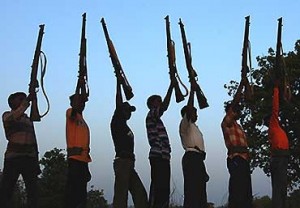 The Supreme Court has held that the use of extra-legal armed forces in Chhattisgarh is unconstitutional. Responding to a PIL filed by Nandini Sundar, Ramachandra Guha and E.A.S. Sharma, the court’s decision turns on the nature of the Salwa Judum and the appointment of special police officers under the Chhattisgarh Police Act. But if it were a judgment that had merely ruled on the technicalities, it would have been a welcome and competent order, but would have missed its moment of constitutional greatness. This judgment attains such greatness by virtue of its deft combination of insightful legal analysis, the articulation of a moral vision of constitutionalism and development and its sharp invocation of rhetoric (in the best sense of the term) and fiction to buttress its arguments.
 KAFILA - COLLECTIVE EXPLORATIONS SINCE 2006