The Hooter Marks Time

Each morning, factory hooters call out to India’s 50 million industrial workers, many of whom stand by their stations and repeat a single set of tasks with unerring regularity until the hooter sounds again to signal the end of the first shift and the start of another.  Manufacturing provides employment to just 11 percent of India’s workforce, but the sector and its workers are seen as a bellwether for the economy as a whole.

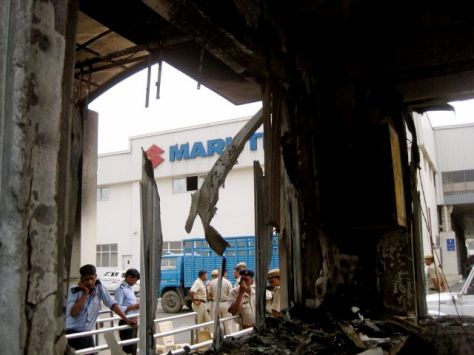
Last week, a senior general manager in Maruti Suzuki’s Manesar plant was killed and several managers injured in a violent confrontation between workers and management, prompting national dailies to speak of the “bad old days of militant trade unionism”.   Yet, industrial unrest is at historic lows in terms of numbers of incidents and man-days lost. In 1973-74, nearly 3,00,000 strikes were called just prior to the Emergency; 2010 saw just 429 such incidents, according to data from the V.V. Giri National Labour Institute.

What accounts for this shift? Has the Indian factory become a safer, better-paid and more secure workplace?

Data suggests the opposite: Today, Indian workers are paid less in real terms than they were fifteen years ago, have less job security, and yet are less likely to strike. Workers in Haryana’s industrial belt suggest that the incident at Maruti Manesar signals the end of the all-powerful union capable of controlling the factory floor, rather than its return. Instead, industry’s reliance on casual workers has created informal leaderless networks that operate outside the framework of strikes and settlements that undergird union activity. Read more

Why the Maldivian ski team is good in short bursts (and other reflections on the Olympics): Sajan Venniyoor

Guest post by SAJAN VENNIYOOR

Now that the 2012 London Olympics has established its progressive republican credentials by recruiting former cold-war assassin, James Bond, to hurl Britain’s 86 year old Queen from a helicopter, following it up with tributes to labour unions, suffragettes, people of colour and the National Health Service (or as the Tories say, ‘leftie multicultural crap’), could we ask some fundamental questions like, what the hell is an ‘Olympic sport’ and how does a 71 year old man in a top-hat sitting on a very expensive horse exemplify the virtues of going faster, jumping higher and being stronger, unless the medal goes to the horse?

Continue reading Why the Maldivian ski team is good in short bursts (and other reflections on the Olympics): Sajan Venniyoor

Review: ‘Impeachment’ by Anjali Deshpande

Guest post by KIRAN SHAHEEN

Impeachment by Anjali Deshpande, published by Hachette India, is a well-told fictional narrative skilfully woven around the aftermath of the shameful disaster commonly known as the Bhopal Gas Tragedy.

The novel is dedicated to Dr Heeresh Chandra, a name we have seldom heard in the 28 years since the tragedy. Who is this doctor to whom the book is dedicated? The author, in a conversation says that for her, this doctor of the dead is not simply unsung but the only true hero of Bhopal.

While reading Impeachment it is difficult to decide whether it is history claiming to be fiction or fiction masquerading as history. The novel recounts actual incidents that still haunt us, intertwined with the fictional private lives of activists that are also the arena of intense gender and caste politics.

Continue reading Review: ‘Impeachment’ by Anjali Deshpande

On the ongoing ethnic violence in Assam: A Statement

The following is the text of a Statement issued in Delhi on 27 July 2012, endorsed by a number of concerned organizations and individuals

We the people from various parts of northeast residing in Delhi, along with concerned individuals, university members, various students’, teachers’, trade union, women’s, civil and human rights organisations from Delhi, strongly condemn the ongoing ethnic conflict with serious communal undertone that has erupted in four districts (Kokrajhar, Dhubri, Chirang and Bongaigaon) of Lower Assam. This has been the most widespread and alarming conflict in the recent history of Assam.

In the last one week we have witnessed the tragedy of nearly 200,000 people belonging to the Bodo and the Muslim communities, being forced to flee from their homes and villages. Currently they stand internally displaced, and are scarred and traumatized. Official figures state that around 41 people have lost their lives so far, while unofficial estimates from the grounds are much higher. More than 400 villages have been torched down until now. Continue reading On the ongoing ethnic violence in Assam: A Statement

Death and the Factory – The Casualties of Maruti Suzuki, Manesar

Factories kill people. Occasionally, those who die belong to the management. Usually, they are workers.

On the first of May, (International Labour Day) 2009, several workers at the Lakhani Shoe Factory in Faridabad, Haryana, were struck by a ball of fire, which engulfed them before they could run to save their lives. The fire, caused by willful neglect of elementary safety procedures, did not result in criminal charges being framed against the management or proprietors of the Lakhani Vardaan Group, which owns the Lakhani Shoes Factory.

A report in the Gurgaon Workers News (No.9/18) has this account of the fire –

“On 1st of May 2009 the Lakhani Shoes factory, plot 122 in Faridabad Sector 24 caught fire, the newspapers first wrote of six, then of ten, then of fifteen dead workers. Lakhani is said to be the country’s largest maker and exporter of canvas and vulcanised shoes, has two dozen units in the district. A younger worker who is employed in a neighbouring factory came to Faridabad Majdoor Library three days later. He said that it is more than likely that 50 – 100 or more workers have been killed. A boiler on the first floor exploded, the floor collapsed and buried many workers who were waiting for their over-time payment in the basement. He said that he saw at least 100 burnt bicycles outside the factory. Continue reading Death and the Factory – The Casualties of Maruti Suzuki, Manesar

Maruti workers produced in district court: Anumeha Yadav

Guest post by ANUMEHA YADAV

In Manesar 25 July court

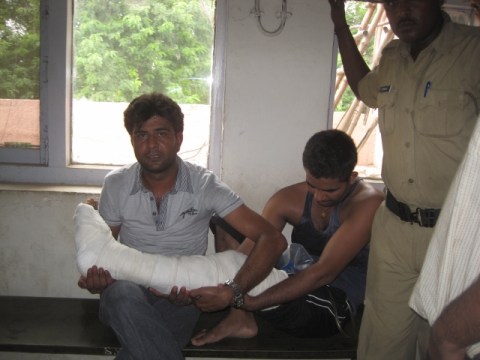
Satbir, a 28 year old worker, was among four workers from Maruti’s Manesar plant produced by Haryana police at the district court in Gurgaon on Wednesday afternoon. Satbir has multiple fractures in his left leg and was taken to the civil hospital from the court room. “I fell while trying to flee the plant. I was in the morning Shift A; we had stayed back because we heard the union leaders were meeting the management to negotiate the reinstatement of a worker,” he recounts. “The violence began after 7 pm, I don’t know why it started. Gate 1 was closed. I feared that I may get attacked in the rioting and the confusion. I and two of my colleagues tried to jump off the back wall but I fell,” he says. Continue reading Maruti workers produced in district court: Anumeha Yadav

Iranian filmmaking in Kashmiri autumn

Set in 2002, shot in 2009, Aamir Bashir’s film Harud will be in select PVR cinemas on Friday, 27 July. Harud is clearly inspired by Iranian films which manage to say a lot without saying much. Like a lot of Iranian cinema, a child is at the centre of the film. The brilliant acting by Shahnawaz Bhat, who plays the protagonist Rafiq, makes the film. In the expressions on his face there is ambiguity and wonderment as much as there is humiliation, helplessness and a desire to do something to change things around him. Here is a film about Kashmir that does not begin with beautiful landscape and does not end with a big encounter between militants and forces. This is not a film that seeks to explain the Kashmir conflict – rather, it takes you inside the lives of ordinary people and how they faced the madness of a conflict. Regardless of what your views on Kashmir are, Harud succeeds in making you empathise with Rafiq and others around him. That, for any narrative on Kashmir, is no small achievement.

Read more about the film in Time Out and ArtViewBlog. Here are some interesting interviews of the director.

The year climate change became common sense: Jacob Sebastian

Guest post by JACOB SEBASTIAN

 Is 2012 the watershed year for climate change? The year it ceases to be a ‘dodgy concept’ and transforms into painful reality?

Some facts to consider:

 *The United States – particularly the food basket that is the American Midwest, is facing its “worst drought” since the 1950s, and is expected to last all summer. US agricultural secretary Tom Vilsack told the media: “If I had a rain prayer or a rain dance I could do, I would do it.” The US is the world’s second biggest food producer, after China, but more importantly, one of the biggest exporters of food.

*Prices of the four key crops: Corn, wheat, sugar and soybean have risen 44%, 48%, 22% and 26% over the last month. The United States produces 41% of the world’s corn and 38% of the world’s soybeans. The two crops comprise two of the four largest sources of caloric energy produced and are thus critical for world food supply. Continue reading The year climate change became common sense: Jacob Sebastian

Resisting Caste Violence – Facing Brutal Repression: NTUI on Maruti-Suzuki

Statement issued by NEW TRADE UNION INITIATIVE on the incidents at Maruti-Suzuki’s Manesar Plant

Dated 19 July, 2012, New Delhi

The present spate of violence at the Manesar plant of Maruti Suzuki as a fallout of a protest by workers against a casteist comment made by a supervisor at a dalit worker reflects the continuing use of ‘caste’ as a method of subordination and oppression reflecting the persistence of deeply rooted primordial structures of society that complement capitalist exploitation. When co-workers protested, the management suspended the abused worker and refused to re-instate him and instead resorted to brutal violence, orchestrated by goons, against the workers and targeting the union leaders.

It is important to note that the Maruti Suzuki management is yet to constitute the Grievance Redressal Committee and the Welfare Committee at its Manesar plant which was agreed upon after the last dispute in October 2011. The present dispute is a well planned instigation by the management to systematically derail the ongoing negotiations on the Charter of Demands submitted by the Maruti Suzuki Workers Union in April 2012 and to discredit the sustained and united struggle of the workers at the Manesar plant. Continue reading Resisting Caste Violence – Facing Brutal Repression: NTUI on Maruti-Suzuki

In Solidarity with Oprah

I recently read a scathing article on Oprah Winfrey. I was quite shocked. The journalist made such fuss about her honest observations as if it’s criminal to not know something. However, what were more astonishing were the serendipitous parallels between her journey to Indian and mine to US. And when I read the article, I almost felt as if someone was mocking at me. I felt outraged and decided that I’ll write this note in solidarity with Oprah. Perhaps then, people will see the injustice done to her. Well, I am a celebrity too, here in this country. Not as big as Oprah but it doesn’t matter. It doesn’t matter even if you’re not able to place me at all. The real celebrities don’t publicize themselves anyway. They’re obscure, consigned to oblivion, with some quaint looking academic in some foreign university (probably US) fawning at the greatness of their work. These days all it takes to be a celebrity is to be notorious with your face pasted everywhere. You’d be surprised by the lack of work backing most people you take for celebrities. Anyway, I am notorious enough for the people who’ve suffered me on stage, I really don’t have much work to support me, and I guess I have had had enough presence in media to statistically pass off as a celebrity. Continue reading In Solidarity with Oprah

Some Reflections on Capital and the Workers’ Movement After Manesar

Workers’ Violence and Corporate Violations of Law

It has been a long time in the making. The violence at Maruti-Suzuki’s Manesar plant on 19 July 2012, that led to the ghastly killing of the general manager, Awanish Kumar Dev was waiting to happen. While the killing was gruesome, I believe this is merely a ‘freeze shot’ of a larger film that has been playing for a very long time now. While it is the media’s wont to focus only on these moments of spectacular violence and then dish out reports from handouts provided by managements and the police, sometimes, such moments of conflagration do illuminate what has been in the dark for so long.

What follows below is an attempt to think through some of the issues that seem to me to lie at the bottom of the violent event. The ‘violent event’ here is not simply what took place in Maruti-Suzuki’s Manesar plant now; it is rather a shorthand for the whole series of such conflagrations that have been taking place over the past few years in the National Capital Region (NCR) – starting with Honda Motors and Scooters 2005,  Graziano Trasmissioni 2008, and many others since – Rico Auto Industries, Pricol Ltd and so on. The struggle in Honda Motors that had been brewing for a long time had eventually spilled over into a series of public protests with severe police violence in the full glare of the media. Things have never been the same in the entire belt since. Rico Auto Industries incident in September-October 2009 subsequently became an important milestone – galvanizing as it did a number of other workers’ strikes. There it had started when the workers struck work after 17 of their colleagues had been dismissed ‘on disciplinary grounds’. Actually, the workers rightly felt that this was to quash their attempt to form a union. And while the workers were protesting at the gate, a group of hired goons attacked them, killing one of the workers and injuring many others. In the Graziano Trasmissioni the issue of contention was the reinstatement of 136 dismissed workers which led to a massive unrest in the unit in Greater NOIDA, leading eventually to an incident not very different from the present one. Continue reading Some Reflections on Capital and the Workers’ Movement After Manesar

What set off the violence at Maruti’s Manesar plant?: Anumeha Yadav

Guest post by ANUMEHA YADAV

Photos by Anumeha Yadav

The year-long industrial conflict at Maruti Suzuki India Limited (MSIL), India’s largest automobile manufacturer’s Manesar plant turned violent on 18 July. At 3:30 pm on Wednesday afternoon, representatives from Maruti Suzuki Workers’ Union and the Maruti management had met to discuss the reinstatement of Jiya Lal, a permanent worker who had been suspended that morning after an altercation with his floor supervisor. Lal is a Dalit and alleges that he had reacted when the supervisor made derogatory casteist remarks against him. The workers were protesting that the management had been unfair, suspending Lal from service while merely sending the supervisor home on leave for a few days. Continue reading What set off the violence at Maruti’s Manesar plant?: Anumeha Yadav

The Poet, His Poems and His Tales

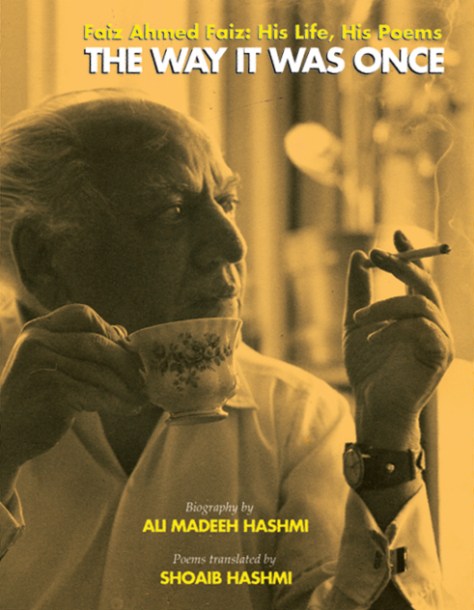
Faiz Ahmed Faiz: His Life, His Poems: The Way It Was Once by Ali Madeeh Hashmi/ Shoaib Hashmi; pp 256; Rs 499; Harper Collins Publishers India, 2012

After a decade without a day job, and associating with Dastangoi for over six years, I can safely say that I am a career storyteller. And one of the things I have learned is that resumes don’t make a person, stories do. Often these stories are not our own stories, but stories we’ve heard amongst loved ones, extended families, friends, work places, milieu; stories we’ve grown up with, stories distilled deep enough to become an integral part of our existence. We may not often identify with our resume but with our stories, always – acquaintanceship strikes, the moment our stories resonate. Continue reading The Poet, His Poems and His Tales

Maruti Suzuki Manesar Workers – Casteist Attack and Repression

The following is a statement issued by the Maruti Suzuki Workers’ Union (MSWU) on 19 July following violence and repression at the Manesar plant yesterday.

The Manesar factory of Maruti Suzuki

The Maruti Suzuki Workers Union (MSWU) is anguished at the recent developments in Maruti Suzuki plant, IMT Manesar where the management has resorted to anti-worker and anti-Union activities in a pre-planned manner leading to violence and the closure of the factory yesterday.

We have had a long tough struggle with the strong unity of our permanent and contract workers to establish and register our Union last year, and had recently as of April 2012 submitted our Charter of Demands to the management of Maruti Suzuki, and the process of negotiation for wages and other demands was underway. However the management has done its utmost to derail the process since long and is trying to break the back of the spirit of unity of the workers and the legitimacy of the Union.

Continue reading Maruti Suzuki Manesar Workers – Casteist Attack and Repression

A blow to reproductive rights in Pakistan: Ayesha Asghar

Guest post by AYESHA ASGHAR

Early in July, Kashmala Tariq, Member of the National Assembly (MNA) of Pakistan, whom Wikipedia describes as “actively involved in women’s rights”, opposed the tabling of the Reproductive Health Bill 2012, saying that it was not in conformity with Islamic laws. The Bill was introduced by another MNA, Atiya Inayatullah, with the purpose of providing reproductive health services, including legal access to abortion,  to women in Pakistan.

Tariq accused the Bill of following the agenda of foreign NGO’s and stated that such proposals that might be in contravention of Islamic injunctions should be sent to the Council of Islamic Ideology and every party’s opinion should be sought. The Bill has been sent to the Cabinet Division for further deliberations.

Does this mean that our women representatives don’t know what reproductive rights include? The responsibility of women parliamentary representatives in Pakistan is more challenging than that of men, as women are more often made victims of oppression either in the name of culture or religion.

Continue reading A blow to reproductive rights in Pakistan: Ayesha Asghar

Of Peace and Other Illusions

This week I reviewed War and Peace in Jangal Mahal, edited by Biswajit Roy, for The Hindu. Kafila readers will be familiar with at least two of the essays in the compilation – by Nivedita Menon and Aditya Nigam and will remember our hectic debates on the subject.

The collected letters of correspondence between the Communist Party of India (Maoist) and the Indian state is an archive of corpses: policemen and guerrillas, commanders and comrades, police informers and Maoist sympathisers. The body count racked up by each serves as a signalling mechanism for the other.

Except for the police and Maoist commanders, the dead usually don’t get to choose sides; their identities are written in reverse, a teleological narration that details seemingly insignificant decisions that end in death.

In June this year, the CRPF, state police and CoBRA battalion killed 19 men, women and children in an anti-Maoist operation, claiming those killed were hardened Maoists. When newspapers reported that villagers said they were conducting a public meeting when they were surrounded by police and shot, the police pointed to six troopers injured in the encounter and asked why villagers were holding a meeting in the middle of the night.

The Maoists have an explanation for their violence as well. “The notion of just principle in a normal situation is different from that [in] a war-like situation,” wrote Maoist commander Kishenji in a letter to the Bengali daily, Dainik Statesman , in which he explained his party’s policy of killing police informers, “During war, freedom of thought, consciousness, initiative and innovation is much limited in scope.”

Read the rest of the review here

Mad Rush for Top CPM Jobs!: CPI (Mohammad Rafi) News Service

Guest Post by CPI ( Mohammad Rafi) News Service

Mad Rush for Top CPM Jobs!:  CPI (Mohammad Rafi) News Service

New Delhi, 15 July 2012: The CPI(M) headquarters saw a mad rush of job applicants after General Secretary Prakash Karat said in a magazine interview that his party paid Rs. 3000-4000 to its whole-time cadre as salary every month. Job seekers from around the country clamoured for immediate appointment to as full time party cadre amidst unruly scenes reminiscent of a typical day at the Indian Parliament.

Karat had mentioned this figure while answering a question as to why the Party’s leaders were mostly from upper caste and middle class backgrounds. According to the CPM General Secretary working class members were hesitant to become whole-timers as ‘ it’s not easy to survive on this small amount’. Continue reading Mad Rush for Top CPM Jobs!: CPI (Mohammad Rafi) News Service

‘Patriotic’ Criminal, ‘Nationalist’ Terrorists

Why Crimes of Lt Col Purohit Are Being Sanitised ? 

Written in different times and under a different context, one discovers that George Orwell’s classic novel 1984, which lampoons authoritarian regimes, is finding strange resonance in today’s India. Readers may be reminded that the Ministry of truth also called ‘minitrue’ – one of the four ministries in Oceania -the fantasy land in the novel, whose job is ‘to engage in any necessary falsification of historical events’ has few slogans written on its wall. It unashamedly declares ‘War Is Peace’, ‘Freedom is Slavery’, ‘Ignorance is Strength’.

As far as my knowledge goes there are no such slogans written on the walls of MHA – ministry of home affairs – here in Delhi whose job is supposed to put a tab on the internal situation of the country, but it appears that it is increasingly moving on similar lines where untruth is packaged and presented as ‘truth’. It is not for nothing that it is finding itself increasingly mired in one controversy after the other. No sooner that it found itself at odds with reality about the illegal abduction of an engineer from Saudi Arabia came the news that it had put its seal of approval on a fake encounter of poor tribals in faraway Chhatisgarh where many other cabinet members of the ruling dispensation had termed it a ‘cold blooded murder of innocents’. But nowhere does its ineptitude seems more blatant if one considers the way it deals with cases of stigmatisation of minorities especially Muslims or for that matter handling cases of what is known as Hindutva terror. Continue reading ‘Patriotic’ Criminal, ‘Nationalist’ Terrorists

The Right to Our Bodies

In a case where the “facts” are both complex and yet also the question at hand, let us start with one that should be undisputed: Pinki Pramanik says she is a woman. She has lived as one, competed as one, and identifies as one. She and no other person or institution – particularly the law or medical science – has the right to decide what her gender identity is regardless of her anatomy, her chromosomes or her hormones. As the investigations against her began, her claim to be a woman should have been accepted at face value regardless of whether narrow judgments of her appearance, manner, physicality or dress led some to believe otherwise.

To add to Nivedita’s post below and track what the Pinki Pramanik case continues to tell us, here is a link to the rest of the Times of India piece cited above that appeared on Monday. The argument I make in that piece has taken a new turn. The gender test results, as reported by the media currently, now say that Pinki is “male” because she has XY chromosome. Yet the report says at the same time that she has “female genital ducts and female external genitalia.” What indeed, then, are we to make of a “conclusive” report that finds Pink to be “male”? The terms and words of the test undo themselves and the underlying assumptions and pathways to the conclusion are far from apparent. If Pink is indeed intersex, then all of these results can stand without the conclusion the report draws of her being “male.” Worth reading are a Journal of American Medical Association article here on Gender Testing and the Olympics, Alice Dreger on sex and gender testing in sports here.

In a national daily this morning, there is a photograph of Pinki. She is taking cooking lessons with her mother in her village. The performance of her gender has begun as her sex is questioned. The only strategy open to her is to now constantly claim all that is uncontestably “woman”: a saree, a pallu over the head, in the kitchen, learning from her mother. Yet again the binaries and essentialisms of our gender identities are reproduced as Pinki tries to erase signs of the apparent “masculinity” of her appearance and behaviour that has driven much of the outrage against her thus far.

On bodies and gender, and what Pinki Pramanik teaches us

The story of Pinki Pramanik and her partner can be pieced together like any other story of intimacy gone bad. After all, human beings invariably encounter pain and betrayal in intimate relationships, just as they encounter joy and desire. No relationship is free of power, whether produced by individual personalities or by social structures — patriarchy, the assumption of heterosexuality as natural, caste, class, race. Why then has Pinki’s story become about something else altogether? Because we assume that our bodies are “naturally” male or female.

But would anyone pass a gender test?

(Here’s the rest of this short piece published in Indian Express yesterday).

Last year I had posted The disappearing body and feminist thought on kafila, raising very much the same issues.

Fallacious perceptions of development – a tribal view from Jharkhand: Richard Toppo

Guest Post by RICHARD TOPPO

Almost a century ago, Katherine Mayo published a book titled ‘Mother India’ that criticized the Indian way of living, and Rudyard Kipling  spoke of the ‘White Man’s Burden’. These writings reflected the colonial perspective that what colonizers did was in the best interest of the colonized people. Consequently, most well-meaning citizens of colonial powers were alienated from the horrible plight of the colonized. Purpose well served – unopposed exploitation.

Years later, independent India seems to walk the same line. The tribal communities in central areas of Jharkhand, Orissa and Chhattisgarh have faced rampant exploitation, displacement and dispossession from their resources at the hands of the state. However, the government has successfully produced  an illusionary perception of ‘development’ that has alienated the middle classes of India from the miseries of tribals. As a result, the government in alliance with corporate interests ruthlessly exploits the tribal population, almost unchallenged by other sections of  society. Continue reading Fallacious perceptions of development – a tribal view from Jharkhand: Richard Toppo