Citizens’ Solidarity with Voices of Democracy – Against the Arrest of Five HR Activists

[This is a statement of solidarity endorsed and signed by over 200 intellectuals, artists, academicians, lawyers, journalists, and students in support of the five arrested in connection with Bhima-Koregaon case. In the 43rd year after Emergency was declared in this country, this statement was issued on June 25th 2018 condemning the arrest of such voices of democracy and demanding their immediate and unconditional release.]

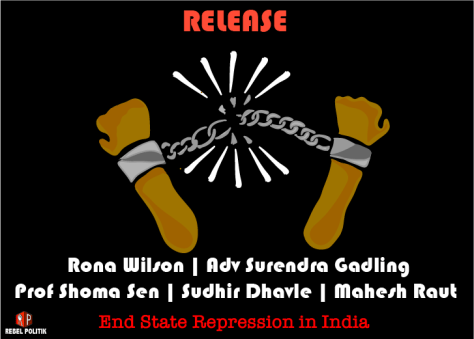
We condemn the arrest of five human rights activists, professors and lawyers in connection with the Bhima-Koregaon clashes early this year. The alarming arrest of Advocate and General Secretary of Indian Association of Peoples’ Lawyers (IAPL) Surendra Gadling, Committee for the Release of Political Prisoners (CRPP) Public Relations Secretary Rona Wilson, Head of English Department Professor Shoma Sen of Nagpur University and member of Women against Sexual Violence and State Repression (WSS), cultural activist and founder of Republican Panthers Jaatiya Antachi Chalwal Sudhir Dhawale and anti-displacement activist and Prime Ministers Rural Development Fellow (PMRDF) Mahesh Raut is a clear manifestation of state terror to crush the voices of dissent in this country.

The intemperate use of sections of the IPC and Unlawful Activities (Prevention) Act (UAPA) on all five reveals legal over-reach and exposes the desperation to foist extraordinary and excessive charges on all five to ensure they remain in the clutches of the Fadnavis-Maharashtra government. All the arrested have consistently worked for the assertion of oppressed and marginalised communities against majoritarian forces, spoken out against Brahmanical patriarchy, upheld peoples’ rights to land, life and dignity, and have strived for the release of political prisoners.

Continue reading Citizens’ Solidarity with Voices of Democracy – Against the Arrest of Five HR Activists

The Monks Who Spew Hate

Why Jailing of Gnanasara Did Not Become News in This Part of Asia

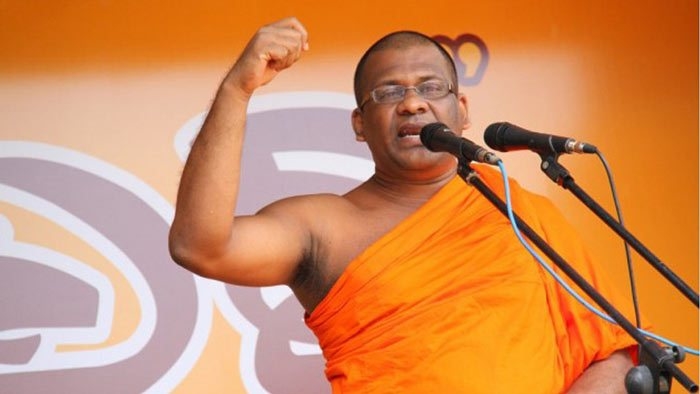
Galagoda Aththe Gnanasara, the controversial leader of Bodu Bala Sena

“Ordered disorder, planned caprice, And dehumanised humanity…”

– Bertolt Brecht in The Exception and the Rule (quoted in The Sunday Leader)

“I have done my duty towards the country,” Gnanasara told reporters as he boarded the bus taking him to prison. Why should I regret?”


Rarely does Sri Lanka convict Buddhist monks.

But few days back a court in Sri Lanka made history when it convicted Galagoda Aththe Gnanasara, the controversial leader of Bodu Bala Sena (Buddhist Power Force) who is referred to as ‘Thero’, The Venerable, and sent him to jail. Scores of his followers, mainly Buddhist monks, were reciting Buddhist prayers when he was being arrested and packed in to the police vehicle.

Reports tell us that Sri Lanka is still facing mini-turmoil over this conviction.

Marches were organised in different cities of Sri Lanka demanding that President pardons him using his special powers. Protesters have also asked that this revered monk should not be forced to wear jail uniform and be allowed to wear saffron robes only.

For people outside Sri Lanka, it would be rather difficult to understand why a Buddhist monk has suddenly become such a polarising figure in the society there.

( Read the full article here : https://newsclick.in/monks-who-spew-hate)

The Man Who Once Sold Tea Later ‘Sold’ Dreams

This is not the story of a man who once sold tea and later ‘sold’ dreams to a people and managed to reach top echelons of power in the biggest democracy in the world.

This is not the story of this man and his rise from the margins of a organisation which is called the biggest cultural organisation in the world nor it is revisiting stories of ‘bravery and fearlessness of his childhood’ (https://www.news18.com/news/buzz/bal-narendra-in-pics-comic-book-shows-fearless-young-narendra-modi-saving-drowning-boy-taking-on-crocodiles-bullies-676841.html) which can marvel a bollywood film or his alleged wanderings in the Himalayas in search of a guru or to fulfill his spiritual quest.

This is also not a recap of the role played by an international PR agency which was appointed by him á decade back to “seek professional and rare expertise” in reaching out to broadest mass of people with a fresh message.

This is also not to revisit this man’s thoughts which find mention in his book which compare the work of cleaning an ‘experience in spirituality.'(https://www.countercurrents.org/gatade010313.htm)

This is also not the story of this man who abandoned his legally married wife merely few months after their union and this is no exercise in telling you that he never went back to enquire about her nor he took initiative to formalise the separation.

This is also not to repeat the fact ad nauseum that he never disclosed his marital status to the outside world so much so that even one of his own deputies – who had worked with him for more than two decades – did not have any clarity over this aspect of his life. (https://www.ndtv.com/india-news/he-is-ram-for-me-pm-modis-wife-corrects-anandiben-patels-on-marital-status-1870700?pfrom=home-trending). Lesser mortals like us would remain baffled why the silence continued to reign all these years.

May be he suffered from selective amnesia for a long duration in his life or was supposedly so engrossed in the work that he considered working for the ‘nation’ that he even forgot to mention it to others. May be the organisation with which he worked frowned upon any such union and he desisted from sharing the news.

This is also not to share with you that when the need arose and he was expected to put the matters straight he supposedly faced Hamlet’s paradox about his being married or not married and preferred to remain ambiguous.This is no comment on those people who could question this ambiguity, who were in seats of power, also preferred to look the other way or maintained silence.

This is also not to tell you that when he toured the country mobilising people to march on the citadels of power – to break the monopoly of the dynasts – he had no qualms in maintaining an ambiguity about his own life. And this style still continues. In fact, once he even told the people that “he is basically a ‘faqir’, a man of god, with no worldly attachment or possession and that it would not take him a moment to leave his office and go away.” (https://www.nationalheraldindia.com/opinion/narendra-modi-his-speeches-and-politics-the-art-of-public-speaking)

This is no attempt to tell you that few years back his selective amnesia or his ambiguity vis-a-vis his marital status was finally over and he formally acknowledged that he was ‘married’.

This is also not to tell you that for all those people who looked at him as a ‘messiah’ – who adored him – who voted for him in overwheling numbes, who supported him ; did not complain at all even when they came to know that he had been very selective with his words while describing his marital status.

This is also not a comment on the immense tolerance level of the people, that they preferred to nod their head even when one of his deputy frankly admitted that one of his key promises to win over people was merely a ‘jumla’.

This little note has nothing to add to all these things and many more which are available in public domain.

May be later day historians would be able to throw light on them better or sit in a judgement. May be they would able to say whether he was really the ‘visionary statesman’ India waited or was a modern day reincarnation of a medieval king who had decreed to shift India’s capital without larger consultation.

This just to tell you that the woman he abandoned

This woman still worships him as a god. (https://www.ndtv.com/india-news/he-is-ram-for-me-pm-modis-wife-corrects-anandiben-patels-on-marital-status-1870700?pfrom=home-trending)

Do not know why ?…

Do not know why ?…

Do not know why ?

India’s Panicky Response to UN Report on Kashmir: Kavita Krishnan

Guest Post by KAVITA KRISHNAN

The Office of the United Nations High Commissioner for Human Rights (OHCHR) released its first-ever ‘Report on the Situation of Human Rights in Kashmir’ on 14 June, 2018. It is unfortunate though predictable, that India rejected the report and its recommendations out of hand, after having already refused the OHCHR access to Kashmir.

Dismissed Without Reading?

The UN report is, however, a historic opportunity for India’s people to reorient and reassess the conversation around Kashmir. India’s media and columnists could have played an important role in creating a hospitable and educative space for this conversation. Instead, what we have seen is the almost panicky attempt, on part of prominent opinion-makers, to shut down the conversation and dismiss the report as too silly even to merit close scrutiny and debate.      Continue reading India’s Panicky Response to UN Report on Kashmir: Kavita Krishnan

Statement from Tata Institute of Social Sciences (TISS) Students, Alumni, Faculty and Staff on arbitrary arrests of academics and activists


Image courtesy Rebel Politik

Statement from Tata Institute of Social Sciences (TISS) Students, Alumni, Faculty and Staff

We, the undersigned students, alumni, faculty, staff and other members of the TISS community stand with Mahesh Raut and the four other activists who have been arrested unfairly and demand their immediate and unconditional release.

On the morning of June 6th, 2018, the Pune Police investigating the Bhima Koregaon case arrested Mr. Mahesh Raut. Mahesh is an alumnus of TISS, a former fellow at the prestigious Prime Minister’s Rural Development Programme (PMRD) and an anti-displacement activist working with gram sabhas on implementation of laws like PESA (Panchayat Extension
to Scheduled Areas) and FRA (Forest Rights Act). He was arrested from Nagpur, where he had been staying for his ongoing medical treatment. On the same day, the premises of Mr. Sudhir Dhawale, Dalit activist and editor of Marathi magazine Vidrohi, Professor Shoma Sen, Head of the English literature department at Nagpur University, Advocate Surendra Gadling, general secretary of Indian Association of People’s Lawyers (IAPL), and Mr. Rona Wilson, secretary of the Committee for Release of Political Prisoners (CRPP) were raided and they were arrested too. Even as the police informed that they were being picked up in connection to the Bhima Koregaon case, the media started releasing news about them being ‘top urban Maoist
operatives’. Continue reading Statement from Tata Institute of Social Sciences (TISS) Students, Alumni, Faculty and Staff on arbitrary arrests of academics and activists

Disinheriting Adivasis – The Gadchiroli Game Plan: Vidhya A

Guest post by VIDHYA A

Image courtesy Subcontinental wind

In a statement issued on April 16th 2018, the Ministry of Home Affairs (MHA) claimed that the ‘National Policy and Action Plan’ to combat Left Wing Extremism (LWE) is ‘a multi-pronged strategy involving security and development related measures’[1]. This new policy, apparently in place since the NDA government came to power at the centre, claims to have ‘zero tolerance towards violence coupled with a big push to developmental activities so that benefits of development reached the poor and vulnerable in the affected areas’[2]. The statement talks of substantial improvement in the LWE scenario by indicating reduced incidents of violence over the last four years. Within a week of this statement to the press, several Maoists are killed in an alleged encounter in Gadchiroli district of Maharastra and, then, in Bijapur district of Chhattisgarh[3]. The Maharashtra state police immediately issued press notes and organised a press conference on April 24th declaring the operation an unmitigated success. A week later, Chhattisgarh police did the same. Even as the death count of Maoists kept rising, the police claimed that none of their personnel, primarily the elite C-60 force in Maharashtra and the Central Reserve Police Force (CRPF), were seriously injured let alone killed in action.

Continue reading Disinheriting Adivasis – The Gadchiroli Game Plan: Vidhya A

Letter of protest to Association of Asian Studies on exclusion of Pakistani participants from Delhi conference

A letter of protest by Concerned Scholars/Conference Participants, addressed to the Association of Asian Studies (AAS), is being circulated  for signatures.

The AAS has bowed to the Indian government’s directive not to include Pakistani nationals at the AAS-in-Asia Conference to be hosted in Delhi between 5 – 6 July, 2018. The letter of protest states that the organisers of the Conference have thus been complicit in the curtailing of basic academic freedom, and that AAS’ soft stand and lack of transparency in the matter has meant an exclusion of Pakistani voices from an international conference on Asia.

If you agree with the arguments being put forward in the letter, please consider signing and circulating it within your network.

You can access and sign the letter here:   Letter to AAS-in-Asia

Thoothukudi Massacre – When State becomes Predator: Bobby Kunhu

Guest post by BOBBY KUNHU

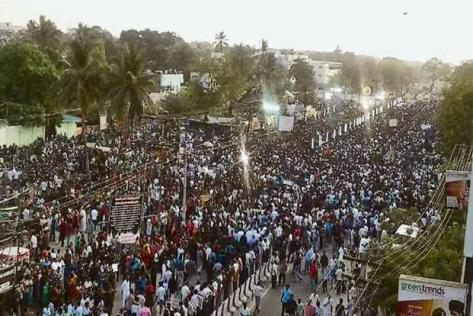
Thoothukudi protests – Image courtesy LiveMint

On 22nd May 2018, in what cannot be imagined even in a dictatorial regime, the police in Thoothukudi, Tamil Nadu – a South Indian state opened fire to kill, on a group of peaceful protesters marching towards the district administration office demanding denial of permission for expansion and closure of the existing copper smelting plant of Sterlite. Sterlite is a subsidiary of the London based corporation Vedanta, which has been dumping toxic waste all over this town since 1998 resulting in widespread health hazards including increase in reports of cancer. This massacre is unimaginable even in the worst dictatorial regimes, because not only were known national and international legal norms and protocols in crowd/riot control violated, but also because the video clippings that have surfaced after the massacre seem to indicate sufficient premeditation – with a plainclothes sniper on the top of a van being ordered to kill at least one person. Continue reading Thoothukudi Massacre – When State becomes Predator: Bobby Kunhu

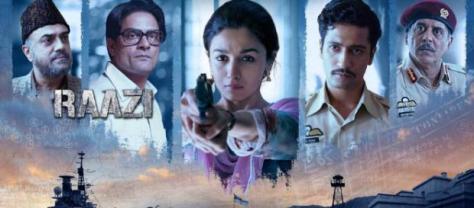
How Does Raazi Resolve The Tension Between Patriotism and Humanity? Kavita Krishnan

Guest Post by KAVITA KRISHNAN

SPOILER ALERT: If you have not seen Raazi, please don’t read this review because it contains spoilers.

Rabindranath Tagore, the composer of the poems that serve as the national anthems of India and Bangladesh, wrote an essay on nationalism in which he asserted, “it is my conviction that my countrymen will gain truly their India by fighting against that education which teaches them that a country is greater than the ideals of humanity.” In a letter to a friend, he wrote, “I will not buy glass for the price of diamonds and I will never allow patriotism to triumph over humanity as long as I live.”

My concern, as I watched Meghna Gulzar’s Raazi, was about how the film handles its central tension – between the values of humanity and patriotism. Continue reading How Does Raazi Resolve The Tension Between Patriotism and Humanity? Kavita Krishnan

Gayatri Mantra – Aryanism versus Hinduism: Rajni K. Dixit

Guest post by RAJNI K. DIXIT

The Gayatri mantra, as it is called these days, has been assigned a very important position in Hinduism. One is supposed to pray to the Sun god with this verse every morning and evening. It is supposed to be a prayer to the Divine Light to guide our mind in the right direction, and to show us   the correct way to live life. At the thread ceremony, which was a rite performed as the initiation of a Brahmin child’s education (samskarajanma or dwijatva i.e. second birth), the Gayatri mantra is spoken in the child’s ear because it is a prayer to guide the mind. It becomes his daily prayer to god for the right guidance and upliftment of mind for his whole life henceforth.

However, this verse was composed in a particular political context, understanding which expands our understanding of what is called Hinduism today.

This verse is composed by the great poet-priest Vishvamitra Gathina, and is selected from a poem of eighteen verses, the 62nd poem of the third mandal of the Rigveda. The major portion of this third mandal or group is   composed by Vishvamitra. ‘Gayatri’ is actually the name of the metre that the verse is composed in. The verse is about god Savita, i.e. the sun, and the correct name by which this verse was originally known is the ‘Savitri’ mantra.

Gayatri is not the composition of an ascetic sage. It is written by a poet-priest who was a born politician, a Rajarshi as the later Sanskrit calls him. This was a time when all good poets worked as professional priests. Composition of literature had no existence separate from religion in those times.

Continue reading Gayatri Mantra – Aryanism versus Hinduism: Rajni K. Dixit