All posts by Aman Sethi

An index of incompetence

One of the issues that the Binayak Sen trial has revealed is the quality of the investigative process in the case and the nonchalance with which the police has flouted even routine guidelines, safeguards and rules.

In a series of “reaction interviews” I did after the verdict came out, Ajai Sahni called the investigative process  “an index of the incompetence of the Chhattisgarh police.”

But, as an editorial in the The Hindu notes, an

“email referring to an occupant of the White House as a “chimpanzee” was introduced by the prosecutor as evidence of the kind of “code language” terrorists resort to. But tragically, it is the Chhattisgarh police that have had the last laugh in this round.”

Continue reading An index of incompetence

The Trial: State of Chhattisgarh versus Pijush Guha, Binayak Sen and Narayan Sanyal

bbc.co.uk

On Christmas Eve, the Raipur Sessions court delivered a surprisingly harsh sentence in the case of The State of Chhattisgarh versus Pijush Guha, Binayak Sen and Narayan Sanyal, where B.P. Verma sentenced all three to life imprisonment for “conspiring to commit sedition.”

This latest ruling on a sedition case isn’t so much about the narrowing of the space of expression in India (there are far more illustrative cases here, here and here) but more about the wide  application of the sedition law to convict when the supporting evidence is questioned by the defence.

Prosecution teams seem to have figured out that in cases involving “Maoist issues” – a poor investigation can easily be supported by planting “seditious” documents and pushing for sedition.

Through the course of this post, I shall try to collate some my coverage over the last two weeks to give you all a sense of how the trial proceeded. As always, I this piece serves as a starting point for further discussions. I would urge readers to post comments with links to articles that they found interesting (along with their own thoughts of course).

Continue reading The Trial: State of Chhattisgarh versus Pijush Guha, Binayak Sen and Narayan Sanyal

“Nobody Can Stop The Revolution”

Over the weekend, a number of journalists received the following statement from Ganapathy; General Secretary of the Communist Party of India (Maoist). In the text, Ganapathy clarifies the Maoist stance on a broad range of topics – particularly Kashmir, the Commonwealth Games, the Ayodhya Verdict, Mamta Bannerjee in Bengal, Obama and the North East.

However, the fact that the questions are posed by an obviously sympathetic “interviewer” and our inability to send any follow-up questions means that, I personally, treat this as a policy document rather than an “interview”. To get a quick newsy sum-up, you could read my report for The Hindu.

I felt it would be interesting for our readers to go through this text to get a sense of “What Maoists Want”.  As a reporter, I am only too aware of how Maoist politics is severely under-reported as opposed to their military tactics.

As neither the Maoists, nor Mr Ganapathy are currently in a position to defend their views on Kafila; I have disabled comments on this post. Afzal’s acerbic (and spot on) comment has changed my mind. Have allowed comments on this piece.Hopefully, this document shall serve as a reference point for further discussions on the Maoist movement.

Continue reading “Nobody Can Stop The Revolution”

Going Viral: Cyberspace’s subtle fevers

Source: neuromancer.org

Over the last few weeks, I have been reading a fair bit on and around the whole idea of cyber-security, the ‘militarization of the internet’, the idea of military viruses and other William Gibson-esque stuff.

For those of us who read (and loved) Neuromancer – Gibson’s cyber punk novel set in a futuristic Chiba City, Japan – recent developments of the outer-fringes of the internet seem eerily like the world that Henry Dorset Case inhabits.

This post is primarily intended to serve no higher purpose than share a bunch of articles that I think are brilliant and should be read by everyone.  If you are looking for themes – I would suggest contemplating the idea of disruptive technology in an increasingly networked world.

Last week, I had posted a link to a story on how the Predator drones used by the CIA might be running on “hack” versions of their aiming software. It reminded of a WSJ article I had read about drones, more than a year ago.

Militants in Iraq have used $26 off-the-shelf software to intercept live video feeds from U.S. Predator drones, potentially providing them with information they need to evade or monitor U.S. military operations.

Continue reading Going Viral: Cyberspace’s subtle fevers

Aim for the Insurgent…

Source: historycommons.org

… and you just might hit the wedding party. A fascinating intellectual property rights dispute offers up a possible reason for the number of civilians killed by American drone strikes.

To quote from the article from The Register:

The dispute surrounds a location analysis software package – “Geospatial” – developed by a small company called Intelligent Integration Systems (IISi), which like Netezza is based in Massachusetts. IISi alleges that Netezza misled the CIA by saying that it could deliver the software on its new hardware, to a tight deadline. Continue reading Aim for the Insurgent…

Chhattisgarh Field notes

Over the last month, the levels of violence in Chattisgarh appear to have de-escalated to a degree. I say de-escalated rather than reduced because the violence is largely driven by raids and counter-raids between the Maoists and the security forces, which is very different from the chaotic and un-nerving violence described in the recently leaked Iraqi war-logs covered by the Guardian and the NYT.

Sources in the police and the Maoists agree that the reduction is largely due to this year’s torrential monsoons which submerged large parts of the interiors in Dantewada and Bijapur. In the monsoons, the jungle tracks used by both forces turn into fast moving streams, making it difficult to launch operations and confining the forces to their camps.

Continue reading Chhattisgarh Field notes

Opening Pandora’s box

Source: NDTV.com

The Ayodhya judgement is out; Pandora’s box has been opened and I suppose the hope fairy is fluttering amidst us all. That there haven’t been riots is being seen as a sign that “the country has moved on”.  My personal sense is that the absence of riots simply proves that riots are rarely spontaneous: adequate security has ensured an uneasy calm.

It’s still too early (at least for me) to make sense of this verdict, so I thought we could kick off the debate on Kafila by posting a list of links and resources and perhaps take the conversation forward as more and more information comes in.

To start off, the Judgements can be accessed at http://rjbm.nic.in/ . The top half of the page contains the gist of the judgments while your can find the entire judgement below the fold.

Continue reading Opening Pandora’s box

On Torture and Testimonies

I was going to write out a reply to the comments on Shuddha’s post, Kashmir’s Abu Gharaiab, but thought I would expand it into a larger post.

I’d like to make clear that I have been to Kashmir only once – and that too for a few hours in the aftermath of the earthquake, so if anyone writes back saying, “I should see the ground reality in Kashmir”; I concede that point straight off the bat.  I should see the ground reality in Kashmir; we all should.

However, over the last eight months, I have had the opportunity to interact very closely with central paramilitary forces like the BSF and CRPF in the course  of their deployment in Chhattisgarh, where I work. Many of the men conducting anti-Maoist operations in Chhattisgarh have served in Kashmir and the North-East theatres.

Over the last three days, I and a reporter from the Times of India have been working on a story in which a group of adivasis from two villages in Chhattisgarh’s Kanker district have accused the BSF of torturing a number of young men and women from their respective villages by beating them and also administering electric shocks.

Continue reading On Torture and Testimonies

What if man dies in the forest, and no one is around to see it?

Last week, the  Chhattisgarh police were caught in an extraordinary encounter in the forests of Dantewada. The encounter was interesting not just in the event itself, but also in the Police’s attempts to shape media perception during and long after the encounter.

On Kafila, we devote a considerable amount of our time trying to decode how the press covers particular events. Perhaps this post shall go some way in explaining why our morning papers look the way they do.

If the police are to believed, on August 4 this year, the Koya commandos were caught in a Maoist ambush, yet through brilliant rear-guard action emerged completely unscathed, along with the body of a “Maoist fighter”, a 12 bore shotgun and two IEDs to boot.

The “ambush” caught a lot of us in the press unawares: something had happened in the forest – but what? A series of strategic leaks had primed the media to expect “major losses” among the security forces – so when the police emerged from the jungle unscathed, everyone was expected to heave a collective sigh of relief.

However, for once, the Chhattisgarh based press was skeptical.

Continue reading What if man dies in the forest, and no one is around to see it?

Remember, what the dormouse said …

Given the need to show ‘results’ in Chhattisgarh, the police are pulling some unlikely rabbits out of still stranger hats. The latest is Lingaram Kodopi, tipped by the police to be “Azad’s successor”, but as Jefferson Airplane reminds , If you go chasing rabbits…

The following piece appeared in The Hindu under the joint by-line of Aman Sethi and Smita Gupta.

In a press conference on Sunday, S.R.P Kalluri, Senior Superintendent of Police of Chhattisgarh’s Dantewada district, identified the prime suspect behind the July 6 attack on the house of Congress worker and civil contractor Avdesh Singh Gautam. According to a press release circulated by the Chhattisgarh police, “this attack was masterminded by Lingaram Kodopi, a resident of Sameli village.”
“In the last few months, Kodopi had received training in terrorist techniques in Delhi and Gujarat,” the release stated, claiming that Lingaram was “in touch” with writer Arundhati Roy, activist Medha Patkar and Nandini Sundar, a sociology professor at the Delhi School of Economics. The police also said that Kodopi was tipped to succeed Communist Party of India (Maoist) central spokesperson Azad, after the latter was killed by the Andhra Pradesh Police on July 2 this year.

Crossed Wires: Intelligence and Counter-intelligence in Chhattisgarh

On May 16 this year, adivasis, attending the weekly Sunday bazaar at Unchapur in Chhattisgarh’s Rajnandgaon district, found six corpses stretched out on the main thoroughfare of the village. In a note placed on one of the bodies, the CPI (Maoist) took responsibility for executing the six villagers for succumbing to “the lure of money” and serving as “police informers”.
The Rajnandgaon killings are a manifestation of the escalation of the confrontation between Maoist cadres and security forces in Chhattisgarh. As the scope of the conflict has widened from purely armed engagement to the disruption of intelligence networks, the Maoists and security forces have both enlisted civilian support for intelligence gathering. This has made the adivasis targets in a war being fought in their name.

Women become targets; SPOs issue gag orders

Ever since Mukram hit the news, there has been a sure and steady attempt to cut-off access to the areas surrounding the Chintalnar Camp.

In the meantime, sources who helped me and a reporter from Tehelka access the villages are worried about their safety. SPOs in Chintalnar have reportedly threatened to “take action” against villagers who help the press.

The following is a recent article for The Hindu that has provoked some of the backlash against the press.

A series of shots rang out in the night far beyond the barricaded perimeter of the Central Reserve Police Force camp here in Chhattisgarh’s Dantewada district. For a few minutes, the sentries on duty returned fire before their guns, and the ones that sounded in the distance, fell silent.

By morning, the adivasi settlements around the camp had emptied, the villagers wary of being caught and questioned by the CRPF’s morning patrol. “Everyone is hiding in the forests,” said a villager from Markaguda, a village about two km from the camp, “I expect we shall be beaten up this morning.”

Mukram violence worsens; adivasi girls allege rape


Two sisters live in a clearing in the forest about 10 km beyond the abandoned houses and empty yards of Mukram village in Chhattisgarh’s Dantewada district. A third young girl cowers in the courtyard of her aunt’s house in neighbouring Tokanpalli. Between 14 and 18 years of age, Kose, Rame and Hidme (names changed) say they fled their homes in Mukram after they were sexually assaulted by Special Police Officers of the Chhattisgarh Police on May 22 this year.
“We can’t return to Mukram,” said Rame, “If they [the SPOs] find us again, they said they would cut my body into pieces and bury it in cement and no one would ever find it.”

Mukram slips into a vortex of violence

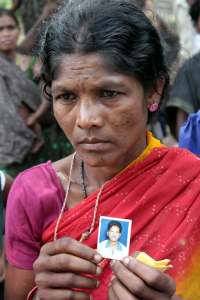
Aimla Rame holds up a picture of her husband Aimla Nanda who disappeared after a police raid in Mukram. Photo: Aman Sethi/ The Hindu

Mukram: Rumours swirling around Mukram suggest that this adivasi village in Chhattisgarh’s Dantewada district may soon be abandoned. “There is talk of going to Orissa or Andhra [Pradesh],” said a prominent adivasi leader with familial ties to Mukram, “It could happen in as little as a week. Villagers say there is too much pressure from both, the Maoists and the Police.”
A mid-sized village of about 100 houses, Mukram shot to prominence as the site where an ill-fated company from the 62nd Battalion of the Central Reserve Police Force (CRPF) rested on the night of April 5 this year.  At dawn on April 6, the company was ambushed by about 300 armed cadres of the Communist Party of India (Maoist), resulting in the death of 76 security force members.
In a statement released after the attacks, the CPI (Maoist) praised the efforts of Comrade Rukhmati, a Maoist commander and Mukram resident, who was killed in the ambush. On May 11, The Hindu reported the death of Kunjam Suklu, a Mukram resident who, his family members allege, was beaten to death by the CRPF in a fit of retaliatory rage.

Death of villager mired in controversy

Sukma: Chhattisgarh police confirmed the death of Mediyum Bandhi, a 27
year old adivasi from Aitpal village, in the Sukma police station in
Chhattisgarh’s Dantewada district. Police claim they shot Bandhi
as he tried to escape from the lock-up. Bandhi was shot three times in
the back with a Self Loading Rifle (SLR).

Bandhi’s death comes three days after an explosion, triggered by the
Communist Party of India (Maoist), killed 15 civilians and 16 members
of the security forces.  Many of the policemen killed were Special
Police Officers based out of Sukma.

According to Sukma police, Bandhi, 27, and Podiyam Kosa, 25,
were apprehended on Wednesday morning from Aitpal
village as they were wanted in a number of criminal cases including
murder.  The two villagers were first taken to Gadiras police
station for questioning and then brought to Sukma as Gadiras does not
have a lock-up.

Adivasis allege torture in anti-Naxal operations

Seventeen Adivasi villagers of Samna in Orissa’s Narayanpatna block
claim that they were brutally assaulted in custody last week, an
allegation the police have denied.

According to the villagers, they were picked up on May 9, as part of a
joint operation conducted by the Orissa and Andhra Pradesh police
along the inter-State border, airlifted to a police station in Andhra
Pradesh and held in custody for three days before being released on
May 14.

“Uniformed policemen surrounded our village on Sunday morning [May 9],
when we were leaving for the market,” said Nachika Jaddo, one of those
who were picked up. “Seventeen men, including two dokras [old men]
were rounded up, beaten up and then dragged to a spot 2 km away.”

Continue reading Adivasis allege torture in anti-Naxal operations

Arms and the Maoists

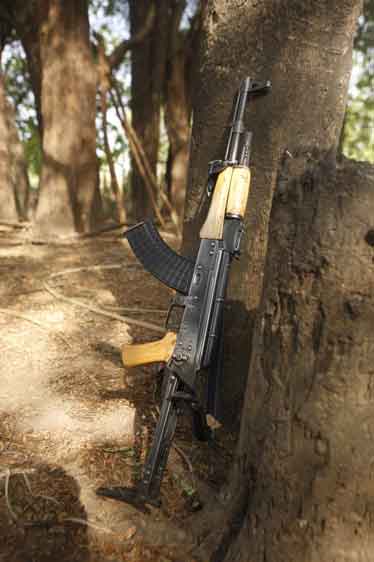
Ramana's AKS series Kalashnikov Rifle. A variant of the AK-47, the 'S' references the 'Skladnoy' or 'folding' metallic shoulder stock. Photo: Ishan Tankha/Open Magazine
In 1988, Ravula Srinivas paid Rs 100,000 for a black-market AKS series Kalashnikov rifle with a light-wood finish and a folding metal shoulder stock.  On April 6 this year, the same rifle was pressed into service in an ambush that killed 75 members of the Central Reserve Paramilitary Force and one Head Constable of the Chhattisgarh police in Chhattisgarh’s Dantewada district.
In the intervening years, Ravula has grown from a young student from Warangal into Ramana, Secretary of the South Bastar Regional Committee of the CPI (Maoist) and chief architect of the April 6 attack; unchanged by the years, the rifle has never left his side.
On April 14, The Hindu was offered access to Maoist leaders Ramana and Ganesh Ueike. in the Jagargunda forests in Dantewada.  The visit offered a rare, though by no means comprehensive, insight into how the CPI (Maoist) sources, maintains and distributes weapons among its cadres.

Nandini Sundar – Will counting caste reduce inequality?

Nandini Sundar’s recent Op-Ed for The Hindu on caste-enumeration in the latest round of the census. Read the entire article here.

But come back with your comments – what do you think about caste–enumeration?

Yesterday when the census enumerator visited, I asked him how he felt about the current debate on counting caste in the census: “Not comfortable at all”, he said, “I don’t even like asking whether someone is SC/ST or Other, leave alone what their caste is.” But, he added, “caste is an inescapable reality of Indian society.”

The debate on counting caste in the census has not moved on from 2001, when opinion was equally divided. Supporters of caste enumeration argue that census categories merely reflect existing classifications, and that only the census can provide the figures necessary to map inequality by caste. Opponents argue that the census does not mirror but actively produces social classifications and ways of thinking. They point to the history of mobilisation around caste in the census and the consequent dangers of both distorted data and increased social tensions. In neither case has much thought been given to how the data might be used, the different kinds of figures needed for different purposes, or alternative ways of collecting the required data. Read the rest of the article here

The Oblique Strategies of Trickster City

It’s midnight: An aspiring model cooks up a batch of Fem Bleaching Cream; an actor rehearses his dialogues to the sounds of manic laughter, “Oh tell them all it is I who is God,”; a fourteen year old feigns sleep as his father looks on, wondering what has prompted his son to abandon his studies and look for work; a woman throws her abusive husband to the floor and whips him with his belt.
In the morning, a young man will awaken at the crack of dawn and walk down to the slaughterhouse; an empty street shall bear witness to a middle aged woman’s defiant declaration, “I will work. I don’t care what you think! I don’t care what the world thinks.” The muezzin will call the faithful to prayer.  A bulldozer will plow through the heart of this twenty five year old settlement: clearing space for the 2010 Commonwealth Games, altering these lives forever.
In February 2006, the residents of Nangla Maanchi, a working class settlement of migrants in Delhi, were confronted by a signboard: “This land is the property of the government. It should be vacated.” By August that year, Nangla was bulldozed to make way for an “athlete’s village” to house this year’s Commonwealth Games.

School’s Out in Chhattisgarh, (But the Force is in!)

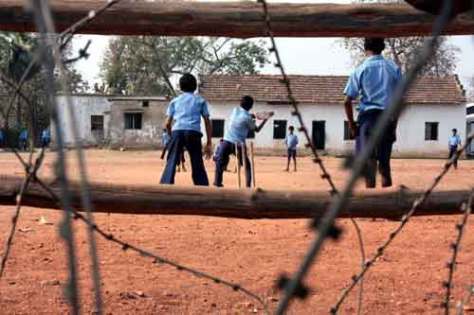
School’s out! In Kerlapal, Dantewada, battle-weary soldiers of the B Company of the 2nd Battalion of the Central Reserve Police Force peer over barbed-wire fences as skinny schoolboys in sky-blue shirts play cricket. The force has occupied the senior school and with it the basketball court and part of the playing field; but the game must go on.
As paramilitary troops pour into Chhattisgarh to fight the Maoists, the absence of military barracks has forced soldiers and children to share the only concrete structures in the countryside — the village school.

The Day of Long Knives

Gachanpalli: Stories of the “Operation” reverberate along the path from the Andhra Pradesh border to Gachanpalli, a village deep in forests of Chhattisgarh’s Dantewada district. Villagers along the 35 kilometre stretch of broken track, bombed-out schools, and graves, still speak of the day when security forces swept through their fields and killed 12 men.

Testimonies collected from the villages of Gachanpalli, Gattapad and Palachalam in the Konta block in Dantewada claim that at least 12 of the 30 people killed during a security operation in September 2009 were innocent villagers with no links to the Maoists.  If true, the allegations point to a concerted attempt at dissimulation on the part of Chhattisgarh’s security forces.