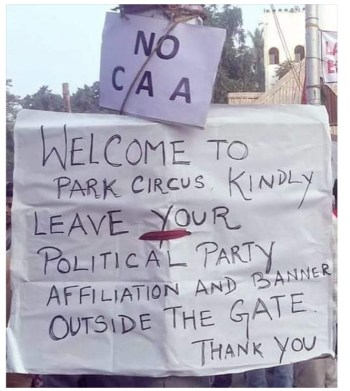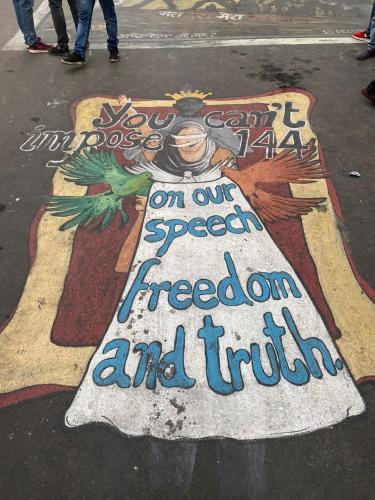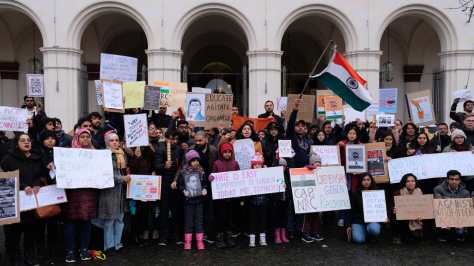
The question that is uppermost on most people’s minds today is what will happen to the Citizenship Amendment Act (CAA) and how long will the protests continue? The home minister Amit Shah declaring that the Act will not be withdrawn and the government will not move an inch, regardless of the protests, is a direct challenge to the people of India. With the Supreme Court looking the other way, taking up challenge thrown by Shah can only mean one thing now: if the Act does not go, the regime must. Mass movements have been known to bring down oppressive regimes, and even in the recent past, we have seen that happen in different parts of the world.
Subsequent developments, however, also indicate that often forces emerge that basically take advantage of the mass movements to hijack them and install equally unpopular regimes – a matter we need to discuss very seriously. I will briefly return to this ‘political question’ later as it is of utmost importance that we grasp the possibilities and dangers inherent in the present moment.
Amidst the bustle of talk and announcements on stage, there is a surprise at Shaheen Bagh. A young, slim girl student in ankle length boots, dark pants and shirt is invited to take the podium. She begins her speech by saying that the Citizenship Amendment Act (CAA) has put her in a dilemma. She studies in Jharkhand where many of her close friends are Rashtriya Swayamsevak Sangh (RSS) and Bharatiya Janata Party (BJP) members. Their opinions matter to her personally. At the same time, when she comes to Shaheen Bagh she is gripped by the dangers and stakes involved in the CAA.
Beginning this week, we are starting a column which will appear every Thursday. The name of this column, ‘Parapolitics’, is meant to indicate something that happens all the time, outside the formally designated sphere of politics, or what is sometimes called ‘the political’ by political theorists. As a matter of fact, most of such politics – parapolitics – takes place everyday and is deeply tied to our everyday lives. It is also what we may call ‘existential politics’: the dalit boys flogged by upper caste men inside a police station in Una, the woman of Unnao, whose family is decimated by the rapist’s henchmen, the mob-lynching to which Muslims are subjected on a daily basis, the farmer or the unemployed who commits suicide, the displaced adivasis or the workers who fight back – all these are instances of things deeply political but occurring away from or beneath the ‘proper’ domain of politics. The ‘proper domain of politics’ – that of state/government, parties, elections, alliances and so on – has repeatedly historically revealed its fundamental disconnect with such existential politics. Indeed, whenever faced by mass protests, the first response by the political class is to reduce it to the purported machinations of ‘opposition parties’. It cannot think of people, ordinary people, coming out in autonomous action. We might recall the response of the UPA government, at the height of the anti-corruption movement, challenging the locus standi of the protesters with the questions: ‘who are you?’ or ‘who has authorized you?’ etc Parapolitics is that unauthorized politics of everyday life, which often bursts out into the open but may also simply go on under the surface without any necessary public manifestation.
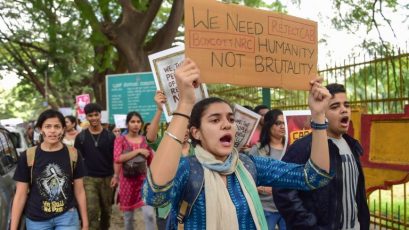
Students protest in Bengaluru, photo courtesy PTI
The most striking aspect of the present upsurge of popular anger around the Citizenship Amendment Act (CAA), as has been widely noticed, is the way defiant young women have become the face of the struggle. I am not referring here only to the women whose iconic images are circulating everywhere today, but also to the sheer number in which they have come out and the power with which they have been speaking their mind before the media. And they belong to all communities.
Joint Statement by Feminists Urging the President of India
to Commute Death Sentence to Life Imprisonment
As individuals and groups who have been engaged in the struggles for women’s rights, safety and justice, it is often presumed that we would support the demand for death penalty for sexual assault. But for decades, even as we have consistently fought to make the world safer for women through changes in policy and law, and social awareness by breaking the silence on these heinous crimes, we have consistently argued against the death penalty for sexual assault, as well as, all other crimes.
This article that explores the enjoyment of violence, epsecially in the social media world, in the wake of the brutal violence perpetrated by the Yogi Adityanath regime in Uttar Pradesh. It should be read as a sequel to Jaya Sharma’s earlier article published in Kafila in June last year.
‘Maza aa gaya Yogiji maza…Lathi aisi lagi ki maza aa gaya…’
Maza is a word used often in tweets in response to police attacks on CAA-NRC protestors in UP. Unlike it’s staid, sanskritized counterpart anand, maza has a charge, a buzz and could translate into English as ‘thrill’. ‘Thrilling Yogiji thrilling’… ‘The way the lathi struck…thrilling’. I’ll return to such tweets to explore the following questions.
Might it be that there is an erotic charge to political violence? Might it be that the erotic charge is not limited to those who perform the violence but also animates the millions who hear, see or read that such violence has been meted out? Well beyond “not caring”, might it be that they “get off” on such violence? Can the proactive, enthusiastic support for political violence be understood only in terms of “ordinary folk” being corrupted by evil leaders? Might we also need to see what within the collective psyche could be pushing them towards a terrible kind of enjoyment of such violence? Continue reading The Yogi and the Erotics of Violence: Jaya Sharma→
It was difficult to miss the smugness with which the Home Minister of India (HM) addressed a TV show he had orchestrated through one of the infamous godi (lapdog) media after the central cabinet had approved Rs 39.41 billion for updating the National Population Register (NPR) and Rs 85 billion for Census 2021 operations.The show was meant to dispel the misgivings about the link between NPR and the nationwide NRC—National Register of Indian Citizens (NRIC). In meetings across the country and within the Parliament, the HM had been proclaiming or rather threatening to carry out NRIC. However, his enigmatic statements did nothing to allay the grave fears people across India have about NPR, given the government’s obsession and resolve to identify what they call illegal residents. There is no doubt that instead of pressing concerns such as unemployment, alarming fall in per capita consumption and an extraordinary economic slump, of late the single-minded focus of the regime is on dividing the Indian people into different categories, branding, imprisoning and even throwing some out of India. Continue reading Nationwide NRC -The Devil at the Heart of India’s Draconian Digitalization: CP Geevan→
With the central government denying three states’ – Bengal, Kerala and Maharashtra – tableaux proposals for Republic Day, politics has reached a new low. There is no doubt that the current struggles against the CAA/NRC and the confrontational stance of the Centre with these governments has a lot to do with this denial. The following is a petition that was started by Not in My Name Bangalore but it is a broad appeal to all chief ministers, minister and legislators, to boycott this farcical celebration of the Republic while destroying its very spirit.
We, citizens of India, have watched with horror and no little terror the political developments since 2014, and especially since the elections of 2019. There has been a steady attack on, and erosion of, our constitutional rights in this time.
The Citizenship Amendment Act (CAA), in conjunction with the National Register of Citizens (NRC) and its precursor, the National Population Register (NPR), is a big blow to the Constitution of India. It is as disastrous and it is unconstitutional, and officially rings in the establishment of a Hindu Rashtra.
There has been staunch resistance to the CAA, most powerfully from student communities across the country. We wholeheartedly support them, in our words and on the streets. What was equally heartening was the pushback from the political establishment in a number of states – in varying degrees, it is true, but still truly a cause for hope. Continue reading Citizens Ask States to Boycott Republic Day Parade→
On Saturday (21st Dec), a crowd of around one hundred Indians residing in Munich and surrounding assembled at Geschwister Scholl Platz, a square in front of the Ludwig Maximilian University of Munich to protest against the Citizenship Amendment Act (CAA) and the National Register for Citizens (NRC). This place was chosen for its historical significance as it was from here that the White Rose resistance movement against the Nazi regime had started.
Teachers from different colleges and departments of the University of Delhi have expressed shock at the police repression on the struggles of the academic community across different universities in India and issued the following statement in support of the students.
We, concerned teachers of Delhi University, extend solidarity to the struggling academic communities of Jamia Millia Islamia (JMI), Aligarh Muslim University (AMU), Jawaharlal Nehru University (JNU), Delhi University (DU), and other central and regional universities that have borne the brunt of police excesses these past few days. We also express condemnation of the authoritarian and undemocratic manner in which the current dispensation is using all kinds of power to crush the basic rights of people to peacefully protest and question unjust laws. The closing off of metro stations, arterial roads, blocking of mobile networks, en masse detention of citizens who are peacefully gathering to protest, growing number of FIRs, 5000 plus preventive detentions, consistent heckling of protesters, including attack on public property during police raids, etc. are shocking and reflect blatant misuse of state power. The shameful act of interrupting media interactions / press briefings of vocal scholars/academicians through coercive police action is nothing short of sinister. The 25 plus and rising death toll of protesters, as well as the reports of police raids of Muslim localities, households and institutions is highly condemnable.
Members of Ritwik Ghatak’s extended family have issued the following statement, responding to reports appearing in the media about the BJP youth wing planning to use bits from Ghatak’s cinema for what appears to be some propaganda film about refugees and migrants.
We, the undersigned, family members of the late Shri Ritwik Kumar Ghatak, strongly condemn the reported misappropriation and misuse of his politics and his cinema by the Bharatiya Janata Yuva Morcha to defend the controversial and discriminatory National Register of Citizens (NRC) and the Citizenship Amendment Act (CAA).
Shri Ghatak’s cinema reflected his deep empathy for the underprivileged — in particular, the displaced and marginalised victims of political and social upheavals. He was secular to the bone, as everyone who knew him can attest, and his writings and cinema are proof of this.
Rattled by the upsurge in popular protests across the country against the passage of the Unconstitutional Citizenship Amendment Act, 2019 in parliament, Prime Minister Modi has accused the anti-NRC and anti-CAA protesters and the opposition parties of spreading “rumours and lies”. The assertions made by Mr. Modi in Ramlila Maidan (December 22, 2019), however, are brazen falsehoods which must be exposed and rebutted in public interest.
Modi says:“NRC in Assam was initiated only because of the Supreme Court Order. No discussion on nationwide NRC has been held within the Government and the matter has never been brought to the Parliament.”
Rebuttal: The BJP Manifesto for the 2019 LS elections states under the section Combating Infiltration (p.11):
There has been a huge change in the cultural and linguistic identity of some areas due to illegal immigration, resulting in an adverse impact on local people’s livelihood and employment. We will expeditiously complete the National Register of Citizens process in these areas on priority. In future we will implement the NRC in a phased manner in other parts of the country. (Emphasis Added)
As students, alumni and faculty members of the University of York, UK, we stand in solidarity with all students in India who are engaged in protests against the discriminatory Citizenship (Amendment) Act, 2019. We believe that the right to dissent, protest and demonstrate are fundamental rights integral to all democracies. Articles 19 (1) (a) and 19 (1) (b) of the Indian Constitution explicitly state that the right to protest is a fundamental right. Such a right is safeguarded in international human rights conventions as well.
The wave of protest in India in response to The Citizenship Amendment Act, 2019 (CAA) passed on 11th December 2019 is being violently suppressed. Protesters claim the Act fundamentally alters the concept of Indian citizenship and is against the secular and inclusive India Constitution as it introduces discrimination against Muslims and other ethnic minorities. Protests are happening across all the states in the Northeast of India and have spread to the university campuses in the rest of the country. There have been deaths and injuries in the Northeast and the government has imposed an internet blackout effectively cutting them off from the rest of the world. Injuries have also been reported from JamiaMillia and AMU. On the 19th December, students, noted academicians, activists and political leaders have been detained by the police, following peaceful protests. Continue reading Dublin City University Faculty and Students Condemn Repression of Peaceful Protests in India→
As members of the academic community in India, we the undersigned, stand in solidarity with students across the country protesting against the Citizenship (Amendment) Act 2019 (CAA) and the National Register of Citizens of India (NRC). Fundamentally discriminatory and unjust, CAA-NRC contradict the founding principles of the Indian Constitution and undermine international human rights conventions such as the United Nations International Covenant on Civil and Political Rights and the United Nations Declaration of the Rights of Indigenous Peoples. The Act institutionalizes discrimination based on religion, besides threatening the interests of indigenous people of the North-Eastern states.
Law teachers and researchers from across the world have strongly condemned the recent police brutality against students of different universities struggling the recent changes in Citizenship law. They have also criticized the CAA and the NRC ideas as majoritarian and one that subverts our Consttitutional vision. Their statement:
We, the undersigned teachers and researchers of law, strongly condemn the police brutality on the peaceful protest by the students at Jamia Milia Islamia, Aligarh Muslim University and other universities.
On 15 December 2019 police entered the Jamia Milia Islamia and Aligarh Muslim University, and assaulted and detained the students. Students were dragged out of campus, and were paraded outside with hands raised. We believe that the action of the police is an attempt to suppress dissent and is an attack on the autonomy of the universities. The police action violates, inter alia, the right to peaceful assembly and freedom of speech and expression guaranteed under the Constitution of India and international law instruments to which India is a state party. We emphasize that academic institutions are an arena of discussion, debate and dissent, and the peremptory and ultimate objective of universities is to speak truth to power. By using force against the students, the government has struck at the heart of the culture of protests.
Concerned health activists and health professionals and women’s rights activists have issued the following statement against the brutal use of force by the police against students, especially in Jamia Millia Islamia and AMU.
We, the health networks, health activists, health professionals, Women’s Rights Activists and concerned activists strongly condemn this abhorrent act by the police force on the students of Jamia Milia Islamia University, Delhi and Aligarh Muslim University, Uttar Pradesh on 15th – 16th December 2019.
Following is a statement by the faculty, researchers and students of the University of Southern Florida, USA, in support of the struggle of students across universities against CAA and NRC.
We, the undersigned, faculty, postdoctoral fellows, students, and alumni of University of South Florida (USF), in strongest possible terms,condemn the Citizenship Amendment Act (CAA) and assault and police crackdown on anti-CAA protests across India. We staged a protest on USF’s Tampa campus on December 19, the day widespread protests were organized across India on this issue. Even though our protest is India-specific, this is about protecting democracy and minority rights.
The Indian government recently passed the CAA, which we believe, allows for the first time in secular India, a citizenship provision based on religion. When combined with National Register of Citizens (NRC), and National Population Register (NPR), the CAA can strip Indian Muslims of their rights and citizenship.The NRC and NPR also threaten transgender communities, dalits, the homeless, indigenous communities, and others who will not be able to provide necessary documents.We believe that the Indian government’s actions are unconstitutional and fundamentally violate the principles of equality and non-discrimination in a democracy. Continue reading Support for Anti CAA/NRC Struggle from University of South Florida→
Statements of support for the students’ struggle against the CAA and NRC continue to pour in. We will try and keep publishing as many as we can. In this post is a statement from the University of British Columbia, Canada.
We, the students, faculty, alumni and scholars of the University of British Columbia, and the South Asian community in Vancouver, strongly condemn the police violence unleashed on students protesting against Citizenship Amendment Act and National Register of Citizens of India, across universities in India. Specifically, we condemn the police brutality on Muslim students of Jamia Millia Islamia and Aligarh Muslim University where the excessive violence of police machinery is reflective of the Islamophobia of the present government. We strongly oppose the recently passed Citizenship Amendment Act which inherently discriminates citizenship for Muslims on religious grounds. The Act provides citizenship to six religious minority communities from Pakistan, Bangladesh and Afghanistan while it explicitly leaves out Muslims. Citizenship Amendment Act (passed on December 11, 2019) along with National Register of Citizens of India and National Population Register will bring about systematic displacement and dispossession of two hundred million Muslims in India as their citizenship will be put to test and they can be easily rendered stateless. Continue reading Support for Struggling Students from University of British Columbia→
The following is a statement issued by faculty members of South Asian University on the recent police excesses against peacefully protesting students and other citizens.
We, the undersigned teachers of the South Asian University, New Delhi are deeply disturbed by the developments at the Jamia Milia Islamia and Aligarh Muslim University in the last few days.
As it is well documented now through the media reports and eye witness accounts of students, on 15 December 2019 police entered the Jamia Milia Islamia and Aligarh Muslim University and assaulted and detained the students who were peacefully protesting against the Citizenship (Amendment) Act, 2019 (CAA) and National Register of Citizens (NRC). Continue reading South Asian University Statement in Solidarity with Students and Citizens Protesting CAA and NRC→
Support for the students of Jamia Millia Islamia and Aligarh Muslim University is continuously pouring in from different of the world as people watch the horrors perpetrated by the Indian police on unarmed, peacefully protesting students. The following is yet another of an international statements of support.
We, the undersigned, condemn the recent spate of state violence unleashed against students of Jamia Millia Islamia (JMI) and Aligarh Muslim University (AMU) by the ruling BJP government. We are students studying in various universities and educational institutions outside of India, and are extremely appalled to see the brazen attack on the democratic rights of students across universities in India. Students of JMI and AMU have been protesting against the discriminatory Citizenship (Amendment) Act, 2019 (CAA), which enforces a highly selective citizenship criteria based on faith that excludes Muslims and effectively reduces the status of millions of Muslims in India to ‘illegal migrants’. The police have shown zero restraint in their attempt to suppress the agitations and it is clear that the students are violently targeted because of their Muslim identity. Continue reading Another International Statement Condemning State Violence Against Students of JMI and AMU→
Following is a statement issued by current and former faculty members and students of the University of Warwick in solidarity with the ongoing struggle of the students against the new citizenship law.
As students, alumni and faculty members of the University of Warwick, we stand in solidarity with all students in India who are engaged in protests against the discriminatory Citizenship (Amendment) Act, 2019. We believe that the right to dissent, protest and demonstrate are fundamental rights integral to all democracies. Articles 19 (1) (a) and 19 (1) (b) of the Indian Constitution explicitly state that the right to protest is a fundamental right. Such a right is safeguarded in international human rights conventions as well.
The peaceful and non-violent demonstrations by students have been met with extraordinary police violence, particularly in Jamia Millia Islamia and Aligarh Muslim University, with recent reports from established media sources indicating that police and paramilitary forces entered university campuses and hostels by force and brutally attacked students. As a consequence, hundreds of students have been injured, some very seriously. Such police action contravenes both the Constitution of India as well as international human rights laws. We call for an immediate end to state-led violence and for proper action to be taken against the perpetrators of it.Continue reading University of Warwick In Solidarity With Students Protesting the CAA in India→