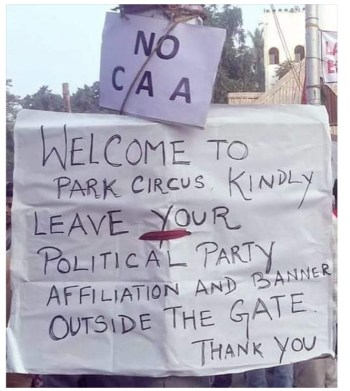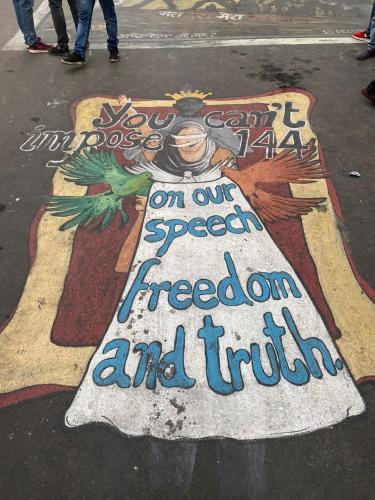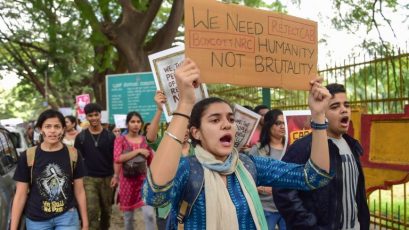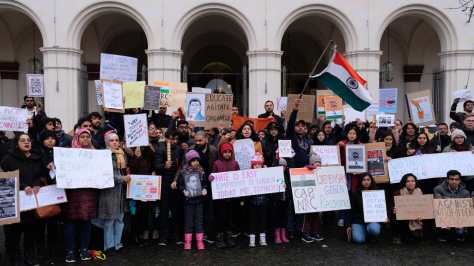
As members of the academic community in India, we the undersigned, stand in solidarity with students across the country protesting against the Citizenship (Amendment) Act 2019 (CAA) and the National Register of Citizens of India (NRC). Fundamentally discriminatory and unjust, CAA-NRC contradict the founding principles of the Indian Constitution and undermine international human rights conventions such as the United Nations International Covenant on Civil and Political Rights and the United Nations Declaration of the Rights of Indigenous Peoples. The Act institutionalizes discrimination based on religion, besides threatening the interests of indigenous people of the North-Eastern states.
Law teachers and researchers from across the world have strongly condemned the recent police brutality against students of different universities struggling the recent changes in Citizenship law. They have also criticized the CAA and the NRC ideas as majoritarian and one that subverts our Consttitutional vision. Their statement:
We, the undersigned teachers and researchers of law, strongly condemn the police brutality on the peaceful protest by the students at Jamia Milia Islamia, Aligarh Muslim University and other universities.
On 15 December 2019 police entered the Jamia Milia Islamia and Aligarh Muslim University, and assaulted and detained the students. Students were dragged out of campus, and were paraded outside with hands raised. We believe that the action of the police is an attempt to suppress dissent and is an attack on the autonomy of the universities. The police action violates, inter alia, the right to peaceful assembly and freedom of speech and expression guaranteed under the Constitution of India and international law instruments to which India is a state party. We emphasize that academic institutions are an arena of discussion, debate and dissent, and the peremptory and ultimate objective of universities is to speak truth to power. By using force against the students, the government has struck at the heart of the culture of protests.
Concerned health activists and health professionals and women’s rights activists have issued the following statement against the brutal use of force by the police against students, especially in Jamia Millia Islamia and AMU.
We, the health networks, health activists, health professionals, Women’s Rights Activists and concerned activists strongly condemn this abhorrent act by the police force on the students of Jamia Milia Islamia University, Delhi and Aligarh Muslim University, Uttar Pradesh on 15th – 16th December 2019.
Following is a statement by the faculty, researchers and students of the University of Southern Florida, USA, in support of the struggle of students across universities against CAA and NRC.
We, the undersigned, faculty, postdoctoral fellows, students, and alumni of University of South Florida (USF), in strongest possible terms,condemn the Citizenship Amendment Act (CAA) and assault and police crackdown on anti-CAA protests across India. We staged a protest on USF’s Tampa campus on December 19, the day widespread protests were organized across India on this issue. Even though our protest is India-specific, this is about protecting democracy and minority rights.
The Indian government recently passed the CAA, which we believe, allows for the first time in secular India, a citizenship provision based on religion. When combined with National Register of Citizens (NRC), and National Population Register (NPR), the CAA can strip Indian Muslims of their rights and citizenship.The NRC and NPR also threaten transgender communities, dalits, the homeless, indigenous communities, and others who will not be able to provide necessary documents.We believe that the Indian government’s actions are unconstitutional and fundamentally violate the principles of equality and non-discrimination in a democracy. Continue reading Support for Anti CAA/NRC Struggle from University of South Florida→
Statements of support for the students’ struggle against the CAA and NRC continue to pour in. We will try and keep publishing as many as we can. In this post is a statement from the University of British Columbia, Canada.
We, the students, faculty, alumni and scholars of the University of British Columbia, and the South Asian community in Vancouver, strongly condemn the police violence unleashed on students protesting against Citizenship Amendment Act and National Register of Citizens of India, across universities in India. Specifically, we condemn the police brutality on Muslim students of Jamia Millia Islamia and Aligarh Muslim University where the excessive violence of police machinery is reflective of the Islamophobia of the present government. We strongly oppose the recently passed Citizenship Amendment Act which inherently discriminates citizenship for Muslims on religious grounds. The Act provides citizenship to six religious minority communities from Pakistan, Bangladesh and Afghanistan while it explicitly leaves out Muslims. Citizenship Amendment Act (passed on December 11, 2019) along with National Register of Citizens of India and National Population Register will bring about systematic displacement and dispossession of two hundred million Muslims in India as their citizenship will be put to test and they can be easily rendered stateless. Continue reading Support for Struggling Students from University of British Columbia→
The following is a statement issued by faculty members of South Asian University on the recent police excesses against peacefully protesting students and other citizens.
We, the undersigned teachers of the South Asian University, New Delhi are deeply disturbed by the developments at the Jamia Milia Islamia and Aligarh Muslim University in the last few days.
As it is well documented now through the media reports and eye witness accounts of students, on 15 December 2019 police entered the Jamia Milia Islamia and Aligarh Muslim University and assaulted and detained the students who were peacefully protesting against the Citizenship (Amendment) Act, 2019 (CAA) and National Register of Citizens (NRC). Continue reading South Asian University Statement in Solidarity with Students and Citizens Protesting CAA and NRC→
Support for the students of Jamia Millia Islamia and Aligarh Muslim University is continuously pouring in from different of the world as people watch the horrors perpetrated by the Indian police on unarmed, peacefully protesting students. The following is yet another of an international statements of support.
We, the undersigned, condemn the recent spate of state violence unleashed against students of Jamia Millia Islamia (JMI) and Aligarh Muslim University (AMU) by the ruling BJP government. We are students studying in various universities and educational institutions outside of India, and are extremely appalled to see the brazen attack on the democratic rights of students across universities in India. Students of JMI and AMU have been protesting against the discriminatory Citizenship (Amendment) Act, 2019 (CAA), which enforces a highly selective citizenship criteria based on faith that excludes Muslims and effectively reduces the status of millions of Muslims in India to ‘illegal migrants’. The police have shown zero restraint in their attempt to suppress the agitations and it is clear that the students are violently targeted because of their Muslim identity. Continue reading Another International Statement Condemning State Violence Against Students of JMI and AMU→
Following is a statement issued by current and former faculty members and students of the University of Warwick in solidarity with the ongoing struggle of the students against the new citizenship law.
As students, alumni and faculty members of the University of Warwick, we stand in solidarity with all students in India who are engaged in protests against the discriminatory Citizenship (Amendment) Act, 2019. We believe that the right to dissent, protest and demonstrate are fundamental rights integral to all democracies. Articles 19 (1) (a) and 19 (1) (b) of the Indian Constitution explicitly state that the right to protest is a fundamental right. Such a right is safeguarded in international human rights conventions as well.
The peaceful and non-violent demonstrations by students have been met with extraordinary police violence, particularly in Jamia Millia Islamia and Aligarh Muslim University, with recent reports from established media sources indicating that police and paramilitary forces entered university campuses and hostels by force and brutally attacked students. As a consequence, hundreds of students have been injured, some very seriously. Such police action contravenes both the Constitution of India as well as international human rights laws. We call for an immediate end to state-led violence and for proper action to be taken against the perpetrators of it.Continue reading University of Warwick In Solidarity With Students Protesting the CAA in India→
The following is a statement from the alumni of NLU Jodhpur, in solidarity with the students at the receving end of police brutalities in Delhi, Aligarh, Assam and other universities.
We, the undersigned alumni of National Law University, Jodhpur unequivocally condemn the police excesses in response to student protests at Jamia Milia Islamia University, Delhi University, Aligarh Muslim University, Dibrugarh University, Gauhati University, Cotton University, Assam and other universities across India. As persons with training in constitutional laws and values, we recognize the significance of dissenting speech and assembly, and the need to preserve academic spaces as free from State coercion and militarization and to uphold the values of secularism.
Harold Bloom had made it clear many times that his investment in the Greek literary critic Dionysius Longinus, writing in the first century AD, was a way to address and revisit the fundamental encounter of the sublime in our living. Commentators have noticed a remarkable ‘agon’ being played out in Bloom’s career: between his idealizing enthusiasm in romantic-messianic visions and his equal investment in gnostic wisdom and stoic classicism. This agon, or contestation, was his way of addressing a certain space of the uncanny in dealing with art and literature, in contrast to the modernizers and tropologists who, he believed, rejected subjectivity itself as a fallacy. Not Bloom—who had always claimed that the ‘strong critic’ is a kind of poet. As he saw it, literary criticism is an ongoing tussle between the pathos of the heroic will and the ‘literalizers’ who deal in tropes and textual juggleries. But has he been successful in strictly distinguishing the daemonic from the analytic? Are the uncanny and surpassing moments entirely separable from the sensory and the figurative?
[भारतीय-हिन्दू मिथकों और परम्परा पर लंबे समय से लिखते आ रहे बुद्धिजीवी श्री देवदत्त पट्टनायक अपनी एक ट्वीट में एक लाजवाब बात कही . उनहोंने कहा कि जहाँ हिन्दू धर्मं का मतलब वसुधैव कुटुम्बकम है , उसके लिए अगर समूची वसुधा , सारी एक कुनबा है , वहीँ हिंदुत्व का मतलब सिर्फ़ एन आर सी (यानी नागरिकों की राष्हैट्रीय फेहरिश्त ) है. बिलकुल दो शब्दों में , बड़ी खूबसूरती से पट्टनायक साहब ने इन दोनों फलसफों के बीच का फर्क़ खोल कर सामने रख दिया है. इस संक्षिप्त लेख में डाक्यूमेंट्री फ़िल्मकार और पत्रकार सबीहा फ़रहत उसी एन आर सी से पैदा हुए चंद सवाल उठा रही हैं.]
आजकल अमित शाह केवल एनआरसी पर स्टेटमेंट दे रहे हैं। “घुसपैठियों ” को बाहर फेंक देंगे और हिन्दू, सिख, बौद्ध, जैन, ईसाई, पारसी को नागरिकता दे देंगें। फिर चाहे उसके लिये संविधान को तक पर रख कर सिटीज़नशिप ऐक्ट ही क्यों ना बदलना पड़े!
उनकी इस बात से साफ़ ज़ाहिर है कि देश के 16 करोड़ मुसलमान ही “घुसपैठिये” हैं। “दीमक” हैं और उन्हें देश से बाहर खदेड़ने की ज़रूरत है। लेकिन सिर्फ़ मुसलमान से इतनी नफ़रत क्यों? मुसलमान ने इस देश का क्या बिगाड़ा है? क्या उसने किसी की रोटी छीनी, किसी की नौकरी छीनी, किसी का बिज़नेस हड़प लिया। नहीं! क्योंकि अगर वो ऐसा करता तो आर्थिक तौर पर सबसे ज़्यादा कमज़ोर नहीं होता।
A thought is a tremendous form of excitement. [Alfred N. Whitehead]
We are concerned with the imagination, and the vaguely functionalist remarks we noticed before are not the sketch of an explanation, but an aid to the imagination, to make a different practice a more familiar idea to us, and hence to make us more conscious of the practice we have. Seen in this light, … [t]he imagined alternatives are not alternatives to us; they are alternatives for us, markers of how far we might go and still remain, within our world – a world leaving which would not mean that we saw something different, but just that we ceased to see. [Bernard Williams]
This is an extended essay working off two official documents, and public ones at that: one, the voluminous draft of the National Education Policy 2019 (henceforth Draft NEP) authored by the K. Kasturirangan-led Committee appointed by the Ministry of Human Resource Development, (MHRD) Government of India and, second, the brief report on ‘Promoting and Improving the Quality of Research in Indian Universities/Colleges’ headed by P. Balaram under the auspices of the University Grants Commission (UGC) [accordingly, UGC-Balaram report]. My interest is as much with the former as with the latter; and, although they can be commented upon independent of each other, it is the combined resonance of these two policy suggestions that I am interested to examine (especially as they bear on the higher education [HE] space in India).
The following is a statement issues by teachers and academics in support of Dr Hany Babu, whose residence was raided early morning non 10 September by Pune Police
We, teachers and members of the academic community from across universities, are shocked to know of the illegal raid at the residence of Dr. Hany Babu, Associate Professor in the Department of English, University of Delhi on the morning of 10 September 2019. While the horrifying overreach of a search conducted without a warrant has become routine harassment for dissenting citizens, the attempt made by the Pune Police to forcefully detain Babu’s family for six hours and deprive them of any communication with lawyers or friends amounts to extreme duress. Finally, forcing Babu to change passwords and forfeit access to his email account and other personal online media clearly makes way for a possible planting of evidence, to concoct a case against an assumed ‘suspect’.
Statement by the US-based COALITION AGAINST FASCISM IN INDIA
cafiusa2019@gmail.com Twitter @Hum_CAFI_hai)
Protest on Friday, September 27th at 10:30 am
United Nations Plaza, New York City
India’s Prime Minister Narendra Modi will visit the United States at the end of September. He will attend the United Nations General Assembly Session on September 28. Please join us to protest Modi’s visit. Modi’s government has been orchestrating a pogrom of hate and violence against Muslims and Dalits in India. His government has been cracking down on all forms of dissent and all those who question its politics of hate. Its economic policies have resulted in escalating poverty and thehighest unemployment rate in half a century. We call upon all anti-fascist, anti-racist,secular, and environmentalist groups in the United States to join us in protesting his visit and exposing the retrograde, near-fascist politics of Modi’s government.
The Final NRC published today has excluded a whopping 19.06 lakh persons in Assam. The NRC process had shifted the burden of proof of citizenship on to the entire population of Assam, with people undergoing deep travails over the past four years to get their names included. In a poor country like ours and in a state which witnesses frequent floods, it is not unnatural that lakhs of people were unable to produce documents to prove that they or their ancestors were inhabitants of Assam before 24th March 1971. To rob people of their citizenship and rendering them stateless on the basis of this flawed process would be a gross violation of the fundamental rights guaranteed by the Indian Constitution.
I write this open letter to you as a well wisher, and someone who has been seriously supportive of the Aam Aadmi Party (AAP) through all the ups and downs in the years since its formation. Perhaps like many others, I too have high expectations of the experiment that AAP is and the new ground it has tried to break in terms of providing a government that has steadfastly kept the interests of the common person in mind while taking decisions.
But I also write this letter because I, like many others, have been perturbed by some developments which do not augur well for the future either of your party or of the country. The latter in any case, is set on a disastrous course, thanks to the current dispensation at the Centre. Let me also make it clear right away that I am not one of those who criticize AAP for ‘lacking a clear ideology’ and I in fact value the fact that on many critical issues, AAP has been able to resist the pressure to step into well trodden, familiar responses to specific situations and issues – especially well trodden among Leftists. But I do think that AAP needs to think a bit more seriously about politics – which is not the same thing as ideology.
Economist Jean Dreze, Kavita Krishnan of the CPI(ML) and the All India Progressive Women’s Association, Maimoona Mollah of the All India Democratic Women’s Association and Vimal Bhai of the National Alliance of People’s Movements released the following report to the press today, 14 August 2019, after spending five days in Kashmir, meeting and talking to people.
Security personnel stand guard on a street during a lockdown in Srinagar on August 12, 2019. (Photo credit: TAUSEEF MUSTAFA /AFP/Getty Images)
We spent five days (9-13 August 2019) traveling extensively in Kashmir. Our visit began on 9 August 2019 – four days after the Indian government abrogated Articles 370 and 35A, dissolved the state of Jammu and Kashmir, and bifurcated it into two Union Territories.
When we arrived in Srinagar on 9 August, we found the city silenced and desolated by curfew, and bristling with Indian military and paramilitary presence. The curfew was total, as it had been since 5th August. The streets of Srinagar were empty and all institutions and establishments were closed (shops, schools, libraries, petrol pumps, government offices, banks). Only some ATMs and chemists’ shops – and all police stations – were open. People were moving about in ones and twos here and there, but not in groups.
The following is the full text of the statement issued by 83 English teachers of Delhi University against the attack on the syllabus:
We, the teachers of English across Delhi University are shocked and appalled at the unacademic, politically motivated attack on our syllabus. This is a democratically drafted syllabus, which involved faculty participation from around 40 colleges; over 2 years, and more than 3000 working hours have been spent on it. It is a matter of sorrow and deep academic concern that the syllabus is now being maligned, and is sought to be scuttled, by certain political groups at the University.
This post is the second part, excerpted and slightly adapted, from the booklet by Nagraj Adve, Global Warming in the Indian Context: An Introductory Overview (Ecologise Hyderabad 2019). The first part appeared in Kafila on 1 July 2019
While the earlier post covered the basic science of global warming, the roots of the problem, and how inequality relates to climate change, this part focuses on key impacts of climate change in India, on humans and other species, and the reasons for urgency in tackling the problem.
Villagers try to catch fish in drying pond in West Bengal, image courtesy Science News
Before we consider impacts in India and elsewhere, a few things are useful to keep in mind:
– Unlike most other forms of pollution, the source of carbon dioxide and where its effects are felt can be very far apart. Carbon dioxide generated in the United States affects people on the Orissa coast.
– A significant portion of carbon dioxide emitted today will remain in the atmosphere for centuries, influencing future climates.
– Even after the world ceases to emit carbon, higher average temperatures are “largely irreversible for a thousand years” because the gains of lesser radiation being trapped gets offset by the reduced loss of heat to the oceans. Hence, climate change is the new ‘normal’.
This essay is the first of a two-part excerpt from the booklet by Nagraj Adve, Global Warming in the Indian Context: An Introductory Overview (Ecologise Hyderabad, 2019). This covers the basic science of global warming, the roots of the problem, and how inequality relates to climate change. The second piece, to appear soon, will focus on impacts in India, both on humans and other species, and the reasons for urgencyin tackling the problem. You can read the second part here.
What they told us in Gujarat
A few years ago, a group of us went to northern and eastern Gujarat to find out how climate change was affecting small farmers there. In villages in eastern Gujarat, they told us that the wheat and maize crops had been getting hit for some years during winter. Wheat and maize are important sources of nutrition for poor households in these and nearby regions. But because winters have been getting warmer, the dew (os) had lessened, or stopped entirely for the last few years. For those without wells—most of them poor households—dew is the only source of moisture for their crop. With less or no dew falling, either their crop dried up, or they were being forced to leave their lands fallow.
When we asked them why the winters had been getting milder, the people’s response there was interesting: “Prakruti ki baat hai (it has to do with Nature).” They did not consider it imaginable that human beings had the power to alter Nature on this scale. We do.
As some of you might be aware, our friend and colleague, Dr. Saraswati Kerketta (Assistant Professor in the Department of Geography, Rabindra Bharati University), has recently been a victim of caste-based attack in the university. We write this statement to unequivocally condemn the attack.
We, the concerned faculty members/research scholars across institutions in India and abroad, are deeply disturbed by this incident of caste-based attack on Dr. Kerketta. Dr. Kerketta is a young faculty member from a Scheduled Tribe background, and the sole faculty member appointed in a substantive position in her department, thereby taking on the tremendous task of running the department on her young shoulders. This brazen instance of caste-based harassment meted out to her by a group of students who claim to be affiliated to a political party has hurt and disturbed us immensely as citizens of India. The nature of attack meted out to her – for instance she has been followed by the students up till home after the incident – also showcases the gendered nature of her vulnerability. The incident has been followed by mass resignation on the part of other faculty members from various positions in the university, thereby showing indirect proof of the same.