All posts by Aditya Nigam

Growing Inequality and Deprivation in Telangana – Questions evaded by Srikrishna Committee: Bhim Reddy

Guest post by BHIM REDDY

[The movement for a separate Telangana state has been raging now for quite some time. At Kafila, we have not yet had the occasion for a discussion on the pros and cons of the issue. This post deals with one aspect – that of agricultural economy and its relationship to the perceptions of discrimination. We hope that this post will lead to some debate on a very important issue. AN]

Rural Telangana has experienced income declines for ninety percent of its population, increase in inequality and a drastic decrease in the class-size of cultivators accompanied by an increase in the class-size of agricultural labourers since early 1990s.  This revealing evidence is presented in Srikrishna Committee (Committee for Consultations on the Situation in Andhra Pradesh, headed by Justice B.N. Srikrishna) Report based on NCAER (National Council of Applied Economic Research, New Delhi) surveys conducted once in the year 1993-94 and another in 2004-05. The Committee’s concern over this scenario, despite the purpose of its constitution being to study the situation in Andhra Pradesh state in the context of unrest in Telangana region, has not attracted any attention beyond its worry that the vulnerability of the deprived masses can be ‘used’ by political groups: “…most of the deprived communities in Telangana are facing hardship and therefore are vulnerable to mass mobilization on one pretext or the other, including political mobilization with promises which may or may not be met”. Beyond this shallow concern the Committee is indifferent to such evidence that any study characterised by objectivity and rigorous interrogation would be compelled to undertake a critical examination of the trajectory of economic development and state’s policy, and attempt to explain the cause of such deprivation and growing inequity.

Continue reading Growing Inequality and Deprivation in Telangana – Questions evaded by Srikrishna Committee: Bhim Reddy

The ‘Viral’ Revolutions Spread Across Europe

The New Democratic Upsurges

The mainstream Western media that celebrated the democracy movements in the Arab world not very long back, is relatively silent now. For, then it was the Arab youth’s striving for the ‘western values’ of democracy that it was celebrating. Now that the cry of ‘democracy’ is arising from its very midst, it does not seem to quite know what to do. From May 15 on, for almost two weeks Madrid and other Spanish cities have been witnessing some of the largest demonstrations in recent memory. Protesters have thronged the Puerta del Sol, virtually camping there. As government forces started cracking down, demonstrations began to grow in an ever expanding scale spreading to many other Spanish cities. When the government moved to ban demonstrations on May 20, in the run up to the regional and municipal elections, the protests acquired an even more militant form. A ‘snapshot’ of the rallies in defiance of the ban:

The initial protests against the planned multibillion euro bailout plan for banks, austerity measures and against high unemployment almost 45 percent among the youth), according to reports, were not very large but when the government responded by arresting several activists and demonstrators, things started going out of hand. That was the ‘spark that lit the prairie fire’. As Ryan Gallagher’s report in the New Statesmanput it:

A demonstration against the arrests was organised in the city’s main square, Puerta del Sol, and numbers soon snowballed when word got out over the internet. What began as a group of fewer than a hundred activists reached an estimated 50,000 within less than six days.

The protesters whose arrests had sparked the initial demonstration were released and immediately returned to the square. By the time they arrived, the demonstration was no longer just about their treatment at the hands of the police. It was about government corruption, lack of media freedom, bank bailouts, unemployment, austerity measures and privatisation.

Here is another video of a fierce battle being fought on the streets of Madrid: Continue reading The ‘Viral’ Revolutions Spread Across Europe

Old Left is Dying! Long Live the Left!

[Following the publication of the previous post – the statement on the future of the Left, we have received some important comments that seek to take the debate forward, alongside those predictable, invective laden rants that we know only too well by now. We need to keep the debate on the future of the Left in India going, irrespective of these comments that seek to derail any meaningful discussion. We must continue to assert that ‘the Left’ far exceeds the decadent and decrepit lot that now goes by the name of Left parties in this country. This  post is a slightly modified and longer version of an article that appeared in Bengali yesterday in Ekdin.]

In a recent newspaper article, former Left Front finance minister Ashok Mitra, observed: “The Left Front, led by the Communist Party of India (Marxist), has not merely lost the poll in West Bengal, it has been made mincemeat of.” He was underlining the obvious, catastrophic significance of the results – at least from the Left Front’s perspective. The signs are there for everybody to see, especially when all important leaders of the LF government have faced resounding defeat and the overall vote share of the LF has declined by almost 9 percent since the last assembly election. Mitra’s reference is important as much was being made of the fact that he signed in support of the LF in the course of the election campaign.

But such was the state of drunkenness in power, that only a Biman Bose could say, when virtually everyone knew what was coming, that the LF would still gain a comfortable majority and those who were predicting their decline would have to “swallow their own spit.” More incredibly, even after the elections, indeed after the results came in, both Bose and Prakash Karat in Delhi focused on the fact that their votes had increased by 11 lakh votes in absolute terms. Of course, the minor detail they mentioned in passing was that the TMC alliance had increased its votes much more. The even more minor point that there had been as many as 4.8 million more votes polled this time as compared to 2009 was, of course, beside the point.

Continue reading Old Left is Dying! Long Live the Left!

Why the Left Front did not Endure: Sharib Ali and Shazia Nigar

Guest post by SHARIB ALI and SHAZIA NIGAR

“But it is unlikely that such a review exercise will to lead to the kind of “reformed” Left that its critics are rooting for — a Left tamed by its defeat into accepting the set of economic policies that, in the name of growth, intensify and create new inequalities; a Left subdued… The relentless pressure being put on the Left today is precisely to give up its class approach, to adapt itself to neo-liberal realities represented by the set of policies popularly referred to by workers as LPG — liberalization, privatization, globalization”

– Brinda Karat in The Indian Express

The op-ed piece by Brinda Karat is a brave effort at self defense after almost 5 days of uncomfortable silence following one of the most humiliating defeats in the history of the left movement in India. The article, defensively titled ‘The Left will endure’, is revealing in a number of ways. One that the CPI (M) has nothing much left to say, and two, that most of what it says is an expression of many of the beliefs that the Left Front  continues to hold, or at least professes to hold – even with all evidence against the same –  in review of its performance in West Bengal.

But, before an analysis, it is necessary to point out that Karat’s use of the term ‘The left’ is also a little problematic as it cannot be said with certainty that all people or parties associated with the color red are willing to call the CPI(M) brand of politics their own, and, definitely, not all of them are necessarily in position at the moment to feel the need to say that ‘ the left will endure’.

What the article attempts is to argue:

  1. That the defeat of the Left Front in Bengal was somehow a defeat because of the values that the Left Front professes to hold – equal and sustainable growth, labor rights, class approach to issues, and its refusal to accept foreign capital, etc.
  2. That the critics have written the Left Front off, and are attempting to browbeat them into neo-liberal submission.
  3. That the Left Front record in Bengal has been most applaudable in terms of its commitment to people, secularism, growth, and maintaining a thriving democratic culture in Bengal inspite of the lack of a strong opposition.

Most of the above are only ‘theoretically’ true, and meet reality only at a tangent.

Continue reading Why the Left Front did not Endure: Sharib Ali and Shazia Nigar

Putting the “Jan” into the Lokpal Bill: Nikhil Dey and Ruchi Gupta

Guest post by NIKHIL DEY and RUCHI GUPTA

For many who quite rightly guessed that the Lokpal Bill drafted by the Government would be a non-starter, the alternative merited automatic support. However, little was known about the contents of the two Bills, except that the alternative being proposed by ‘India Against Corruption’ had the prefix of being a “peoples” Lokpal. The consequences are too important to leave to the expertise of the drafting committee. The people must comprehend, and play their part in ensuring that there will be an Act that will empower them to fight corruption- not make them surrender their hopes to yet another anti-corruption organization. How people-centric is the Jan Lokpal Bill (JLP)?

While the JLP is going through rapid revisions – 12 so far – the basic framework and some principles have remained constant. Broadly the Bill can be divided into four sections: the mandate and scope of the Lokpal; composition and selection of the Lokpal; powers of the Lokpal; and functioning of the Lokpal. The composition and selection of the Lokpal is substantively one of the least contentious sections – concerned largely with procedural matters and subjective preferences, rather than ideological or legal viewpoints. A discussion of the other three sections follows.

Continue reading Putting the “Jan” into the Lokpal Bill: Nikhil Dey and Ruchi Gupta

Beyond the Bluster-Equity and Justice in West Bengal: Abusaleh Shariff and Tanweer Fazal

Guest post by ABUSALEH SHARIFF AND TANWEER FAZAL

One of the key issues being keenly watched in the recently concluded assembly elections in West Bengal was the direction in which the Muslim vote was going. Muslims constitute 25 per cent of West Bengal’s population. Despite such high concentration, the near absence of Muslims from public arena—art, culture, literature, public service, education—is alarming and should cause consternation in any polity, especially one that claims its legitimacy in the name of the poor and the marginalized. However, any suggestion that the long Left Front rule had rendered Muslims of West Bengal poorer and deprived than other social groups was taken as an affront to the so-called ‘exceptional’ record of the Left Front. Figures were trotted out, statistics read out in support of this track record. However, there is a difference between sops, assurances and promises made in an election year and the actual performance of a regime that has ruled a state for more than 30 years.

Continue reading Beyond the Bluster-Equity and Justice in West Bengal: Abusaleh Shariff and Tanweer Fazal

वाम मोर्चे की करुण विदाई: ईश्वर दोस्त

Guest post by ISHWAR DOST

ममता की संघर्ष गाथा जीत का जश्न बन कर कोलकाता की जिस राइटर्स बिल्डिंग में प्रवेश कर रही है, उसके गलियारों में कुछ वक्त के लिए ही सही, सन्नाटा-सा तैर गया होगा। यादें उभर आई होंगी। चौंतीस साल का साथ पत्थरों तक के लिए कम नहीं होता। वे मूक दीवारें एक इतिहास की गवाह हैं। एक अपराजेय-से लगते लंबे दौर की; जिसने चुनावों के सात समंदर पार किए; अभेद्य लाल दुर्ग के तिलिस्म को खड़ा किया। अब लोकतंत्र में सबसे लंबे शासन का एक अंतर्राष्ट्रीय कीर्तिमान विदा हो गया। विदाई इतनी करुण और क्रूर कि पिछले मुख्यमंत्री विधानसभा की ड्योढ़ी तक नहीं पहुंच पाए। तैंतीस में से पच्चीस मंत्री विधानसभा से बेदखल हो गए। माकपा बंगाल विधानसभा में कांग्रेस से भी छोटी पार्टी हो गई।

2008 से एक के बाद एक पंचायत, संसद, नगरपालिका चुनाव हारने के कारण इस नतीजे में आश्चर्य की कोई बात नहीं बची थी। सड़क चलते राहगीर तक को पता था क्या होने वाला है। मगर व्यापक वाम से जुड़े बुद्धिजीवियों और पार्टी के भीतर के ही बौद्धिकों तक के आलोचनात्मक विश्लेषण माकपा की आंखें नहीं खोल सके। वाम मोर्चे को बंगाल में अपनी अपरिहार्यता के तर्क पर इतना यकीन था कि उसने अपने लिए आश्चर्य और धक्के का सृजन कर लिया। उसके लिए यह ‘अभूतपूर्व उलटफेर’ हो गया। आलोचकों को मुंहतोड़ जवाब देने की फितरत माकपा को आखिरकार जिस आश्चर्यलोक और रंजो-गम के गढ़हे में ले गई, उससे सावधान रहने की चेतावनी देते हजारों लेख अखबारों, पत्रिकाओं, ब्लॉगों में कदम-कदम पर बिछे थे।

Continue reading वाम मोर्चे की करुण विदाई: ईश्वर दोस्त

HPV Vaccine – Undeniable Violations and Unidentifiable Violators: SAMA

This guest post has been sent by the SAMA team

Enquiry Committee Report on HPV Vaccine Projects – Of Undeniable Violations and Unidentifiable Violators

 Sarojini N and Anjali Shenoi

 Sama – Resource Group for Women and Health

This is in continuation with our previous post (17 May 2010) on the Human Papilloma Virus (HPV) vaccine ‘Demonstration Projects’ conducted by an American NGO PATH, in collaboration with the Indian Council of Medical Research (ICMR) and the two state governments of Andhra Pradesh and Gujarat. These projects have raised several pressing questions related to the ethics of biomedical research in India and the deflection of public health priorities in a context where the influence of the pharmaceutical industry is increasing.

Following strong opposition by civil society groups and a member of parliament, these ‘projects’ were temporarily suspended by the Ministry of Health and Family Welfare (MoHFW). At the same time, the Ministry also appointed a Committee to enquire into the “Alleged irregularities in the conduct of studies using HPV vaccine” with a time frame of three months to submit its report.

A year later, the report submitted by the Committee has identified several deficiencies in the planning and implementation of the project such as ambiguity in the nature and purpose, implementation of the projects, “the need for continued pharmacovigillance of the HPV vaccine” etc.

Continue reading HPV Vaccine – Undeniable Violations and Unidentifiable Violators: SAMA

We Are Where We Know Not What Befalls Us… in Bengal!

Kahan le Chale ho... (image courtesy Small Strokes)

Ham wahaan hain jahaan se hamko bhee
kuchch hamaaree khabar naheen aatee

Roughly translated literally, this famous couplet of Ghalib’s would mean: “We are at that place from where we do not get any news about ourselves”. A somewhat surreal place to be in! It is not just that you are holed in, a place where you are cut off from the world and no longer get any news of the outside – say Plato’s Cave. This descent is into a Cave from where you get no news about yourself! You are in a state of incommunicability with your own self. Clearly, a Self that is deeply at odds with itself.

This is clearly the place where the Bengal communists have descended. Else, who could not have seen the avalanche coming? Even when they lost the 2009 parliamentary elections, they thought that they lost because those sitting in Delhi’s AK Gopalan Bhawan chased the chimera of the Third Front (and they have been repeating this till yesterday, everyone from Buddhadeb to Gautam Deb)! Of course that was a chimera but to delude yourselves that your defeat had nothing to do with your own doings, that ‘the people’ oh love you soo – that is only possible when you have descended into that surreal space.  The interesting thing is that apart from the self deluding communists of the CPM brand, even the ordinary person on the street knew what was coming. Continue reading We Are Where We Know Not What Befalls Us… in Bengal!

Har Qadam pe Zamin Tang Hoti Jayegi… (The Land Will Shrink With Every Step)

For the last few days, a few lines from Sahir Ludhianivi’s long poem Parchhaiyan, have been repeatedly coming back to me. A poem that I had read ever so often in my early youth and thought I had long forgotten, suddenly reappeared in a flash. Here go some of the lines (not really in the order in which they appear in the poem, but in the order in which they came to me):

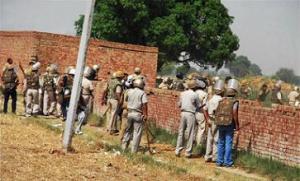
Noida farmers clash with police over land acquisition
Villages turned into police camps

चलो कि चल के सियासी मुक़ामिरों से कहें/ कि हमको जंगो-जदल के चलन से नफ़रत है

कहो कि अब कोई क़ातिल इधर अगर इधर आया/ तो हर क़दम पर ज़मीन तंग होती जाएगी

हर एक मौजे-हवा रुख़ बदल के झपटेगी…

ये खेत जाग पड़े, उठ खड़ी हुईं फ़सलें/ अब इस जगह कोई क्यारी न बेची जाएगी

[Roughly translated: Come let us tell the political gamblers/ that we hate the business of war and strife

Let us tell them that if a murderer dares to come hither/ The land will shrink with each step

Every wave of the air will turn turn against you

These fields have come alive, with the crops swaying on them

No more shall even a bed (of the field) be sold]

Though Sahir’s poem was written as a protest against war, some of these lines resonate with other, more immediately relevant matters. Ironically, Sahir was protesting against the war mongers pillaging civilain populations but here we are, with the new war mongers of our times: what else is the neo-liberal dream but that of pillage and loot of civilian populations by armed forces of civilian governments. And as they, ‘is hammam mein sab nange hain‘! [All are naked in this  in this bathhouse]:  From Buddhadev Bhattacharya of West Bengal to Mayawati of Uttar Pradesh – spokespersons all of the oppressed! And it makes little difference whether it is a BJP-led NDA government in power at the Centre or a Congress-led UPA.

Continue reading Har Qadam pe Zamin Tang Hoti Jayegi… (The Land Will Shrink With Every Step)

Firing and Repression on Factory Workers in Gorakhpur

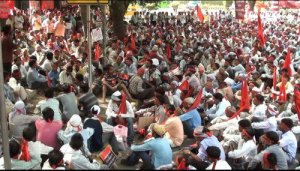
The workers of Ankur Udyog Ltd., a factory in the Bargadwa industrial area in Gorakhpur, eastern UP were attacked by goons called by the factory owner the morning of 3 May. At least seven workers were seriously injured in firing by the goons. Apparently, the factory owners of Gorakhpur have been very angry with the workers for attending the May Day rally at Jantar Mantar, Delhi and one of them suspended 18 workers as soon as they went to resume work. The workers protested against this and the factory owner sent hired goons who fired on the workers injuring 19 of them. The workers had cornered the goons inside the factory but the police came and took them away and let them free. FIRs have been registered from both sides.

may day rally
May Day rally- workers' charter movement

As the tension and repression of the factory owners and the district administration mounts, the workers have planned to go on Satyagraha from May 8 (tomorrow) and the administration is determined to not let it happen. We have received messages saying that trade union organizers fear for the life and safety of the workers and their leaders. The voice of protests from many forums and due to the incident being covered by the local media, the administration has refrained from taking any one sided action till now. But conspiracies are being hatched behind the scenes. Its not a distant reality that the leaders might be killed in fake encounters, or slapped with false charges or lynched by mobs instigated by the factory owners or Adityanath’s goons.

Continue reading Firing and Repression on Factory Workers in Gorakhpur

In Memory of the Unknown Worker, this May Day

Nations build memorials to the Unknown Soldier. A militarized imagination in which the glory  of the Nation is embodied in a nameless and faceless  figure who courts death. This  faceless Unknown Soldier must die so that the myth of the nation can live, and a mythical National Interest devastate the everyday lives of the powerless.

This May Day, let us sing to the memory of the Unknown Worker – celebrated by no one, not even in abstraction!  The faceless figure on whom rest our lives of luxury, our ‘growth’ and the profits of the bourgeois. I borrow the the term ‘unknown worker’ from  Susie Madrak.

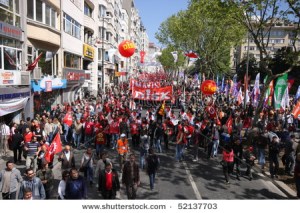
may day rally in istanbul's taksim square

Let us, we who have no nation – antinationals, postnationals, aliens, refugees, immigrants, undocumented workers, development refugees – sing the strains of the Internationale. Let us recall the days when the poetry of the International truly belonged to the ‘wretched of the earth’, the time when the Internationale was not yet taken over and made into the official anthem of nations, parties and governments. The long winter of party-state-nation appropriations of the voices of struggle, that set in more than a century ago, and once again imprisoned them, may be nearing its end.

Continue reading In Memory of the Unknown Worker, this May Day

A Few Lessons on Marxism and Politics

“At a certain point in their historical lives, social classes become detached from their traditional parties. In other words, the traditional parties in that particular organizational form, with the particular men who constitute, represent and lead them, are no longer recognized by their class (or fraction of a class) as its expression” – Antonio Gramsci, Prison Noteboooks, International Publishers, New York, 1971, p. 210. Emphasis added)

This is how Gramsci, sitting inside Mussolini’s fascist prison, began his now celebrated discussion of the ‘crisis of hegemony’. I cite this here apropos of the discussion that has gone on some of the previous posts by Monobina Gupta, Sankar Ray and myself on the CPM/Left in West Bengal, in the course of which, I have been accused of ‘coming out’ as a supporter of the Trinamool Congress, which some have also termed as a fascist or even ‘super-fascist’ organization! Clearly, these gentlemen neither know the history of fascism nor indeed of Marxism. Fed on pamphlets of a certain marxist catechism, they have learnt only one thing: the division of the world into two camps where ostensibly, battle lines are permanently drawn between parties that apparently have a ‘mandate from heaven’ of bearing a particular class character, either bourgeois or working class. I hope none of those who have learnt their ‘dialectics’ or their ‘historical materialism’ from marxism-made-easy pamphlets of Emile Burns, Maurice Cornforth and Stalin will jump to pronounce Gramsci a postmodernist who denies this supposed ‘class essence’ of parties . (I am told though that these too are passe now; ‘cadres’ these days are not meant to read beyond party resolutions and ‘theoretical’ essays of Prabhat Patnaik, whose own world has stopped with Michal Kalecki).

Continue reading A Few Lessons on Marxism and Politics

Cultures of Corruption: Kalpana Kannabiran

Guest post by KALPANA KANNABIRAN

We are a country given to idolatry – both the erection and demolition of idols a favourite pastime that buries under the rubble questions of ethics and constitutional morality.   While this penchant for idolatry raises larger questions,  I will concern myself at this point with the effigy (or the idol upside down) called corruption.

While there has undoubtedly been a marked shift in the languages of corruption in the neo liberal era, calling for new and different strategies to combat it, the fight against corruption is not new.  When women’s groups campaigned decades ago against the testing of banned drugs and contraceptives on poor people by the ICMR, the question that was raised was about the nexus between pharmaceutical companies and state actors that involved deals for which poor and vulnerable communities were pushed to the guillotine.  With Bhopal, the question came up again on the deals between multinational companies (Union Carbide in this case) and the government that violated every principle of human rights, natural justice, constitutional morality and the ethics of care in governance.  Was the derailment of justice effected without corruption at every level? Apart from providing care to the affected, was not the struggle for justice in Bhopal a struggle against corruption?  When the People’s War Group (as it was then called) abducted an elected representative two decades ago (who was later released), the reason they gave to the negotiators was that he misused public funds in the district and asserted that theirs was a fight against corrupt representatives.

Continue reading Cultures of Corruption: Kalpana Kannabiran

Did You Say ‘US Imperialism’, Prakash Karat? Sankar Ray

Guest post by SANKAR RAY

The CPI(M) general secretary Prakash Karat and the Left Front chairman Biman Bose deserve thanks for referring to the WikiLeaks revelation about the US enthusiasm in seeing a change of guard at the Writers’ Buildings, the seat of the Government of West Bengal.

Prakash Karat, CPM general secretary
Prakash Karat, CPM general secretary, courtesy rediff.com

Quoting the cable no 230353 10/20/2009, Mr Karat conveyed the gist of it as follows: “Since the May 2009 parliamentary elections elevated West Bengal’s regional party, All India Trinamool Congress, from obscurity to the second largest constituent party in the United Progressive Alliance, its leader, Mamata Banerjee, has conscientiously sought to re-brand herself as West Bengal’s Chief Minister-in-Waiting. She is using the considerable administrative resources at her disposal as Railway’s Minister, political resources as leader of the state opposition party, and personal resources to initiate this transformation. Supporters and critics acknowledge the new image, but question whether it is indeed a new product, or simply new packaging. Backed by a large parliamentary constituency and allied with the ruling Congress party, Banerjee’s Trinamool is well placed to win the 2011 state assembly elections if she can continue along her current path of self-restraint and avoid making any mistakes along the way.” For details, the reader has to visit http://pragoti.org, even though it’s unabashedly pro-CPI(M).

The CPI(M) supremo observed that the AITC brass “is very much within private outreach. I’m in no position unfortunately to investigate and tell you what they are doing to fulfill this general direction they’ve given in the cable”.

Continue reading Did You Say ‘US Imperialism’, Prakash Karat? Sankar Ray

The ‘Whore of Babylon’ – Or, Misogyny, Sexism, CPM Style

It has to be seen and heard to be believed! Former Arambagh CPM(M) MP Anil Basu , addressing an election rally in his home turf likened Mamata Banerjee to a ‘whore of Sonagachi’, who is now getting rich clients from the US to give money for her election campaign! I draw attention to this with the greatest of respect for the women  he is referring to, sex workers who work hard to make a living. When Basu refers to them, however, it nothing but a statement of  misogynist contempt for women in public and reveals, once again the mindset of the Left leadership that rules West Bengal.

Some extracts from today’s Indian Express report:

 “Addressing a rally yesterday, Basu made references to Sonagachi — Kolkata’s red-light area. “Where is she getting the money from?” he asked. “From which bhatar (Bengali derogatory slang for a woman’s “illicit male partner”) did she get Rs 24 crore to fund the Trinamool Congress’s poll expenses?”

Saying that prostitutes in Sonagachi “do not even look at smaller clients” when they get a “big client”, Basu said now that the Trinamool has got a “big client” — the USA — to fund its poll expenses, it is not interested in the “smaller clients” from Chennai, Andhra Pradesh and other places in the country.”

Continue reading The ‘Whore of Babylon’ – Or, Misogyny, Sexism, CPM Style

The Paradoxical Figure of Mamata: Monobina Gupta

Guest post by MONOBINA GUPTA

With the coming assembly elections, West Bengal seems to be poised on the edge of a historic upheaval that will, in all probability, enter the collective memory of its people, much like the momentous 1977 elections. The most palpable moment of this churning will manifest in what looks like an unbelievable denouement – that of the thirty-four year old monolithic rule of the Left Front. Equally stunning might be the image of Mamata Banerjee, bringing the red fortress down – a politician, almost bludgeoned to death by CPI-M cadres on 16th August 1990, now transformed into the emblematic face of this extraordinary hour. The 2011 polls may be billed as the great unraveling of West Bengal, its politics and culture – but also, I think, of gender relations. Banerjee is on the verge of acquiring a unique status, becoming the first woman head of a state well known for its misogynist culture, notwithstanding many claims to the contrary.

mamata banerjee
Mamata Banerjee. Courtesy The Hindu, Arunangsu Roy Chowdhury

An important aspect of Banerjee’s ascendancy may be lost if we fail to locate her persona within this grid of power and gender relations; if we do not contextualize her in Bengal’s thriving culture of male chauvinism. The association of West Bengal and its ruling Marxists with the autonomy and radicalization of women – who are supposedly respected in Bengal unlike in other parts of the country – is a well preserved myth. Bengal respects its women, but only if they belong to the hallowed league of ‘Mothers and Sisters’. Like elsewhere, ‘deviant’ women have little place in the land of the Renaissance.

Continue reading The Paradoxical Figure of Mamata: Monobina Gupta

Chronicle of a Bail Foretold: Saroj Giri

Guest post by SAROJ GIRI

Till very recently it was not possible to discuss Binayak Sen without referring to the corporate land grab and state repression in Chhattisgarh. Somehow Salwa Judum, the displacement of thousands of adivasis and the Maoist movement would come in the picture. Above all, what would come out is Sen’s work in the specific context of the suffering of the adivasis. Indeed soon after the bail order was granted, it came so naturally for Sen’s beaming wife to state that he will of course go back to resume his work in Chhattisgarh.

Upon his release from Raipur Central Jail on April 18 2011, Sen immediately called for a dialogue between the Maoists and the government and reminded us of so many other political prisoners languishing in the country’s jails. In the video showing Sen being greeted by his supporters after his release he enthusiastically joins in giving slogans saying, ‘Shankar Guha Niyogi Zindabad’. But the supporters soon after break into ‘Binayak Sen Zindabad’. You could immediately see this embarrassed look on his face, totally disapproving this iconisation.

Indeed, Sen seems very far off from celebrating his release as a major victory for democracy or a boost forIndia’s image as a modern democracy and so on. He seems really far off from the dominant discourse which seeks to cleanse the ‘Binayak Sen issue’ of the harsh realities of India’s dirty war, the inequality and the injustice towards the adivasis and their suffering. Continue reading Chronicle of a Bail Foretold: Saroj Giri

He’s Out on Bail- Time to Think Again: Dilip D’Souza

Guest post by DILIP D’SOUZA

So you’ve been following the Binayak Sen case. What now? What are the aspects and implications of the case to consider now that he is out on bail?

Here are a few that come to my mind. Your mileage may vary.

*The suspicious things Sen is supposed to have done. For example, you have heard often that Sen visited Narayan Sanyal in jail multiple times. Why, you ask. Whatever the reason, think of this: In 2006, before the first time (and indeed before each subsequent time), he wrote to the Raipur Jail Superintendent asking for permission to visit Sanyal. After this request made its way through the police bureaucracy, senior police officials in Raipur wrote to the same Superintendent saying “Central Jail Raipur mein bandi Narayan Sanyal se bhent karne ke liye Dr. Binayak Sen jaata hai to is karyalay ko koi aapatti nahin hai.” (“This department has no objection if Dr. Binayak Sen goes to meet Narayan Sanyal who is detained in Central
Jail, Raipur.”)

If the police had no objection to the visits “at the time”, why was this later an issue at all? Why have learned commenters made so much of this, hinting at dark things Sen must have been doing? One example,  note how the author of the ‘report’ says “Admittedly, the meetings took place with prior permission from jail officials”, but has let stand the implication that there was something dark going on).

Continue reading He’s Out on Bail- Time to Think Again: Dilip D’Souza

‘Anna Hazare’, Democracy and Politics: A Response to Shuddhabrata Sengupta

In an earlier post, (hits to which have broken all records on Kafila), Shuddhabrata Sengupta has raised some extremely important points in the context of the media-simulated coverage and celebrations around the ‘Anna Hazare’ movement. I agree with the central argument made by Shuddha – which is about the authoritarian, indeed totalitarian implications of the proposed Jan Lokpal Bill (though, as many commentators to the post have pointed out, the Bill really remains to be drafted and passed in parliament).

I have no doubt whatsoever that any demand that simply seeks a law of the sort that has been raised by the movement (even in the proposed form), is completely counterproductive. Indeed, it is naive. Matters like corruption or communalism cannot simply be legislated out of existence through tougher laws. Inevitably, they will lead us up to China type situations where you will end up demanding summary trials and executions. Even in the best of cases, a law and state-dependent mode of addressing such problems, adds to the powers of a corrupt bureaucracy. I also agree with his (and Bobby Kunhu’s) criticisms of some aspects of what they have both chosen to designate as ‘mass hysteria’ of sorts – I certainly do not agree with this description but that need not detain us here. I am  interested in something else here and that has to do with the way the movement has struck a chord among unprecedentedly large numbers of people – mainly middle class people I am sure, but the support for it is not just confined to them. In fact, on the third day of the dharna at Jantar Mantar I received an excited call from a CPM leader who works among the peasants in villages of northern India in the Kisan Sabha, about the response to the movement he had encountered in his constituency. I doubt that this was a support simulated either by the government or by the electronic media. Continue reading ‘Anna Hazare’, Democracy and Politics: A Response to Shuddhabrata Sengupta

Of a Few, By a Few, For the Few: Bobby Kunhu

Guest post by BOBBY KUNHU, carrying the debate on the Anti-corruption movement forward

I am distinctly uncomfortable with predictions – using either scientific or unscientific tools. For me it smacks of charlatanry – from astrology to psephology to stock market speculation. But with the charade that was unleashed for the past few days on news television by the mainstream media and of course at Jantar Mantar and a few other town squares across the “mainstream” Indian political landscape by Anna Hazare’s fast – I did dare to make an attempt – both at prediction and more comfortably with dissent. I foretold the outcome of the fast tableau at an emergency meeting that was convened by some co-travellers at the Salem Citizen’s Forum to debate on whether and how to show solidarity to Anna Hazare…

…Well, it is not just Anna Hazare and his team who won this match comfortably. All actors who joined the show have won the match. Everyone – the “civil society” that sat on fast at Jantar Mantar and other places, the Corporate media, the glamour world, the Government, political establishment of all hues and shades – everyone who bothered to join the game. It was like bathing in the Ganges during the Maha Kumbh – everyone’s sins were washed away. And of course nobody in their right minds regardless of political affiliations or ideologies could take a position “for corruption”!!! A veritable Bush-ian position — either you are with Anna Hazare or you are with corruption. And yes, India Incorporated has won the match and it is time for celebrations!

Read the full post on Countermedia