As a long-time advocate for the rights of women and their empowerment, we are used to comparing the situation of women in Kerala as a good model for women’s empowerment in all fields of life. The history of workers’ struggles and the fact that even women in the informal sector receive government benefits after retirement is a shining example to the rest of the world.
In the past few weeks, the CPM ministers, CITU leaders like Ilamaram Kareem and CPM cyber propagandists have been relentless in their attack against the SUCI, heaping on them insult after insult. The preferred insults have been ‘anarchists’ and ‘tin-pan fund collectors’. The SUCI is a small group of committed people who have however produced significant political impact. They have indeed been a thorn in the flesh of the local CPM for quite some time — from at least the anti-waste dumping struggle at the panchayat of Vilappilsala in 2012 to the K-Rail protests, the SUCI’s intrepid persistence was important in forcing the government to back off. These insults are not new either; we have been hearing them since back in 2012 or earlier. But the Kerala Asha Health Workers’ Association has been especially targeted for slander, as though they were just a tool of the SUCI.
We request the Kerala Government to take necessary actions to end the day/night strike of the Accredited Social Health Activist (ASHA) workers in front of the Kerala secretariat for the last 17 days by meeting their just demands. ASHA workers were the backbone of our valiant fight against the COVID-19 pandemic. However, their work is not acknowledged by our society or our government. The honorarium they receive is paltry compared to the important work they are doing.
It is distressing to read the news of the way in which the ASHA workers’ strike in Kerala is being handled. To say that ASHA workers are being misled by anarchist organisations, as one of your senior leaders did, is to deny their own agency as they agitate for their just demands. It is wilful forgetting of the long history of trade unionism and social activism in the state, which contributed to the famed Kerala model of development.
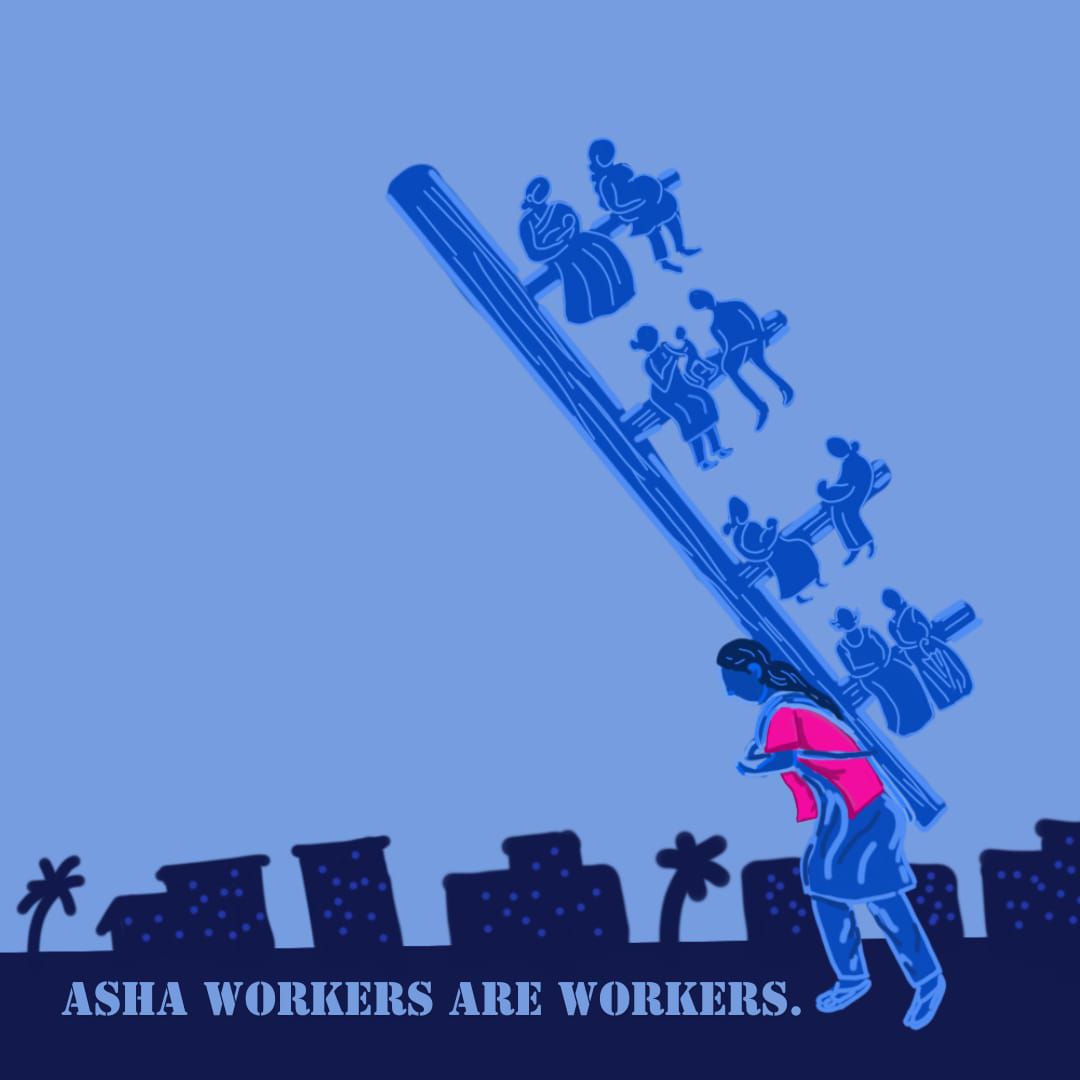
After branding the ongoing ASHA workers’ strike in Kerala, now in its third week, as ‘unnecessary’, the CPM, the leading constituent of the ruling LDF, is now proceeding to stage 2 of strike-denigrating, deploying its master-strike-denigrator — the ex-Minister and CITU leader Elamaram Kareem. This man is notorious for his anti-people stance in many earlier workers’ struggles, notably the epic struggle to end the terrible pollution of the Chaliyar river by Birla’s factory there. The full misogyny that defines the present-day CPM leadership in Kerala, as well as its reeking elitism, may be found in the ugly article that he wrote in the CPM’s organ, Deshabhimani a couple of days back. Despite the CPM’s claims about ‘women’s empowerment’, if one takes Kareem seriously, it now firmly believes that the public care work that the ASHAs do are only ‘service’ and that they are ‘not workers’.
In the democracy of our dreams, you, I and Asha workers are equal. But in this world, a (yet to be identified) person shouted at Asha workers from the first floor of the health minister’s official residence and they had to return without meeting the minister. A huge reason why the health department was praised by the world was the labour of these women. The minister’s demeanour towards them makes me wonder if she has forgotten this.
The Tamil Nadu Textile and Common Labour Union (TTCU) stands in solidarity with the ASHA workers of Kerala, whose strike has now entered its third week. As a women’s trade union we understand how difficult it is for women workers to step away from their responsibilities and take to the streets. It is never an easy decision, but one that becomes necessary when all other avenues to have their voices heard are exhausted.
ASHA workers, the backbone of community healthcare, are neither privileged nor part of the ruling class. They receive honorariums, not wages, for their essential services. This constitutes a clear instance of labor exploitation and informalisation, a practice ironically reminiscent of the current government’s own historical roots in worker strikes dating back to the 1920s. Today, Dalit, Bahujan, and Adivasi women are leading the charge in this strike, demanding recognition as workers entitled to dignified working conditions and a basic living wage.
The ASHA workers’ strike in Kerala is entering its third week. We are appalled by the CPM-led government’s apathy and the disgusting ignorance of the CPM’s own history of trade unionism displayed by their spokespersons in the media. Maybe the forgetfulness of history is deliberate, because the CPM can no longer continue to nurture even minimally the ‘party of the poor’ image that it built in the middle decades of the twentieth century. While the ASHA workers were on strike in front of the State Secretariat and an ASHA Workers’ mass meet called by the striking association drew a very large number of such workers to the capital city, the government was busy holding an investors’ meet. Such a government cannot be expected to be attentive to the needs and rights of the workers, perhaps.
On 25 January 2025, major newspapers in Kerala carried an advertorial on their front pages, styled as an imagined news feature from the year 2050. While a corner warning noted it was not actual news but a creative feature tied to a seminar by a deemed to be university, the format closely mimicked a genuine front-page report. The headline announced the ban of currency notes and a complete shift to digital currency starting February 1st, complete with fabricated names for officials such as the Reserve Bank Governor and opposition leaders. Despite slightly altered typography, the resemblance to legitimate news was convincing enough that many readers overlooked the disclaimer and were deeply alarmed.
In the past weeks, the Malayalam press has been abuzz with a case of gruesome murder — by a young, highly-educated woman named Greeshma who plotted murder to end a relationship that she did not wish to continue. In 2022, she poisoned her boyfriend who was apparently reluctant to end the relationship. He died a slow and painful death. It was subsequently found that the murder was a family conspiracy — and that the woman’s mother and maternal uncle were accomplices. The police investigation revealed that Greeshma had committed premeditated murder; the Neyyatinkara Sessions Court awarded the 24-year-old the death sentence, calling the murder “brutal, gruesome, diabolical, and revolting.”
I started writing on Kafila in 2007. I met Nivedita at a conference in Delhi where she listened to my research on sexuality and development in Kerala; she took me by the arm gently, persuaded me to start writing in a non-academic but rigorous style, and showed me the possibilities of the new medium.
This is the recording of a public discussion of a set of proposals to be submitted to the Kerala Labour and Skills Department, addressing the issues raised by the Hema Committee Report which probed the conditions of women workers in Malayalam cinema. The committee was set up in the wake of the kidnapping and sexual assault of a female actor which was allegedly orchestrated by an influential male actor as an act of revenge. Outraged by the attack on their colleague, some women actors in Malayalam cinema came together to form the Women in Cinema Collective. It was their pressure that resulted in the formation of the committee. The committee took up this truly challenging assignment and completed it in December 2019, but the Kerala government delayed releasing it till last month. Only a redacted version was released which led to an uproar about the way the government seemed determined to protect the accused men, rumoured to be the most powerful actors and others in the industry. The uproar led to resignations of powerful peddlers of misogyny and upper-caste violence in the Malayalam cinema industry — notably, Ranjith, Chairman of the Kerala State Chalachithra Academy and the en masse resignation of the executive committee of AMMA, the gatekeeping organisation set up and controlled by dominant elements in the industry. The report’s release encouraged many less-prominent female artists to complain against powerful actors. The resignation of Mukesh, actor and CPM MLA has been demanded strongly by feminists, but the CPM has refused to order him to step down.
The Althea Women’s Collective is a feminist group based in Thiruvananthapuram. This discussion is based on the proposals they intend to add to a petition to be submitted to the Kerala State Labour and Skills Department.
The Hema Committee Report has led to a welcome flurry of feminist activism in Kerala, both among the mainstream feminists as well as others. All political viewpoints within Malayali feminism have stood strongly with the WCC and sought to further their fight, with the implicit agreement that the WCC should not perceived as responsible for all further work.
Letting out one last enormous lie (sigh) that it was taking ‘moral responsibility’ for the allegations of sexual violence and harassment against the shameless men that it protected , the monster passed, with all the executive members resigning together. A new executive committee will be elected two months later by the general body, they said.
I don’t have to offer any details of what happened at Wayanad. It is the worst disaster of its kind, or perhaps of any kind, that has ever happened in Kerala. But how could it have been so unexpected to the Malayali mainstream? This is what galls me.
So Suresh Gopi, persistent in his effort to ‘take Thrissur’ (his own words), has finally managed to win the Thrissur seat in the 2024 Lok Sabha elections. I have been deluged with messages and queries from friends outside expressing shock and surprise.
Last month, on the 21st of January 2024, a young woman, an assistant public prosecutor at a lower court in the district of Kollam in Kerala, took her own life, after sending out one last desperate plea — calling for justice after her death at least. She revealed through audio clips that fighting for justice at her workplace had worn her out completely. Her words brought out the rot infecting the institution of public prosecution (the stench of it is very much in the air, actually, unbearable it has become, though our political leaders and social justice motormouths seem to largely ignore it).
Diwali, or Deepavali as it is called in the south, is a joyous occasion but this time it has brought only tears. What a bizarre Deepavali it is this year, with the awful blazing fires in the sky and the earth, with ear-splitting sound from non-stop bombing. I may not be in Gaza, but my mind refuses to leave the place and my very soul shudders each moment.

 KAFILA - COLLECTIVE EXPLORATIONS SINCE 2006