All posts by Lawrence Liang

Delhi University Restrained for Alleged Admission of Infringement: True Lies? Amlan Mohanty

Cross posting an intervention  by Amlan Mohanty from SpicyIP since it provides us with a very insightful analysis of the recent injunction obtained in the DU photocopy case. It also refers to  an anonymous link to communication which indicates what the real intent behind the case is.

Delhi University Restrained for Alleged Admission of Infringement: True Lies?

This afternoon, in response to my post announcing a petition relating to the OUP-Delhi University copyright dispute, we received a comment informing us that an order had already been passed against Delhi University a few days ago.
There was also a link to an e-mail allegedly sent to various publishers informing them of this order. The e-mail appears to have been sent from the lawyers representing the publishers. Unfortunately, this was posted anonymously in our comments section so we are unable to verify its authenticity. However, if it is in fact genuine, it raises an entire gamut of interesting questions that the future of this case will hinge upon.
Academic Publishers – An Insider’s perspective: Anonymous Contributor

I am posting an email I received this morning by someone who works at a leading multinational academic publishing house and hence wants to remain anonymous which raises very important points relevant to the ongoing debate about copyright, photocopying and the practices within academic publishing. (Thanks to anonymous contributor for this)

Also for more detailed discussions please see the following posts at spicyip by Amlan Mohanty (1, 2,) Shamnad Basheer (1, 2) and Prashant Reddy 1

Hello Lawrence,

In his Op-Ed in today’s Hindu, Sudhanva Deshpande referred to your work, and soon, I stumbled upon your articles at Kafila and the general discussion on the blogosphere. As someone who worked for a few years in a leading multinational academic publishing company, I thought I might — if this doesn’t sound too pretentious — offer some more ammunition to you. What I have to say may not be immediately relevant to the DU case, but I hope you’ll have the time to read. Continue reading Academic Publishers – An Insider’s perspective: Anonymous Contributor

Shadow Libraries

This is an article that I have written for e-flux which speaks to some of the debates that have taken place in Kafila on the photocopying case at DU. Most of the debates have been framed thus far by  legal questions and  questions of cost and access. While  ideas of cost and access are  useful for pragmatic arguments they fail to capture the delirious thrill  which marks most of our encounters with books (whether purchased, photocopied or  downloaded). In one of the comments to my earlier post Jeebesh Bagchi suggested that we should invoke the idea of shadow libraries and also the fact that our arguments should not be scared of dancing so here goes.

The original article can be found here

Shadow Libraries

Over the last few monsoons I lived with the dread that the rain would eventually find its ways through my leaky terrace roof and destroy my books. Last August my fears came true when I woke up in the middle of the night to see my room flooded and water leaking from the roof and through the walls. Much of the night was spent rescuing the books and shifting them to a dry room. While timing and speed were essential to the task at hand they were also the key hazards navigating a slippery floor with books perched till one’s neck. At the end of the rescue mission, I sat alone, exhausted amongst a mountain of books assessing the damage that had been done, but also having found books I had forgotten or had not seen in years; books which I had thought had been permanently borrowed by others or misplaced found their way back as I set many aside in a kind of ritual of renewed commitment. Continue reading Shadow Libraries

Reading the Violence in Assam: Here and There: Musab Iqbal

Guest post by MUSAB IQBAL
… the fact that violence was not merely transitional, a birthmark or a departure, but a much more general and continuous aspect of modern life – Gyanendra Pandey

1.

The misreading or out of place reading of any local and contextual issue and putting it in a wrong frame can be very catastrophic. The recent episode of violence in Assam and the fury it triggered across the country is a classic example of such misreading. But apart from the misreading this complete episode is certainly indicator of certain other phenomenon underlying our fragile society.

Moreover it looks that this is not only adding to verbal construction of abuse but also a very controlled confusion working at someone’s behest. The rally and violence in Mumbai, Ranchi, and Jamshedpur whose motivating factor was this violence happening in northeast and cross border against “Muslims”. The other episode, which adds to cynicism, is through popular newspapers in South India and in Assam publishing that Assamese will be subject to target and then under the cloud of rumor and suspicion these residents of the state is forced to run.

Continue reading Reading the Violence in Assam: Here and There: Musab Iqbal

Fair Use and Course Packs: A Comparative Perspective : Danish Sheikh

Guest post by Danish Sheikh

The first day of law school, we were handed 5 sets of non-aesthetically pleasing  spiral bound sheets of paper.  They contained a jumble of articles from eclectic sources; varied in size from a 150 pages to this-is-going-to-sprain-my-arm; and when relied on by the instructor, were absolutely indispensable.  The course packs were provided by the university at a reasonable fee, and soon became an integral part of our legal education.  True, there were occasional classes where a textbook was imposed on you by the professor, but again, it was often possible to track down a helpful senior’s tattered copy. Only if you got truly unlucky did you have to deplete your dwindling student resources to fork out money for a 500 page hardbound tome.

Continue reading Fair Use and Course Packs: A Comparative Perspective : Danish Sheikh

Oxford and Cambridge University Publishers v. Students of India

This is an op ed which was written for the Indian Express  and addresses some of the key issues in the ongoing copyright case filed against Rameshwari Photocopy services and the Delhi university. I am reposting  it here for now. It is a little truncated because of the word limit for newspapers but will post a longer version with comparisons from other countries.

Oxford and Cambridge University Publishers v. Students of India

 Accompanying a team conducting a raid against a photocopying shop outside AIIMS a few years ago a copyright lawyer had a moment of revelation akin to the apocryphal story of St Paul’s conversion  on the road to Damascus when Paul was asked by God “Why do you persecute me?”. In this case even as the photocopier was being arrested he defiantly turned to the lawyer and said “If I don’t sell these photocopies where do you think your doctors are going to come from? The lawyer in question is now a leading expert on copyright and public interest and one wonders whether a similar question posed to the lawyers representing Oxford and Cambridge University Press would evoke a similar change of heart especially if they considered their own route to becoming lawyers. The fact of the matter is that in most academic disciplines textbooks are extremely expensive and unaffordable for the average student and if one attempted to buy all the books which are prescribed for a course it would mean that only very few privileged students would afford an education in India. Continue reading Oxford and Cambridge University Publishers v. Students of India

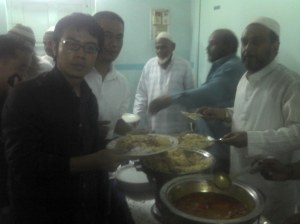
Iftar Party for Members of the North East Community hosted at Nilasandra: A Report

In the last few days the Nilasandra area in Bangalore has gained infamy across India as  it came up as the name touted over and over again as the most sensitive area in Bangalore and the one which featured in most  rumours about potential attacks against members of the north east community.

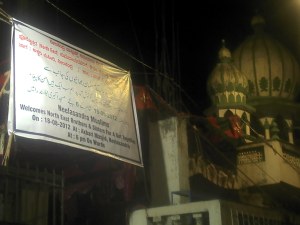
In a remarkable show of camaraderie and generosity the Muslim community called for an iftar party in the Akbari Masjid in Nilasandra and dozens of members of the north east community were invited along with members of the state administration. Over a thousand Muslims from Nilasandra, Anepalaya and Austin Town collectively vowed to safeguard the north east community living in Nilasandra.

In a touching speech one of the officials of the Akbari masjid Sadr Saab said that it was unfortunate that Nilasandra had shot to fame in this manner, and that residents of Nilasandra wanted to prove the world wrong by ensuring that there would be no violence of any kind in the days to come. A seventy year old man belonging to the Gurkha community similarly stated that he had lived for a long part of his life in Nilasandra and had never encountered anything unpleasant so far and did not expect to  in the future either.

There have also been similar exercises in trust building that have taken place in other parts of the city and lets hope that these gestures of friendship will contribute towards lessening the atmosphere of distrust and fear that currently exists.

Anonymous, India and the Blackhat Spectacle: Oxblood Ruffin

Guest post by OXBLOOD RUFFIN

If there be time to expose through discussion the falsehood and fallacies, to avert the evil by the process of education, the remedy to be applied is more speech, not enforced silence.
— Justice Louis D. Brandeis, Whitney v. California

Any discussion of Anonymous is problematic. One is never sure which Anonymous is being referenced: the meme, the group as a whole, or an individual operation. And the press doesn’t appear to know or care. It has gone into a rapturous fap over the loose knit collective, declaring them, inter alia, the most influential group in the world, terrorists, and – wait for it – very dangerous hackers. This last descriptor is particularly amusing. There are, in fact, so few real hackers within Anonymous that they could petition the U.N. as an endangered species.
Continue reading Anonymous, India and the Blackhat Spectacle: Oxblood Ruffin

Meet Ashok Kumar the John Doe of India; or The Pirate Autobiography of an Unknown Indian

The internet has been abuzz with  news of all the major ISPs in India blocking popular websites including piratebay, vimeo, dailymotion and pastebin etc. This is pursuant to a Chennai high court order available here and there are a number of unanswered questions about the validity of the blocking of the websites including whether the DOT were entitled to ask for a blocking of the site on the basis of the orders, how the ISPs chose these particular websites since the order itself does not mention any particular website. This is not to mention the larger question of how the last ten years has seen the dubious rise of John Doe orders as preemptive measure against copyright infringement.

For those unfamiliar with John Doe orders, they are ex parte injunctions ordered against unknown persons. Just to put this in context, ex parte injunctions are not the easiest things to obtain since they are based on the denial of  another person’s right to be heard. So even for cases of violence against women getting an ex parte restraining order is not easy. In contrast the last ten years we have seen the ease with which one can obtain these orders for copyright infringement cases. Continue reading Meet Ashok Kumar the John Doe of India; or The Pirate Autobiography of an Unknown Indian

When Laughter becomes a laughing matter: Statement by CSSSC Faculty Members on the Cartoon Controversy

Going by the ruckus surrounding cartoons these days, by the angry, at times violent, reactions of elected lawmakers against any kind of caricature of prominent personalities, it seems ‘laughter’ itself has become a laughing matter in contemporary India. And, this indeed is puzzling. The emerging trend of automatically equating lampooning with character assassination, of treating every expression of joviality targeting persons deputed by people to run the republic as being fundamentally slanderous and libelous, cannot but result in undermining the nation’s democratic charter.

Those who now readily question the public right to parody celebrities or icons are also guilty of forgetting that India has a long tradition of producing social and political commentaries in the form of hilarious visuals and words. The lack of sense of humour of persons at the helm of power today is so profound now that we may very soon lapse into a state of amnesia in relation to the deeply admired and dearly loved cartoonists, such as, Gaganendranath Tagore, R. K. Laxman, K. Shankara Pillai (better known as Shankar), Attupurathu Mathew Abraham (known popularly as Abu Abraham), O. V. Vijayan, Mario de Miranda (better known as Mario).

It is on behalf of the ‘little men’, from whose perspectives the celebrated cartoonists dared to make light heavy-going matters, that we condemn the somber Indian politicians’ and their lathi-wielding goons’ zeal to persecute persons committed to the cause of irony, irreverence and critical humour in public life.

Tapati Guha-Thakurta

Sibaji Bandyopadhyay                                                                     Lakshmi Subramanian

Indraneel Dasgupta                                                                        Sugata Marjit

Manabi Majumdar                                                                           Jyotsna Jalan

Dwaipayan Bhattacharyya                                                          Prachi Deshpande

PranabKumar Das                                                                           Priya Sangameswaran

Rosinka Chaudhuri                                                                        Anirban Das

Saibal Kar                                                                                           Somnath Ghosal

Bodhisattva Kar                                                                               Partha Chatterjee

Centre for Studies in Social Sciences, Calcutta (CSSSC)

May 14, 2012

Dil Se Nahin Dimaag Se Dekho – Thoughts on Satyamev Jayate Episode 1: Shohini Ghosh

Guest post by SHOHINI GHOSH

The first episode of Aamir Khan’s much publicized TV show Satyamev Jayate telecast on May 6, 2012 dealt with “Female Foeticide”. The following is a reflection of the show’s line of reasoning. Since only one out of 13 episodes has been telecast, what follows should not be taken as a judgement on the series but a response to the first episode. For reasons that I will explain later, I will use the term Sex-Selective Abortions (hereafter SSA) instead of `Female Foeticide’.

Continue reading Dil Se Nahin Dimaag Se Dekho – Thoughts on Satyamev Jayate Episode 1: Shohini Ghosh

Library.nu R.I.P

Amongst the competing visions of heaven offered by the various prophets and saints, my favourite remains the one conjured by St. Alberto Manguel. For him, heaven is a place where you can read all the books that you did not finish. It would be difficult for me – proud member of the tribe of bibliophiles- to imagine a better idea of paradise than this. I would even hazard a bet that many of you fellow tribe members would probably imagine yourself in this other world (with enough time) curled up in a  comfortable sofa, opening a copy of Joyce’s Ulysses for the 28th time – saying finally this time.

But even within the order of the saints, one must respect the subtle rules of hierarchy and pecking order, and by that count St. Manguel would have to make way for the highest ordained of them all- the blind seer who saw everything- Jorge Luis Borges, who had much earlier been granted a vision of paradise and he declared that it was shaped like a library.

Continue reading Library.nu R.I.P

All I want is war and peace

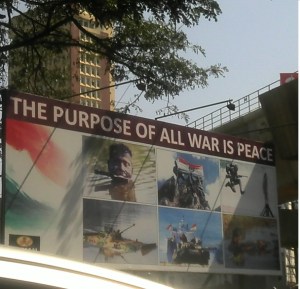
This poster on M.G.Road in the heart of Bangalore, reminded me uncannily of the lines in the marvellous scene in the Mel Brooks film To Be Or Not To Be where he sings All I Want is Peace:

The process is the bloody punishment

Sec. 153A of the Indian Penal Code – that favored child of the religious right- provides for punishment of upto three years imprisonment for the promotion by words (spoken or written) of disharmony, feelings of enmity, hatred or ill will between religious communities. The punishment laid down in this section has to one of the most redundant penal sanctions in the law since in this case the process is the bloody punishment.

There is a similar redundancy in Sec. 295A of the IPC which provides that “Whoever, with deliberate and malicious intention of outraging the religious feelings of any class of citizens of India, by words, either spoken or written, or by signs or by visible representations or otherwise] insults or attempts to insult the religion or the religious beliefs of that class, shall be punished with imprisonment of either description for a term which may extend to three years, or with fine, or with both.

Continue reading The process is the bloody punishment

Child Malnutrition in Karnataka- A Report

In light of the Planning Commission’s cruel joke of pegging the poverty level at an expenditure level of Thirty Rupees day, I wanted to bring our attention to a recent report compiled by Clifton D’Rozario in his capacity as an advisor  to the Commisioners on the right to food. The report may be downloaded from here


Continue reading Child Malnutrition in Karnataka- A Report

Beyond ‘Middle Class’ and ‘Corruption’: Jeebesh Bagchi

Guest post by JEEBESH BAGCHI

I have been thinking that If we drop “corruption” and “middle class”  we may find some other way to understand what we sense unfolding from Ramila grounds and television studios.

The term middle class has bloated so much that it now holds within it Narayan Murthy to Shekhar Gupta via Nandan Nilekani to a student in Sonepat to all people in this list and on facebook.  And on the other hand corruption seem to have bloated much further in which commissions from infrastructure deals (in lakhs of crores), commissions for arms deals, someone delaying papers, to admission costs, to a hawker buying some uninterrupted time in the street (20 rupees) is all melted down.

Could one start from some other point? Continue reading Beyond ‘Middle Class’ and ‘Corruption’: Jeebesh Bagchi

A beacon of light in the heart of darkness: SC holds Salwa Judum unconstitutional

The Supreme Court has held that the use of extra-legal armed forces in Chhattisgarh is unconstitutional. Responding to a PIL filed by Nandini Sundar, Ramachandra Guha and E.A.S. Sharma, the court’s decision turns on the nature of the Salwa Judum and  the appointment of special police officers under the Chhattisgarh Police Act. But if it were a judgment that had merely ruled on the technicalities, it would have been a welcome and competent order, but would have missed its moment of constitutional greatness. This judgment attains such greatness by virtue of its deft combination of insightful legal analysis, the articulation of a moral vision of constitutionalism and development and its sharp invocation of rhetoric (in the best sense of the term) and fiction to buttress its arguments.

Fiction, William Gass reminds us is the figure of truth. Law has always produced and promoted legal fictions and the substantive interpretation of law often rests upon on a body of rhetorical figures and scenarios. The imaginative and moral character of legal fiction can often be found wanting, but there are times when the courts produce inspired moral visions that outdo even literature. Although fiction in the manner of its making, is pure philosophy, Gass says that no novelist has created a more dashing hero than the handsome absolute, or conceived more dramatic extrications- the soul’s escape from the body, for instance, or the will’s from cause. Nandini Sundar v. State of Chattisgarh is an excellent example of the ways in which the law can productively use metaphor as legal argument (‘our constitution is not a pact for national suicide’)

There will be time in the near future to examine all the nitty gritties of the judgment, but for now lets celebrate this amazing judgment. I am reproducing some extracts which may be of interest, and highlighting some of the key metaphors that the judges use in describing the state of affairs in Chhattisgarh and India more generally. (Full text available here; .pdf, 58 pages.) Continue reading A beacon of light in the heart of darkness: SC holds Salwa Judum unconstitutional

On sedition: Sarim Naved

In this guest post, SARIM NAVED gives a chronological account of sedition in Indian law, and discusses the procedural aspects laid down for a magistrate to take cognisance of sedition

After the 1857 revolt, the Press Act of 1857 which prohibited all publications, without licensing, was passed. This Act known as Lord Canning’s Act  applied to all kinds of publication, including books in all languages and other printed papers in all languages. 1860 saw the enactment of the Indian Penal Code, which remains in force today in a relatively unchanged manner. The Indian Penal Code, while not directly dealing with the press, does incorporate provisions that impinge upon and regulate the activities of the press. The code dealt with issues ranging from offences against a person’s body or property to criminal breach of trust to offences like defamation and obscenity that directly concerned editors.  In the words of Rajeev Dhavan, “It was a comprehensive code. Not all these provisions were directed against free speech but virtually all could be used against it.” Amendments were later introduced to bring in the offence of sedition in 1870, the offence of promoting enmity between classes in 1898, the offence of outraging religious feelings in 1928 and imputations or assertions prejudicial to national integration, which were added by the government of independent India in 1972. Continue reading On sedition: Sarim Naved

Clamping down on the dissenting voice

Part 3 of a 3 part series by SIDDHARTH NARRAIN. First published on The Hoot.
 

While the Supreme Court’s decision lay to rest the debate on the scope and constitutional validity of the sedition law, the life of the sedition law is entangled with that of political dissent in the country. A brief search for reported High Court and Supreme Court cases on sedition gives us an indication of the kinds of situations where the sedition law is commonly used.

For instance, in 1967, the government prosecuted Ghulam Rasood Choari, the editor of an Agra based Urdu weekly called Ehsas for exhorting the Muslims of the country, especially the Muslims of Kashmir to violence against the government and bringing the readers of the paper into ‘hatred’ and contempt and dissatisfaction with the government (Ghulam Rasool Choari v. The State 1968 CriLJ 884).

Continue reading Clamping down on the dissenting voice

How Sedition crept into the constitution: Siddharth Narrain

Part 2 of a 3 part series by SIDDHARTH NARRAIN. First published on The Hoot

While in their Draft Constitution, the Constitutional Framers included ‘sedition’ and the term ‘public order’ as a basis on which laws could be framed limiting the fundamental right to speech (Article 13), in the final draft of the Constitution though, both ‘public order’ and sedition were eliminated from the exceptions to the right to freedom of speech and expression (Article 19 (2)).Commenting on this omission many years later, Justice Fazl Ali said: 

The framers of the Constitution must have therefore found themselves face to face with the dilemma as to whether the word “sedition” should be used in article 19(2) and if it was to be used in what sense it was to be used. On the one hand, they must have had before their mind the very widely accepted view supported by numerous authorities that sedition was essentially an offence against public tranquillity and was connected in some way or other with public disorder; and, on the other hand, there was the pronouncement of the Judicial Committee that sedition as defined in the Indian Penal Code did not necessarily imply any intention or tendency to incite disorder.

Continue reading How Sedition crept into the constitution: Siddharth Narrain

We are all seditious now, but when did this start?

I am afraid that unlike in Sholay, where the reply to Gabbar’s question and in our time, the reply to Nivedita’s question would have to be more than ‘Do sarkar’. But regardless of the rather large numbers, given the extreme nervousness which prompts a law like sedition, hopefully, they will still return to the sarkar, khaali haath.

As a part of the We Are All Seditious series, I am posting three guest posts written by SIDDHARTH NARRAIN which provides us with an overview of the history and the politics of sedition law in India.

These posts have been hosted by The Hoot, a highly recommended site for keeping track of the media in India. The first in the series looks at three major trials,  Gandhi’s trial and those of Tilak and Shiekh Abdullah. Continue reading We are all seditious now, but when did this start?