
All posts by Shuddhabrata Sengupta

Iran: Inquilab Zindabad?

Once upon a time, only a hundred or so years ago, and earlier, Iranians were our neighbours. Many were friends, relatives – uncles, grandparents, ancestors, some were husbands, wives and lovers. And cities like Delhi, Lucknow, Murshidabad and Hyderabad spoke Persian better than they spoke English, or even Hindi. The distance from Tehran and Isfahan to Delhi, Lucknow and Lahore, or across the water from Bandar Abbas to Bombay or Karachi, in miles and in the imagination, seemed less than what we can even begin to understand today.

The Bengal renaissance had one of its points of origin in a Persian broadsheet called Mirat ul Akhbar published by Ram Mohan Roy in Calcutta. The first Iranian talking film and the last ‘Irani’ restaurant both have their origins in Bombay. The Sabk-e-Hindi, or the ‘Indian Style’ continued to adorn the more ornate fringes of Persian poetry in Iran. The miniatures painted in the ateliers of Delhi and Agra owed a great deal to the paints, brushes, colours and visions of visiting masters from Tabriz. The sitar and the sarod came from Iran, and stayed on. We shared jokes and stories, poets, prophets and pranksters, wine and spices, surnames (Kirmani, Rizvi, Mashadi, Yazdi) and clan histories, heresies and wisdom and a thousand other things that neighbours, friends, cousins and lovers share.
Continue reading Iran: Inquilab Zindabad?

Remembering Tiananmen Square on the 4th of June

Twenty years ago, the dictatorship that rules China crushed a peaceful gathering of students and young people in Tiananmen Square, leading to large numbers of deaths. That day, I think I came of age, politically. It taught me, that the realities I held in the highest esteem could suddenly, over night reveal themselves to be monsters. There was no quicker way to grow up, suddenly.

I was an undergraduate student in Delhi University at that time, and a member (not overly active) of the Students Federation of India, a front organization of the Communist Party of India (Marxist). I had been following, with close interest, the events unfolding in Beijing, where what seemed to be an entire generation of students and young people had been assembling, peacefully, for more than two months, in support of political reform, openness and democracy. For me, as for many others who identified with the left in India, and elsewhere, the students movement was of enormous significance, as it pointed towards the possibility of a dynamic socialist democracy. We were buoyed by the cheerfulness of our Chinese student comrades, followed every communique, every slogan with care and affection, and said to ourselves, “see, they sing the Internationale”.

Continue reading Remembering Tiananmen Square on the 4th of June

Protests in Israel against Gaza Attacks

We are all aware of the terrible toll of unarmed civilian casualties caused by the IDF (Israeli Defence Forces) air strike on Gaza a few days ago. It demonstrates yet again the willingness of those who currently hold power in Israeli to sabotage the chances of a lasting and durable peace with the Palestinian people. There is no other way to describe these air strikes other than as acts of gross state terrorism. Bombing unarmed civilians from the skies, including children is not a solution or an answer to terrorism. It is terrorism.

Of course, Hamas, (which controls the West Bank, and whose origins lie in the cultivation by Israel of an ‘Islamist Opposition’ within the Palestinian ranks in the eighties and earlier ) with its own obduracy has contributed to the ‘blowback’ that holds the peace process in Israel-Palestine hostage to a never ending cycle of competitive retribution.

Continue reading Protests in Israel against Gaza Attacks

Thinking Through the Debris of Terror: After Bombay

Last week’s terror attacks on Bombay/Mumbai, for which there can be no justification whatsoever, have targetted railway stations, restaurants, hospitals, places of worship, streets and hotels. These are the places in which people gather. where the anonymous flux of urban life finds refuge and sustenance on an everyday basis. By attacking such sites, the tactics of the recent terror attack (like all its predecessors) echo the tropes of conventional warfare as it developed in the twentieth century. These tactics valued the objective of the escalation of terror and panic amongst civilians higher than they viewed the neutralization of strictly military or strategic targets. In a war without end, (which is one way of looking at the twentieth century and its legacy) panic is the key weapon and the most important objective.

Continue reading Thinking Through the Debris of Terror: After Bombay

‘Don’t Hold My Hand Longer Than You Need To’

There is such a thing as an exhaustion of witnessing. Glued to the television for long snatches of time over the last forty eight hours, while I watched gun battles and firestorms in Bombay, the first thing that i found failing was reason, the second thing that failed was speech, the third thing that failed was the capacity to do anything meaninful in the face of such disproportionate horror. I did nothing. I was parched, I drank a lot of tea, and water. I nursed insomnia to fitful, erratic snatches of sleep, populated by lucid dreams that smelt of cordite.

Continue reading ‘Don’t Hold My Hand Longer Than You Need To’

The Jamia Nagar Encounter: ‘Curioser and Curioser’

The well known journalist Praveen Swami, who is celebrated by some as an ‘encounter expert’ and ‘authority on terrorism’ has finally offered his comment on the Jamia Nagar encounter in the Hindu. See Behind the Batla House Encounter. It smells fresh.

Now, I really like Lewis Carrol, and am happy that Swami has invoked Carrol, Alice and Wonderland while criticising those (like me) who have chosen to take a skeptical stance towards the official handout of what exactly happened on the 19th of October in L-18, Batla House, Jamia Nagar. With due respect to Praveen Swami, lets read him in the spirit of Carrol and come to conclusions about who is Alice, who is the Red Queen and who is the white Rabbit, in due course.

It takes far more intelligence to read Swami than it must take for Swami to write like Swami. Which is disconcerting, given, that in Swamis case, he has a whole bureau full of intelligence to back him up, and all we have is the stuff between our individual ears, and occasionally our own eyes, our own ears and our own two feet. No wonder, we have to strain our credibility to believe the six and more impossible things that the police’s special cell, the intelligence bureau and its anointed experts would have us swallow whole for breakfast, with each morning’s headlines in the newspapers.

Continue reading The Jamia Nagar Encounter: ‘Curioser and Curioser’

A Little Less Melodrama and a Lot More Forensics

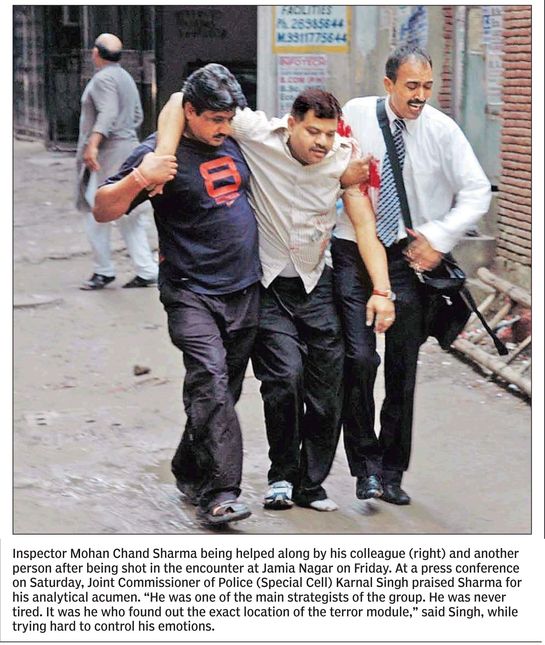
On Looking at a Photograph taken on the Margins of an ‘Encounter’

From page 3, Sunday Hindustan Times, 21 September, 2008

  Continue reading A Little Less Melodrama and a Lot More Forensics

Random Thoughts on September 14; After 5 Bombings in Delhi

Driving through the city of New Delhi after midnight, in the early hours of the 14th of September, one could have easily mistaken the eerie calm in the broad avenues that skirt the hollow centre of Lutyens Delhi as the lull of a city tranquil and asleep to itself and the world. Continue reading Random Thoughts on September 14; After 5 Bombings in Delhi

Breakthrough in Singur?

Dear all,

(Adapted from a recent post made on the Reader List)

Kafila has in the past discussed the debacle of Nandigram in West Bengal and more recently, Singur.

For the past several days, a peaceful agitation on the Durgapur expressway near the Tata Motors Factory site in Singur in West Bengal has protested against the West Bengal Industrial Development Corporation and the West Bengal Government’s decision not to engage with the demands of the farmers and others who did not voluntarily accept the paltry compensation offered to them by the WBIDC for the loss of their land or their livelihoods.

At the close of last night, the Governor of West Bengal, Gopal Krishna Gandhi announced that a solution acceptable to all (the protesting farmers at Singur and the Government of West Bengal) has been found, and that Ms. Mamata Bannerjee of the Trinamool Congress (one of the key protagonists of the Singur protest) would announce that the agitation at Singur would be suspended.

This is good news, as it demonstrates that hitherto unwilling and insensitive governments that try to ride roughshod over people in the interests of capital can be made on occasion to listen to organized and peaceful  expressions of peoples’ dissent. The CPI(M) led Left Front Government of West Bengal seems to have learnt at least some lessons from the fallout of its earlier shameful and anti-democratic conduct in Nandigram. This is welcome. It can only be hoped that the CPI(M) leadership takes stock,  learns to listen more to people, and indeed to many from amongst their own cadre who have been unhappy about the way in which their party brokered unfair land deals for Capital.

The people of Nandigram had based their struggle on what they had learnt from the earlier phase of the Singur situation. It appears today that the people of Singur have benefited from the restraint shown by a government and ruling party chastened by its mismanagement of the situation in Nandigram. The people of Singur owe their current sense of respite to a great extent to the people of Nandigram and their struggle.

Though it may be premature to call this ‘breakthrough’ a victory for peasants and working people, it is certainly reason to believe that not every struggle conducted by ordinary people over land, resources and livelihood is doomed to failure. This news should raise the hopes of all those committed to protest against unjust land aquisition and transfer moves – be they in Orissa, Haryana, Kerala, Goa, Kashmir or elsewhere.

See a PTI report in the Hindu that gives more details of the agreement.

regards,

Shuddha

Statement on Censorship in Kashmir by Reporters without Borders

Censorship and violence against press in Kashmir
Reporters WIthout Borders, 25th August, 2008

Reporters Without Borders calls on the Indian authorities to put an immediate stop to the censorship and violence against the media in Kashmir that has been prompted by a wave of protests against Indian rule. At least 13 journalists were beaten by police yesterday in Srinagar, local TV stations are being censored and a curfew is making it hard for newspapers to bring out their issues.

“This latest crisis in Indian Kashmir must not be used as a pretext for subjecting the press to more violence and obstruction,” Reporters Without Borders said. “Journalists must have all the guarantees they need, including permanent passes, to be able to work freely despite the curfew. We also call on the police authorities to investigate the violence by certain elements that have led to injuries in the ranks of the press. If no sanctions are adopted, the door will be left open for more abuses. Finally, we call for an end to the censorship of local TV stations, which is a clear violation of the right of Kashmiris to be informed.”

Continue reading Statement on Censorship in Kashmir by Reporters without Borders

“I See Kashmir from New Delhi at Midnight”

(Adapted from a posting made earlier today on the Reader-List, Apologies for Cross Posting)

Even as the Indian state seems to be on the threshold of losing its grip both on hearts and minds in Kashmir and on its own wisdom, we have our own bunch of proud patriots making a heroic effort to convert the column inches of newspapers and the floor space of television studios into their own, special, battleground. Perhaps they might be consoling themselves with the hope that the turf battle of perception management in the media may yet be won, even if Kashmir is lost. Somehow, I am not so sure that this is going to be the case.

Unfortunately for them, to win in arguments, both – the state in Kashmir, and the Indian nationalist hard liners in the media and on other public fora, need some ideas, some attempt at reason, some amount of vision. I am afraid, that so far, neither the state, nor its hyper-loyal editorialists, sound-byte commandos and cyber-footsoldiers, have been able to display any. Instead, we have had bullets in Kashmir, and as I write this, news of midnight raids, arrests and the putting in place of the machinery of a major crackdown tomorrow, on those planning to assemble to protest peacefully on Lal Chowk in Srinagar, and restrictions on the freedom of expression. It is possible that a lot will happen tomorrow and in the next few days that will not filter through on television and the newspapers. It is possible that internet connections will be momentarily ‘down’ and that phone contact with the valley may be suspended. If it is not, then it is imperative that those who are in the valley, especially journalists of major international newspapers witness and report what might happen. If the worst does not come to pass, then, everyone will be relieved, and I really hope that is the case. We must remember, that in 1989-90, major massacres took place in Srinagar and in the rest of India, nobody really knew what was going on before it was too late. It is not as easy today for the Indian state to replicate the news blackout that accompanied the crackdown that took place in 1989, but certainly, the signs are that there might just be an attempt to do precisely that underway.

The PTI report quoted in a story just uploaded on the Indian Express website an hour before midnight, yesterday, 24th August, makes for chilling reading, especially if we read between the lines. It deserves being quoted in its entirety.
Continue reading “I See Kashmir from New Delhi at Midnight”

Gun Salutes for August 15, 2008

Anniversaries are good opportunities for reflection. I write this in the early hours of 15th August, 2008, the 61st anniversary of Indian independence.

The events of the past few months, and the past few days, in the Indian administered state of Jammu and Kashmir have demonstrated how well and how equally (or not) the police, paramilitaries and armed forces of the Indian Republic treat different kinds of protesting crowds. The facts that I am about to discuss are good measures with which to think about the relationship between acts of power, different kinds of people, sovereignty, life and death in the Indian nation state as it has evolved over the past 61 years.

The region of Jammu in the province of Jammu and Kashmir has been caught in the grip of a fierce agitation against the revocation of the land transfer to the Amarnath Shrine Board. We have all seen footage of angry SASS (Shri Amarnath Sangharsh Samiti) activists brandishing trishuls, setting up roadblocks and burning tyres, the agitation has spread to different parts of India

Continue reading Gun Salutes for August 15, 2008

The Rest of Now

My colleagues (Jeebesh Bagchi and Monica Narula) and I (as Raqs Media Collective) have been working over the last year on curating an exhibition titled ‘The Rest of Now’ which opened recently as part ofManifesta 7in the town of Bolzano/Bozen in northern Italy. Manifesta is an itinerant biennial of European contemporary art. I am posting below our curatorial essay, which may be of interest to some amongst you, and look forward to your responses.

The Rest of Now
by Raqs Media Collective

1.

A hundred years ago, Filippo Tommaso Marinetti, artist, poet and high priest of a muscular industrial aesthetic, was seriously injured in an automobile accident on the outskirts of Milan.  Continue reading The Rest of Now

Farewell to our Humid Weimar

Dear All,

I find it sad that all those who live in India are being sent headlong into a period of turbulence following the unilateral  decision by the so-called Left parties in response to the Indo-US  Nuclear Deal to withdraw support from the UPA government. This decision is not a response to basic issues like the rising cost of living, but in support of the chimera of ‘sovereignty’ in military affairs. It is shameful that parties that continue to call themselves communist should feel no embarassment at all in exhibiting the worst and most pathetic form of militarist nationalism, premised on the maintainance of an obscene Nuclear military policy. In all likelihood, if the government of the day fails  to pass the test of numbers on the floor of parliament, India will head straight for early elections.It will do so entirely because of the ‘Patriots’ on the so called ‘Left’. Continue reading Farewell to our Humid Weimar

The Hyde Act and the 123 Treaty

I have for a long time wondered about the noise that constantly gets made on the possibility of an Indo-US nuclear deal. And recently, for quite unrelated purposes, had to do some thinking on this for a posting on the Sarai Reader List. I thought that the substance of what I had to say in that posting, might be of interest to Kafila readers. So apologies for cross posting of this material, which has appeared previously on the Reader List.

Now, what is the Hyde Act, what exactly is the 123 Treaty? These matters need a little clarification.

The Hyde Act, or, the Henry J. Hyde United States-India Peaceful Atomic Energy Cooperation Act of 2006, to give the act its full title, is a piece of legislation, introduced by Congressman Henry Hyde, passed by the US Congress, which creates the legal basis for co-operation between the United States and India. See the Wikipedia articles on the Hyde Act and the 123 Agreement. Continue reading The Hyde Act and the 123 Treaty

Statement on Taslima Nasreen

Public Statement by Forum For The Protection of Free Speech and Expression

At a time when India is projecting itself on the
world’s stage as a modern democracy, while it hosts
international literary festivals and book fairs, the
Government of India, most mainstream political parties
and their armed squads are mounting a concerted
assault on peoples’ right to Free Speech.

It is a matter of abiding shame that even as some of
the world’s best-known writers were attending the
Jaipur literary festival and prestigious publishers
were doing business at the World Book fair in Delhi,
the exiled Bengali writer Taslima Nasrin was (and is)
being held in custody by the Government of India in an
undisclosed location somewhere in or around Delhi in
conditions that amount to house arrest. Contrary to
misleading press reports stating that her visa has
been extended, her visa expires on the 18th of
February, after which she is liable to be deported or
remain confined as an illegal alien. Continue reading Statement on Taslima Nasreen

Arundhati Roy on Taslima Nasreen and Nandigram: Interview with Karan Thapar on IBNlive.com

As we have been discussing both Nandigram and the situation that Taslima Nasreen has found herself over the last few weeks, I thought that it might be interesting to listen in on a conversation that Karan Thapar has had with the writer Arundhati Roy that takes on both these questions. This interview was broadcast today on CNN IBN.


Transcript of Arundhati Roy interviewed on the treatment of Taslima Nasreen by Karan Thapar on ‘Devil’s Advocate’, broadcast this evening on CNN-IBN

The transcript was published on Sun, Dec 02, 2007 at 20:32, on the IBNlive.com website

A video of the interview is also available on the website.

———————————————

Hello and welcome to Devil’s Advocate. How do India’s leading authors respond to the treatment given to Taslima Nasreen over the last 14 days? That’s the key issue I shall explore today with Booker Prize- winning novelist Arundhati Roy.

Karan Thapar: Arundhati Roy, let me start with that question. How do you respond to the way Taslima Nasreen has been treated for almost 14 days now?

Arundhati Roy: Well, it is actually almost 14 years but right now it is only 14 days and I respond with dismay but not surprise because I see it as a part of a larger script where everybody is saying their lines and exchanging parts.

Continue reading Arundhati Roy on Taslima Nasreen and Nandigram: Interview with Karan Thapar on IBNlive.com

The Sword and the Monk’ s Cowl: Curfew in Kolkata

“Instead of society having conquered a new content for itself, it seems that the state has only returned to its oldest form, to a shamelessly simple rule by the sword and the monk’s cowl. “

-Karl Marx, The 18th Brumaire of Louis Napoleon

We live in strange times. Really strange times. Just as the news from Kolkata was getting better, it got worse again.The sudden spectre of ‘communal rioting’ has reared its head, as if from nowhere in West Bengal. The All India Minorities Forum, a little known entity led by a busy body called Idris Ali materialized yersterday on the streets of Kolkata demanding the deportation of the exiled Bangladeshi writer, on the grounds that she had once injured the sensitivities of Muslims. Crowds attacked police, pitched street battles continued, the Army was called in. Curfew was declared, and on television, Biman Bose, a CPI(M) and ‘Left’ Front hatchet man, declared – “… if her stay creates a problem for peace, she (Nasrin) should leave the state” (see NDTV report at the end of this posting)

Continue reading The Sword and the Monk’ s Cowl: Curfew in Kolkata

A little Biology, A little Arithmetic, A lot of Politics: Sudhanva Deshpande on Nandigram, again

Dear Sudhanva,

*A Biology Lesson*
The discussion on Nandigram is heading in interesting directions across lists and blogs, (even as the Army walks the talk in Kolkata tonight) and I find this situation of accumulating discursive intensity actually very productive. Let a hundred rejoinders blossom, and a few good schools of thought contend. So I welcome your rejoinder and criticism of my text. And I for one, stand chastised by your incisive criticism of my posts (responding to your earlier writing) on the reader-list, and on Kafila.

Continue reading A little Biology, A little Arithmetic, A lot of Politics: Sudhanva Deshpande on Nandigram, again

All those who do not sleep tonight

Dear all, (apologies for cross posting on Reader List)

Sometimes I wonder whether, when I use the phrase ‘rentier cultural apparatchiki’ it actually describes faces, real people, or is it just an abstract category, that one deploys in anger and sadness.

Well, em, here are some faces, some names – people we meet, say hello to, read the books of, see the art of, watch the films of…

As the weather turns in Delhi, we will meet them more often, there will be soirees, readings, screenings, exhibition openings, so much fun in the winter whirlwind, and they will turn up – two by two, or one by one,
and in the silence between us will hang the heavy weight of the name of a place called Nandigram.

Read these names, read them carefully –

Irfan Habib, Prabhat Patnaik, Utsa Patnaik, Shireen Moosvi, Jayati Ghosh, Indira Chandrasekhar, Rajen Prasad, Arjun Dev, D.N. Jha, Vivan Sundaram, M.K. Raina, C.P. Chandrasekhar, and Saeed Mirza.

Continue reading All those who do not sleep tonight

Nandigram Redux: Reading Sudhanva Deshpande

It is interesting to witness the spin doctoring of the CPI(M) come into play once again in the wake of the renewed violence in Nandigram, which in CPI(M) newspeak is now being called ‘a transition to peaceful conditions’ .

Recently, I have had the opportunity to read the seasoned voice of one of the leading ‘cultural’ lights of the Consolidated Promotors of India(Militant) in Delhi, Comrade Sudhanva Deshpande, on Nandigram Redux, on an extended posting made on Pragoti.org,

I urge you all to read Sudhanva Deshpande’s text as a window into the amazing felicity with which the Consolidated Promotors of India (Militant) constructs the edifice of its positions.

In this posting, I intend to subject Comrade Deshpande’s text to some close reading. I am writing this in order to respond especially to the work that Aditya Nigam is doing in keeping the question of Nandigram alive on Kafila.I have relied extensively on reports, news and analysis on an excellent archive-blog – Sanhati – for a great deal of the material for this posting. Continue reading Nandigram Redux: Reading Sudhanva Deshpande