All posts by Nivedita Menon

JNU – The State of the University: JNU Teachers’ Association

Report prepared by Jawaharlal Nehru University Teachers’ Association

 (October 7, 2025 – updated version of report first released in September 2023)

Jawaharlal Nehru University (JNU) has suffered terribly under the effects of the concerted attack it has faced since February 2016. The vicious campaign slandering the image of the institution, its faculty, and its students, that was unleashed at that point of time was only the beginning of a long drawn process of sapping the institution of the vital energies that underlay its remarkable achievements and earned the institution such great prestige across the country and the world. What followed that attack has been a systematic process of undermining the institution from ‘within’, with the office of the Vice Chancellor serving as its hotbed. The current and the previous occupant of that office have shared the responsibility for this. Even as old wounds continue to fester, new injuries continue to be inflicted on the institution’s body politic – whereby JNU is being subjected to a process of death by a thousand cuts. This is happening despite the current Vice Chancellor being an alumna of the University.

In the last one decade, the terms ‘governance’ and ‘leadership’ have been turned on their heads to acquire rather ominous meanings, whereby they have in effect become synonyms for their antonyms. From being a ‘public’ institution in which the quest for knowledge and learning in all its dimensions thrives through the lives of its students and faculty, the University has been steadily pushed in the direction of being reduced to being an expression of the Vice Chancellor’s persona, into a fiefdom in which the writ of the occupant of that office reigns supreme. Displaying utter contempt for institutional norms and statutory provisions that made for democratic self-governance and orderly functioning, a centralised, arbitrary and dictatorial mode of (mis)governance was put in place, which tolerated no questioning of decisions. Currently, the JNU Administration under the leadership of the Vice Chancellor is waging a war against the University faculty. Continue reading JNU – The State of the University: JNU Teachers’ Association

The hopeless quest for a pure incorruptible knowledge – decoloniality and its discontents

[This post by Nivedita Menon is the fourth essay of the series in Kafila titled Decolonial Imaginations. Links to the previous essays are given at the end.

The terms ‘decolonization’ or ‘decolonial’ have become quite critical now, given that the impulse of justice lies at the core of these concepts. Neither postcolonial nor decolonial perspectives are compatible with right-wing ideologies but the fact that Hindutva ideologues in India and the rightwing globally are now trying to appropriate that language makes it seem to some that the very idea of the postcolonial or decolonial is suspect. We believe that this demonizing of decolonial theory from a position defensive of the European Enlightenment needs to be unpacked in the interests of a mutually productive debate. Kafila will be publishing a series of interventions on what the idea of the decolonial imagination involves, locating decolonial theory as speaking from the margins, drawing attention to identities which the orthodox Left subsumed under ‘class’ and which the rightwing in India seeks to assimilate into Brahminism. Additionally the orthodox left’s rejection of spiritual beliefs and inability to engage with them is also a factor that may have produced the space for right wing appropriations of a field marked “religion”. 

We hope that these interventions will clear the ground for productive conversations on the left rather than polarised and accusatory claims.]

Introduction

As Hindutva ideologues and the rightwing globally, appropriate the idea of “decolonising”, it seems to many opposed to these trends, that scholarship around decoloniality is itself the problem. Such arguments tie in with earlier ongoing attacks on postcolonial scholarship since the 1990s that virtually accuse it of directly contributing to the rise of the right. Decolonial scholarship is relatively a new arrival in the Anglophone world (since the 2000s), and ever since the rightwing started using that language, the same charges are laid at its door as well. Indeed, the implication (and sometimes outright allegation) is that decolonial/postcolonial scholars were secretly rightwing all along.

This charge I will address in a somewhat different way in the first section, by way of analogies with other bodies of knowledge.

The second section will address another related critique of decolonial thought, that it is “merely epistemic” and does not consider the materiality of structures of power

Finally we will ask the question – when Hindutva claims to be “decolonising”, what is it doing exactly? Continue reading The hopeless quest for a pure incorruptible knowledge – decoloniality and its discontents

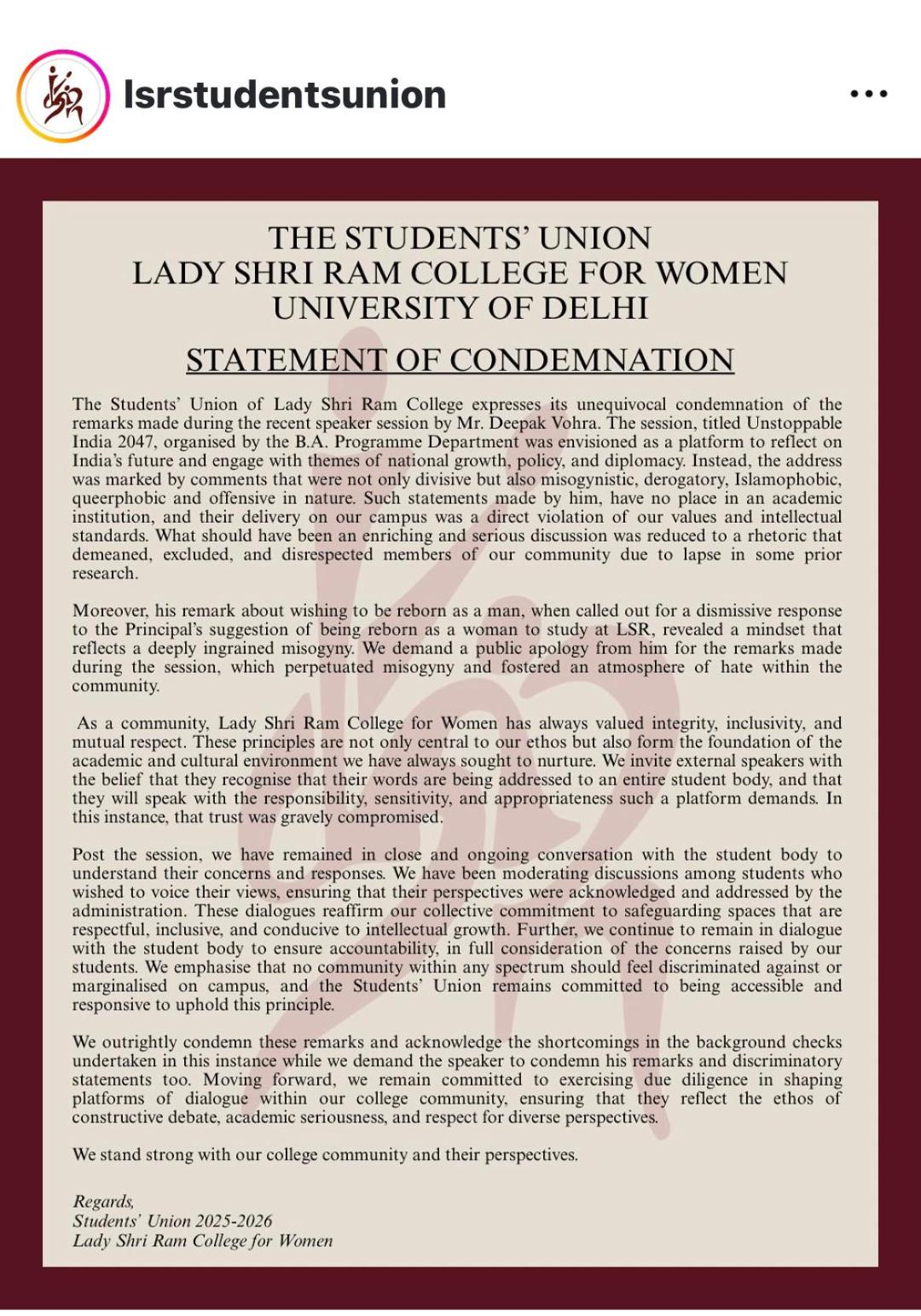
Lady Shri Ram College Students’ Union statement on former diplomat’s remarks

LSR graduates express outrage at former diplomat’s comments at the college

Over 500 graduates of Lady Shri Ram College (University of Delhi),  released a statement of outrage at the communal and misogynist statements of former IFS officer Deepak Vohra at an event held at the college on September 11, 2025

The statement and full list of signatories is below.

As proud alumnae of Lady Shri Ram College across the globe, we condemn the recent episode concerning Deepak Vohra in the strongest possible terms and call upon the college, and its senior management to explain how this came to happen.

This week, Lady Shri Ram College invited a retired diplomat Deepak Vohra, who freely articulated misogynist and communal views without being challenged at a lecture on college premises. He made openly anti-Muslim comments, told the young women in the audience that their roles were primarily that of mothers of future citizens, directed wholly inappropriate remarks to the principal of the college from the stage thereby insulting also the institution she heads.  And yet, there was no censure or objection expressed at the event itself and students were not even allowed to walk out in protest.

Lady Shri Ram College (LSR) is not simply an undergraduate women’s college, it stands for a vision of a world in which women have space to explore their interests and capabilities and rests on the legacy of a newly democratic India that chose to make world class higher education accessible to women from a diversity of backgrounds. LSR as an institution exists to actively enable such a vision. Despite the deeply patriarchal contexts many students come from, LSR gives them the space to experiment with ideas, explore freedoms, be inspired by other women, all outside the constant censorious gaze of men.  The teaching in the classroom has always been of an excellent standard, and outside it, there are a host of enrichment activities that makes an LSR education the well-rounded experience it should be. Continue reading LSR graduates express outrage at former diplomat’s comments at the college

Anti-colonial Thought and the Global Right – An untenable alliance: Ishan Fouzdar

Guest Post by ISHAN FOUZDAR

[This post is the third essay of the series in Kafila titled Decolonial Imaginations. Links to the previous essays are given at the end.

The terms ‘decolonization’ or ‘decolonial’ have become quite critical now, given that the impulse of justice lies at the core of these concepts. Neither postcolonial nor decolonial perspectives are compatible with right-wing ideologies but the fact that Hindutva ideologues in India and the rightwing globally are now trying to appropriate that language makes it seem to some that the very idea of the postcolonial or decolonial is suspect. We believe that this demonizing of decolonial theory from a position defensive of the European Enlightenment needs to be unpacked in the interests of a mutually productive debate. Kafila will be publishing a series of interventions on what the idea of the decolonial imagination involves, locating decolonial theory as speaking from the margins, drawing attention to identities which the orthodox Left subsumed under ‘class’ and which the rightwing in India seeks to assimilate into Brahminism. Additionally the orthodox left’s rejection of spiritual beliefs and inability to engage with them is also a factor that may have produced the space for right wing appropriations of a field marked “religion”. 

We hope that these interventions will clear the ground for productive conversations on the left rather than polarised and accusatory claims.]

Introduction

Anti-colonial thought is under attack. Some scholars have accused decolonial and postcolonial theories of nativism. Interestingly, the phenomenon that provoked this accusation is stranger than the accusation itself. The global North and the global South have witnessed an unlikely alliance of anti-colonial rhetoric and right-wing discourse. While the Hindu Right in India deems Muslims to be colonial invaders, the Right Wing in Europe constructs the influx of refugees as a colonial invasion, which will lead to a ‘great replacement’ of White Europeans by West Asian and African refugees. The solution – ‘decolonise’ by expelling the colonisers and reviving the ‘glorious’ ‘indigenous’ past. This invokes several questions: How do European right-wing groups lay claims on decolonisation? Are there common links between these right-wing ‘decolonisation’ projects? More importantly, does the presence of anti-colonial language in right-wing discourse automatically translate to the conclusion that postcolonial and decolonial theories are inherently nativist?

I undertake two broad tasks. First, I lay forth the ‘anti-colonial’ rhetoric of these right-wing projects. Secondly, I condense their similarities and use them to show why anti-colonial thought should not be seen to be irredeemably polluted by this misappropriation.

Before I trace the right-wing appropriation of anti-colonial language, a caveat about the usage of the terms anti-colonial, postcolonial and decolonial is in order. I use anti-colonial thought to broadly bundle postcolonial and decolonial theories. The reason being that both theoretical schools present varying critiques of the socio-cultural and intellectual legacies of colonialism. The difference in the kind of critique separates postcolonialism from decolonial theory. Continue reading Anti-colonial Thought and the Global Right – An untenable alliance: Ishan Fouzdar

The Man Who Died at Gate Number Three: Avantika Tewari

This is a guest post by AVANTIKA TEWARI

It was night when the man died.

In the thick, humming night of a city that never truly sleeps — only flickers. Flickers between traffic signals and app pings, between delivery promises and the quiet violence of exhaustion.

He collapsed just beyond Gate Number Three in a residential colony in Delhi, somewhere between the parked dumpers and the weary under-construction site of the Metro.

He fell softly, without spectacle. The kind of death a city absorbs without noticing, like rain into dust.

In a few days, the Resident Welfare Association had drafted a statement — not out of grief, but out of inconvenience: “What if it had been one of us?”

The question hung in the air like a perfume of moral panic. A swift and bloodless message was delivered — the dumpers, it was agreed, would no longer be stationed near Gate Number Three. Continue reading The Man Who Died at Gate Number Three: Avantika Tewari

Urgent Call for Peace by Indian and Pakistani Feminists​

The ceasefire is just the first step in the long walk to justice and peace​

In a show of historic cross-border feminist solidarity for peace, over 10 organizations and approximately 1000 people have come together to issue a powerful statement calling for immediate de-escalation, dialogue, and justice in the wake of renewed hostilities between the two nations. The signatories include feminists, peace activists, artists, journalists, academics, students, grassroots organizers and  other professionals from India and Pakistan.

11 May 2025

We, feminists from India and Pakistan, unequivocally welcome the ceasefire declared by our two nations today. The tension and escalation of the last fortnight remind us of how fragile peace is. The ceasefire is also a vindication of calls for de-escalation and peace by lakhs of ordinary people on both sides of the border. Even as we hope this indicates an absolute cessation of hostilities, we recall the recent events. 

We condemn the terror attack in Pahalgam that killed 25 tourists visiting Kashmir from different parts of India and one from Nepal. One local person also lost his life in the Pahalgam attack. The targeted attacks deepened the communal divide between Muslims and Hindus in India and were exploited to incite hatred, fear, and calls for collective punishment.

In the aftermath of the Pahalgam terror attack, it is the women—including as mothers, daughters, sisters, wives—who are left holding the unbearable weight of grief. Instead of respecting and sharing it, it has been weaponized and policed—especially when it refuses to follow the script of hate. Himanshi Narwal, the young widow of one of the slain victims, was among the survivors who amid unimaginable pain still found the strength to appeal for peace. She asked people not to direct their rage against Kashmiris and Muslims who, like her, are trapped in a cycle of violence they did not create. For that simple act of humanity, she has been trolled, vilified, and attacked by chest-thumping nationalists more committed to blood lust than truth. 

Continue reading Urgent Call for Peace by Indian and Pakistani Feminists​

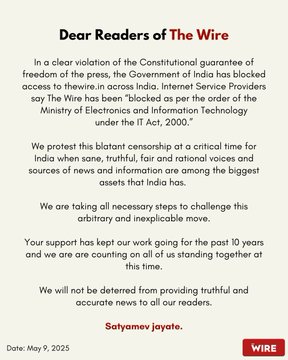
Condemn censorship – The Wire’s website blocked

Citizens of a democracy have the right to information even during times of conflict and war. The Wire has been one of the few news news portals left over these years of state repression, that has stood firm, carrying out this responsibility ethically and courageously.

Today the Editor Siddharth Varadarajan issued a statement on the blocking of access to The Wire by the government of India.

While television channels ignite themselves with mindless jingoism and bloodthirsty rants, even irresponsibly carrying out real time coverage of operations putting lives of armed forces and civilians in danger, what has been banned? The news portal that has seriously and quietly carried out the task of purveying information and analysis, in this difficult time.

A strong statement has been issued by DIGIPUB News India Foundation, of which The Wire is a founding member, and the declared objective of which is to “help ensure the creation of a healthy and robust news ecosystem for the digital age. “

The statement reads:

DIGIPUB strongly condemns the blocking of The Wire’s website
DIGIPUB’s founding member The Wire has released a statement on Friday, May 9 stating that the access to their website has been blocked by some Internet Service Providers following government orders. One of the ISPs says the block has been done by the Ministry of Information and Broadcasting under the IT Act, 2000.
If the Indian government has indeed blocked access to The Wire, then it is a blatant attack on press freedom. Silencing independent media doesn’t protect democracy—it weakens it.
This is a critical time for the nation and such actions impede rational thinking. The urgency and horrors of battle cannot be used as an excuse to silence independent journalism.
A free media is the best antidote to misinformation and fake news, DIGIPUB strongly condemns this attempt to suppress journalism. We demand the immediate reversal of such censorship, the orders for which have not even been made public. The Indian Government must uphold constitutional values of free speech and restore unrestricted access to independent media—democracy cannot survive in silence.

As a collective, Kafila stands in solidarity with The Wire and calls upon all democratic forces and voices to speak up against censorship, to stay calm and united for peace, and to reject and resist the bloodthirsty politics that has brought the region to the edge of catastrophe. We join our voices with other citizens of Southasia calling on both governments to de-escalate tensions, turn decisively towards diplomacy and ensure peace in the region.

Concerns arising from the suicide of Atul Subhash – A feminist response: Naveddu Nilladiddare, Karnataka

Statement by Naveddu Nilladiddare, Karnataka, a state wide network of organisations and individuals concerned with issues related to women and all human rights

The tragic suicides of Atul Subhash and police constable, Tippanna Alagur in Karnataka have once again given rise to volatile debates on the ‘misuse’ of the laws related to gender violence specifically the (erstwhile) IPC 498 A and the Dowry Prohibition Act. It has provoked a PIL in the Supreme Court that seeks reform of these laws to “prevent harassment of Innocent husbands.”  It has also given space for irrational and dangerous fears being unleashed by men’s rights organisations and a sensational media about “greedy and exploitative” women who are a threat to the institution of the family with their rapacious demands for maintenance and alimony. Even the Home Minister of Karnataka has legitimised these fears stating that the suicide has “opened up a debate about men’s rights” in the country.  These statements and debates betray an ignorance of the processes of law in addition to a denial of violent patriarchy that continues to impact on the lives and deaths of women and men. 

Continue reading Concerns arising from the suicide of Atul Subhash – A feminist response: Naveddu Nilladiddare, Karnataka

Salaam Anita! 1958 – 2024

Anita Ghai with friends on her birthday in 2021

Anita Ghai (October 23, 1958 – December 11, 2024) psychology scholar and practitioner, feminist and disability rights activist, taught at Jesus and Mary College, Delhi University, for about three decades, then moved to Ambedkar University Delhi, from where she retired as Professor. She is the author of (Dis)embodied Form: Issues of Disabled Women (2003), Rethinking Disability in India (2015) and a significant edited volume Disability in South Asia: Knowledge and Experiences (2018)

How much I learnt from you, Anita my friend, and how am I performing this unthinkable task of writing your obituary! I feel as if I am writing this for you to read, for you to be gently critical about, because for sure I would have missed a nuance or two while writing about the points at which gender and disability intersect, for you cannot be written about without reference to your thinking and your scholarship. About three decades ago you sought me out to have a conversation on disability, and that destablizing  conversation never ever ended. You blew open my theoretical horizons by introducing me to the field of Disability Studies, to the idea of decentering disability from a medical to a social model, to the idea that we are not divided between abled and disabled bodies, but that we all occupy a continuum of being Temporarily Abled Bodies. A sudden fracture, an illness, and within a split second you move from abled to disabled body. You wear spectacles, your hearing is mildly impaired, you have that problem in bending your wrist because of a childhood fall – each one of us is on that continuum. Continue reading Salaam Anita! 1958 – 2024

Freedom, not surveillance! Reclaim the Night Campaign Kolkata responds to measures suggested by the West Bengal government

Statement by Reclaim the Night Campaign, Kolkata 

‘Reclaim the Night’ is a mass movement demanding justice for the RG Kar rape and murder incident. It has united many people across West Bengal, across the country and even outside India in several places. It has brought people out onto the streets, united them in rage, and one could say it is making – not “history” – but her/queer/trans* story. This movement has brought school and college students, women working in call centres, nurses, doctors, health workers and women working in several other sectors out onto the streets to protest. Women from many villages and rural areas have added their voices to this movement and thousands upon thousands of people have occupied the streets at night, throughout the night, till the wee hours of morning. Muslim women have stepped out to reclaim the streets in several areas and Trans- queer persons have taken part and brought forward their demands. Everyone’s participation has really lifted ‘Reclaim the Night’ to a different height.

Our main objectives are to secure justice in all unresolved cases of sexual violence, including the RG Kar incident, and to secure safety and freedom for women and communities of marginalized genders/sexuality everywhere and at all times. We extend solidarity to all those who are working towards achieving this goal.

From what the combined voice of the movement has upheld, we wish to respond and clarify our standpoint regarding the statement made by Alapan Bandyopadhyay, Chief Administrative Advisor to the Chief Minister, Mamata Banerjee.

Continue reading Freedom, not surveillance! Reclaim the Night Campaign Kolkata responds to measures suggested by the West Bengal government

Vinesh Phogat – You are our champion! Feminist Solidarity with Vinesh

प्यारी विनेश,


बधाई हो!!


तुम हारी नहीं हो, तुम तो हमारी हीरो हो और बनी रहोगी। कल तुमने पेरिस में करके दिखा दिया कि असल में तुम क्या हो। तुम्हारी दक्षता का कोई मुकाबला नही है, और तुम्हारे लिए कोई ऊंचाई ऊंची नहीं है।


इस अयोग्य घोषित किए जाने से मायूस मत होना। हम समझते हैं कि वजन का ध्यान रखने की ज़िम्मेदारी तुम्हारी नहीं थी। इस बात की जांच होनी चाहिए कि इसमें गलती कहाँ और किससे हुई है। हम तुम्हें अयोग्य घोषित किए जाने के लिए अपना विरोध व्यक्त करते हैं और यह कहना चाहते हैं कि तुन इस वक़्त बिल्कुल दुखी मत होना।


तुम ऊंची उड़ान भरती रहोगी, उम्मीद मत छोड़ना। तुम हमारी हीरो हो और बनी रहोगी।


पेरिस से लौट कर जब आओगी तो हम सब जंतर-मंतर पर एक बार फिर मिलेंगे और फिर जश्न मनाएंगे तुम्हारी सफलता का।


मेडल मिलना, नहीं मिलना, जीत का पैमाना नही है। सफलता औऱ जीत का पैमाना तुम्हारी दृढ़ता और हिम्मत है l


भारत के और दुनिया भर के न्याय-प्रिय  और नारीवादी साथी तुम्हारे साथ हमेशा थे, हैं और रहेंगे! ✊🏽


हम हैं,

Dear Vinesh,


Congratulations!!


You have not lost. You are our hero and will remain so. Yesterday in Paris you showed what you really are. Your skill is unmatched and there is no height that you can’t scale.


Please don’t be disappointed by this ‘disqualification’. We understand that it was not your responsibility to take care of your weight. There should be an investigation as to where and by whom the mistake has been made. We express our protest against your disqualification and would like to request you not to feel sad in this moment.


You will keep flying high, do not lose hope. You are and will remain our hero.


When you return from Paris, we will all meet once again at Jantar Mantar and celebrate your success.


Winning a medal or not is not the measure of victory. The measure of success and victory is your determination and courage.


Justice-loving and feminist saathis of India and around the world were, are and will always be with you! ✊🏽


We are 


Endorsed by: Continue reading Vinesh Phogat – You are our champion! Feminist Solidarity with Vinesh

Anti Muslim violence after June 4th election results: APCR

Report prepared by Association for Protection of Civil Rights

Although the BJP came back with a much reduced majority (or perhaps because of that) the agenda of anti Muslim violence has been ramped up.  We, the people of India, who restored the dignity of the Constitution, must continue to bear witness, continue to fight against the hate filled politics of Hindu Rashtra, continue to assert  – Not in My Name.

Sab yaad rakha jayega, as the poet Aamir Aziz says.

We will remember these names, and the names of thousands of Muslims killed by lynch mobs, who have had their livelihoods destroyed, whose faith has been insulted, who suffer imprisonment without any basis till today.

Sab yaad rakha jayega.

There has been total of eight lynching incidents after the results of the General Elections were announced on June 4, 2024.

  • Twenty-three-year-old Salman Vohra, who had gone to watch a cricket tournament match in Chikhodra, Gujarat on 22 June, was mercilessly beaten to death by a group of men.
  • Three Muslim men, residents of Uttar Pradesh, were brutally attacked by a Hindutva mob in Chattisgarh’s Raipur on 7 June. Saddam Qureshi and his cousin Chand Miya Khan (23), both from Saharanpur district, and Guddu Khan (35) from Shamli district, were transporting cattle when they were allegedly chased by a mob in Raipur; two died on the spot, while one died after 10 days.

Continue reading Anti Muslim violence after June 4th election results: APCR

The National Testing Agency is a scam – shut it down now! Ayesha Kidwai

Guest post by AYESHA KIDWAI

UPDATE: A followup to this article has been published in The Wire.

Below we share a compilation of  two Facebook posts by AYESHA KIDWAI. With the latest educational scandal of the UGC NET exam being cancelled because the National Testing Agency admitted to gross violations of confidentiality, we see everything come to pass, that teachers all over the country foretold regarding the drastic changes made in the education system over the past ten years. Reasonably robust public universities have been brought to their knees – drastic fund cuts to libraries and student scholarships, corresponding rise in funds to security agencies, university admissions delayed by months in some years,  anomalies in admissions that are impossible to confirm because full admission lists with breakups are no longer made available to faculty or students. The system has become utterly opaque. And all this is excluding the academic changes that are still being brought about in an endless stream by the head of the UGC – a range of fantastical policies such as twice a year admissions,  PhD admission immediately after a BA in subjects the students may not have studied, along with the ending of the MPhil degree. It’s like Mamidala Jagadhesh Kumar, who began the process of destroying JNU as its Vice Chancellor (a task ably taken up now by the current Vice Chancellor) asks himself every morning – what can I do today that’s fun, will create utter confusion and block the process of critical thinking and serious scholarship some more?

Teachers watch enraged, as our committed and hardworking students face hurdle after hurdle in their goal of pursuing knowledge and dignified livelihoods.  As they protested this latest blow to their educational hopes outside the office of the Minister for Education they were manhandled by the police, picked up and detained.

Image courtesy The Telegraph

Along with Ayesha, we say to them –

Do not be disheartened or depressed. Do not believe that just because the BJP-RSS has smashed the entire country’s education system to smithereens, that education or honesty is worthless. It is in fact the only way out of this morass— that’s why these fascists do not want you to have it. Because if you do, you will also find your way out of them. So instead of turning your disappointment inward and causing yourself harm or distress, express your anger please.

Centralization and exclusion have been the hall marks of the transformations. Faculty inputs in admissions have been obliterated with the gigantic and bloated National Testing Agency (NTA) emerging as the chief control centre of all entrance examinations. What is this beast?

Ayesha Kidwai tells us more.

In January this year, the autonomy of universities to conduct their own entrance examinations at the research level was snatched away by the UGC by an arbitrary diktat that the UGC NET examination conducted by the National Testing Agency (NTA) will serve as the sole examination by which admission to PhD programmes will be determined. All the Central University Vice Chancellors immediately complied with this directive, riding roughshod over the internal protests by students and teachers alike. The end result of going with this corrupt, disorganised organisation called the NTA is therefore this: THERE WILL BE NO ADMISSIONS TO THE PHD PROGRAMMES OF MOST UNIVERSITIES AT THE BEGINNING OF THE ACADEMIC YEAR IN JULY-AUGUST THIS YEAR. Continue reading The National Testing Agency is a scam – shut it down now! Ayesha Kidwai

Nari Shakti – A report card for the 2024 Elections: Bahutva Karnataka

Statement released by Bahutva Karnataka, a forum of concerned citizens and organisations


“Nari Shakti” was invoked by Prime Minister Narendra Modi amid ‘Azadi Ka Amrit Mahotsav’ in 2022. Since then it has been highlighted as an important plank by the BJP. This report looks at how women have fared over the last decade and outcomes of key women focused initiatives.

Violence against Women

Claim: Women’s security will be given more priority (BJP Manifesto, 2019).

“India has been shamed by a string of high-profile rapes and sexual attacks on women….Our heads hang in shame when we hear about rapes….Why can’t we prevent this?”

–   Narendra Modi, 2014

“Women security is UP government’s top priority

  • CM Yogi Adityanath

Reality: Crimes against women and sexual violence have increased in 10 Years of Modi Rule Continue reading Nari Shakti – A report card for the 2024 Elections: Bahutva Karnataka

But what about Love? Hyderabad and the 2024 Elections PART II: R. Umamaheshwari

Guest Post by R UMAMAHESHWARI

Second part of a two part article. Part I A City Built on Love can be found here.

A wedding party travelling by night depicting Sultan Muhammad Quli Qutb Shah of Golconda (r.1580-1612) bringing home his bride, the beautiful Hindu dancing-girl Bhagmati. (Ashmolean Museum, University of Oxford)

Compared to the more complicated record of the last Nizam of Hyderabad, the popular memory of Mohammad Quli Qutb Shah continues to be one associated with love.

It was Muhammad Quli Qutb Shah who sincerely prayed for his city, his Fakhunda Buniyad (the city with fortunate foundations) or Bhagnagar – “mera shahar logan su mamur kar, rakhyan jun tun darya mein min ya sami” (fill my city with people, as you would a river with fish). And he did not pray for only certain species or kinds of fish.

And so, we now have Greater Hyderabad, starting from that one prayer. He ruled from 1565 to 1611 over the kingdom of Golconda – for 31 years and died at the age of 46. He built the capital city of Hyderabad and many architectural wonders, the most famous among them being Charminar (1591), the Jami (Mecca) Masjid (1597), and the Darush Shifa (1595) – which housed a Unani hospital, many gardens, palaces and so forth.

Muhammad Quli also poured his heart out in other ways, such as in ghazals, Marsiya (elegy), Rekhti (“women expressing sentiments for men in a language exclusively spoken by them”), and so on. Some of these (as recorded in the book by Narendra Luther, Prince, Poet, Lover, Builder Muhammad Quli Qutb Shah, The Founder of Hyderabad, Publications Division, Government of India, 1991), being relevant to the times, are reproduced below. Continue reading But what about Love? Hyderabad and the 2024 Elections PART II: R. Umamaheshwari

A City built on Love – Hyderabad and the 2024 elections PART I: R. Umamaheshwari

Guest post by R UMAMAHESHWARI.

First part of a two part article. Part II But What About Love? is available here.

[From a painting (artist not mentioned) in Narendra Luther, Prince, Poet, Lover, Builder Muhammad Quli Qutb Shah, The Founder of Hyderabad, Publications Division, Government of India, 1991]

Backdrop

This is a two-part article on the current electoral battle for the Hyderabad constituency between what is ostensibly being perceived (in some circles) as a contest between majority and minority fundamentalism, represented by BJP’s Madhavi Latha and AIMIM’s Asaduddin Owaisi, respectively. But this is a staid and limited perspective. More to it lies in its history being re-configured in a linear and straitjacketed manner by the Hindutva politics, to the exclusion of all else. Hence, this essay is in two parts: the present electoral contest set in context and second part (the final word) being that which always troubles Hindutva: Inter-faith Love, plural histories, of what made the city which is now contested, yet again.

Part 1 – Setting the Context

The entire stretch of Hyderabad between Golconda and Malakpet, approximately 20-25 kms, on the southern bank of the now slushy Musi River, is perceived as the ‘old’ city. The term itself has a relatively new genesis. Roughly 5 kilometers of road divides Charminar (in the ‘old’) from Abids (a commercial hub in the ‘new’ city), 5 kms from Golconda (in the ‘old’) to Mehdipatnam (in the new) and around 4 kms from Malakpet to Koti.

There are 16 revenue mandals in the Municipal Corporation of Hyderabad area, 6 of which are in the old city. These are – Charminar, Bandlaguda, Bahadurpura, Sayeedabad, Asifnagar and Golconda. Back in 2004, 500 of the 811 notified slums (of the 1800 squatter settlements) were in the old city.  Their numbers seem to have increased in recent times. Continue reading A City built on Love – Hyderabad and the 2024 elections PART I: R. Umamaheshwari

REJECT CAA-NRC – REJECT NATIONALIST XENOPHOBIA – REJECT DETENTION CENTRES: Hasratein A Queer Collective

Guest post by HASRATEIN : A QUEER COLLECTIVE

On 11 March 2024, four years after the passing of the Citizenship (Amendment) Act, 2019, the BJP government notified the CAA rules. Continuing their symbolic violence in creating a Hindu Rashtra, the notification came at the beginning of the month of Ramadan, held to be holy by Muslims across the world. As part of their election agenda, this marks another step to consolidate the Hindu vote bank which has been fed on anti-Muslim proposals and propaganda machines. While CAA apologists are using refugee rhetoric to spread hatred against Muslims in the country, the CAA rules show the bureaucratically stringent proofs demanded (Schedule IA and IB) which will ensure many who attempt to claim citizenship through the Act will be rendered de facto stateless.

CAA 2019 is an amendment to India’s citizenship law that fast tracks citizenship acquisition for non-Muslim minorities of neighboring countries of Afghanistan, Pakistan, and Bangladesh. This includes Hindus, Sikhs, Jains, Buddhists, Parsis, and Christians from these three countries. An earlier version of the bill with this logic was passed by Lok Sabha in 2016 but did not get cleared by Rajya Sabha. The Act introduces anti-secular provision by making religion a criterion in citizenship acquisition. CAA 2019 fulfills many agendas of Hindu nationalism at the same time. Continue reading REJECT CAA-NRC – REJECT NATIONALIST XENOPHOBIA – REJECT DETENTION CENTRES: Hasratein A Queer Collective

Call to participate in compiling information on disability access: Centre for Disability Studies, NALSAR, Hyderabad

Appeal sent by AMITA DHANDA and ANITA GHAI

Let us do it together!
The Supreme Court of India on 29th of November 2023 took up the long pending case of Rajive Raturi vs Union of India, and expressed dissatisfaction on the manner in which the Union, States and Union Territories were implementing their accessibility obligations. Since the reports submitted by the governmental authorities to the Court were also found unsatisfactory, the Court directed the Centre for Disability Studies (CDS), NALSAR Hyderabad:

to submit a report on the steps required to be taken in accordance with the guidelines and the Accessible India Campaign to, inter alia, make all State and Central Government buildings, airports, railway stations, public transport carriers, all Government websites, all public documents and the ICT eco system fully accessible to persons with disabilities.

The Court had asked the Union Ministry of Social Justice to take care of the logistics.

Continue reading Call to participate in compiling information on disability access: Centre for Disability Studies, NALSAR, Hyderabad

Demanding respectful and inclusive language for sex workers: Sex Workers and Allies South Asia (SWASA)

Text of a petition initiated by SWASA, signed by 3640 sex workers and allies, sent to the UN Special Rapporteur on Violence Against Women, Reem Alsalem on January 31, 2024. This is in response to a call for inputs towards the Special Rapporteur’s report on violence against women to be presented to the UN  Human Rights Council in June 2024.

Sex workers and allies at a rally demanding sex work be recognized as work under government labor rules, on the eve of International Labor Day, in Kolkata, April 30, 2022. AP Photo/Bikas Das. Image courtesy Human Rights Watch

We, the undersigned write to bring to your attention our concerns regarding the problematic terminology used in the call for inputs to the report of the Special Rapporteur (SR) on violence against women (VAW) and girls to the Human Rights Council.  The thematic report of the SR on VAW that will be presented to the UN Human Rights Council at its 56th session in June 2024 proposes to examine the nexus between the global phenomenon of prostitution and violence against women and girls.

The call for inputs states that the Special Rapporteur would like to receive inputs to better understand the relationship between prostitution and violence against women, to clarify terms, approaches and actions States should take in order to maintain the spirit of international human rights law and to effectively protect women and girls from all forms of violence. Continue reading Demanding respectful and inclusive language for sex workers: Sex Workers and Allies South Asia (SWASA)

The Preamble of the People