All posts by Nivedita Menon

His Smile Matters Too: Vikas Bajpai

Guest Post by VIKAS BAJPAI


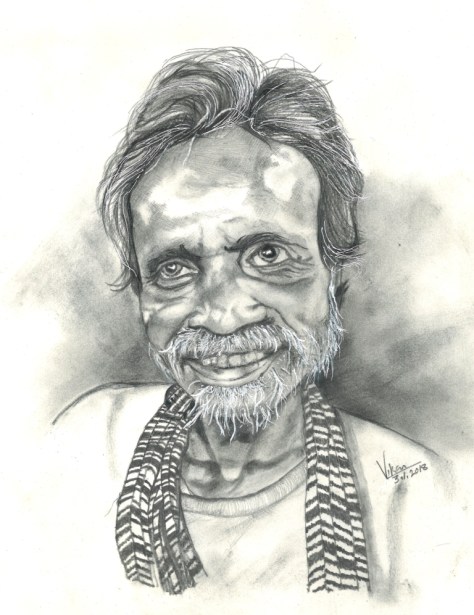
Ram Teke Bhoi, rickshaw puller from Puri, Odisha

My search for Mr Bhoi, whose sketch I present above, had started on the 1st of January 2017. It culminated sometime around the middle of May 2017 in Puri while on my sojourn to the state of Odisha for conduct of Jawaharlal Nehru University’s entrance exam. Between these two points in time I shall try to weave a tiny story, albeit a true one, of the hundreds of millions of our country’s women and men who live by the sweat of their brow but are expected to remain content with the brow beatings they get in return. Mr Bhoi to me emerges as emblematic of this goings on.

In the last week of December 2016 our ‘twosome awesome’ daughters – Moozna and Amaira, my wife and I had been on a vacation to Meghalaya. On our return back home we decided to have a teat-a-tea with the rhinos at the Kaziranga National Park. Kaziranga in itself was a tame affair and is not relevant to the narrative I attempt to weave here. Rather your attention is solicited for something that transpired on our way back to Guwahati from Kaziranga.

Continue reading His Smile Matters Too: Vikas Bajpai

Development Outcomes And Politics in Gujarat: Atul Sood

Guest Post by ATUL SOOD

Development is back in focus after the endless noise about cow protection, nationalism, Hindu-Muslim, janeus, Shiv Bhakti, Gorakhpur governance, casteism, love jihad, enemy nation and the rest. Why this talk about development now? Perhaps the dissent and protests on the ground by various sections in Gujarat in the last few years have compelled even the diehards to acknowledge (Mr. Amit Shah recently said ‘It is not my point that the issues raised in those agitations are not an issue’), that something is deeply problematic about the “Gujarat Model of Development”. The ASHA workers have taken to the streets demanding a living wage, regularized working hours and social security; dalits are no longer silent about the violence, indignity and intimidation heaped upon them; displaced families from Sardar Sarovar Dams have occupied streets seeking rehabilitation; farmers are demanding reprieve from a crisis to which they have had no hand in creating; tribals and evicted farmers are protesting against showpiece infrastructure projects which have meant their displacement and destruction of human habitations; and the youth from cultivating castes are seeking guarantee for jobs.  The list is continuing.  

Continue reading Development Outcomes And Politics in Gujarat: Atul Sood

Was the ‘Dancing Girl’ of Mohenjodaro actually a warrior?

NAMAN AHUJA, art historian, asks an exciting question that reminds us that the interpretation of artefacts, indeed, interpretation as such, is inevitably framed by the context of the viewer, and therefore always open to rethinking.

The image below is one that we are all familiar with, the exquisite sculpture of the ‘Dancing Girl’ found at Mohenjodaro.

Naman Ahuja, speaking to Anindita Ghose, suggests that the reading of this image as a dancing girl can be attributed to a perspective arising from the normalizing of patriarchal values prevalent in contemporary society. Ahuja offers an alternative reading that is much more persuasive:

The figure has bangles all the way up her left arm but her right arm is bare, as any working person would have it. A decorated left arm and a bare right arm free for labour…or for war? If she was a dancing girl by profession, surely it would have been relevant to keep both arms decorated? Look at the way she is standing. Look at her confidence. One arm on hip. Head thrown back. The way her hand is sculpted, there might have been a spear in her hand. Is she a warrior figure? Could she be a soldier rather than a dancing girl?

I can’t wait for this exhibition, India And The World: A History In Nine Stories,  to come to Delhi!

Nightmarish Visions – Indian government proposal for ‘Institutions of Eminence’: JNUTA

Statement by JNU Teachers’ Association

In early November, the JNU administration forwarded to all Centres/Special Centres/Schools, the Government of India proposal to establish twenty “Institutions of Eminence” to achieve world class status, from amongst the existing Government/Private institutions and new institutions from the private sector. It conveyed its intentions to submit an application to the UGC under the scheme and has asked Centres/Special Centres/Schools to provide comments on Part-1 – III [Vision for Institute of Eminence], Part-1 – IV [proposed fifteen year strategic plan], and Part-1 – VI [Proposed five years implementation plan] of the attached proforma.

This note from JNUTA is first to direct colleagues’ attention to the serious debate that this GoI plan has occasioned, in a country where higher education has simply failed to deliver in terms of access, quality, and justice — with a Gross Enrolment Ratio of just 20.4, as per the All India Survey of Higher Education (2013), it is the responsibility of educationists to query whether an outlay of Rs. 10,000 crore on ten institutions is warranted in the first place. (Please see the following pieces in favour of the proposal, and against it, in particular). Given that the goal of this whole initiative is a limited one of achieving a breakthrough into the world top 100 rankings, the teaching community must thoroughly discuss what rankings are good for anyway, and what significance the term ‘world class’ truly signifies, if the goals of education are essentially humanist and necessarily inclusive in character.

Continue reading Nightmarish Visions – Indian government proposal for ‘Institutions of Eminence’: JNUTA

Statement by concerned citizens on the continued incarceration of Hadiya

We, the undersigned concerned citizens, are greatly disturbed by news reports of the NCW in-charge, Rekha Sharma’s visit to meet Hadiya at the home of her father, Mr. Asokan, where she continues to be incarcerated. These reports raise more fears than they allay.

Ms Hadiya has been reported by Ms Sharma to be ‘healthy and happy’. However, Ms. Sharma goes on to state, without providing any evidence whatsoever, that while there is no ‘love jihad’ in Kerala, there are forced conversions.

It bears reiteration that Ms. Hadiya is a twenty four year old adult woman, who took a decision to convert to Islam, and then to marry a Muslim man. For this exercise of self determination, Ms. Hadiya has been placed under house arrest in her parents’ control, and this shocking violation of Ms. Hadiya’s personal liberty and her right to take decisions about her own life, has been endorsed by the legal system.

Continue reading Statement by concerned citizens on the continued incarceration of Hadiya

#whatnow? Ponni

THIS POST IS WRITTEN BY PONNI

To all the men, women, and all those of named and unnamed genders in my life, intimate, private and public, who have shown me safety, joy, pleasure, comfort and love and who ask of me, gently, the same. I love you all.

I was raped when I was 14, Or maybe 15. Not sure. It took me three years to realise it happened. Another ten to choose to begin to deal with it. And another six to realise the details and extent of what happened. And so, the process continues. Far from over. So yeah, #metoo.

When I moved to Delhi I called home crying everyday, not only because I didn’t know Hindi and everyone chided me by calling me madrasi, but because I got sexually harassed everyday. It wasn’t the ‘far away’ whistling kind I was used to in Chennai. I saw penises from unzipped pants in the crushing closeness of Delhi buses. Again, on the bus, I had men masturbate on my shoulders and am still showering to get it off me. So yeah, #metoo.

Once I was older, I acquired some ‘power’ (by my standards) – people had heard of my name from publications, activist work – I was accused or it was implied that I could have sexually harassed or abused two women at two different times. I was in romantic relationships with them. Neither one made the accusation public. Neither one of them were my equals in age, or cultural capital. One of them got in touch many years later and tried to establish a friendship again while implying that she never meant to make me feel that way. But I was too scared to even respond. The other was much closer to me and so I said more and she said more to me. She was the one I had a physical relationship with. I will never forget that feeling of power, enormous self doubt, and painful reflection. I will always ask myself what my intentions were, how I may have expressed them and why I wasn’t able to negotiate power in a way that was adequately and appropriately dignified, respectful, kind and most importantly equal-ising.

Continue reading #whatnow? Ponni

Statement Condemning BJP Appropriation Of Muslim Women’s Voices: Bebaak Collective

We, as Bebaak Collective (Voices of the Fearless), are writing this statement unequivocally condemning  the comment made by the BJP leader Subramanian Swamy in an event in Mumbai on Friday, 27th October that the party could win in Uttar Pradesh elections because Muslim women believed that it was BJP who could save them from ‘triple talaq’. (See, “Muslim women felt only BJP could save them from triple talaq says Swamy” Indian Express, 28th October) BJP leaders have time and again celebrated the victory of the recent judgement that invalidates the instantaneous practice of triple talaq and the leadership have often claimed the victory to itself, strategically pointing out the silence of the Congress government during the Shah Bano case.

Continue reading Statement Condemning BJP Appropriation Of Muslim Women’s Voices: Bebaak Collective

Say NO to Aadhar – sign the petition

Sign the petition here.

Text of the petition

I’m Saying NO to Aadhaar

We the undersigned wish to place on record our opposition to the Aadhaar scheme which is being aggressively pushed by the government in complete violation of norms, procedures and Supreme Court orders. 

Many of us have resisted enrolment. Many of us are already enrolled. But today, we stand together to say NO To Aadhaar. 

We oppose Aadhaar because it violates our Constitutional rights and freedoms as citizens. 

We oppose Aadhaar because it undermines the foundations of our democracy, disempowering us as citizens while giving government the means to control every aspect of our lives. 

The mess created by Aadhaar is not a matter of poor implementation or “teething troubles” as claimed by the government.  Aadhaar cannot be fixed with some tweaking and tinkering. It is fundamentally flawed and  must be scrapped.      

We say NO to Aadhaar because  Continue reading Say NO to Aadhar – sign the petition

From Feminazi to Savarna Rape Apologist in 24 hours

Two explanations before I begin.

First – I write this in my personal capacity. In this article I represent none of the other signatories to the statement that appealed for the crowd-sourced list of sexual offenders to be withdrawn, and for complaints to be followed through institutional mechanisms (henceforward referred to as Statement). I might still use the pronoun ‘we’ sometimes, please consider that a slippage; that collective identity is something developed over three decades in a movement, and I hope I never lose that habit. But this is my individually written post. Similarly, after the Statement, Kavita Krishnan has written on Scroll, Ayesha Kidwai on Facebook and Nandini Rao on  her blog, each expanding on some aspect or the other of our brief statement.

Second – the Statement was not and is not a ‘Kafila’ statement, it was simply posted on Kafila. Just as a statement posted on Wire is not a Wire statement or a statement on Scroll a Scroll statement, unless explicitly declared to be. Kafila is a collectively run blog with about 20 members, of which I am one of the founder members. Any member of the collective can post directly on Kafila without checking back with other members of the collective. We have often had robust debates among collective members taking opposing sides on a situation, and these debates have played out on Kafila in the past. Only one Kafila member is a signatory to the Statement, myself. I posted it on Kafila because it is a site which is my first site of preference, whether I am attacking the Hindu right or writing on feminist issues. I asked the other signatories if I could post it here, since I have to ask nobody nor approach anybody to post on Kafila.

Lawrence Liang is also a member of the Kafila collective. He does not ‘run’ Kafila (as has been alleged by many), no individual does. But it seems that in this new era of ‘radical’ politics, individual control and leadership of campaigns is assumed.  Further, Mahmood Farooqui too was a Kafila collective member. When a specific complaint of sexual abuse and rape was brought against him by a complainant anonymous to us, the Kafila collective suspended him immediately from Kafila publicly, pending investigation of the complaint. That was the only collective statement Kafila has issued in its ten years of functioning as a voluntary, non-funded blog.

Continue reading From Feminazi to Savarna Rape Apologist in 24 hours

Statement by feminists on Facebook campaign to “Name and Shame”

As feminists, we have been part of a long struggle to make visible sexual harassment at the workplace, and have worked with the movement to put in place systems of transparent and just procedures of accountability. We are dismayed by the initiative on Facebook, in which men are being listed and named as sexual harassers with no context or explanation. One or two names of men who have been already found guilty of sexual harassment by due process, are placed on par with unsubstantiated accusations. It worries us that anybody can be named anonymously, with lack of answerability. Where there are genuine complaints, there are institutions and procedures, which we should utilize. We too know the process is harsh and often tilted against the complainant. We remain committed to strengthening these processes. At the same time, abiding by the principles of natural justice, we remain committed to due process, which is fair and just.
This manner of naming can delegitimize the long struggle against sexual harassment, and make our task as feminists more difficult.
We appeal to those who are behind this initiative to withdraw it, and if they wish to pursue complaints, to follow due process, and to be assured that they will be supported by the larger feminist community in their fight for justice.

Ayesha Kidwai

Brinda Bose

Janaki Abraham

Janaki Nair

Kavita Krishnan

Madhu Mehra

Nandini Rao

Nivedita Menon

Pratiksha Baxi

Ranjani Mazumdar

Sabeena Gadihoke

Shikha Jhingan

Shohini Ghosh

Vrinda Grover


Violence against women – two patriarchal judgements: Gargi Mishra and Shreya Munoth

Guest post by GARGI MISHRA AND SHREYA MUNOTH 

Do a woman’s attire, appearance, sexual history or prior relationship with a perpetrator of sexual violence constitute a valid defence for a perpetrator of a sexual offence? Does the meaning of consent vary for educated women? The law, as it stands, doesn’t permit these factors to be taken into account while adjudicating crimes of violence against women nor does it prescribe varying standards. Unfortunately, however, deeply ingrained patriarchal mindsets rear their ugly heads ever so often flouting express statutory proscriptions, most recently demonstrated by two judgments delivered in the last fortnight dealing with rape.

The Punjab and Haryana High Court suspended the sentences of three students granted by the trial court for the rape of another student. The basis for this suspension, amongst others, was the victim’s “misadventures and experiments”, her “promiscuity” and the absence of brutal violence accompanying the sexual assault. Close on the heels of this, the Delhi High Court, on appeal, acquitted Mahmood Farooqui, a filmmaker, overturning the trial court’s verdict of finding him guilty of rape having performed forced oral sex on a visiting woman scholar.  While so doing, the Delhi High Court purposively misinterpreted the position of law on what constitutes consent and seems to have been largely influenced by the victim’s previous relationship with Farooqui, her being educated (a “woman of letters”), the supposed feebleness with which she said ‘no’ to the sexual act, and the fact of Farooqui’s bipolar disorder. Continue reading Violence against women – two patriarchal judgements: Gargi Mishra and Shreya Munoth

Are We Heading towards a Nuclear Winter? A Theoretical Framework: Rameez Raja

Guest post by RAMEEZ RAJA

The discovery of nuclear energy or radioactivity in 1930s and 1940s by the scientists in a sense murdered the true spirit of science. After the bombings by the United States over Japan in 1945, physicists and nuclear scientists practically got to know about the massive amount of energy a nuclear explosion can release. At around the same time, scientists started experimenting to harness nuclear energy for generating electricity as well. However, after the destruction caused by atomic explosions in Japan, Albert Einstein changed his stance towards using nuclear energy after witnessing the horrifying episode in human history. Along with him, many other nuclear scientists and bomb designers like Ted Taylor, John Gofman, Michio Kaku turned anti-nuclear activists after studying about the harmful effects nuclear radiation can cause.

Kennette Benedict, a senior advisor to Bulletin of the Atomic Scientists argued that the three communities which benefit by supporting nuclear warheads are “weapons scientists and engineers, private military contractors, and the government nuclear weapon bureaucracy.” Some realists and neo-realists like Hans Morgenthau (Politics Among Nations), Kenneth Waltz (Theory of International Politics) and John Mearsheimer (The Tragedy of Great Power Politics) championed the deterrence theory for avoiding major wars. Surprisingly, the nuclear hawks feel proud of their nuclear achievements and development, despite the fact that nukes failed to provide them with total security and also that nuclear energy is not a cheap source for generating electricity as reported by physicist, M. V. Ramana in his book The Power of Promise.  Continue reading Are We Heading towards a Nuclear Winter? A Theoretical Framework: Rameez Raja

In the Forbidden Land of Iran – the past, survival and imperial nostalgia: Inshah Malik

Guest post by Inshah Malik
Iran is politically and economically isolated and in that isolation, to call it an experiment of nation building is misleading, but nevertheless, it is an on-going exercise. Under the crippling sanctions, the party is still on!

I don’t have the usual agenda to visit Iran. I’m not an intrepid western traveler barging into the forbidden land, to explore my political other. My two year journey within Iran is a certain sojourn necessitated by my consistent desire to unravel the personal and political meaning of my existence. As a Kashmiri scholar burdened by a political inheritance of the prolonged Kashmir conflict, I seek to unearth the connection between Kashmir and Iran. This connection, as I understand now, is not simply political, in that both places are Muslim dominated, but more spiritual. It is in the erasure and random references to Kashmir in Farsi through which I attempt to understand the crisis of a Muslim consciousness entwined with the political domination of an imperial world order.

I encounter Kashmir as a meaningful reference in the poetry of Iran’s national poet, Hafiz Continue reading In the Forbidden Land of Iran – the past, survival and imperial nostalgia: Inshah Malik

In Which Swaminathan Iyer McDonaldises the Tribals and Serves Other Junk Food : Shripad Dharmadhikary and Nandini Oza

Guest Post by SHRIPAD DHARMADHIKARY AND NANDINI OZA

Reposted from Manthan

What can one expect when one is faced with a blog by “India’s leading economic journalist” which is titled “Most of the ousted tribals are flourishing and loving it”? That there will be a large helping of fries on the side? That it will taste great but is really junk? In all of these expectations, one is not disappointed.

First, a little background. The leading economic journalist is Swaminathan Iyer, who along with a colleague carried out a survey of some tribals ousted by the Sardar Sarovar Narmada dam, comparing their situation with those left behind in the hilly areas near the river, and others in the hilly areas but near a mining project. On 10th Sept 2017, Iyer wrote a blog titled “Why many tribals don’t mind being ousted” based on his study. In a matter of just two days, Iyer has come out with a second blog based on the same study on the same topic. One wonders why. But then, again, one may not wonder, for the Sardar Sarovar has become an important topic with the Prime Minister scheduled to dedicate to the nation the dam on 17th Sept 2017.

The first blog was a classic case of misinterpretation of data, hiding the more important issues, and conclusions not supported by research findings, as we showed in our response. We showed that the tribals do mind being ousted. Now Iyer has written another blog on the matter, which skirts the issues we had raised in our response and omits some crucial survey findings given in the earlier blog, but still tries to show the Sardar Sarovar rehabilitation program as being successful.

Continue reading In Which Swaminathan Iyer McDonaldises the Tribals and Serves Other Junk Food : Shripad Dharmadhikary and Nandini Oza

Why tribals do mind being ousted by dams: Shripad Dharmadhikary and Nandini Oza

SHRIPAD DHARMADHIKARY and NANDINI OZA write a stinging response to Swaminathan Anklesaria Iyer’s unsupported claims in Times of India about how much tribals love being ousted for big dams. The newspaper did not care to publish this rebuttal so the authors posted this on Dharmadhikary’s blog and also in the comments section to Iyer’s article.

We reproduce Dharmadhikary and Oza’s original response in full below from Manthan.

However, here is an update from Shripad:

I put my comment in brief, within the allowed 3000 characters, yesterday in the Comments section. Today, it’s gone.

Then, a friend brought to my notice that Swaminathan has written a completely new version of the blog and put it out yesterday. Wonder if he is in the habit of writing different versions of the same blog within a matter of two days! https://blogs.timesofindia.indiatimes.com/Swaminomics/most-of-the-ousted-tribals-are-flourishing-and-loving-it-thank-you-activists/

Have yet to read the new version of his bog properly (am out since early morning), but it appears that he has rewritten it in a way that tries to skirt the response we had given. Now I am planning to write another response to the new blog….but can only do it tomorrow as busy with meetings today.

And now, Dharmadhikary and Oza’s original response in Manthan:

SA Iyers’s piece in Times of India dated 10 Sept 2017, “Why many tribals don’t mind being ousted by dams”, examining the condition of some of the oustees of Sardar Sarovar Narmada dam is a classic case of misinterpretation of data, hiding the more important issues, and conclusions not supported by research findings. Indeed, a proper reading of the article itself shows that unlike Iyer’s assertion, his own figures show that tribals do mind being ousted. Some important points are given below.

Iyer claims that their “surveys showed, unambiguously, the resettled villagers were better off than their former neighbours in semi-evacuated villages.” In support, among the figures given from their survey, they point out that comparing the resettled with their former neighbours who remain in the original areas, the access to drinking water was 45% against 33%, to PHCs was 37% versus 12% and to hospitals 14% versus 3%. Given that the oustees were resettled between 25-30 years ago, and that the Sardar Sardar project has poured in hundreds of crores of rupees for resettlement, these figures don’t speak of oustees being better off, but indeed, point to the pathetic case of the oustees.

Continue reading Why tribals do mind being ousted by dams: Shripad Dharmadhikary and Nandini Oza

Take back our government – BJP’s Electoral Bonds and Corporate Control: Bharat Sarkar Bachao Committee

Received from Bharat Sarkar Bachao Committee, Delhi

Sign Petition Against the BJP’s Electoral Bonds – An Open Door for Corporates to Control Our Government

Sign petition here

हिंदी के लिए नीचे देखें

In this year’s budget session of Parliament, the Modi government quietly introduced a new provision in the Finance Act that throws open the door for corporates to purchase our government – and for the BJP to get huge unaccounted funds.

The new instrument is called an “electoral bond.” An electoral bond is just a piece of paper, worth a certain amount of money, that can be purchased from a notified bank and given to a registered political party. The party can then cash the bond and get the money.

But – and this is the key – all laws and regulations have been changed to prevent anyone from knowing who purchased the bond and who encashed it. The Income Tax Act has been amended to state that the political party is not required to disclose who gave them the money. The Companies Act has been amended to say that a company can give any amount of money to political parties, and it does not have to disclose who it donated to (earlier, companies could only donate up to 7.5% of their profits and had to make the recipients public). The bank is not required to disclose who purchased the bond.

The only institution who will know which company gave money to which political party is the bank – and, therefore, the party in charge of the Finance Ministry, namely the BJP. The government claims they want to “protect donors from harassment”. But, of course, the ruling party at the Centre will know about donors using electoral bonds, and it can and will harass them if they donate to the opposition.

In short, electoral bonds are just a giant, open funding channel for corporate cash to flow to the BJP.

They are also a perfect route for money laundering. Once money is put into an electoral bond it is untraceable. Sources that preferred to remain anonymous in the RBI have effectively pointed this out – noting that bearer bonds are just another form of cash.

Multiple institutions have already opposed the bonds. The opposition in the Rajya Sabha voted to reject money bonds, but using the ‘money bill’ provisions of the Constitution, the BJP overruled them by a vote of the majority in the Lok Sabha. The Election Commission has called electoral bonds a “retrograde step”. The outgoing Chief Election Commissioner, Naseem Zaidi, has said the “public has a right to know who is making donations” and that “electoral bonds will rob poll funding of transparency.”

In 2002, when directing candidates to disclose their assets when standing for elections, the Supreme Court had said that voters’ right to know is “fundamental and basic for the survival of democracy”. Electoral bonds are not just one more bad policy. They are a direct threat to the foundations of Indian democracy. We face the prospect of corporates not only influencing policy through the back door, but of effectively purchasing the government through the front door. It is vital for people to raise voices against this ‘reform’ before it is too late.

Hindi petition follows.

Continue reading Take back our government – BJP’s Electoral Bonds and Corporate Control: Bharat Sarkar Bachao Committee

The Need to Integrate the Sciences for an Integral Society: Vikas Bajpai

Guest post by VIKAS BAJPAI

There couldn’t be a more opportune time than the present moment in India’s history for an impassioned cry for science to arise from the scientific community in the country. On the 9th of August 2017 scientists from across India carried out the ‘March for Science’ in twenty six cities with the plea addressed to the Prime Minister of the country demanding that:

the Government to uphold Article 51A of the Constitution and to restrain the attempts that run counter to the development of scientific temper, human values and spirit of inquiry enshrined in the Constitution (Organizing Committees of the India March for Science in different cities, 2017).

It was further stated:

Science is not a set of beliefs. Science tries to understand the laws governing the material world and society following a well-established methodology where nothing is accepted without evidence. Thus science has created a body of knowledge that has been tested by practice, which provides the basis for advancement of society. That is why it is now an established canon of governance that all decisions that impact people’s lives should be based, not on personal beliefs, but on scientific evidence (ibid).

Within days, Avijit Pathak, a sociologist teaching at Delhi’s Jawaharlal Nehru University wrote his piece, the ‘Hubris of Science’ in The Indian Express as a rejoinder to this ‘March for Science’.

Continue reading The Need to Integrate the Sciences for an Integral Society: Vikas Bajpai

Free Hadiya – An apeal to the Chief Justice of India from Pinjra Tod

Guest post by PINJRA TOD, a Delhi-based collective of students fighting to “Break the Cages” of women denied the rights of adult citizens by the restrictive and patriarchal rules of women’s hostels.

Your Lordship,

We write to you, to bring to your notice a recent judgement of the Kerala High Court which has annulled a consensual marriage of an adult Muslim woman. The judgement also makes many other remarks which can completely undermine any claim for equal citizenship for women and are violative of their fundamental and constitutional rights. Hadiya is a young woman, 24 years of age who has went on record to say that she willingly converted to Islam. Her parents have since approached the court twice asserting that she has converted to Islam under external force, demanding that she return to living with them. In their second petition to the Kerala High Court they also raised the allegation that she would be transported outside the country and demanded the court’s intervention.

During the proceedings of the second petition, Hadiya contracted a marriage with a Muslim man according to Islamic rites and rituals and stated her full consent in the marriage. The Kerala High Court has finally annulled the marriage and forced Hadiya into the custody of her father. She has not even been allowed a phone and has been denied any contact with the rest of the world beside her parents, in effect putting her under house arrest for no proven crime committed by her. Policemen guard her every day and just beyond stand RSS cadre further ensuring that their prize catch finds no exit from the situation.

Continue reading Free Hadiya – An apeal to the Chief Justice of India from Pinjra Tod

Women’s groups & concerned individuals welcome Supreme Court judgement on triple talaq

Endorsements are still pouring in for this statement, but we are posting it here with just the first names with which it was sent out.

22 august 2017

We wholeheartedly welcome the judgment of the Hon’ble Supreme Court in the matter of Triple Talaq brought before it by a number of Muslim women and Muslim women’s rights groups. In arguing that the practice of Triple Talaq is both, un-Quranic and Un-Constitutional, it is an important departure from earlier judgments on all women’s rights, because it is based on the tenets of equality, dignity and secularism as enshrined in the Constitution.

As women’s groups and individuals we recognise that the current political climate of communalisation and violence, when the entire Muslim community is under attack in India and much of the Islamophobic world today, makes the fight for minority and gender rights an even more uphill task. Hence we extend our solidarity and salute the courage of the Muslim women who have fought everyday patriarchy within, religious institutions and the family, as well as communal forces to seek justice and equality from the courts.

Even as we celebrate this victory as one that strengthens the fight for secular rights, we are aware that this is but one step in our continued battle against all kinds of patriarchal power and the prevailing political order that seeks to convert this into a majority-minority issue.

In our joint struggles for gender justice in all laws relating to marriage and family, beyond the religious framework, we believe that the Supreme Court judgment on Triple Talaq is an important affirmation of Constitutional values of equality, secularism, pluralism and dignity for all citizens. We hope that this will be the framework in all matters of justice for gender and minority rights.

Hasina Khan, Bebaak Collective
Awaz-e-Niswaan, Mumbai
Saba Khan, Parcham, Mumbai
Parwaaz, Amedabad
Sahiyar, Baroda
Janvikas, Ahmedabad
Hameeda, Sadbhavna Trust, UP
Shabina, Vanangana, UP
Muslim Mahila Manch, Nagpur
Sandhya Gokhale, Forum against Oppression of Women, Mumbai
Chayanika Shah, Labia – A Queer Feminist LBT Collective, Mumbai
Vani Subramanian, Saheli Women’s Resource Centre, New Delhi
Renu Mishra, Association For Advocacy and Legal Initiatives, Lucknow
Kavita Srivastav, Peoples’ Union for Civil Liberties, Jaipur
Rahana Adib, Astitva, UP
Razia Patel, Indian Institute of Minority Education, Pune
Meena Seshu, SANGRAM/Nazariya, Sangli
Swati Sanyal, Swayam, Kolkata
Malobika, Sappho for Equality, A queer feminist activist group, Kolkata
Shyamala Natraj, South India Aids Action Programme, Chennai
Arundhati Dhuru, National Alliance of People’s Movements
Mamata, Humsafar Trust, Lucknow

In JNU, the Struggle to Define the University: Kartik Maini

Guest post by KARTIK MAINI

One day, the war will end, and I will return to my poetry

Contemporary India loves its army. For a civilisation that defines itself as intrinsically nonviolent, we do also love our wars.

On 23 July, 2017, Vice Chancellor Jagadesh Kumar, students of the Jawaharlal Nehru University, and members of Veterans India – a collective of ex-servicemen, gathered to commemorate the Kargil Vijay Diwas. The impulse of the commemoration is two-fold – it is a celebration of the Indian army’s reclamation of Kargil from Pakistani encroachment, as also an occasion to mourn the war’s martyrs who sacrificed their lives in service of the nation. For a university, commemoration should involve a quiet moment of reflection on the enormous human costs of war.

Continue reading In JNU, the Struggle to Define the University: Kartik Maini

The Modi regime, its minions in the JNU administration and the brave struggle of whistle blower Prof Rajeev Kumar

The prime minister of India Narendra Modi’s cheap hindutvavaadi jibes in his farewell address to vice president Hamid Ansari were better suited to Republic TV or The Organiser, but under Modi’s regime, parliament is pretty much run like an RSS shakha, and Modi himself seems no different from Arnab Goswami.

Said Modi in parliament to the distinguished out-going vice president:

Aapke karyakaal ka bahut saara hissa West Asia se juda raha hai. Usi dayere mein zindagi ke bahut varsh aapke gaye, usi mahaul mein, usi soch mein, aise logon ke beech mein rahe. Wahan se retire hone ke baad bhi jyadatar kaam wohi raha aapka; Minorities Commission ho yah Aligarh Muslim University ho, zyadatar dayara aapka wohi raha.

Lekin yeh 10 saal puri tarah ek alaga zimma aapka sar mein aaya. Puri tarah ek ek pal samvidhan samvidhan samvidhan ke hi dayere mein chalana. Aur aapne usko bakhubi nibhaane ka bharpur prayaas kiya. Ho sakta hai kuch chatpatahat rahi hogi bhitar aapke andar bhi. Magar aaj ke baad shayad woh sankat bhi nahin rahega. Mukti ka anand bhi rahega aur apni mulbhut jo soch rahi hogi uske anusaar aapko karya karne ka, sochne ka, baat batane ka awsar bhi milega.

Continue reading The Modi regime, its minions in the JNU administration and the brave struggle of whistle blower Prof Rajeev Kumar