All posts by Nivedita Menon

JNUTA statement on HRD Minister’s Observations

JNUTA is disappointed at the statement by the Minister of Human Resource Development regarding the number of research scholars working with each faculty in JNU, and considers his remarks as unbefitting of the Minister of Human Resource Development.

First of all, the claim that there are JNU teachers guiding more than 20/25 registered students is simply false, as this suppresses the important fact that JNU like other universities across India, has a provision that allows students to deregister from the university. This provision has proved very beneficial, as it enables students to take up employment and slow-track their PhDs until their life circumstances allow them to return to their jobs.  It is only when deregistered students over a decade are included that some professors can have a reasonably large number.

Continue reading JNUTA statement on HRD Minister’s Observations

In the face of election results, Nazim Hikmet on life and living

Nazim Hikmet was a Turkish poet and writer. A communist revolutionary, he was repeatedly arrested for his political beliefs and spent much of his adult life in prison or in exile.

Living is no laughing matter:
you must live with great seriousness
like a squirrel, for example–
I mean without looking for something beyond and above living,
I mean living must be your whole occupation.
Living is no laughing matter:
you must take it seriously,
so much so and to such a degree
that, for example, your hands tied behind your back,
your back to the wall,
or else in a laboratory
in your white coat and safety glasses,
you can die for people–
even for people whose faces you’ve never seen,
even though you know living
is the most real, the most beautiful thing.
I mean, you must take living so seriously
that even at seventy, for example, you’ll plant olive trees–
and not for your children, either,
but because although you fear death you don’t believe it,
because living, I mean, weighs heavier…

Translated by Randy Blasing and Mutlu Konuk

Read the whole poem here.

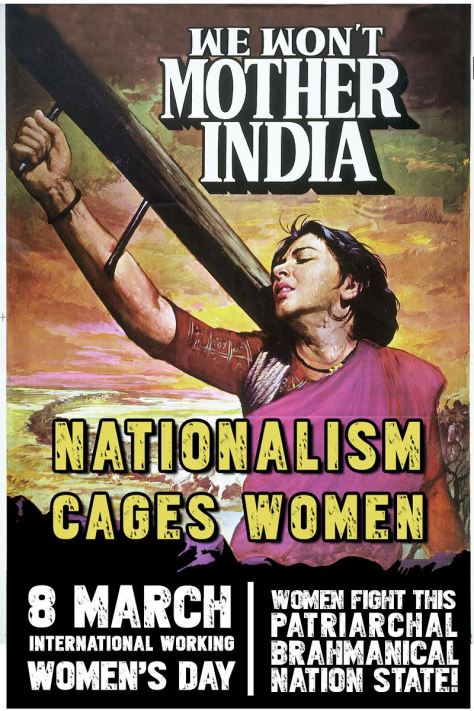
Our “hormonal outbursts” will be your nightmare! Pinjra Tod

Statement and image by Pinjra Tod

On the eve of International Working Women’s Day, Maneka Gandhi has given a deeply patriarchal, casteist and classist statement to a media channel saying that hostel curfews are necessary as “laxman rekha” for controlling women’s “hormonal outbursts”, that the question of “women’s safety in colleges cannot be solved with just two Bihari guards with dandas”, that there should be separate days for men and women to go to the library at night.

Its clear to us that she has said this today in response to the fact that women students across the country from Benaras to Mumbai, Delhi to Patiala, Lucknow to Hyderabad, Chennai to Ludhiana, Roorkie to Cuttack have come out strongly to assert their presence in the university space and claim over public resources.

Continue reading Our “hormonal outbursts” will be your nightmare! Pinjra Tod

March 10th Chalo Nagpur! Women against Manuvaad and Hindutva: Manjula Pradeep

MANJULA PRADEEP on Dalit Camera

http://https://www.youtube.com/watch?v=_vTq711Clc4

Arrey ABVP, Kaahey so Creepy?

Are Students at their Work? Prashant Kumar

Guest Post by PRASHANT KUMAR

Students who are protesting across the country are being charged that they are not doing what they are supposed to do. What I understand this charge say is that they are not doing their “duties” or fulfilling their “responsibilities” as a student. I seriously doubt thislimited understanding of being a “student”. To say this, I feel an intellectual burden to explicate what it means to be a student. I will argue that these students are also the one who, contrary to the charge, does their “duties” and carries out their “responsibilities”.

Generally speaking, anyone who tries to learn and reflect upon what he learnt can be considered as a student. However, one becomes a student technically when he does this job within an academic institution. In this sense, studentship is a job to get mature with the help of institutional academic training(s) as well as reflecting back on these. Maturity, as I discern, is nothing but to understand the real meaning of a world, and act according to this apprehension. In this sense, understanding and acting go together. Lack of one will categorically destruct the purpose of a student.

There is one more aspect of this maturity with relation to, what Kant terms, enlightenment. Continue reading Are Students at their Work? Prashant Kumar

Gender Justice In Naga Society – Naga Feminist Reflections: Dolly Kikon

DOLLY KIKON in raiot.in

Dolly Kikon points out that Article 371 (A) is breached also in the ongoing coal mining operations and the oil exploration negotiations in Nagaland. Naga politicians, landowners, village councils, and business families have all interpreted the provision for their benefit to mine for minerals and not be held accountable for the environmental degradation. But it is only when women may enter the decision-making process (and potentially reverse such policies) that Article 371 suddenly becomes sacrosanct.

What is the meaning of gender? What is the meaning of Justice? Which comes first in Naga society and how do we understand it? Like many nationalist societies around the world, the issue of gender justice and rights have remained marginal for a long time. We were told that issues like women’s rights or gender justice could wait till the Naga people gained their freedom. In that context, what did it mean to bestow any kinds of rights on women in Naga society? When terms like gender ‘rights’ and ‘equality’ remains extremely resentful terms for a larger section of powerful Naga traditional bodies, they become meaningless words. I ask these questions in relation to the opposition against 33% reservation that escalated into a violent protest and brought the entire state of Nagaland to a standstill recently. If Naga customary law is seen as the foundation of justice, the exclusion of women from these powerful decision making-bodies negates the entire notion that these are pillars of justice. The Indian state and the male traditional bodies alike are responsible for excluding the Naga women from all spheres of representative political processes. Article 371 (A) is a prime example of the patriarchal nature of the Indian constitution that bestows the Naga male bodies to have full authority and power to interpret customary affairs covering social, religious, and criminal cases.

JNUTA Statement on ABVP violence in Delhi University

Jawaharlal Nehru University Teachers Association

STATEMENT ON VIOLENCE AND INTIMIDATION IN DELHI UNIVERSITY AND OTHER UNIVERSITIES

Issued on February 23, 2017 

The JNU Teachers Association condemns in strongest terms the violence and hooliganism perpetrated in Delhi University by the ABVP over the last two days, reported widely in the media. What is also worrying, along with the violence unleashed is, that by all accounts, the police seemed unwilling to control the violence and remained a mute spectator. The events at Delhi University are part of a larger pattern by which the university as a space for freedom and the adventure of ideas is being relentlessly attacked.

The Delhi University Incidents

The latest event in this series of attacks on the universities in Delhi University unfolded in two related episodes. Continue reading JNUTA Statement on ABVP violence in Delhi University

The Struggle to Save the JNU Act – The Student Standing Counsel’s response to UGC 2016: Pratiksha Baxi

Guest post by PRATIKSHA BAXI

The growing global mistrust and derision of the intellect and all that is the intellectual, is a political trd that displaces reason, method, contemplation, experiment, reflexivity and critique as valued traits in education. This politics colonises the University Grants Commission (UGC) in specific ways. Unlike 2008-9 when the UGC was mindful of the autonomy of the University, the UGC now is made to mandate every University to follow its anti-intellectual policies and surrender academic autonomy. The UGC has been used to put in place a repressive apparatus that is emptying out Universities of reflexivity, critique and contemplation on which are built standards of excellence. With the 2016 UGC Regulation on minimum standards for MPhil and PhD (in effect since 5 July 2016),[1] the audit culture of the UGC, has now been hijacked to empty out universities of research scholars, literally. Continue reading The Struggle to Save the JNU Act – The Student Standing Counsel’s response to UGC 2016: Pratiksha Baxi

Feminists Condemn Opposition To Women’s Reservation In Nagaland Municipal Councils

We, the undersigned women’s organisations and concerned individuals take serious note of the fierce opposition to women’s reservation of 33% seats in Nagaland Municipal Councils by male dominated tribal bodies in Nagaland in the name of protecting their tradition and customary practices that bar women from participating in decision-making bodies. We strongly condemn this anti-woman position of Nagaland Tribes Action Committee (NTAC) that has been formed supposedly to “protect” Naga tribal practices. While NTAC quotes Article 371(A) of the Constitution to assert that they are empowered to make their own laws, they choose to ignore Constitutional principle of equality before law, thus denying the Naga women their electoral rights.

Time and again women’s movements in India have confronted issues of community identity vs the rights of women. In almost every instance, communities and their leaders have chosen to sacrifice the rights of women to safeguard patriarchal practices in the name of tradition and custom. In the present imbroglio NTAC has used threats and violence to prevent women from filing their nominations, or even to withdraw their papers. Through all this, the State government has remained silent spectator and tried to wash its hands off on the issue of women’s representation in local bodies by cancelling the elections to local bodies under pressure from these tribal bodies by merely citing law and order concerns. In the process, the State has become complicit in protecting patriarchal traditions to the detriment of principles of gender equality. What is not being asserted is that Urban Local Bodies are not traditional Naga institutions recognised by Article 371(A) of the Constitution but rather, Constitutional bodies under Part IX of the Constitution over which the traditional Naga bodies have no mandate. Continue reading Feminists Condemn Opposition To Women’s Reservation In Nagaland Municipal Councils

JNU VC misleads media on research vacancies: Ayesha Kidwai

Guest post by AYESHA KIDWAI
The JNU VC has fed this information to the Times of India. The title of the table below, published in the Times of India, should be Get the Numbers WRONG, as barring two rows, all the numbers are incorrect. And the interpretation that our VC gives to these numbers is even WRONGER!

First of all, JNU has no exclusively M.Phil. intake at all. Continue reading JNU VC misleads media on research vacancies: Ayesha Kidwai

Meanwhile, in India, Islamophobia proceeds apace

DARSHANA MITRA in The Wire

While many in India have recoiled at the manner in which the Trump administration has made religious discrimination a key ingredient of its refugee and  immigration policy, we should also turn to look at similar legislative provisions being proposed in our own country.

The Citizenship (Amendment) Bill of 2016 is a short, three-page document that seeks to amend Section 2(b) of the Citizenship Act. The Citizenship Act deals with the acquisition and termination of Indian citizenship. Section 2(b) of the Citizenship Act defines the term “illegal immigrant”. The Citizenship (Amendment) Bill proposes to amend the definition of this term by adding this proviso:

“Provided that persons belonging to minority communities, namely, Hindus, Sikhs, Buddhists, Jains, Parsis and Christians from Afghanistan, Bangladesh and Pakistan, who have been exempted by the Central Government by or under clause (c) of sub-section (2) of section 3 of the Passport (Entry into India) Act, 1920 or from the application of the provisions of the Foreigners Act, 1946 or any order made thereunder, shall not be treated as illegal migrants for the purposes of this Act.”.

This effectively means that persons from minority religious communities from our neighbouring Muslim majority countries shall not be considered as illegal migrants and subjected to prosecution. Further, the Bill also proposes an amendment to the Third Schedule of the Act, which would allow minority communities, namely Hindus, Sikhs, Buddhists, Jains, Parsis and Christians from Afghanistan, Bangladesh and Pakistan to qualify for naturalisation as a citizen of India if they are resident in India or in service to the Government of India for an aggregate period of not less than six years, as opposed to eleven years for everyone else.

Read the full article here.

In solidarity with all who see the map upside down: Shukla Sawant

Sent by Shukla Sawant, Professor, School of Arts and Aesthetics, JNU.

Joaquín Torres-García,  Upside-down Map (1943). 


88d5504f366713693474d35db3e1b9596f4033a3-1

Read more about this image and about “the essentially fictional status of maps and the power they possess for construing and constructing worlds.”

In Solidarity with People Affected by the ‘Muslim Ban’: Call for an Academic Boycott of International Conferences held in the US

If you would like to endorse this statement, as I have, please go to the link given below. As of 4 February 2017, 13.00 GMT the letter has 6000+ signatures.

On 27 January 2017, President Donald Trump signed an Executive Order putting in place a 90-day ban that denies US entry to citizens from seven Muslim majority countries: Iran, Iraq, Syria, Yemen, Sudan, Libya and Somalia. So far, the ban includes dual nationals, current visa, and green card holders, and is affecting those born in these countries while not holding citizenship of them. The Order also suspends the admittance of all refugees to the US for a period of 120 days and terminates indefinitely all refugee admissions from Syria. There are indications that the Order could be extended to include other Muslim majority countries.

The Order has affected people with residence rights in the US, as well as those with rights of entry and stay. Some of those affected are fleeing violence and persecution, and have been waiting for years for resettlement in the US as refugees. Others are effectively trapped in the US, having cancelled planned travel for fear that they will be barred from returning. The order institutionalises racism, and fosters an environment in which people racialised as Muslim are vulnerable to ongoing and intensifying acts of violence and hatred.

Among those affected by the Order are academics and students who are unable to participate in conferences and the free communication of ideas. We the undersigned take action in solidarity with those affected by Trump’s Executive Order by pledging not to attend international conferences in the US while the ban persists. We question the intellectual integrity of these spaces and the dialogues they are designed to encourage while Muslim colleagues are explicitly excluded from them.

Continue reading In Solidarity with People Affected by the ‘Muslim Ban’: Call for an Academic Boycott of International Conferences held in the US

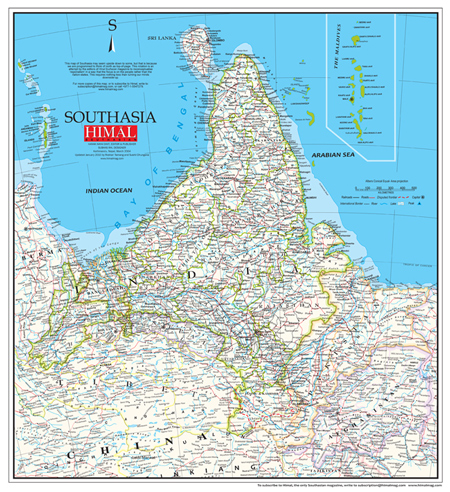
On RSS ignorance, the “upside down map” of India, and on being “anti-national”

himal_map_4501Himal Southasian’s ‘right-side-up’ map. In their words: “This map of Southasia may seem upside down to some, but that is because we are programmed to think of north as top of page. This rotation is an attempt by the editors of Himal to reconceptualise ‘regionalism’ in a way that the focus is on the people rather than the nation-states. This requires nothing less than turning our minds downside-up.

Turn your eyes away, gentle reader. You have already become anti-national by viewing this image.

More on this in a minute. First some background.

On the 3rd of February, ABVP called a bandh in Jai Narain Vyas University (JNVU), Jodhpur, forcibly stopping classes and demanding suspension of the organizers of a conference and police action against them, as well as against myself. Police complaints have now been lodged, and perhaps FIRs, we hear.

The charge? The conference, and my lecture in particular, was anti-national. Not one of these ABVP students attended the event, nor is there yet a video recording available to my knowledge, largely because the ABVP also gathered in intimidatingly large numbers outside the shop that had conducted the recording, and the owner shut up the shop and fled. The entire drama and some sensationalist and outright false stories in the local Hindi press, is based entirely on the testimony of one person, NK Chaturvedi, retired professor from the History department at JNVU, who attended just one session, mine.

Continue reading On RSS ignorance, the “upside down map” of India, and on being “anti-national”

How do the new UGC regulations affect prospective students applying to JNU? Ayesha Kidwai

This is the first of a five part series in which AYESHA KIDWAI will explain how the UGC Gazette Notification of 2016, especially as interpreted by the VC of JNU, will affect different categories of students, faculty, and the general public.

Ayesha Kidwai is Professor, Centre for Lingustics, School of Language, Literature and Culture Studies, JNU.


poster1-ugc

Revisiting the demonetization survey: Juhi Tyagi

Guest Post by JUHI TYAGI

In light of the recent book, I Am A Troll: Inside the Secret World of the BJP’s Digital Diary authored by journalist Swati Chaturvedi which describes the working of the BJP’s media’s cell to systematically undermine dissenting opinions, we need to revisit other, seemingly innocuous, government media campaigns such as the demonetization survey and its use as a tool in bending into shape public opinion.

The demonetization survey was officially launched on 22nd November 2016 on the NM app by the government. Its purpose was to receive feedback from the people themselves on the validity of withdrawing 86 percent of the currency in circulation to address two problems: that of black money and counterfeit currency. The survey consisted of nine questions, with the tenth providing space for sharing suggestions. The questions dealt with people’s beliefs about the existence of black money in India and on its need to be eliminated. On their opinions of the government’s efforts against corruption, and more particularly, on the effectiveness of demonetization in ridding society of black money, all corruption and terrorism while creating opportunities for higher education, health care and affordable housing for all.

Continue reading Revisiting the demonetization survey: Juhi Tyagi

Never forget, never forgive: Justice for Rohith

xrohith1-16-1484552927-jpg-pagespeed-ic-5axp0tr5hh

NHRC indicts Chhattisgarh police: WSS statement

STATEMENT BY WOMEN AGAINST SEXUAL VIOLENCE AND STATE REPRESSION

WSS welcomes the decisive intervention of the National Human Rights Commission in  cases of sexual violence against Adivasi women by police and security forces engaged in anti-Maoist operations in Chhattisgarh. Validating our assertion that sexual violence is being used as a weapon of war in Bastar,  the Commission has held the State government “vicariously liable” for gross violations of human rights.

Continue reading NHRC indicts Chhattisgarh police: WSS statement

Demonetization not a “war on black money” unless finances of political parties made accountable: Nishank Varshney

Guest Post by NISHANK VARSHNEY

While the common man is being subjected to infinite scrutiny and daily changing rules, the political parties enjoy to have a free-run at not disclosing a large part of their income, running into thousands of Crores. As long as the political parties continue to enjoy this exemption, the menace of black money cannot be said to have been tackled.

In one of the most unprecedented decisions in the Indian history that was taken on 8th November, 2016, the Prime Minister Shri Narendra Modi, suddenly announced the cancellation of Rs. 500 and Rs. 1000 notes with a view of “eliminating black money”. Over the last seven weeks, the PM has regularly reiterated this stand, and called Demonetization a “war on black money” through his speeches at various election rallies, the survey on his mobile app, and most recently in his “Mann ki Baat” program on Sunday. However, Mr. Nasim Zaidi, the Chief Election Commissioner of India, recently expressed that “many political parties are being used as conduits for siphoning off black money”.

As per the Representation of the People Act, 1951 (RP Act), political parties are not required to report the names of the individuals or organizations from whom they have received donations of amounts less than Rs. 20,000. A study by Association for Democratic Reforms (ADR) has shown that these ‘unaccounted donations’ form a large part of political parties’ income. In the year 2014-15 alone, BJP declared an income of 505.26 Crore from unknown sources, while Congress received a sum of 445.22 Crore from unknown sources during the same time-period. At present, there are over 1700 registered political parties in India, and many political parties may have been misusing this exemption to convert their black money, as voiced by the Chief Election Commissioner. Continue reading Demonetization not a “war on black money” unless finances of political parties made accountable: Nishank Varshney

JNU VC sabotages democratic functioning of Academic Council to push through anti-social justice policies

First, here is the statement issued by 20 faculty members of the Academic Council today, about half the members present at the adjourned 142nd AC Meeting.

PRESS RELEASE BY MEMBERS OF THE JNU ACADEMIC COUNCIL

We, faculty members of the JNU Academic Council, are shocked and dismayed at the manner in which the Vice Chancellor has conducted the 142nd Academic Council meeting of December 23rd (adjourned to December 26th). This was a thinly attended meeting since it was held at short notice in the middle of the winter vacation, despite several requests for rescheduling.

The minutes of the previous (141st) Academic Council meeting that had been circulated contained many errors, misrepresentations, and falsities. Several of these had been pointed out by many members of the Academic Council, including in written representations to the Registrar.

Continue reading JNU VC sabotages democratic functioning of Academic Council to push through anti-social justice policies