All posts by Nivedita Menon

Meanwhile, in India, Islamophobia proceeds apace

DARSHANA MITRA in The Wire

While many in India have recoiled at the manner in which the Trump administration has made religious discrimination a key ingredient of its refugee and  immigration policy, we should also turn to look at similar legislative provisions being proposed in our own country.

The Citizenship (Amendment) Bill of 2016 is a short, three-page document that seeks to amend Section 2(b) of the Citizenship Act. The Citizenship Act deals with the acquisition and termination of Indian citizenship. Section 2(b) of the Citizenship Act defines the term “illegal immigrant”. The Citizenship (Amendment) Bill proposes to amend the definition of this term by adding this proviso:

“Provided that persons belonging to minority communities, namely, Hindus, Sikhs, Buddhists, Jains, Parsis and Christians from Afghanistan, Bangladesh and Pakistan, who have been exempted by the Central Government by or under clause (c) of sub-section (2) of section 3 of the Passport (Entry into India) Act, 1920 or from the application of the provisions of the Foreigners Act, 1946 or any order made thereunder, shall not be treated as illegal migrants for the purposes of this Act.”.

This effectively means that persons from minority religious communities from our neighbouring Muslim majority countries shall not be considered as illegal migrants and subjected to prosecution. Further, the Bill also proposes an amendment to the Third Schedule of the Act, which would allow minority communities, namely Hindus, Sikhs, Buddhists, Jains, Parsis and Christians from Afghanistan, Bangladesh and Pakistan to qualify for naturalisation as a citizen of India if they are resident in India or in service to the Government of India for an aggregate period of not less than six years, as opposed to eleven years for everyone else.

Read the full article here.

In solidarity with all who see the map upside down: Shukla Sawant

Sent by Shukla Sawant, Professor, School of Arts and Aesthetics, JNU.

Joaquín Torres-García,  Upside-down Map (1943). 


88d5504f366713693474d35db3e1b9596f4033a3-1

Read more about this image and about “the essentially fictional status of maps and the power they possess for construing and constructing worlds.”

In Solidarity with People Affected by the ‘Muslim Ban’: Call for an Academic Boycott of International Conferences held in the US

If you would like to endorse this statement, as I have, please go to the link given below. As of 4 February 2017, 13.00 GMT the letter has 6000+ signatures.

On 27 January 2017, President Donald Trump signed an Executive Order putting in place a 90-day ban that denies US entry to citizens from seven Muslim majority countries: Iran, Iraq, Syria, Yemen, Sudan, Libya and Somalia. So far, the ban includes dual nationals, current visa, and green card holders, and is affecting those born in these countries while not holding citizenship of them. The Order also suspends the admittance of all refugees to the US for a period of 120 days and terminates indefinitely all refugee admissions from Syria. There are indications that the Order could be extended to include other Muslim majority countries.

The Order has affected people with residence rights in the US, as well as those with rights of entry and stay. Some of those affected are fleeing violence and persecution, and have been waiting for years for resettlement in the US as refugees. Others are effectively trapped in the US, having cancelled planned travel for fear that they will be barred from returning. The order institutionalises racism, and fosters an environment in which people racialised as Muslim are vulnerable to ongoing and intensifying acts of violence and hatred.

Among those affected by the Order are academics and students who are unable to participate in conferences and the free communication of ideas. We the undersigned take action in solidarity with those affected by Trump’s Executive Order by pledging not to attend international conferences in the US while the ban persists. We question the intellectual integrity of these spaces and the dialogues they are designed to encourage while Muslim colleagues are explicitly excluded from them.

Continue reading In Solidarity with People Affected by the ‘Muslim Ban’: Call for an Academic Boycott of International Conferences held in the US

On RSS ignorance, the “upside down map” of India, and on being “anti-national”

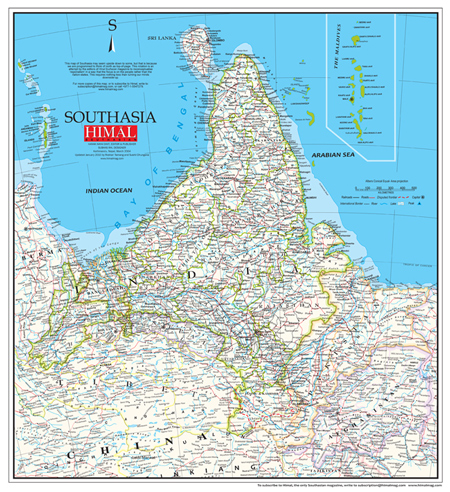
himal_map_4501Himal Southasian’s ‘right-side-up’ map. In their words: “This map of Southasia may seem upside down to some, but that is because we are programmed to think of north as top of page. This rotation is an attempt by the editors of Himal to reconceptualise ‘regionalism’ in a way that the focus is on the people rather than the nation-states. This requires nothing less than turning our minds downside-up.

Turn your eyes away, gentle reader. You have already become anti-national by viewing this image.

More on this in a minute. First some background.

On the 3rd of February, ABVP called a bandh in Jai Narain Vyas University (JNVU), Jodhpur, forcibly stopping classes and demanding suspension of the organizers of a conference and police action against them, as well as against myself. Police complaints have now been lodged, and perhaps FIRs, we hear.

The charge? The conference, and my lecture in particular, was anti-national. Not one of these ABVP students attended the event, nor is there yet a video recording available to my knowledge, largely because the ABVP also gathered in intimidatingly large numbers outside the shop that had conducted the recording, and the owner shut up the shop and fled. The entire drama and some sensationalist and outright false stories in the local Hindi press, is based entirely on the testimony of one person, NK Chaturvedi, retired professor from the History department at JNVU, who attended just one session, mine.

Continue reading On RSS ignorance, the “upside down map” of India, and on being “anti-national”

How do the new UGC regulations affect prospective students applying to JNU? Ayesha Kidwai

This is the first of a five part series in which AYESHA KIDWAI will explain how the UGC Gazette Notification of 2016, especially as interpreted by the VC of JNU, will affect different categories of students, faculty, and the general public.

Ayesha Kidwai is Professor, Centre for Lingustics, School of Language, Literature and Culture Studies, JNU.


poster1-ugc

Revisiting the demonetization survey: Juhi Tyagi

Guest Post by JUHI TYAGI

In light of the recent book, I Am A Troll: Inside the Secret World of the BJP’s Digital Diary authored by journalist Swati Chaturvedi which describes the working of the BJP’s media’s cell to systematically undermine dissenting opinions, we need to revisit other, seemingly innocuous, government media campaigns such as the demonetization survey and its use as a tool in bending into shape public opinion.

The demonetization survey was officially launched on 22nd November 2016 on the NM app by the government. Its purpose was to receive feedback from the people themselves on the validity of withdrawing 86 percent of the currency in circulation to address two problems: that of black money and counterfeit currency. The survey consisted of nine questions, with the tenth providing space for sharing suggestions. The questions dealt with people’s beliefs about the existence of black money in India and on its need to be eliminated. On their opinions of the government’s efforts against corruption, and more particularly, on the effectiveness of demonetization in ridding society of black money, all corruption and terrorism while creating opportunities for higher education, health care and affordable housing for all.

Continue reading Revisiting the demonetization survey: Juhi Tyagi

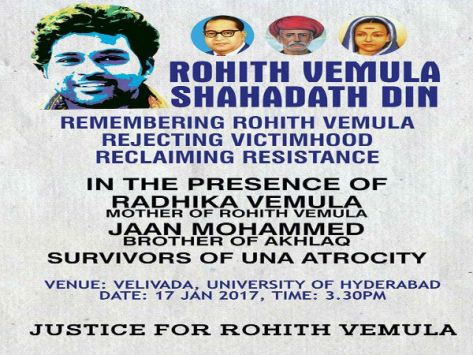
Never forget, never forgive: Justice for Rohith

xrohith1-16-1484552927-jpg-pagespeed-ic-5axp0tr5hh

NHRC indicts Chhattisgarh police: WSS statement

STATEMENT BY WOMEN AGAINST SEXUAL VIOLENCE AND STATE REPRESSION

WSS welcomes the decisive intervention of the National Human Rights Commission in  cases of sexual violence against Adivasi women by police and security forces engaged in anti-Maoist operations in Chhattisgarh. Validating our assertion that sexual violence is being used as a weapon of war in Bastar,  the Commission has held the State government “vicariously liable” for gross violations of human rights.

Continue reading NHRC indicts Chhattisgarh police: WSS statement

Demonetization not a “war on black money” unless finances of political parties made accountable: Nishank Varshney

Guest Post by NISHANK VARSHNEY

While the common man is being subjected to infinite scrutiny and daily changing rules, the political parties enjoy to have a free-run at not disclosing a large part of their income, running into thousands of Crores. As long as the political parties continue to enjoy this exemption, the menace of black money cannot be said to have been tackled.

In one of the most unprecedented decisions in the Indian history that was taken on 8th November, 2016, the Prime Minister Shri Narendra Modi, suddenly announced the cancellation of Rs. 500 and Rs. 1000 notes with a view of “eliminating black money”. Over the last seven weeks, the PM has regularly reiterated this stand, and called Demonetization a “war on black money” through his speeches at various election rallies, the survey on his mobile app, and most recently in his “Mann ki Baat” program on Sunday. However, Mr. Nasim Zaidi, the Chief Election Commissioner of India, recently expressed that “many political parties are being used as conduits for siphoning off black money”.

As per the Representation of the People Act, 1951 (RP Act), political parties are not required to report the names of the individuals or organizations from whom they have received donations of amounts less than Rs. 20,000. A study by Association for Democratic Reforms (ADR) has shown that these ‘unaccounted donations’ form a large part of political parties’ income. In the year 2014-15 alone, BJP declared an income of 505.26 Crore from unknown sources, while Congress received a sum of 445.22 Crore from unknown sources during the same time-period. At present, there are over 1700 registered political parties in India, and many political parties may have been misusing this exemption to convert their black money, as voiced by the Chief Election Commissioner. Continue reading Demonetization not a “war on black money” unless finances of political parties made accountable: Nishank Varshney

JNU VC sabotages democratic functioning of Academic Council to push through anti-social justice policies

First, here is the statement issued by 20 faculty members of the Academic Council today, about half the members present at the adjourned 142nd AC Meeting.

PRESS RELEASE BY MEMBERS OF THE JNU ACADEMIC COUNCIL

We, faculty members of the JNU Academic Council, are shocked and dismayed at the manner in which the Vice Chancellor has conducted the 142nd Academic Council meeting of December 23rd (adjourned to December 26th). This was a thinly attended meeting since it was held at short notice in the middle of the winter vacation, despite several requests for rescheduling.

The minutes of the previous (141st) Academic Council meeting that had been circulated contained many errors, misrepresentations, and falsities. Several of these had been pointed out by many members of the Academic Council, including in written representations to the Registrar.

Continue reading JNU VC sabotages democratic functioning of Academic Council to push through anti-social justice policies

Angela Davis appeals to President to repeal AFSPA

img_20161217_105346

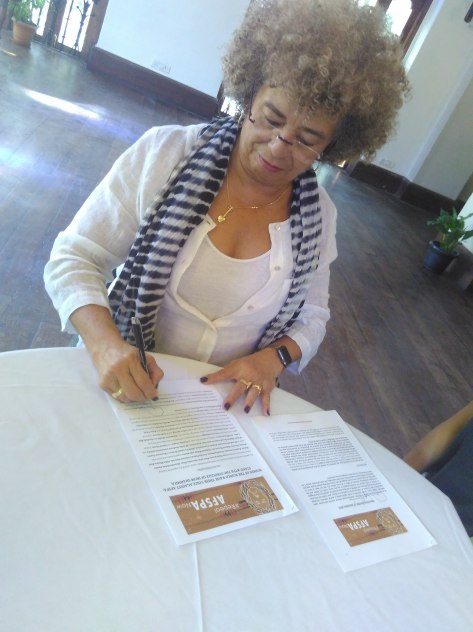
At an exclusive meet-the-press in Mumbai, American black feminist activist and human rights defender, Angela Davis joined feminists in India spearheading a global women’s campaign appealing to the President of India to use his Constitutional powers and repeal the draconian Armed Forces Special Powers Act (AFSPA). In doing so, she extends her solidarity to the struggles of women in India against the impunity granted to security forces under the AFSPA and the consequent widespread violation of rights in all areas where this law has been in force. In particular, Ms Davis salutes the historic struggle of Irom Chanu Sharmila whose 16 year long fast against the AFSPA helped foreground the issue both nationally, and internationally, saying “I am utterly inspired by Irom Sharmila’s strength and perseverance.”

There has been a global campaign of feminists seeking an end to AFSPA.

The full list of signatories can be seen here.

Infantilization of Women in Punjab’s Left: Nikita Azad

Guest post by NIKITA AZAD

It would be an understatement to say that apart from sexualization of young girls, society infantilizes women on a regular basis. Whether in domestic sphere where men decide what is best for the family and women, or office where men consider their women counterparts as less intelligent and inferior, such infantilization manifests itself in various forms and at various places. A similar trend can be observed in movies where men are usually portrayed as saviors whereas women are depicted as young ‘girls’ waiting to be saved. American TV serials from I Love Lucy onwards have routinely infantilized women, and contemporary Hindi soap operas too, represent and treat women as children to be taken care of by their families and husbands/lovers. Such an approach towards women not only reduces their value and identity as thinking, rational human beings, but it also provides men and the patriarchal structure an argument to justify their control over women. It strengthens the general belief that women are inferior, not only biologically but also mentally, and thus, it perpetuates male intellectual hegemony.

In recent times, many white-collar women employees and actresses have spoken against wage gap and workplace discrimination prevalent in their respective fields, which is as much a result of infantilization of women as it is that of gender discrimination. The work done by a woman, however good, is considered inferior as compared to that done by a man, based on the ground that women are more sensitive, emotional, and child-like; and are thus, there are more possibilities of their committing mistakes. Women feminists and non-feminists, who opine on social media on gender discrimination, are often seen as ones who are easily offended and are emotionally immature. Their responses are treated with sexism than with any serious arguments; the reactions are usually perceived as ‘angry’. Their Face Book and twitter accounts are filled with sexually abusive messages and their opinions are seen as having zero or less value when compared to their men counterparts. A good example would be a recent experiment done by a couple on Twitter, whereby a man and a woman, working for the same organization, The Washington Post, published two articles on similar issues but the responses they received were shockingly different. While the man’s inbox was crowded with racist comments, the woman’s inbox was filled with sexist and degrading names that the man could not bring himself to repeat on his post on Twitter.

While the consequences of the sexist practice of infantilization of women have been widely discussed in feminist circles, a study of its presence in otherwise democratic and progressive circles remains absent. Continue reading Infantilization of Women in Punjab’s Left: Nikita Azad

Hasta la victoria siempre

UNTIL VICTORY, ALWAYS…

150304151657-01-fidel-castro-0304-restricted-exlarge-169Image courtesy CNN

A Pinjra Tod Winter Afternoon In Jamia Millia Islamia, November 17, 2016

Statement by Pinjra Tod on November 19, 2016

A fiery anonymous open letter by a women resident of Jamia Millia Islamia to the VC on the arbitrary cancellation of late nights in August last year, marks the inception of Pinjra Tod as a movement. It has been an incredible year of reaching out to each other, connecting, discussing and collectivising in Jamia. Overcoming our anxieties of a repressive state machinery intent on criminalising minority voices and institutions, conquering our fear of an administration that has repeatedly targeted students (especially women) for raising their voices, we came together in Jamia last Thursday (17th Nov), drawing confidence from our collective strength, to hold our first ‘public’ event: an exhibition celebrating the struggle of women for education, and a session of poetry, songs and sharing of experiences.

Women students reiterated that the UGC circular issued on 2nd May’16 is being shamelessly flouted by Jamia administration, as in all other Universities and colleges. There are no sexual harassment complaints committee (the program was conducted beneath a huge anti-ragging banner), libraries and other facilities on campus remain inaccessible to women students after 8 PM, random show-cause notices for ‘misconduct’ are a common practice, very little democratic space for women students to organise events/discussions/screenings within hostel spaces and continuous surveillance.

Continue reading A Pinjra Tod Winter Afternoon In Jamia Millia Islamia, November 17, 2016

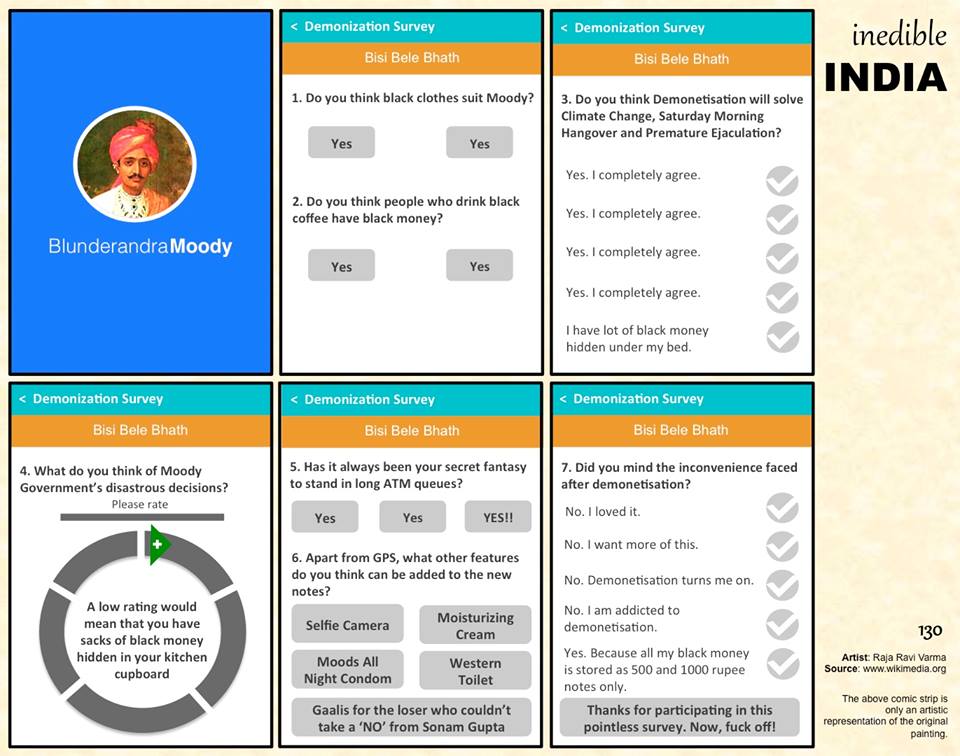
Inedible India on the NaMo App “Survey” on Demonetization

The PMO claimed that more than 93 per cent of the five lakh people who participated in a survey on Narendra Modi App have supported demonetization.

The loaded structure of the survey, the questions to which you can only “agree” or “partially agree”, with no option to “disagree”; all of it is typical of this utterly corrupt and dishonest government which holds the people of India in contempt.

The most powerful response to this government is to mock it.

Take this, Namo!

From Inedible India

15171078_1154465077940674_7199912734542558618_n

Withdraw false charges lodged by Chhattisgarh police against academics and political activists

PETITION TO THE PRESIDENT, PRIME MINISTER AND HOME MINISTER OF INDIA

We, the undersigned, are outraged by recent charges of murder that have been laid against

Delhi University professor Nandini Sundar, JNU professor Archana Prasad, Vineet Tiwari (of Joshi Adhikar Sansthan, Delhi), Chhattisgarh CPI(M) state secretary, Sanjay Parate, Mangalram Karma, and Manju Kawasi, CPI activist and Sarpanch of Guphidi in Sukma district, by the Chhattisgarh police in the killing of Shamnath Baghel.

The charges are patently fabricated, and follow a pattern of intimidation by the Chhattisgarh police every time evidence is released of their lawless prosecution of the war against the Maoists. Earlier this year, Sundar, Prasad, Tiwari and Parate were part of a fact-finding team that looked at the impact of Maoist violence and state excesses on ordinary villagers in Bastar, finding that they were victims of fake encounters, rapes, arrests, beatings, IED blasts, and killing of informers, implicating Maoists, police, and security forces. The residents of Bastar were also found to be facing the renewal of attacks by civilian militias armed by the state. At that time too, the district administration of Bastar had tried to implicate the fact-finding team on fake charges on the basis of a contrived complaint. More recently, when the police were charge-sheeted on the basis of evidence gathered by Sundar and others for carrying out arson in an operation in 2011, they retaliated by burning effigies of her and other activists and journalists in order to intimidate and incite violence against them.

Sundar and others have put on record their unequivocal condemnation of the killing of Shamnath Baghel. Their writing and interventions on the ongoing war in Bastar have consistently condemned all forms of violence, whether by the state or by the Maoists.

We are saddened by the climate of silencing of dissent that is becoming widespread in India and concerned that the work of researchers, journalists, lawyers and activists is being monitored and controlled to quell critical scrutiny of governmental actions. We believe such silencing of opposing views poses a grave danger to the democratic values of India.

Continue reading Withdraw false charges lodged by Chhattisgarh police against academics and political activists

Indian Muslim women – Caught between misogynists and hypocrites: Sanober Umar

Guest Post by SANOBER UMAR

The ugly patriarchal politics of ‘Triple Talaq’ or unilateral ‘instant divorce’ through which Indian Muslim men (specifically Sunnis who follow the Hanafi school of Islamic jurisprudence), can divorce their wives by pronouncing the word ‘talaq’ thrice in a single sentence, has appeared once again in mainstream politics. In this board game played over Muslim women, you have two main players. On the one hand you have the ever-so-vocal and self-proclaimed representatives of Muslims –  The All Indian Muslim Personal Law Board (AIMPLB) – and on the other hand, you have right-wing public figures of Hindutva, including our very own Prime Minister Mr. Modi, shedding tears of concern for Muslim women’s rights.

However Muslim women should not be deemed as agentless victims in this plot, and many are raising their voice against this practice by asserting their Koranic rights. Nonetheless, it is important to emphasize that while AIMPLB and Hindutva politics may seem to be polar opposites, the two have much more in common when it comes to curbing or denying Muslim women their rights. The male dominated AIMPLB is clearly vested in its project of misogyny even at the cost of denying Muslim women their Islamic right of longer procedures of divorce, that allow time and space for reasonable consideration before annulling a marriage. On the other hand, Hindutva men are no saviours of Muslim women either, as many instances both past and present have shown – including the recent spates of rape and murders (such as the Haryana rapes and murders by Gau Rakshaks and not to forget, the horrifying Muzaffarnagar violence not too long ago).

Continue reading Indian Muslim women – Caught between misogynists and hypocrites: Sanober Umar

End repression in Kashmir: A call from civil society

We, the undersigned, are dismayed over the ongoing crisis in Kashmir. We have watched in horror and shock the repetitive cycle of state aggression leading to violence, deteriorating state of civil liberties, violation of fundamental rights and ever escalating loss of human life and dignity in Kashmir. In the last 115 days, we have lost over 100 lives in Kashmir. More than 15,000 civilians have been injured, out of which 4500 persons have suffered grievous injuries due to pellet-guns, 4664 have been injured by bullets. Over 8000 people have been arrested out of which 434 people have been detained under the Public Safety Act (toll as on October 30, 2016).

The immediate response of the Indian state to the recent uprising in Kashmir was the imposition of curfew, which is continuing till date. A media gag where newspaper offices have been raided, copies confiscated and editors threatened with dire consequences, accompanied it. Journalists reporting the situation have been attacked, intimidated and threatened with violence by those supposedly responsible for protecting them. Most recently the government banned the publication of Kashmir Reader, a daily newspaper published from Srinagar.

Continue reading End repression in Kashmir: A call from civil society

The RSS war on thought and ABVP as foot soldiers

Ever since the present Modi government came to power, there appears to have been a clear set of orders issued from the Rashtriya Swayamsevak Sangh (RSS) headquarters to its student organization, the Akhil Bharatiya Vidyarthi Parishad (ABVP), to go on the rampage in university campuses all over India. From getting specific parts of syllabuses changed under threat of violence, disrupting events by other student organizations on campuses, to forcing university administrations to intervene to curb freedom of expression, to filing police complaints against dissenters, they seem to have been acting according to a well rehearsed script, subverting democratic processes on campuses. After its recent electoral defeats in JNU and Hyderabad Central University (HCU), however, the ABVP’s role seems to have acquired an even more virulent feature. The game plan appears to be to provoke violence wherever possible so that rather than any kind of debate, however contentious, on issues such as nationalism, minority rights and caste injustice, what we are increasingly likely to see are violent standoffs between student groups, which have to be controlled by the police. These are often represented in the media as brawls between students, as if there were no ideology or political content involved, just two groups of students “clashing.” But of course, in each case ABVP is involved, and in some kinds of reporting it can even be made to appear that ABVP was somehow the victim.

This is the moment at which teachers need to finally accept that ABVP is not just another student organization. We have tended to take the position in our universities that we must not condemn or directly address ABVP, since we must not directly involve ourselves in student politics. Teachers must talk to administration, be publicly critical of its lapses, take all measures necessary to display and enact our solidarity with students under attack by this regime. While students take their own decisions on modes of struggle and so on, teachers see our role as supportive but with a critical distance.

However, now we may need to start thinking of ways in which we  recognize the organization of the ABVP as a serious threat to Indian democracy. I don’t mean individual students, who would also be in our class-rooms, and with whom it may still be possible to continue a conversation, and whose examinations we will continue to grade with utmost probity. as we have always done.

But the ABVP as an organization has a specific role to play, as storm-troopers in the project of Hindu nationalism, and we cannot afford any longer not to face up to this fact frontally.

Continue reading The RSS war on thought and ABVP as foot soldiers

Seven of Us – The Other Side of the Armed Forces: Sanjeev Kumar

Guest Post by SANJEEV KUMAR

Seven of us in my family including me, along with 90% of the young men from my village, have tried to join the army at least once in our lives. Here I am using the term ‘army’ to include all armed forces and paramilitary forces.

Three members of my family succeeded and are now in the army along with around a hundred others from my village. More than two-thirds of them gave bribes of 1-2 lakh rupees, either by selling land or using family savings, to join the army. There are others who were cheated by dalals.  Hardly any of them would claim that they joined the army to serve the nation; rather, they joined the army to bring some relief to their starving families. Most of them teased and molested girls while travelling ticketless in trains to army recruitment centres in different parts of the country. Most of them including my brother, took 7-12 lakh rupees as dowry for marriage. Hardly any one of them wants their children to be in the army in preference to other civilian jobs.

My father also tried once to join the Indian army in the early 1980s but my grandfather hid his joining letter from him because my grandfather believed farming was better for him and for the family. Whenever they quarrelled in the early 2000s, I always heard my father blaming his father for the poverty of the family, because he did not allow him to join the army. It was around the same time that I first heard of anyone giving a bribe to join the army. It was my own uncle who was barely 5 to 7 years older than me, who  sold his agricultural land to pay 1 lakh rupees to a dalal as bribe through his mamaji who was also in the army. I also heard of two young boys in my village who had earlier given around 40000 rupees as bribe to join Bihar Police but lost all their money to a  dishonest agent. It was courageous of my uncle to risk his money even though the news of how two other village boys were cheated was fresh in the air. He had the courage to do that because his secondary dalal was his own mamaji. He had the courage to do that also because he had no other alternatives.

Continue reading Seven of Us – The Other Side of the Armed Forces: Sanjeev Kumar

Indian and Pakistani citizens speak out against war

article-sbhlockykc-1452406888

Images from #ProfilesforPeace (Scroll.in)

This petition will be delivered to:

  • Prime Minister Of India Narendra Modi
  • Prime Minister of Pakistan Nawaz Sharif

We, the people of India and Pakistan, stand in solidarity with each other to speak out against war in any form because, in war, we are all losers regardless of who might appear to win.

We hope that the elected representatives of both countries will exercise restraint, and act with wisdom, in the interests of lasting peace in our region, which alone can ensure economic progress and political stability.

We urge our leaders to come up with creative diplomatic solutions instead of engaging in a violent display of military might that threatens to destroy precious human life and natural resources.

We are determined to end the hostility that has festered between our nations since 1947, so that we can collectively work on the challenges that our common to us: climate change, terrorism, and widespread social injustice.

We want India and Pakistan to make a joint commitment to promote a culture of peace and non-violence, in keeping with the United Nations Sustainable Development Goals, and our vision for a better future for the young people of this planet.