All posts by Nivedita Menon

Modi says sorry to Kafila

Invitation from Kafila

Dated: Saturday, 28 September, 2013

Dear Narendrabhai,

We at Kafila would like to invite you to a small get-together in Lodi Gardens tomorrow (Sunday 29th) at 10 am. We really really (really!)  hope you can make it.

Best wishes forever,

Kafila Team

From the Office of Mr Narendra Modi, CM, Gujarat

Dated: Monday, 30 September, 2013

Dear Kafila team,

We thank you for your kind invitation to Mr Modi. He sends his regrets that he was unable to attend your get-together as he was otherwise occupied on Sunday 29th at 10 am.

US EMBASSY SORRY FOR NOT ATTENDING SUNDAY RALLY, CLAIMS BJP

Aadhaar – What next after the SC ruling? Kalyani Menon-Sen

Guest Post by KALYANI MENON-SEN

Poor Mr Nilekani. Just when everything was going swimmingly for him – adulatory interviews in the foreign press, tantalising rumours of a Congress ticket for the 2014 polls, lots and lots of votes on a poll to select the Greatest Living Indian – comes another well-aimed spanner in his works from that bunch of litigacious Jokers who have been playing rasta roko with his Batmobile for some time now.

The Supreme Court ruling of 23rd September is curt and unequivocal – a) two other challenges to Aadhar in the High Courts of Chennai and Mumbai to be clubbed with this one and heard by a Constitution Bench; b) an immediate freeze on linking Aadhar to benefits under social schemes; and c) a direction to tighten up the registration process to make sure that only Indian citizens are enrolled.

Every line of this ruling is a painful blow for Aadhar. It’s bad enough that the Court has taken seriously the charge that Aadhar violates Constitutional rights. The implication that there are serious errors in the registration process is even worse, and pulls the plug on one of the main arguments in support of the UID  – that it will stop leakages in government schemes by weeding out bogus beneficiaries. Worst of all is the decoupling from the “Apna Paisa Apne Haath bandwagon. If the UPA decides not to  jettison the cash transfer scheme – its big-ticket strategy for the 2014 polls – it will find a way to keep it going without Aadhar. Whether or not this strategy pays off, Aadhar will be the loser. Continue reading Aadhaar – What next after the SC ruling? Kalyani Menon-Sen

World’s Biggest Old Age Home with Cheapest Canteen

parliamnthouse

Information received via Rakesh Chaturvedi

The only place in India where food is cheap.

Tea- 1.00
Soup-5.50
Daal-1.50
Meals-2.00
Chapati-1.00
Chicken-24.50
Dosa-4.00
Biryani-8.00
Fish-13.00

Rakesh Chaturvedi suggested that instead of the Food Security Bill, let the Government give food to the poor at the Parliament canteen rates.

Good idea. That may allay the corporate media’s fears that the Food Security Bill  may further strain India’s weakening economy.

Taking off from this interesting price list, some idle research  on this rainy Sunday morning yielded the following information: There has been a noticeable shift in the age profile of MPs in  Lok Sabha. Continue reading World’s Biggest Old Age Home with Cheapest Canteen

Online mapping of sexual harassment in Mumbai

header_mumbai-1024x409
After the spate of rapes and molestations in Mumbai and of course, the daily sexual harassment of women, AKSHARA CENTRE decided to launch HarassMap-Mumbai. it is a socio techno tool using crowdsourcing to enable women to report their experiences and citizens to spot and report unsafe spaces. The idea is to get women to report and engage local groups and the police to take action. This is possible if people use their mobiles and internet connections.
Check it out: HarassMap-Mumbai

Muzaffarnagar 2013 – Violence by Political Design: Centre for Policy Analysis

This fact-finding exercise was coordinated by the CENTRE FOR POLICY ANALYSIS. Team members were the human rights activist and former civil servant Harsh Mander; former Director-General of the Border Security Force, E N Rammohan; Professor Kamal Mitra Chenoy of Jawaharlal Nehru University; National Integration Council member John Dayal; senior journalist Sukumar Muralidharan and CPA Director and senior editor Seema Mustafa.

Introduction and Overview

The first impression of the Muzaffarnagar countryside, now green with the sugarcane ripening for harvest, is of utter desolation. Villages are tense with fear.  Kasbas and hamlets are purged of their Muslim presence and the Hindu quarters have also emptied out in a self-imposed curfew even at midday, as women and children peep out from behind closed doors and windows, their menfolk having fled to avoid arrest as criminal complaints are made out against them. Fear is in the air. The atmosphere reeks of embitterment and betrayed trust, with neighbour now unwilling to trust neighbour, and apprehensive of ever returning to their accustomed lives. All the evidence points towards people who were forced to flee their habitations in sheer terror and seek out the safety of gathering among others of their own faith, occupying any vacant space in areas where they could be sure of not being targets just because of who they were.

“We will never go back to our villages”, say Muslim women refugees in a makeshift camp in the tehsil town of Budhana, some twenty kilometres from Muzaffarnagar. Continue reading Muzaffarnagar 2013 – Violence by Political Design: Centre for Policy Analysis

Common sense and Hindu nationalism – Why the Catholics in Goa are not Hindu: Albertina Almeida & Others

This Guest Post by ALBERTINA ALMEIDA, AMITA KANEKAR, DALE LUIS MENEZES, JASON KEITH FERNANDES AND R. BENEDITO FERRÃO is a response to a statement by Chief Minister of Goa, Manohar Parrikar.

Can a Goan Catholic be Hindu? Can Catholics professing a tradition of Catholicism that is over five centuries old be considered Hindu in culture? This is what the Chief Minister of Goa, Manohar Parrikar, sought to suggest in a recent interview with Sambuddha Mitra Mustafi of the New York Times India blog India Ink, where he said:

I am a perfect Hindu, but that is my personal faith, it has nothing to do with government. India is a Hindu nation in the cultural sense. A Catholic in Goa is also Hindu culturally, because his practices don’t match with Catholics in Brazil [a former Portuguese outpost like Goa]; except in the religious aspect, a Goan Catholic’s way of thinking and practice matches a Hindu’s. So Hindu for me is not a religious term, it is cultural. I am not the Hindu nationalist as understood by some TV media – not one who will take out a sword and kill a Muslim. According to me that is not Hindu behavior at all. Hindus don’t attack anyone, they only do so for self-defense – that is our history. But in the right sense of the term, I am a Hindu nationalist.

Parrikar’s bizarre statement was in response to the question of whether he saw himself as a Hindu nationalist. Of course, a quick and easy response to his statement would be to summarily dismiss it as expected rhetoric flowing from his saffron affiliations; yet, questions persist, not least because of the peculiar and oft-misrepresented Goan scenario. Continue reading Common sense and Hindu nationalism – Why the Catholics in Goa are not Hindu: Albertina Almeida & Others

The Many Avatars of Fear: Amrita Nandy

Guest Post by AMRITA NANDY

I have recently come to the US for a year. My “settling down” has happened under the viral shadows of the Rose Chasm debates. (See HERE and HERE)

Personally, the online exchanges struck a chord for me because I too, like Rose, am a student who is new in a foreign country and to its culture, trying to feel at home, adjust, mingle, accommodate and, most of all, make sense of some new experiences.

Before you point out that this juxtaposition of Rose’s context with mine is too simplistic and reductive, allow me to say “of course”.

Of course! A comparison, contrast or parallel of our respective experiences is not where I am headed to.

This is merely my account of being an outsider in America. More precisely, this is my attempt to engage with the articulation of fear in its many avatars and contexts.

Yes, fear!

Continue reading The Many Avatars of Fear: Amrita Nandy

Report of the Fact Finding Investigation conducted to ascertain facts in the case of alleged rape and murder of Dalit girl in Jind district of Haryana

Report of Fact Finding Team put together by  ALL INDIA DALIT MAHILA ADHIKAR MANCH. Received via Kalyani Menon-Sen

01TH-DIVYA-Coun_02_1570280e

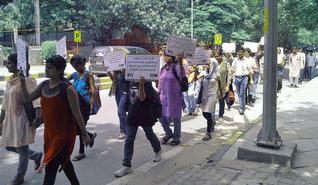
Women activists protest outside Haryana Bhavan in Chandigarh on September 1 demanding a CBI probe into the death of the Dalit girl in Jind. Image from The Hindu

On 24th August, a 20 year old Dalit girl was brutally raped and murdered in Jind, Haryana, while she was on her way to write an examination. Her body was found near a canal the next day by the police. There were cigarette burn marks on her body and significant indications of sexual violence. It is clear that she was kidnapped, raped and then murdered.

However, at the time of the fact finding, even after four days the culprits had not been identified or arrested, and there was no progress on the investigation beyond sending the body for post mortem. In fact, the parents of the girl, members of her village and various Dalit activists refused to cremate the body and were sitting on dharna in front of the Jind Civil Hospital to protest against police and administrative apathy and callousness. It was very clear that the Haryana police and administration was exhibiting gross negligence in this case, ignoring the law and evading established investigative procedure.

It is at this point that the All India Dalit Mahila Adhikar Manch (AIDMAM) decided to put together a fact finding committee to visit the area, meet the key people involved and ascertain the facts of the case. Continue reading Report of the Fact Finding Investigation conducted to ascertain facts in the case of alleged rape and murder of Dalit girl in Jind district of Haryana

The One Thing White Writers Get Away With, But Authors of Color Don’t: Gracie Jin

In this article, GRACIE JIN asks why only white writers are assumed to be capable of writing about cultures not their own.

Bill Cheng’s first novel, Southern Cross the Dog, debuted in June. His book, a fine example of writing what you don’t know, has been billed as “audacious” and “ambitious,” but you’ll be hard-pressed to find a review that doesn’t wonder at the novelty of a Chinese-American man from Queens, New York, writing about rural black Mississippi…

Unfortunately, most reviewers and interviewers seem to care less about the quality of Cheng’s writing than they do about the answers to these questions: Did the Chinese guy get it right? Can an authentic picture of the South come from a man of Asian descent who grew up in Queens?

…How many celebrated white writers have written characters who were not exactly like them? William Faulkner, Joseph Conrad, Mark Twain, Pearl S. Buck, Colum McCann, Yann Martel, and Arthur Golden immediately come to mind. In a society masquerading as post-racial, it is still only the white man who can speak authoritatively for every man. People of color, on the other hand, are expected to speak only for themselves….

Ideally, the authority of a work of fiction should be judged against the standards of the world that it creates, not by its alignment with a rigid notion of reality. By this measure both Cheng and Johnson’s books are empathetic, engaging, and deeply imaginative. Both are worth a read. Both are fiction.

Read the full article here.

Let taxpayers pay for ‘our’ treatment abroad, while they rot in government hospitals: Harsh Taneja

Guest post by HARSH TANEJA

The Government of India has recently gifted its bureaucrats a privilege. The state will reimburse the total cost of medical treatment abroad for the three highest civil services officers (the IAS, IPS and IFS).

And this entitlement is not limited to procedures that cannot be carried out in India.

According to this newspaper report, these officers and their families can decide to go abroad for even routine procedures such as bypass surgeries. A privilege that is unfair, undemocratic and borders on institutionalized corruption. Here’s why.

First, the most obvious argument pointed out in the newspaper article itself, is the huge expenditure to the exchequer. However that to me is the beginning of why this is problematic. The following two concerns are perhaps more grave. Continue reading Let taxpayers pay for ‘our’ treatment abroad, while they rot in government hospitals: Harsh Taneja

Race too, after all, along with Gender: Arvind Elangovan

A few facts and some thoughts on the reception of Michaela Cross’s experience of India – Guest Post by ARVIND ELANGOVAN

Since Michaela Cross’s experience was part of a study abroad program conducted annually by the University of Chicago, and I was part of the program – for three years as a graduate student assistant (for the Fall quarters of 2007-2009), and one year as faculty in the program (Fall of 2010) – I think I could most usefully contribute by highlighting a few facts about the program itself. In the process I would think aloud about some of the issues that have come up in the reception of Cross’s experience in India, especially in the responses of Rajyashree Sen and Ameya Naik. I choose Sen’s and Naik’s responses partly because they have been the most recent, but also because between them they represent the spectrum of possible positions that one could usefully take about this issue. Needless to add, there have been other responses, such as the one posted by another fellow University of Chicago student on the trip, an article titled ‘In Defence of Rose Chasm (Michaela Cross) and countless other comments, criticisms, and responses that have flooded the Internet world.

However, between Sen and Naik, the basic ends of the spectrum are quite clear. Sen contends that it is not only a white woman’s problem but an issue for all women and that some self-regulation and discipline would have gone a long way to avert the unsavory experiences if not completely eliminate their possibility. Naik, at the other end of the spectrum, points out that the expectation of preparedness or caution urged by Sen belies the possibility of questioning the pervasive culture of sexual violence, in which any cautionary attempt to be safe, is to pay merely lip service to acknowledging the crime of sexual violence, instead of combating more difficult questions about such a culture. Continue reading Race too, after all, along with Gender: Arvind Elangovan

How to dress for your body shape

How to dress for your body

Courtesy Pramada Menon’s Facebook Page

Indians of Another Colour, Or why Goans are More than Just Portuguese: Hartman de Souza

This guest post by HARTMAN DE SOUZA is in response to Europeans of An Other Colour – Why the Goans are Portuguese

The news that Goa’s Catholics obtain Portuguese citizenship and flee wherever they can with their families, availing in fact of whatever loopholes are available, is not that new a phenomenon to Goans following matters on the ground – even though it may now serve to open out a new thread in the discussion of postcolonial societies, and in particular, the travails of immigrant communities in what is supposedly a ‘globalized’ world.

It helps to keep in mind that it is Goa that is the classic case of a ‘failed state’, and not Pakistan, as Indians like to believe. Goa was once a beautiful territory protected by Ghats on three sides, rich with an abundance of water, blessed with fertile land, and made up of villages each of which had control of their commons through a sophisticated system of village governance that far predated the Portuguese Colonialists. Today however it is a state governed by politicians who work hand-in-glove with their crony partners whether in mining, real estate or industry,  a state in a freefall towards entropy. Continue reading Indians of Another Colour, Or why Goans are More than Just Portuguese: Hartman de Souza

Exemplary guidelines for the Police regarding sexual assault

RAHAT is a collaboration between Women and Child Development and Majlis Legal Centre, Mumbai, to provide Socio-Legal Support to Victims of Sexual Assault. One of the initiatives taken by RAHAT was the drafting of  guidelines for Police while recording and investigating cases of Sexual Assault. A circular with these guidelines has been issued by the Police Commissioner of Mumbai to all police stations in Mumbai. 

This is the English translation of the circular.

Special Police Circular No. 27/2013, Dated 12.8.2013

Sexual offences against:

• a person (boy or girl) under 18 years of age shall be registered under POCSO ( Protection of Children from Sexual Offences)Act,  2012

• a woman above 18 years of age shall be registered under IPC ( Under Ss. 354, 354A, 354B, 354C, 354D, 376, 376A, 376B, 376C, 376D, 376E and 509 IPC) Continue reading Exemplary guidelines for the Police regarding sexual assault

Europeans of An Other Colour – Why the Goans are Portuguese: R. Benedito Ferrão & Jason Keith Fernandes

Guest post by R. BENEDITO FERRÃO & JASON KEITH FERNANDES 

This article serves as a response to Sir Andrew Green’s comment on the alleged misuse of Portuguese citizenship by Indian nationals of Goan origin whom the Daily Star and the Daily Mail have characterized as immigrants who travel to Great Britain to take advantage of it. Green’s perspective from a few months ago mirrors prevalent xenophobic views on the rights of immigrants to Europe; hence, the counterpoint offered here hopes to challenge such bias as it will surely continue to be expressed.

On 13 May, 2013, the Goan Ethernet was aflame with outrage at statements made by Sir Andrew Green, chairperson of Migration Watch, carried in the Daily Star and the Daily Mail. The Daily Star reported, “An Indian national from Goa can obtain Portuguese citizenship if their parents were Portuguese citizens prior to 1961,” and quoted Green as saying, “They can then move straight to the UK with their family. On arrival they can avail themselves, immediately, of all the benefits available to UK citizens.” The Daily Mail seems to have been spurred on by Green’s statement, going on to claim that “[a] number of Indian nationals from the former Portuguese territory of Goa are thought to have taken advantage of the loophole. Indians living in Goa can claim they have Portuguese heritage and so claim Portuguese citizenship. They can then move directly to Britain – without ever having to visit Portugal – and bring a family without meeting any qualification test.”

Given the manner in which the matter regarding Goan access to Portuguese citizenship has been reported in the British press, as academics studying Goa and the Goan community, we believe that there is a need to redress such misrepresentations and firmly call out, not only the wilful amnesia about Britain’s imperial past, but also the Anglo-centric interpretation of colonialism, the post-colonial, and de-colonised world order that motivates such representations. In so doing, our aim is to address not merely a need for Goans and others of former Portuguese India to assert the legitimacy of their actions, but to also enable a view of the global order from a position that is more respectful of the formerly colonised. Continue reading Europeans of An Other Colour – Why the Goans are Portuguese: R. Benedito Ferrão & Jason Keith Fernandes

Mathura too did not scream: Forum Against Oppression of Women

Guest Post by FORUM AGAINST OPPRESSION OF WOMEN

As a feminist collective that was formed in the aftermath of the historic Mathura rape case in 1980, in which two police men had sexually assaulted a tribal girl within the police station, two recent cases of sexual assault (in Mumbai) have become matters of grave concern for us. These were filed by women against medical professionals who had committed the crime within their clinic or hospital,

On May 17th 2013, a 26 year old woman had gone, accompanied by her husband, to meet Dr. Rustom Soonawala who had been treating her for TB and later infertility since August 2012. This was at around 6 pm as per appointment. Upon examination, the doctor told them that the TB was almost cured and then asked the husband to go out of the examination room, locked the room, and raped her while covering her mouth with his hand. Continue reading Mathura too did not scream: Forum Against Oppression of Women

To travel or not to travel to India: Karen Dias

This is a Guest Post by KAREN DIAS

The most recent ‘Incredible India’ video ad campaign shows a young woman of seemingly European descent traveling alone through India. She is seen drinking coconut water and being friendly with a man, playing chess with holy men, being helped after a fall by two men, cheering at a snake boat race on a boat filled with men, playing Holi surrounded by more men and strolling on what looks like a deserted beach with a male mahout and his elephant. Sadly, the truth is far from what the video depicts for foreign women traveling in India, and most of them will try their best to not find themselves alone in situations like the ones shown in the video.  Stories of foreign women being verbally and sexually harassed are not new in this country and being accompanied by male friends or relatives is almost never a deterrent. Continue reading To travel or not to travel to India: Karen Dias

Joint statement on atrocities on cultural activists and Dalits

Please send endorsements to  asit1917@gmail.com

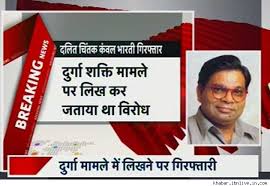
download (1)We, the undersigned, are appalled and outraged by the arrest of Kanwal Bharti eminent Dalit writer for his comments on Face book. If one looks seriously at the banner headlines in the corporate media, the Indian ruling classes are  the new economic power house of the world and India, the world’s largest democracy. Various clauses of the Indian constitution guarantee the fundamental rights of its citizens to to freedom of expression and to choose ones cultural and political views. The pretensions of the Indian state about it being a liberal democracy have proved to be a total mockery of the very meaning of the words like liberalism, democracy and rule of law. Since the past six decades, under draconian laws like AFPSA, UAPA, National Security Act, tens of thousands of people have died in ‘encounters’, thousands of youth have vanished from Kashmir and Punjab. There are genocides happening on the struggling people of oppressed Nationalities, thousands are tortured, there are thousand of unknown mass graves in Kashmir. Thousands of woman are raped, tortured and killed in police custody. Continue reading Joint statement on atrocities on cultural activists and Dalits

Network of Women in Media demands safety for women media professionals

The Network of Women in Media, India, (NWMI) is shocked and angry at the alleged gangrape of a woman journalist and the assault on her male colleague in the evening of August 22 while they were on assignment for a print publication near the Shakti Mills compound at Mahalaxmi in Central Mumbai.

The two journalists were accosted and intimidated by a few people who demanded to see their authorisation for shooting in the area. They took the woman journalist aside on the pretext of securing the authorisation for her, tied up her colleague and allegedly gangraped her. In all, five persons perpetrated the attack, according to preliminary reports. The woman journalist showed great presence of mind in freeing herself and also managed to free her colleague and the two then sought to file a complaint with the N M Joshi Marg police station. They are being treated at Jaslok Hospital now for multiple injuries.

The incident is a grim reminder of the deteriorating state of safety for women in Mumbai as well as the lack of security for media professionals, especially women media professionals. The harassment of women professionals in the media is on the rise and, along with work-place related harassment, journalists also have had to contend with anti-women prejudices and biased reactions from employers as well as law enforcement officers.

The Network of Women in Media, India extends all support and solidarity to the journalists who were assaulted. The NWMI also cautions its colleagues in the media to report on the incident responsibly and sensitively, without providing unnecessary details that provide markers to the identity of the journalists involved.

NWMI also demands that the police conduct a speedy investigation into the assault and ensure that justice is delivered without delay. It also urges media employers to ensure the safety and security of their staff.

Yours sincerely,

Geeta Seshu, Kalpana Sharma, Meena Menon, Sameera Khan, Sandhya Srinivasan, Laxmi Murthy, Sharmila Joshi, Ammu Joseph, Rajashri Dasgupta, Jyoti Punwani and others

on behalf of

Network of Women in Media, India

Salaam, Sharmila Rege!

2006112210820401

Sharmila (right) receiving the Malcolm Adiseshiah Award (2006) from Padmini Swaminathan, Director of Madras Institute of Development Studies (Source: The Hindu)

Sharmila Rege passed away yesterday, aged 48, a month after she was diagnosed with cancer. Sharmila described herself as a Phule-Ambedkarite feminist, and was a dear friend to many of us, a political activist of enormous integrity and the moving spirit behind Krantijyoti Savitribai Phule Women’s Studies Centre at Pune University. Her scholarship was immense and inspiring, consistently traversing the minefields of caste and gender, constantly complicating one with the other. Writing Caste, Writing Gender: Reading Dalit Women’s Testimonios brought together first-person accounts of eight Dalit women from the 1920’s to the present – the voices of Babytai Kamble, Shantabai Kamble, Muktabai Sarvagod, Shantabai Dani, Kumudtai Pawde, Urmila Pawar, Janabai Girhe and Vimaltai More, emerge powerfully and relentlessly in their matter-of-fact assault on caste society’s smugness and violence. Sharmila worked with these ‘testimonios’ (a term she drew from Latina feminism) in a series of’ ‘translations’ – translating from Marathi, translating time and place, translating herself, and encouraging  readers to translate themselves too, in terms of Phule and Ambedkar’s scholarship and politics, to read themselves through the lens of the non-Brahmin and Dalit movements in Maharashtra. Continue reading Salaam, Sharmila Rege!

We’re singing Holi songs: Inayat Anaita Sabhikhi

Guest post by INAYAT ANAITA SABHIKHI: CGNet Swara is a voice based portal, where stories reported by citizen journalists are available for playback online on their website or through a regular mobile phone. By dialing the CGNet number, you can either record a message or listen to the previous four messages recorded on the server. This is primarily operating in the Central Gondwana region, a tribal belt in central India known to be economically and socially disadvantaged.

woman-reporting

A reporter for CGNet Swara

The idea behind this, as explained by its founder, Shubhranshu Choudhury in this TEDx talk is to democratise the use of media. It is an attempt to combat the neglect and skewed approach of mainstream media towards this entire region and its people. Continue reading We’re singing Holi songs: Inayat Anaita Sabhikhi